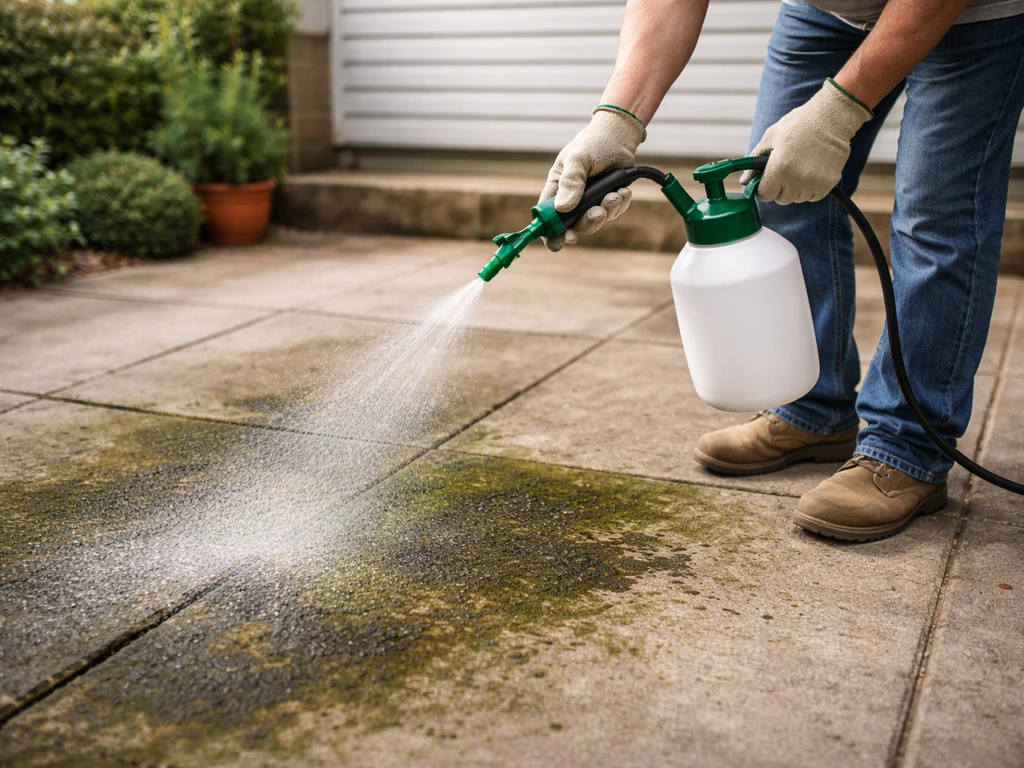
For most homeowners, the best pressure washer for a patio is an electric unit in the 1,500 to 2,200 PSI range. That's enough grunt to shift mold, algae, moss, and ground-in dirt from concrete, brick, and stone without blowing the joints out of your paving. The Sun Joe SPX3000 sits right in that sweet spot at 2,030 PSI and 1.
Best Pressure Washer for Patio: Top Picks by Size and Surface
Rhea Lang
1 May 2026
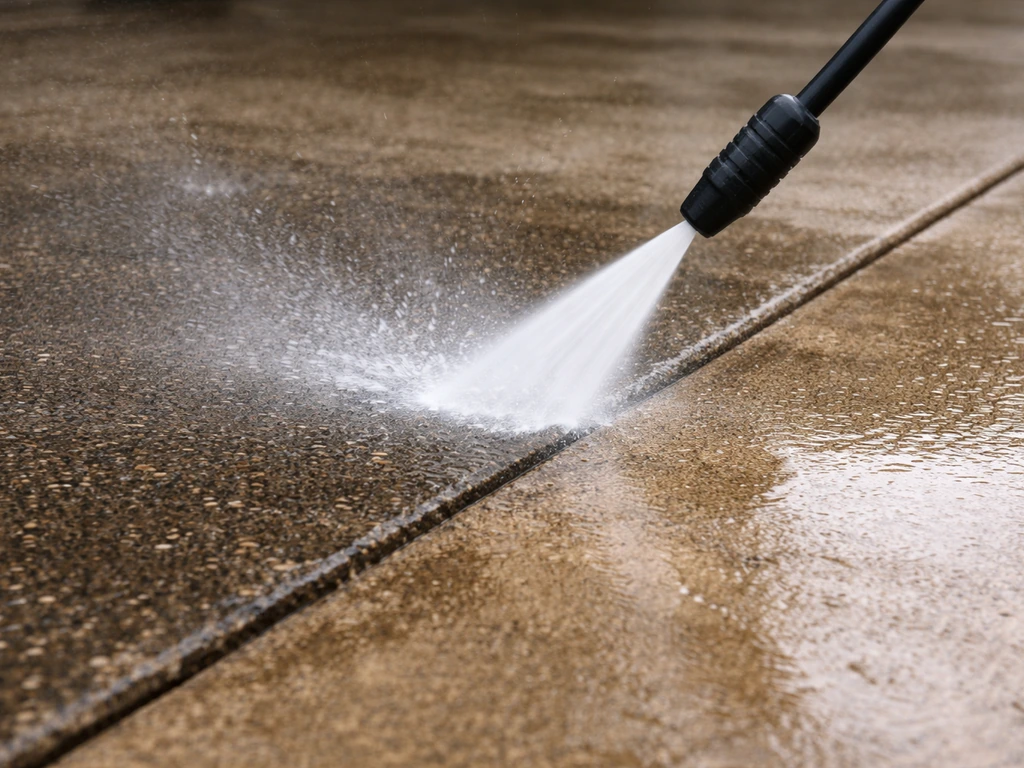
The SPX3000 spec sheet also lists it as CSA listed, includes a 34-inch extension wand and a 20-foot hose, and backs it with a full two-year warranty 2,030 PSI.
76 GPM, it handles patios and cars, it's under $200, and it comes up repeatedly in real-world testing as a reliable all-rounder. If that's all you needed to know, go buy it. If you want to make sure you're getting the right machine for your specific patio surface, stain type, or patio size, keep reading.
The best patio pressure washer pick for most homeowners
The Sun Joe SPX3000 is the one I'd hand to a neighbour who asked me what to buy. It puts out 2,030 PSI at 1.76 GPM, which translates to enough cleaning power for concrete, brick, and natural stone patios without being so aggressive that you need to worry about damage on a normal day. It runs on a standard household outlet, has a 34-foot power cord, and comes with five quick-connect nozzles (0°, 15°, 25°, 40°, and soap). It's CSA listed, backed by a 2-year warranty, and marketed specifically for patios, driveways, and vehicles. That versatility matters because most people don't want a dedicated patio-only machine sitting in the garage for 48 weeks of the year.
Is it perfect? No. The hose is 20 feet, which can feel short if your patio is large. The trigger gun is plastic and feels it. But for the price and the cleaning results on a typical residential patio, nothing at this level consistently beats it. Consumer Reports testing of comparable machines confirms that what actually separates good from great at this tier is real-world performance on heavy-duty jobs like long-neglected decks and patios, not just specs on a box. The SPX3000 cleans consistently well across multiple surface types, which is exactly what you want when you're picking one machine to do it all.
How much pressure do you actually need? PSI and bar explained
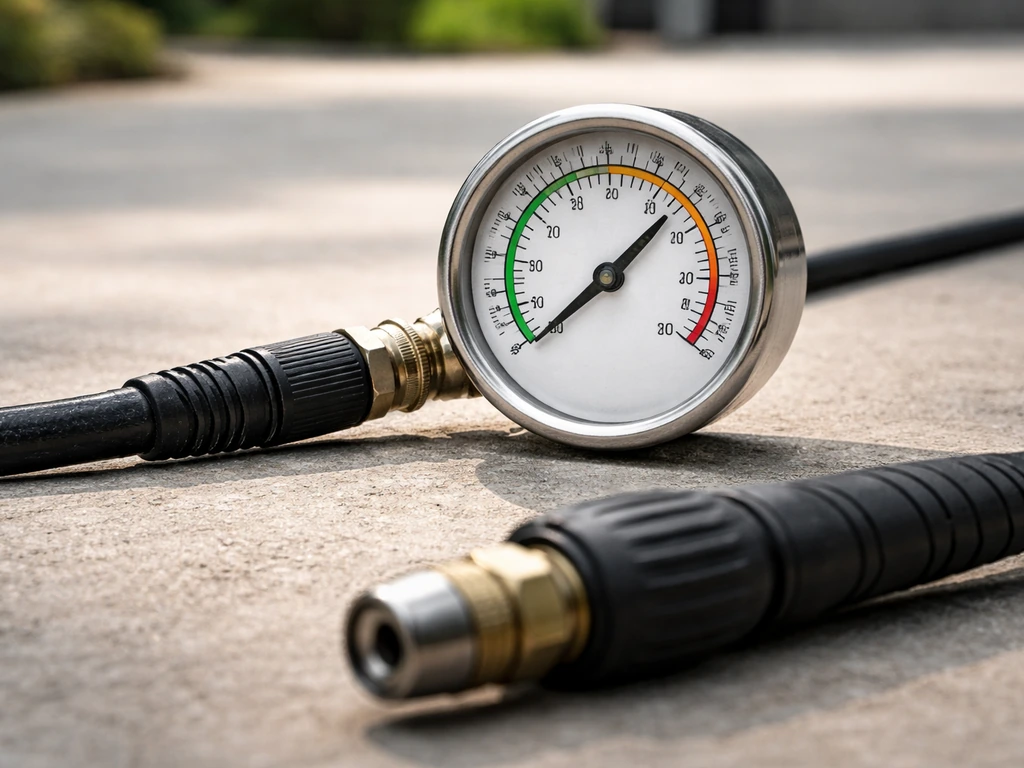
PSI (pounds per square inch) is the US standard; bar is more common in the UK and Europe. They measure the same thing. One bar is roughly 14.5 PSI, so a 130 bar machine is about 1,885 PSI, and a 150 bar machine is around 2,175 PSI. For most patio cleaning, you want to be sitting between 100 and 150 bar (1,450 to 2,175 PSI). That range handles algae, moss, surface grime, and light staining on hard paving without stripping mortar or damaging softer surfaces.
The number people get wrong most often is assuming more PSI always means a better clean. I learned this the hard way when I used a 200 bar commercial unit on a sandstone patio and pitted the surface trying to shift some lichen. The damage was permanent. For the vast majority of residential patio jobs, anything above 2,500 PSI (roughly 172 bar) is overkill and actively risky on natural stone, brick with soft mortar, and most tiles. Save the high-bar machines for bare concrete driveways or industrial surfaces.
| PSI / Bar range | What it's good for | Watch out for |
|---|---|---|
| Under 1,500 PSI / 100 bar | Cars, garden furniture, light patio rinsing | Won't shift stubborn mold or algae effectively |
| 1,500–2,200 PSI / 100–150 bar | Most residential patios (concrete, brick, stone) | Best all-round range for patio cleaning |
| 2,200–2,800 PSI / 150–190 bar | Tough concrete, oil stains, heavily neglected surfaces | Too aggressive for sandstone, slate, porcelain |
| 2,800+ PSI / 190+ bar | Commercial/industrial use | Serious damage risk on most patio materials |
Large patio vs. small patio: electric or gas, and does flow rate matter?
If your patio is under about 40 square metres, a mid-range electric pressure washer is all you need. Something like the SPX3000 at 1.76 GPM will clean it in a reasonable session without you needing to refuel or deal with exhaust fumes. For a typical suburban patio or courtyard, electric wins every time: quieter, no engine maintenance, no petrol to store, and you can use it in a garage or covered space without gassing yourself.
Bigger patios, say 60 to 100+ square metres, are where flow rate (GPM or litres per minute) starts to matter as much as PSI. A higher GPM means you're moving more water across the surface per minute, which speeds up the job considerably. Gas-powered washers typically deliver 2. 3 GPM and above, and that extra volume makes a real difference when you're working through a large area.
They also don't depend on a power outlet, which matters if you're working at the back of a large garden. The downside: they're heavier, louder, need annual engine servicing, and are significantly more expensive. For a genuine large patio (think extended garden paving, a wraparound deck, or a shared courtyard), a gas unit in the 2,500–3,000 PSI / 2. 3–2.
5 GPM range is worth the investment. For everything smaller, stick with electric.
Match the pressure washer to your patio surface and stain type
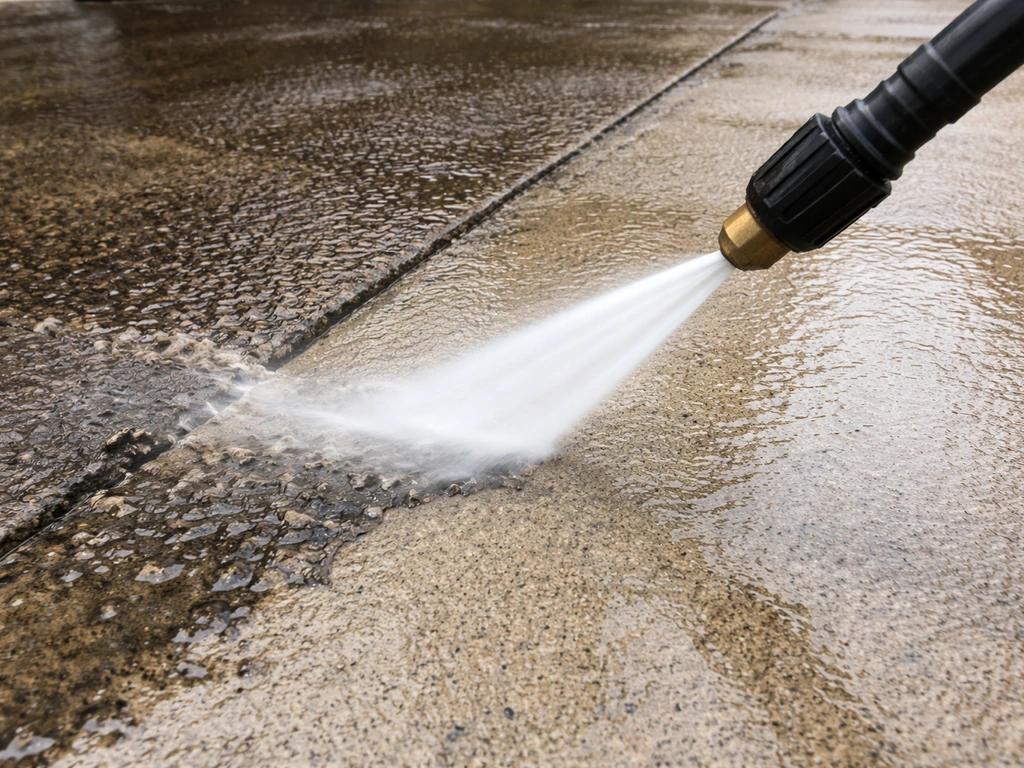
The biggest buying mistake people make is choosing a pressure washer based only on patio size, ignoring the material. Concrete can take a beating. Sandstone and slate cannot. Here's how to match your machine to what you've actually got.
Concrete patios
Concrete is the most forgiving surface to pressure wash. You can comfortably use 2,000 to 2,500 PSI with a 25° nozzle for general cleaning and switch to a 15° or turbo nozzle for oil, rust, or heavy staining. A rotary surface cleaner attachment (more on that below) is highly recommended for large concrete areas because it cleans evenly without the stripe marks you get from a handheld lance. For mold and algae on concrete, apply a diluted sodium hypochlorite solution first, let it dwell for 10 minutes, then pressure wash. You'll use half the time and get a far better result.
Brick and natural stone
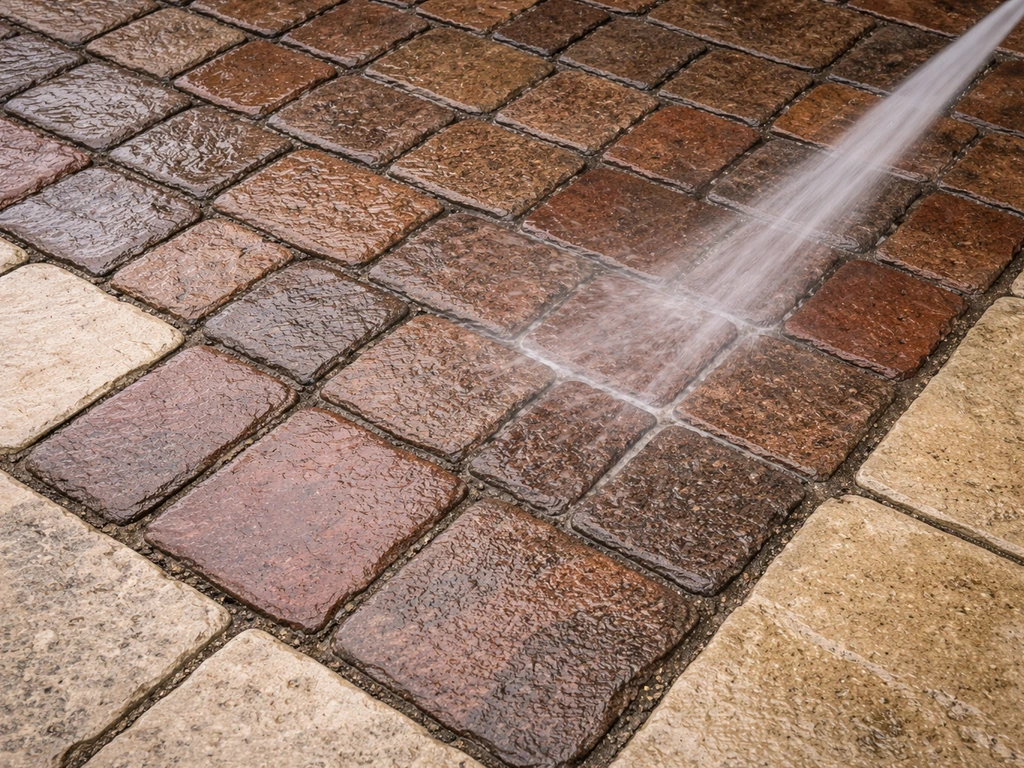
Brick and natural stone (think granite setts or limestone flags) can handle 1,500 to 2,000 PSI comfortably, but the mortar joints are often the weak point. Use a 25° or 40° wide-angle nozzle and keep the lance moving. Don't linger on a single spot, and don't hold the nozzle closer than 20 to 25 cm from the surface. For moss and algae between joints, a patio cleaner detergent applied first does most of the work, and the pressure washer finishes it off without gouging out the jointing compound.
Sandstone
Sandstone is soft and porous. Keep pressure below 1,500 PSI (100 bar) and always use a 40° wide-angle nozzle. I'd honestly reach for a specialist sandstone patio cleaner and a stiff brush before I'd aim a pressure washer at it. If you want the best patio cleaner without a pressure washer, a specialist cleaner plus a stiff brush is usually the safer route for delicate surfaces like sandstone. If you do use one, keep the nozzle at arm's length (30 cm minimum) and use sweeping passes rather than holding it in one place. The damage from getting this wrong is irreversible, and it's very easy to do.
Slate
Slate is tougher than sandstone but can delaminate (split into layers) under concentrated high pressure. Stick to 1,200 to 1,800 PSI max and use a 25° or 40° nozzle. Never use a zero-degree or turbo nozzle on slate. A gentle pass with a diluted mild detergent will lift algae and grime without risking the surface. If your slate patio is sealed, be aware that aggressive pressure washing can strip the sealant, which means resealing is needed afterwards.
Porcelain and ceramic tiles
Porcelain tiles are dense and very hard-wearing, so the tile face itself can handle pressure well. The vulnerability is the grout lines. Use 1,500 to 2,000 PSI with a 25° nozzle, and angle the spray across the tiles rather than directly down into the grout. Acidic cleaners should be avoided on porcelain as they can dull the surface over time. For mold and algae on porcelain, a diluted bleach-based solution works well, followed by a rinse at moderate pressure.
Nozzles, detergent, distance, and technique
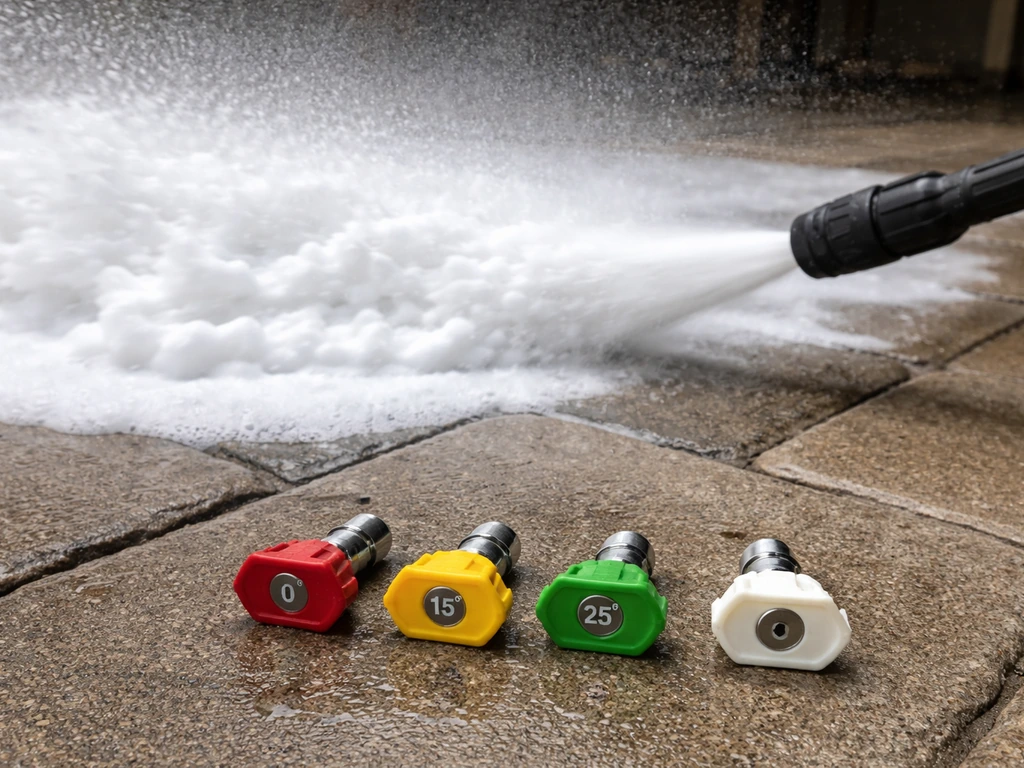
The nozzle you fit changes the effective pressure and spray pattern more than most people realise. A 0° red nozzle focuses all the pressure into a needle-point jet. It's genuinely dangerous on patio surfaces (and skin) and has almost no place in residential patio cleaning. The 15° yellow nozzle is for heavy-duty stripping on concrete only.
The 25° green nozzle is the workhorse: great for general patio cleaning on robust surfaces. The 40° white nozzle is your go-to for softer materials and wide-area rinsing. Shop Joe’s SPX3000-TPS quick-connect tip set documentation explains what each included nozzle does, including the [40° (gentle for sensitive surfaces) and the black soap nozzle for low-pressure detergent application](https://support. shopjoe.
com/hc/en-us/articles/42342482115220-Pressure-Washer-Quick-Connect-Spray-Tip-Set-Nozzles), and notes the set is for SPX3000 series models. The black soap nozzle drops the pressure right down to let detergent flow through the system without clogging.
For most patio jobs, the sequence that works is: apply detergent with the soap nozzle, let it sit for 5 to 15 minutes, then switch to the 25° nozzle to rinse and clean. Keep the nozzle 20 to 30 cm from the surface and use consistent overlapping sweeping passes. If you stop moving, you'll etch the surface or create a visible clean patch surrounded by grime.
A rotary surface cleaner attachment is genuinely transformative for flat paving: it covers more area per pass, cleans more evenly, and massively reduces the water splashback that soaks your legs. In one Reddit r/pressurewashing thread discussing the Sun Joe SPX3000, users share practical context about accessories and compatibility alongside the commonly stated 2030 max PSI and 1. 76 GPM ratings [rotary surface cleaner attachment](https://www. reddit.
com/r/pressurewashing/comments/y3vjep/). If you're buying a machine for regular patio cleaning, budget an extra $30 to $50 for one.
- 0° (red): avoid on all patio surfaces
- 15° (yellow): concrete only, heavy stains, rust, oil
- 25° (green): general patio cleaning on concrete, brick, and robust stone
- 40° (white): sandstone, slate, tile grout lines, rinsing and finishing
- Soap/black nozzle: detergent application only
- Rotary surface cleaner: recommended for any flat patio over 20 sqm
On detergent: a dedicated patio cleaner or an outdoor multi-surface cleaner works better than washing-up liquid or household bleach straight from the bottle. The concentrated formulas designed for pressure washers are diluted correctly for the soap dispenser tank and won't gum up the system. For heavy biological growth (mold, algae, moss), a sodium hypochlorite-based outdoor cleaner applied at dwell time before pressure washing gives noticeably better results than pressure alone. If you're dealing with grease or pet stains, look for an enzymatic cleaner as a pre-treatment.
One machine for the patio and the car: what specs to look for
This is actually one of the most practical questions in this category, and the good news is that the same mid-range electric pressure washer handles both jobs well. The key is having a machine that spans a meaningful pressure range from below 1,500 PSI (safe for vehicle paintwork and glass) up to around 2,000 PSI for patio cleaning. The Sun Joe SPX3000 at 2,030 PSI with a 40° nozzle and good nozzle distance (around 40 to 50 cm for vehicles) is fine for car washing. You would never use the 0° or 15° nozzle on paintwork, but that applies to any machine.
What to avoid for a patio-plus-car machine: anything above 2,500 PSI as your minimum setting (some cheaper units have no adjustable pressure, just full-blast), and gas-powered washers (overkill for cars, awkward to use in a tight driveway). For the combo use case, look for variable pressure or at least a wide range of included nozzles, a foam cannon or soap tank (for car pre-wash), and a longer hose (25 feet or more). The SPX3000 checks most of these.
If you want even more car-washing friendliness, look at models that accept a foam cannon attachment, which many Sun Joe and Ryobi electric units do. For UK buyers, the equivalent spec range sits between 130 and 150 bar from brands like Karcher and Nilfisk.
Before you buy: a practical shortlist and checklist
Here's how to make the buying decision fast. Answer these three questions: How big is your patio? What surface material do you have? Do you want to use it for cars too? Then use this checklist against any model you're considering.
- PSI between 1,500 and 2,200 for most home patios (go lower for sandstone/slate, higher only for tough concrete)
- GPM of at least 1.5 for smaller patios; 2.0+ for large areas
- Five nozzle set included (0°, 15°, 25°, 40°, soap) — don't settle for fewer
- Hose length of at least 20 feet (25 feet is better for larger patios or combined car use)
- Soap/detergent tank built in, or compatible with a foam cannon attachment
- Warranty of at least 1 year (2 years is the benchmark at this price tier)
- Weight and wheel design: anything over 15 kg should have wheels, not just a carry handle
- For electric: check cord length (at least 30 feet) and that it's GFCI protected or CSA/CE listed
- For gas: check that oil is included and the engine brand (Honda and Briggs & Stratton are reliable)
- If buying for patio and car: confirm variable pressure or wide nozzle range, and check foam cannon compatibility
If you want a deeper dive into specific model comparisons, side-by-side patio pressure washer reviews cover individual machines in more detail. And if you're in the UK specifically, the pressure washer market looks a little different with Karcher and Nilfisk dominating the mid-range, so a UK-focused guide is worth consulting for local availability and pricing.
If you’re searching for the best power washer for patios UK, comparing UK availability and pricing can help you pick the right model with confidence. There's also a solid case for skipping the pressure washer entirely on delicate surfaces like sandstone or weathered slate, where the best patio cleaner without a pressure washer approach might actually protect your paving better. The right tool really does depend on what's under your feet.
But if you've got a standard concrete, brick, or mixed-stone patio and you just want to know what to buy today: get a 1,800 to 2,200 PSI electric pressure washer with a full nozzle set, add a rotary surface cleaner, and pair it with a proper patio cleaning detergent. That combination will handle 95% of what a typical patio throws at it, and you'll wonder why you didn't do it sooner.
FAQ
Can I remove mold and algae from my patio with just water pressure?
Yes, but only if the machine has enough flow and you use the right pre-treatment. For typical patio growth (algae, moss), apply a bleach-based outdoor cleaner or patio cleaner first, let it dwell, then rinse with a 25° nozzle. If you only blast with water, you often push grime deeper into joints instead of lifting it.
What should I check before pressure washing if my patio has cracked grout or loose joints?
If your patio has any loose or cracked grout, pressure washing can widen the damage. Repoint or patch before washing, and use a wider nozzle angle (25° to 40°) with consistent movement, avoid holding the nozzle in one spot, and keep a slightly greater distance on porous surfaces.
How do I safely pressure wash a car with the same washer I use for my patio?
For cars, you should avoid 0° and 15° nozzles, and you should rinse thoroughly before soap to remove grit. Use the 40° nozzle (or 25° if you need more power) and keep distance around 40 to 50 cm, because closer blasts can dull paint or force water under trim.
When should I use a rotary surface cleaner attachment instead of a wand?
A patio surface cleaner helps most when the area is flat and wide. If you have lots of edges, steps, or irregular landscaping, you will still need a lance for corners and between features, but the surface cleaner will reduce striping and speed up the main field cleaning.
Will pressure washing remove a sealer on my patio?
Not always. If your patio is sealed, aggressive pressure and certain detergents can strip or haze the seal, especially on soft or older sealants. Use moderate pressure (generally 1,500 to 1,800 PSI for most hardscapes), test an inconspicuous spot, and plan to reseal after cleaning if the seal is affected.
Can I use bleach or dish soap instead of pressure-washer patio detergent?
Use a dedicated pressure-washer detergent or patio cleaner, because they’re formulated to work with the soap tank and foam dilution. Household bleach or dish soap can either under-dose, over-dose, or clog, and some dish soaps leave slippery residues that attract dirt again.
What extension cord and electrical safety tips matter for an electric patio pressure washer?
Electric washers should use the correct outdoor-rated extension lead and a GFCI-protected outlet. If you need a long reach, prioritize a longer onboard hose or a properly rated extension, and avoid running power cables across wet paving where they can be damaged.
Why do I get patchy, streaky, or “halo” marks after pressure washing?
Yes, and it’s a common reason patios look worse after cleaning. Clean in sections with overlapping passes, keep the nozzle moving, and avoid concentrating on one patch. If you see a visible ring, you likely stopped too long or the surface dried mid-session.
How do I choose the right nozzle when I’m not sure what my stain is?
Start by cleaning with a moderate nozzle (often 25° for robust surfaces), then increase only if needed. If you need to use 15° or turbo for stubborn staining on a safe-for-it surface like bare concrete, do it briefly and at a distance you can maintain, otherwise you risk etching.
Is it ever worth pressure washing sandstone or slate, or should I avoid it entirely?
Do a small test first, because sandstone and some weathered stone can be irreversibly marked by concentrated jets. If you’re unsure, consider a specialist stone cleaner plus a stiff brush, and use low pressure with a wide-angle nozzle if you decide to pressure wash at all.
How do I decide between electric and gas for patio cleaning, beyond just patio size?
If the job is under about 40 square metres and you have an outdoor outlet nearby, electric usually makes more sense. Choose based on surface and access, not only area, and remember that gas is better for very large areas because it can run longer without refueling.
What’s the risk if my pressure washer cannot reduce PSI (full-blast only)?
Overkill can damage joints and surfaces, especially on porous stone, mortar, and sealed finishes. If your unit is fixed high PSI, look for machines with adjustable pressure or nozzle options that effectively reduce impact, and avoid any machine that has no way to lower pressure for delicate jobs.
Next Article
How to Use Wet and Forget Patio Cleaner Step by Step
Step by step guide to apply Wet and Forget patio cleaner, prep and safety, dwell time, rinse or no rinse, and troublesho