Yes, Kärcher patio cleaner attachments are genuinely good, probably the single biggest upgrade you can make to a pressure washing setup for patios. The rotating disc design cleans faster, leaves far fewer streaks than a lance, and keeps dirty water off your walls and furniture. That said, 'Kärcher patio cleaner' can mean two very different things depending on what you search for, and buying the wrong one is an easy mistake. This guide cuts through that, gives you a straight verdict, and tells you exactly how to get real results on your specific patio surface and stain type.
Is Karcher Patio Cleaner Any Good? Real Results Guide
Rhea Lang
13 May 2026
What 'Kärcher patio cleaner' actually means (attachment vs chemical)
When most people search for a Kärcher patio cleaner, they're usually thinking about one of two things: a rotary surface cleaner attachment that clips onto a Kärcher pressure washer, or a bottle of Kärcher-branded patio cleaning chemical. These are completely different products, and buying the wrong one wastes time and money.
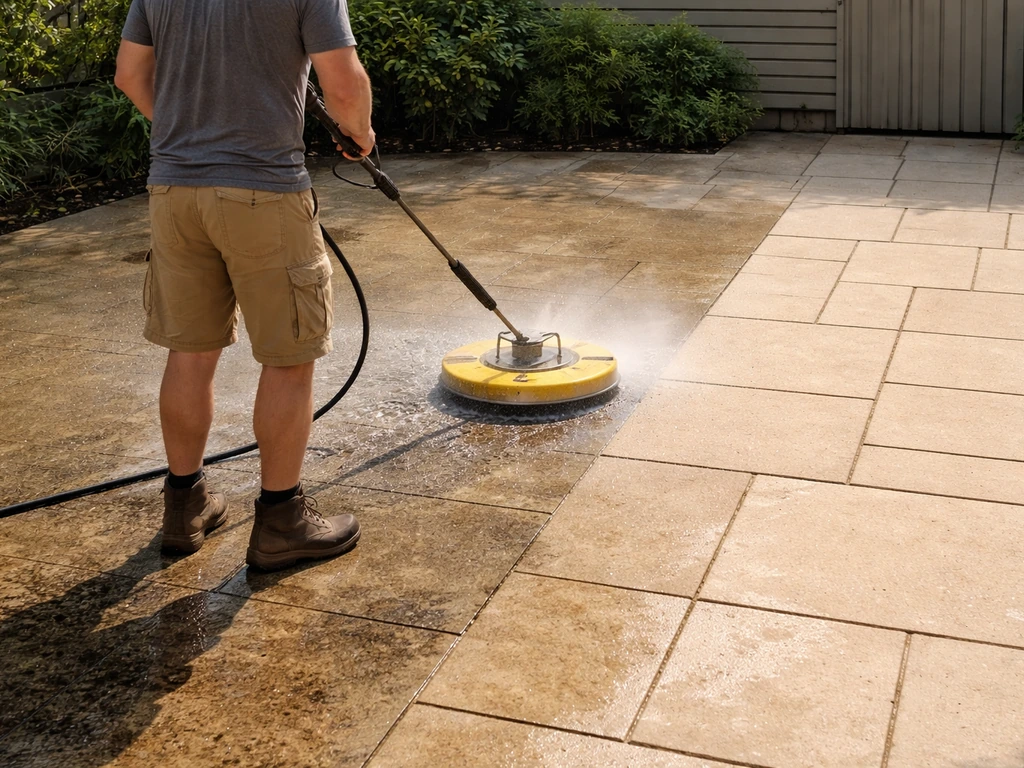
The attachment (the thing most people actually want) is a circular disc-shaped head that sits flat against your patio and uses two or more rotating nozzles to scrub the surface evenly. Kärcher makes several versions, the T150, T350, and the T 5 and T 7 PLUS are the main models you'll see. If you're deciding between models, this is where our karcher t5 patio cleaner review coverage helps you compare the T5 against the alternatives T150, T350, and the T 5 and T 7 PLUS. The T350 is the sweet spot for most homeowners: it's compatible with K2 through K7 pressure washers, has adjustable cleaning pressure for different surfaces, and delivers what Kärcher calls blank" rel="noopener noreferrer">splash-free cleaning. The T 5 and T 7 PLUS (sold more in the US market) also include a pressure dial. Specific model deep-dives on the T5 and T150 are worth reading separately if you're narrowing down which attachment to buy.
The chemical cleaner is a separate product entirely, a liquid concentrate or ready-to-use formula you apply to the patio surface to break down organic growth, staining, or grease before rinsing off. If you’re after chemicals instead of the attachment, you’ll want to look for a Kärcher patio cleaner bottle that matches the stain or growth you’re dealing with. Kärcher does make one, but it competes with plenty of other brands and isn't particularly special. If someone told you to 'get the Kärcher patio cleaner,' check whether they meant the attachment or the bottle, because your shopping experience will be very different.
Quick verdict: is the Kärcher patio cleaner attachment actually worth it?
For the vast majority of homeowners with a medium to large patio, yes, it's absolutely worth it. The rotary surface cleaner covers ground roughly three to four times faster than a standard pressure washer lance, produces a consistently even clean without the streaky tiger-striping you get from a fan nozzle, and the splash containment means your fence panels, outdoor furniture, and legs stay dry. I've used these on patios where previous attempts with a lance left obvious stripes across the whole surface, one pass with a T350 fixed that completely.
Where it's best suited: anyone with a patio larger than about 15 square metres, a Kärcher K2 or above, and regular cleaning challenges like algae, moss, or general grime buildup. Where it's less useful: very small patios (the time savings vanish), extremely delicate surfaces that can't take pressure at all, or if you're dealing with deep chemical stains that need a soaker treatment rather than mechanical cleaning.
How it performs on different patio surfaces
The surface you're cleaning matters a lot, both for which attachment model to use and how you set the pressure. Here's what to expect across the most common patio materials.
Concrete and tarmac/asphalt
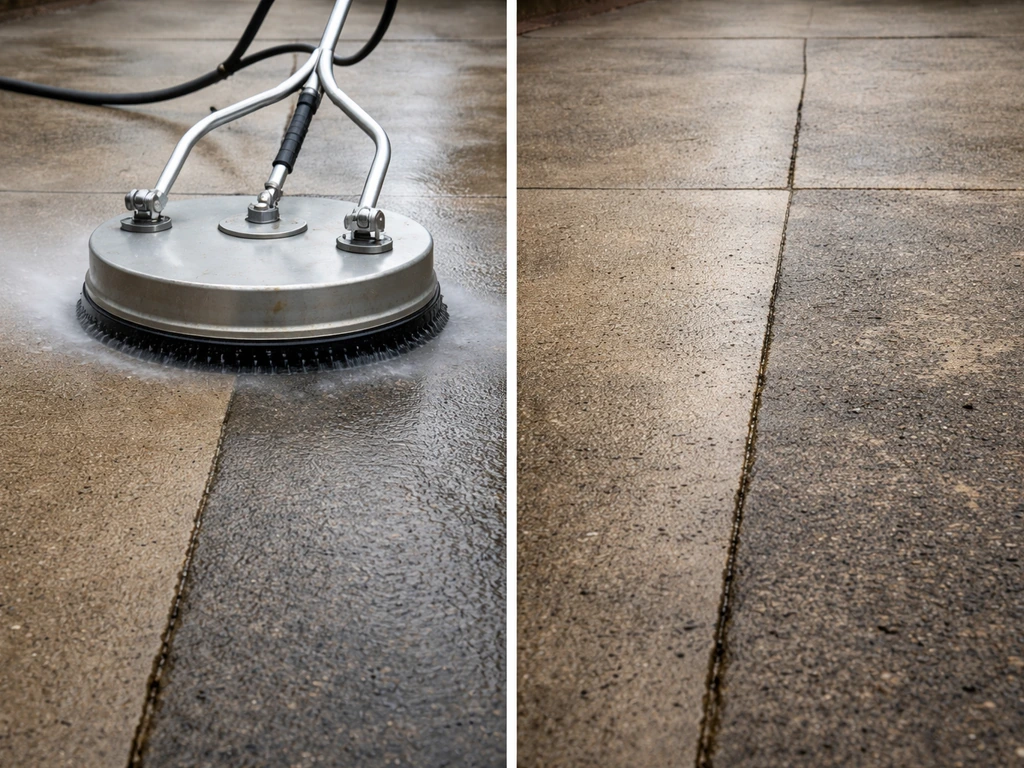
This is where rotary surface cleaners absolutely shine. Concrete is tough and forgiving, so you can run at higher pressure without worry. The T350 and equivalent models love concrete, you'll see a dramatic before/after on grey or stained driveways and concrete patios after a single pass. If there's heavy moss or black algae, do a pre-treatment first, then use the surface cleaner for the mechanical removal.
Natural stone and brick
Both work well with a Kärcher surface cleaner, but take care around the pointing/mortar joints. The rotating nozzles can blast loose mortar out of older joints if pressure is too high. Drop the pressure down a notch, keep the head moving, and check your joints before and after. Brick in particular tends to hold algae in the texture, one pass often isn't enough, so a second slower pass or a pre-soak with patio cleaner chemical helps.
Sandstone
Sandstone is where you need to be careful. It's a soft, porous stone and high pressure can pit or erode the surface over time. If you're using a T350, dial the pressure right down, use a K2 or run a K4/K5 at reduced pressure. Never use the maximum setting on unsealed sandstone. A gentler approach with a suitable patio cleaning chemical that you let dwell for 15 to 20 minutes, then rinse on low pressure, often gives safer and better results. If your sandstone is sealed, you have a bit more tolerance, but still go low.
Slate
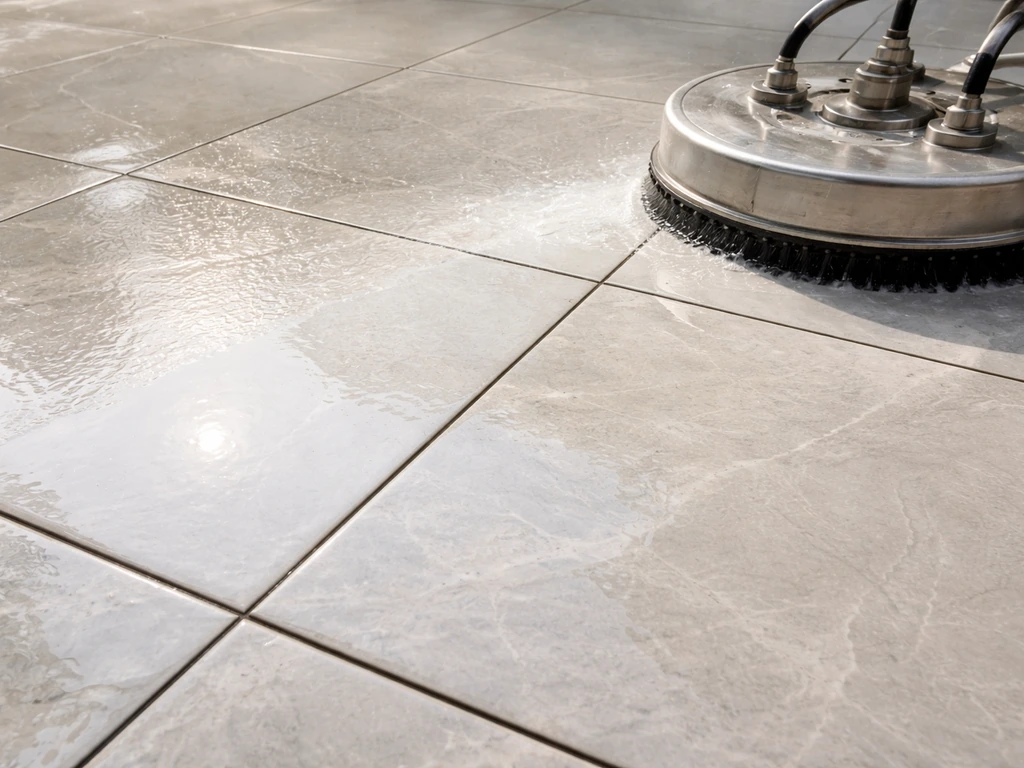
Slate is generally fine with a surface cleaner at moderate pressure, but the layered structure of natural slate means aggressive cleaning can cause flaking or surface delamination on older or lower-quality stone. Test a hidden corner first. Sealed slate handles pressure cleaning much better. Post-clean, slate can look quite different in colour as layers of grime come off, that's normal.
Porcelain patio tiles
Porcelain is one of the most pressure-washing-friendly surfaces you'll encounter. It's dense, non-porous, and very hard. The Kärcher surface cleaner works brilliantly on porcelain, and you can run at higher pressure without surface damage. The main risk on porcelain is the grout or pointing between tiles rather than the tiles themselves, same advice as brick applies. Porcelain also tends to show algae and green staining clearly, so a pre-treatment step before surface cleaning gets a noticeably better finish.
| Surface | Surface Cleaner Performance | Recommended Pressure Level | Pre-treatment Advised? |
|---|---|---|---|
| Concrete | Excellent | High (K4–K7) | For heavy algae/moss |
| Brick | Good | Medium (K3–K5) | Yes, especially for algae |
| Natural stone | Good with care | Medium-low (K2–K4) | Recommended |
| Sandstone | Use caution | Low (K2–K3 minimum setting) | Yes, often preferable to pressure alone |
| Slate | Good on sealed, careful on unsealed | Medium (K3–K4) | Recommended |
| Porcelain | Excellent | High (K4–K7) | For algae and green staining |
What stains and problems it actually tackles
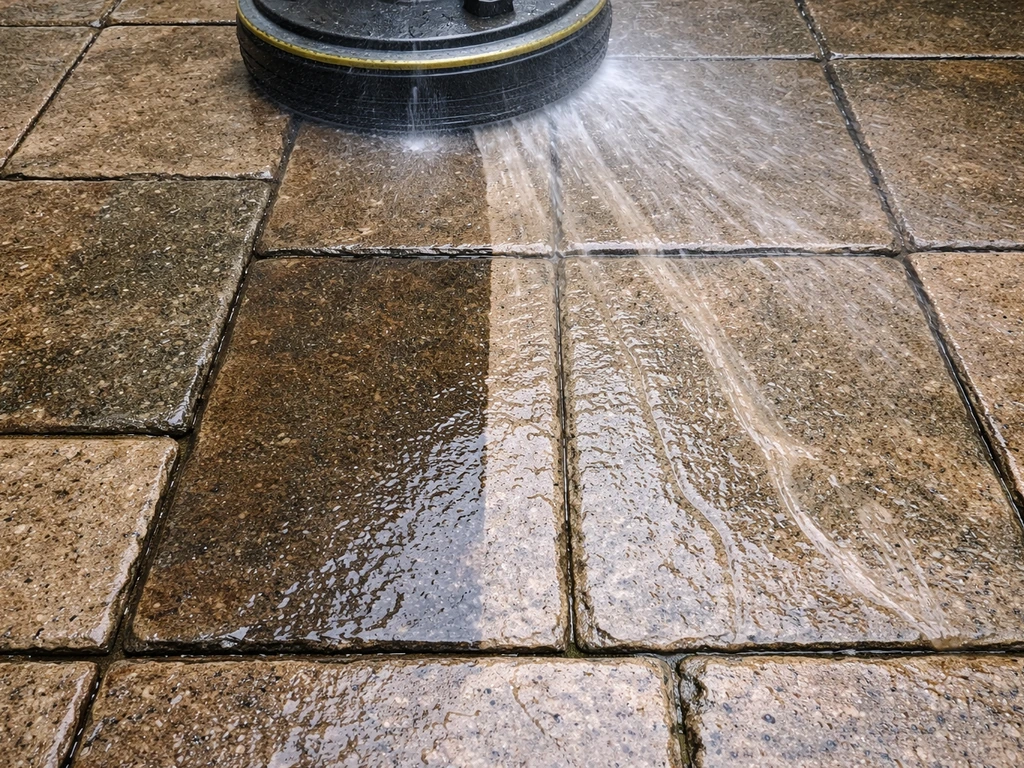
Mold, algae, and moss
This is the bread and butter of patio surface cleaning. Green algae, black mold, and fuzzy moss all respond well to the combination of a pre-treatment chemical and a Kärcher surface cleaner. The physical action of the rotating jets lifts the biological matter off the surface more effectively than a lance because the coverage is even and consistent. Important note: the surface cleaner removes what's there today, but it doesn't prevent regrowth. Apply a patio biocide or anti-algae treatment after cleaning and let it dry to slow regrowth significantly. On shaded, damp patios, you might need to clean once a year regardless.
Rust stains
The Kärcher surface cleaner won't remove rust stains on its own. Rust is a chemical stain, not a surface deposit, it's bonded into the stone or concrete. You need an oxalic acid-based rust remover applied first, left to dwell, then rinsed with the pressure washer. The surface cleaner helps with the rinse phase but the chemistry does the work. Don't expect mechanical pressure alone to shift rust marks, no matter how powerful your machine.
Grease and oil
Similar story to rust: grease needs a degreaser product applied first. Standard pressure washing, even with a surface cleaner, tends to spread grease rather than remove it on the first pass. Apply a dedicated patio degreaser, let it break down the oil for 10 to 15 minutes, then go over with the surface cleaner. You may need two passes on older or deeply soaked grease stains, especially on unsealed concrete which absorbs oil readily.
Pet stains and organic contamination
Dog urine, bird droppings, and leaf tannin stains are generally easier to deal with. Fresh contamination responds well to the surface cleaner alone with a general patio detergent. Older, dried-in pet urine on porous stone can leave residual odour even after thorough cleaning, in this case, an enzymatic cleaner applied and left overnight does a better job before you rinse. Post-clean, consider a patio sealer to reduce future absorption on natural stone.
How to use it properly and get real results
Getting good results from a Kärcher patio cleaner attachment isn't complicated, but the steps matter. Here's how to do it right.
- Clear the patio first: remove furniture, plant pots, and debris. Sweep off loose leaves and dirt. This prevents blocking the surface cleaner and gives better coverage.
- Pre-rinse the surface with your pressure washer on a wide fan setting. This softens buildup and helps you see what you're actually dealing with.
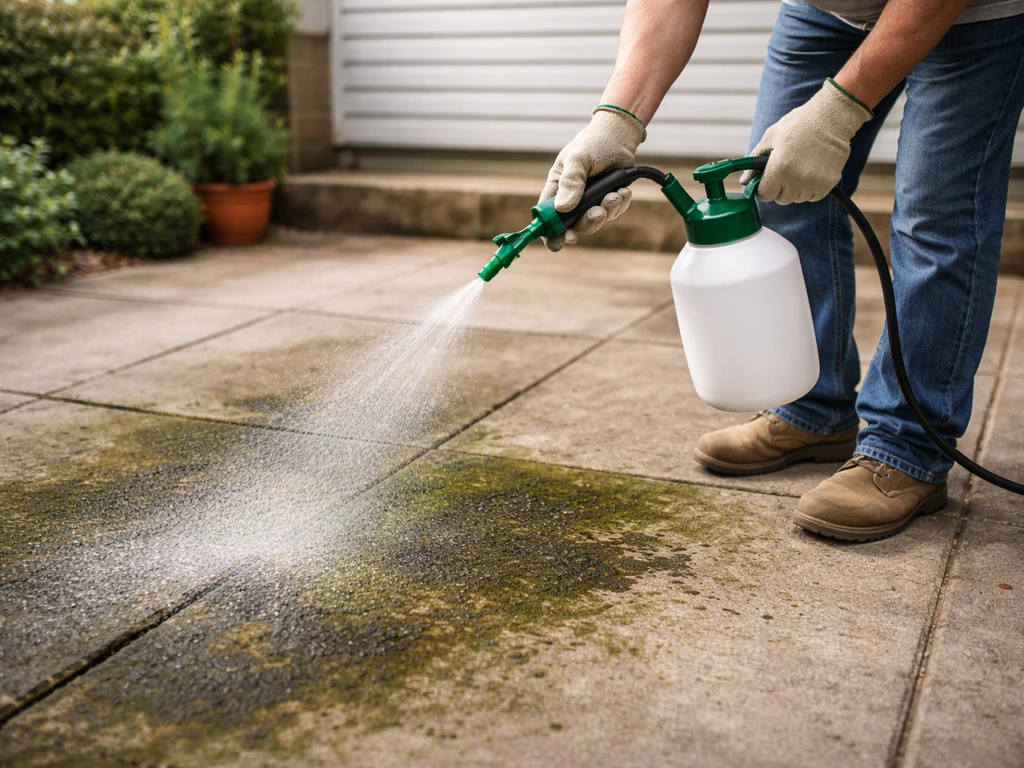
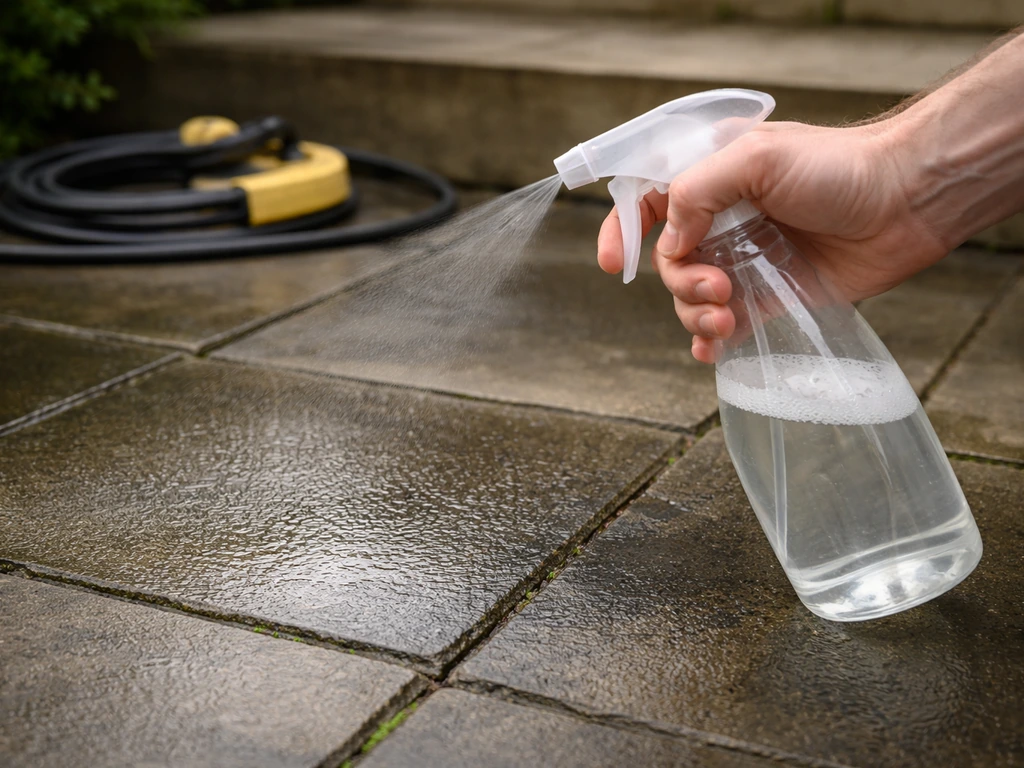
- Apply a patio cleaning chemical if you have algae, moss, grease, or significant staining. Use a watering can, pump sprayer, or the pressure washer's detergent tank. Follow the product dwell time — usually 10 to 20 minutes. Don't let it dry on the surface.
- Set your pressure washer to the appropriate pressure for your surface using the T350's adjustment dial. Start lower than you think you need — you can always increase it. For most patios, a mid-range K4 or K5 setting is a good starting point.
- Work in overlapping rows with the surface cleaner, keeping steady, consistent movement. Don't hover in one spot or rush too fast — both leave marks. Overlap each pass by about 5 to 10 centimetres to avoid stripe lines.
- Rinse the whole area with your pressure washer on a fan nozzle when you're done. This removes loosened grime and any chemical residue. Rinse into a drain or away from planted areas.
- Inspect the result once dry (a wet patio often looks better than it is). If patches remain, spot treat with chemical and repeat that section.
- If using an anti-algae treatment or sealer post-clean, let the surface dry fully — at least 24 to 48 hours in good weather — before applying.
What to pair it with and what to avoid
Compatible pressure washers and connections
The T350 is compatible with Kärcher K2 through K7 Home and Garden pressure washers, which covers the vast majority of domestic Kärcher machines. If you're on a K1 or an older non-compatible model, check the quick-connect fitting before buying, some older machines use a different connector. For anyone deciding which Kärcher machine to pair with the attachment, the K4 and K5 range offer the best balance of pressure (enough for most patios) and cost. The T 5 and T 7 PLUS models are the US-market equivalents and work similarly across compatible pressure washer ranges.
Detergents and chemicals that help
- General patio cleaner concentrate: dilute per instructions, apply before surface cleaning, good for general grime and organic growth
- Patio biocide or anti-algae treatment: apply after cleaning to prevent regrowth — this is the step most people skip and then wonder why the patio goes green again quickly
- Oxalic acid rust remover: apply to rust stains before rinsing, not a job for mechanical pressure alone
- Enzymatic cleaner: best for pet urine and organic odour on porous surfaces
- Kärcher's own RM 760 patio detergent: works fine, broadly comparable to own-brand alternatives at similar prices
What to avoid
- Bleach-based cleaners on natural stone: can cause discolouration and surface damage, especially on sandstone and limestone
- Maximum pressure on soft stones, pointing, or grout: you will erode the joints over time
- Cleaning in freezing temperatures: wet stone combined with frost can cause surface cracking
- Leaving algae removal products to dry on the surface before rinsing: can cause residue staining
- Pointing the surface cleaner at anything other than a flat patio surface: it's not designed for walls or vertical surfaces and won't seal properly
Post-cleaning slip risk
This is worth flagging: a freshly pressure-washed patio, especially natural stone, can be significantly more slippery than a grimy one until it fully dries. The algae and moss you removed were acting as a non-slip layer (a terrible one, but still). Warn household members, keep pets off until dry, and if the surface is inherently smooth (polished slate, for example), consider a patio anti-slip treatment or sealant with a textured finish.
Troubleshooting and when to switch methods
Still getting streaks after cleaning
Streaks usually mean the surface cleaner is moving too fast, the pressure is too low, or the attachment needs descaling (the nozzles can clog over time). Try a slower pass at slightly higher pressure, and check the rotating arm spins freely. If you're still getting marks, clean with the lance on a 25-degree nozzle using overlapping fanning strokes as a finishing pass.
Green growth comes back within weeks
You cleaned the surface but didn't apply a post-clean biocide treatment. Physical removal alone doesn't kill the spores, they regrow quickly in damp, shaded conditions. Apply a patio biocide or algae inhibitor after the surface dries. Reapplication once or twice a year keeps regrowth much slower.
Surface looks worse or has new marks after cleaning
This sometimes happens on sandstone or limestone when the grime was actually masking surface erosion or colour variations underneath. It's not the cleaner's fault, the stone was already damaged. If you've pressure-washed soft stone and see pitting or a rough texture, drop to a much lower pressure and consider switching to a chemical soak-and-rinse approach rather than mechanical cleaning going forward. A penetrating stone sealer will help protect what's left.
The surface cleaner isn't removing deep stains
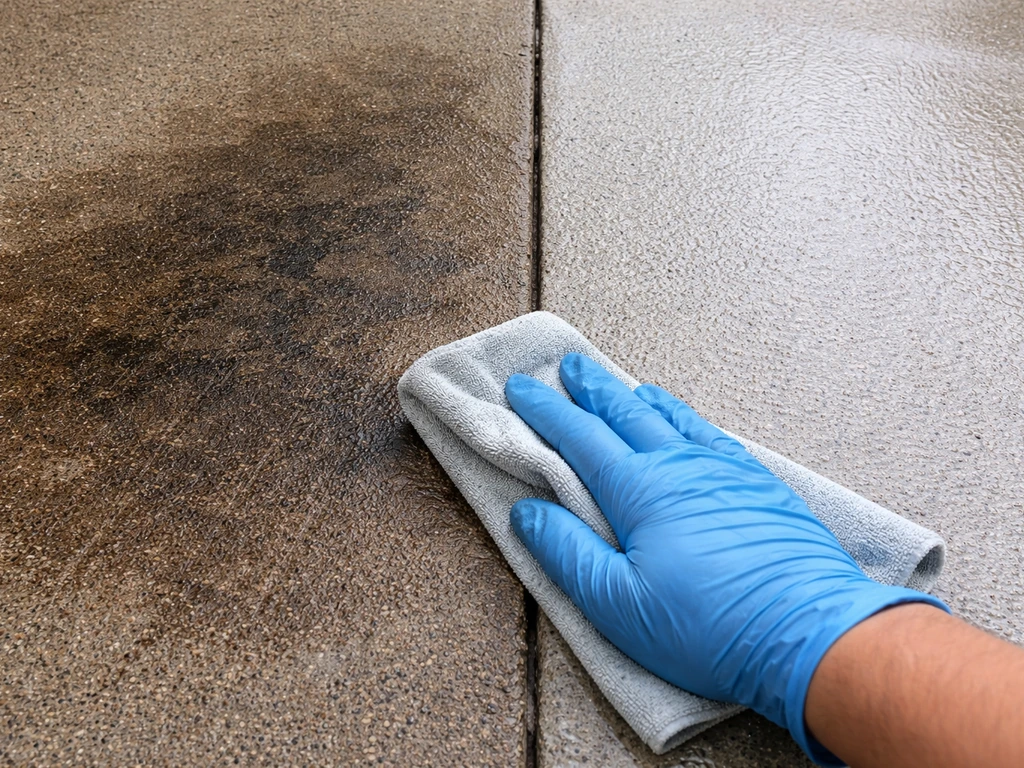
If rust, oil, or tannin stains survive a full clean, the chemistry hasn't been applied. Go back to the pre-treatment step with the appropriate product for that specific stain type. The surface cleaner is excellent at removing physical grime and biological growth, it is not a chemical treatment, and it won't substitute for one.
When to skip the surface cleaner entirely
There are a few situations where a Kärcher patio cleaner attachment isn't the right tool. Very small patios or awkward corners where the disc can't sit flat, heavily pointed traditional patios where you'd risk blasting out the mortar at any useful pressure, soft stone like sandstone that's already eroding (go chemical-only), and situations where the main problem is a chemical stain that needs soaking rather than scrubbing. In those cases, a careful lance technique, a soft brush, or a purely chemical approach will do less damage and often deliver better results.
Should you buy it? A quick checklist
Run through this before purchasing. If you tick most of the 'yes' boxes, it's a solid buy.
- Do you already own a Kärcher K2 to K7 pressure washer? (If yes, the T350 will connect without adapters)
- Is your patio larger than about 15 square metres? (Smaller than that and the time saving is marginal)
- Is your patio made of concrete, brick, porcelain, or sealed natural stone? (Best results on these surfaces)
- Are your main problems algae, moss, general grime, or surface blackening rather than deep chemical stains?
- Are you okay spending a few minutes on pre-treatment with a chemical before the mechanical clean?
- Do you want to avoid the stripy finish that lance pressure washing often leaves?
If you ticked four or more of those, a Kärcher patio cleaner attachment is genuinely one of the most worthwhile accessories you can buy for patio maintenance. Start with the T350 if you want a reliable, widely compatible option with adjustable pressure. If you're hunting for the Karcher T350 patio cleaner best price, compare the total cost including the right pressure washer connection and shipping. If you're on a tight budget or have a smaller machine, look at the T150 as the entry-level alternative. And if you want the full picture on each model before deciding, the individual model reviews for the T5, T150, and T350 go into much more detail on specific features, prices, and real-world performance differences.
FAQ
Is a Kärcher patio cleaner attachment better than using a pressure washer with a rotating nozzle or brush head?
In most cases, yes for patios because the disc keeps the cleaning path even and reduces streaking, but a rotating brush can be competitive on smaller areas. If you try it, prioritize products that sit flat and splash-control well, and expect more edge-to-edge variation than with a true surface cleaner head.
What is the fastest way to tell whether I should buy the attachment or the Kärcher patio cleaning chemical?
If your main problem is algae, moss, grime, or general dirt, you want the surface cleaner attachment plus (optionally) a post-biocide step. If your main problem is rust, grease, or tannin, you need the correct chemical pre-treatment first, then rinse with the surface cleaner (the attachment alone usually will not solve it).
Can I use a Kärcher patio cleaner on my K1 pressure washer or older Kärcher model?
Only if the connection and pressure rating match what the attachment is designed for. The biggest mistake is assuming compatibility because the brand matches, older machines may use a different quick-connect. Check the fitting type before buying, and if your machine is too low power, cleaning performance will look disappointing.
Why does my cleaned concrete look patchy or lighter in some areas after using the surface cleaner?
Patchiness often happens when the grime was protecting older stains or when the surface was unevenly porous. If it looks like pitting or rough texture, the patio may have surface damage already, drop pressure and switch to a chemical soak-and-rinse approach rather than continuing mechanical scrubbing.
How do I avoid streaks, even pressure lines, and “swirls” with the T350-style cleaners?
Most streaking is either travel speed too fast, pressure too low, or nozzles partially clogged from buildup. Use a slower, steady pace with slight overlap, confirm the rotating arm spins freely, and if needed, do a quick nozzle clean or descaling before chasing higher pressure.
Is it safe to clean near garden plants, pets, or my fence panels?
Splash containment helps, but it does not make everything risk-free. Keep pets and people off until the area fully dries, and for sensitive plants consider rinsing plants nearby afterward and using chemicals only as directed, because biocides and rust removers can harm foliage.
What should I do if the patio becomes slippery after cleaning?
This is common, especially on concrete and natural stone, because algae removal can temporarily reduce traction. Block off access until dry, then consider a textured anti-slip sealer or treatment if the surface remains too slick after drying.
Will the patio cleaner attachment prevent algae or moss from coming back?
No, it removes what is present, it does not stop regrowth. For best results, apply the appropriate patio biocide or anti-algae treatment after the surface dries, and reapply on shaded, damp patios about once or twice per year depending on local conditions.
What pressure should I use on sandstone or other soft porous stones?
Use low pressure and avoid the maximum setting, unsealed sandstone can pit or erode. If you see any roughening or sand-blasting feel, stop and switch to a chemical dwell-and-rinse method. Also, test in a hidden corner first because sealed vs unsealed behavior can differ a lot.
How do I remove rust or grease stains if the attachment is not working?
Apply the correct pre-treatment first, rust usually needs an oxalic acid-based remover, grease needs a dedicated degreaser. Leave it to dwell as directed, then rinse and use the surface cleaner for the mechanical rinse. Expect that pressure alone will not lift rust or deeply absorbed oil reliably.
Can I use a surface cleaner attachment around tile grout or between pavers?
Be cautious, the head can blast out loose mortar or lift weak joints if pressure is too high. Lower the pressure, keep the head moving, and do a quick inspection before and after. If your grout is already failing, mechanical cleaning may worsen it.
If stains remain after a full clean, how can I tell whether it is chemistry or the surface itself?
If you pre-treated the correct stain type and it still persists, the stain may be embedded or the surface may be damaged or permanently discolored. Re-check that you used the right chemical for the stain, and if no pre-treatment was applied, go back to that step rather than increasing pressure with the attachment.
Next Article
How to Use Wet and Forget Patio Cleaner Step by Step
Step by step guide to apply Wet and Forget patio cleaner, prep and safety, dwell time, rinse or no rinse, and troublesho