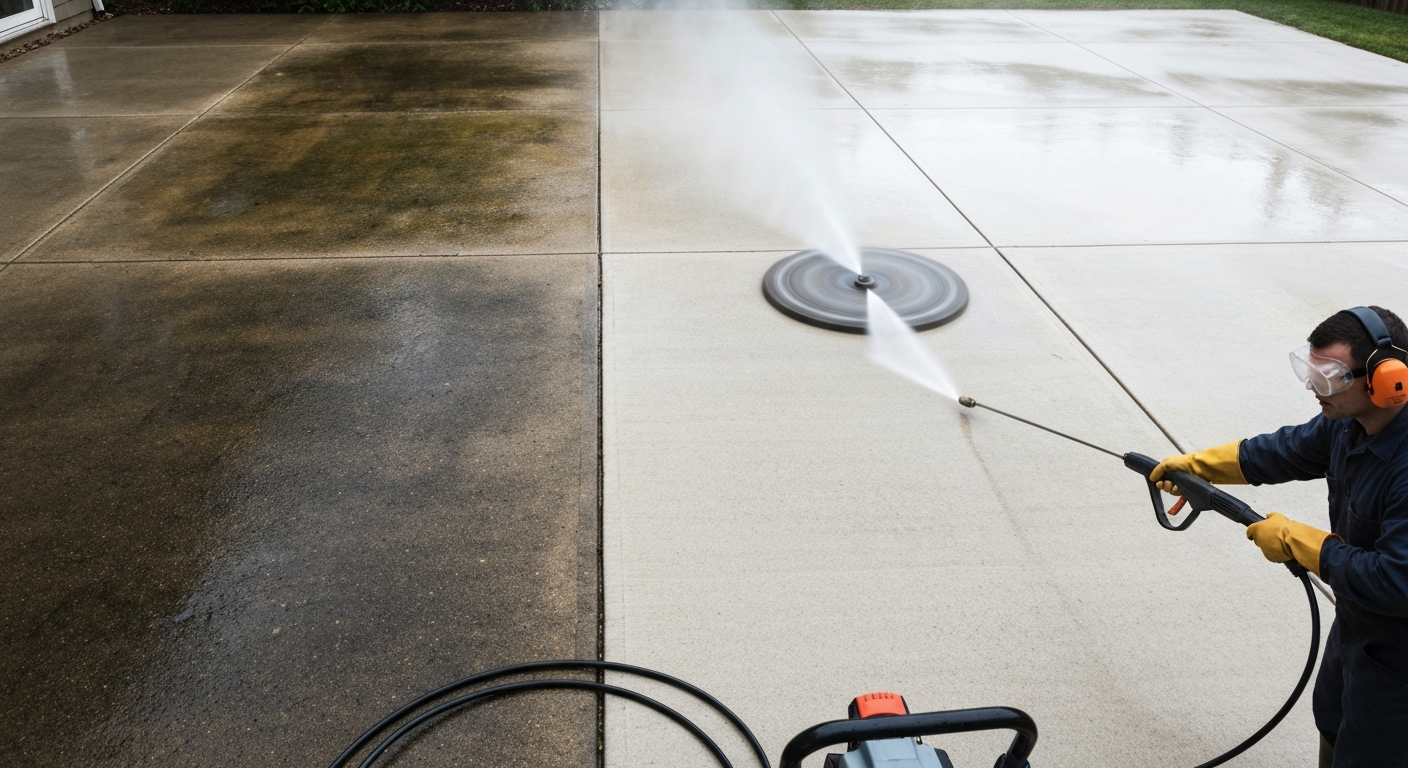
For most brick patios, the sweet spot is an electric pressure washer rated around 1,500 to 2,000 PSI paired with a 25-degree or 40-degree nozzle and a surface-cleaner attachment. That combination cleans efficiently without blasting mortar out of joints or spalling softer bricks. If I had to name one model right now: the Sun Joe SPX3000 handles light-to-medium brick jobs well at a price that makes sense for occasional use, while the Ryobi RY142300 is the midrange pick I keep recommending, and the Karcher K5 Premium fills the premium electric slot. For bigger patios or heavy staining, a gas unit like the SIMPSON MegaShot MSH3125 adds serious flow, but you need to respect the pressure limits around mortar joints.
Best Power Washer for Brick Patio: Top Picks & Guide

Rhea Lang
13 Aug 2026
Quick take: top picks at a glance
- Best budget electric: Sun Joe SPX3000 (2,030 PSI / 1.76 GPM) — great for small-to-medium patios, light staining, and first-time users
- Best midrange electric: Ryobi RY142300 (2,300 PSI / 1.2 GPM) — solid build, onboard storage, reliable for regular seasonal cleaning
- Best premium electric: Karcher K5 Premium (2,000 PSI / 1.4 GPM) — Water-Cooled motor for longer run times, excellent accessory ecosystem
- Best budget gas: SIMPSON MegaShot MSH3125 (3,200 PSI / 2.5 GPM) — Honda GC190 engine, built for larger jobs, requires careful throttle control on brick
- Best surface cleaner (electric): Greenworks 12-inch surface cleaner (up to 2,300 PSI) — pairs directly with the SPX3000 and Ryobi picks
- Best surface cleaner (gas/high-flow): MTM Hydro 15-inch surface cleaner — handles the GPM output of the SIMPSON and similar gas units
The top picks reviewed
Budget electric: Sun Joe SPX3000
The SPX3000 is almost the default recommendation for homeowners who pressure wash their patio once or twice a year, and for good reason. Its certified rated output sits at 2,030 PSI and 1.2 to 1.76 GPM depending on the nozzle, which is right in the safe zone for brick. The dual-detergent tank system is genuinely useful because you can pre-load a brick-safe cleaner without interrupting the job to swap containers. The axial pump is sealed and not user-serviceable, so expect a design life in the 250 to 400 hour range rather than thousands of hours, but for seasonal DIY use that is years of patio cleaning. At around $150 to $180 retail, it is easy to justify. I have used this model on red clay brick with light efflorescence and on older reclaimed brick, and as long as you use the 25-degree nozzle from at least 12 inches away, it does not disturb the joints.
Midrange electric: Ryobi RY142300
The Ryobi RY142300 steps up to 2,300 PSI and comes with a more convenient roll-cage frame and onboard hose storage, which matters when you are moving around a brick patio with a surface cleaner attached. The PSI is still within the acceptable range for most modern brick (the practical upper limit around mortar joints is roughly 1,200 PSI, and you achieve that by adjusting distance and nozzle angle rather than dialing down the machine). Priced at around $200 to $250, it bridges the gap between entry-level and professional-grade and is the unit I would buy if I expected to clean a 300 to 500 square foot patio each spring and fall.
Premium electric: Karcher K5 Premium
Karcher's K5 Premium sits around $350 to $400 and justifies the price mainly through its water-cooled induction motor, which is rated for longer continuous operation than the brushed motors on budget units. The rated output is around 2,000 PSI and 1.4 GPM. For a brick patio, the PSI is almost perfectly calibrated, and the Karcher accessory ecosystem is excellent: the Patio Cleaner attachment (their branded surface cleaner) is one of the cleaner-spinning designs I have tested, leaving very few swirl marks on brick. If you care about finesse and long machine life over raw power, this is the pick. It is also the unit I reach for when cleaning older, softer brick where I want precise control rather than brute force.
Gas option: SIMPSON MegaShot MSH3125
The SIMPSON MegaShot MSH3125 pairs a Honda GC190 engine with a 3,200 PSI / 2.5 GPM axial-cam pump and is the entry point into gas territory for most DIYers. At roughly $400 to $500, it overlaps with premium electrics on price but delivers significantly more flow, which matters when you are running a 15-inch surface cleaner across a large patio. The critical thing to understand is that 3,200 PSI is above what you should direct at brick joints from close range: a U.S. Department of Veterans Affairs construction specification explicitly caps pressure at 1,000 PSI for brick cleaning and mandates at least a 12-inch standoff. With the SIMPSON, you manage pressure through distance (18 to 24 inches from brick surfaces) and by always using a surface cleaner rather than a wand for flat sections. Used correctly it cleans faster than any electric option and handles heavy moss and algae staining that would take an electric unit multiple passes. I learned this the hard way when I let a friend use the wand from about 8 inches away on a garden wall and we spent the afternoon re-pointing joints.
Model comparison: specs side by side
| Model | Type | PSI (rated) | GPM | Price range (2026) | Surface-cleaner compatible | Pump type |
|---|---|---|---|---|---|---|
| Sun Joe SPX3000 | Electric | 2,030 | 1.2–1.76 | $150–$180 | Yes (up to 12" / 2,300 PSI models) | Axial (sealed) |
| Ryobi RY142300 | Electric | 2,300 | 1.2 | $200–$250 | Yes (12–14" cleaners) | Axial |
| Karcher K5 Premium | Electric | 2,000 | 1.4 | $350–$400 | Yes (Karcher Patio Cleaner) | Induction / axial |
| SIMPSON MegaShot MSH3125 | Gas | 3,200 | 2.5 | $400–$500 | Yes (15" cleaners recommended) | Axial-cam |
| Greenworks 12" Surface Cleaner | Attachment | Up to 2,300 PSI | N/A | $40–$60 | Fits SPX3000, Ryobi | N/A |
| MTM Hydro 15" Surface Cleaner | Attachment | Up to 4,000 PSI | N/A | $80–$110 | Fits SIMPSON and similar gas units | N/A |
Why these models made the list
Every model here was evaluated against four criteria specific to brick patio cleaning: safe PSI ceiling, surface-cleaner compatibility, real-world usability (hose length, weight, maneuverability around patio furniture), and value for typical homeowner use. I did not include any unit whose maximum PSI exceeds what you can safely manage on brick without specialized training, and I excluded models with published complaints about joint damage on brick surfaces in user feedback forums.
PSI safety was the primary filter. The National Park Service Preservation Briefs recommend starting at 100 to 300 PSI for historic masonry and scaling up only if needed, and the Brick Industry Association puts the practical upper ceiling for cleaning most modern brick at around 1,200 PSI. Every recommendation here can be operated within that envelope by adjusting distance and nozzle selection. The gas unit exceeds that at the nozzle tip, but real working pressure on the surface at 18 to 24 inches with a surface cleaner stays within safe limits.
Surface-cleaner compatibility was the second filter. A surface cleaner eliminates the tiger-striping and risk of concentrated lance pressure, and all the picks above accept an appropriate cleaner. The sizing rule-of-thumb used by professionals is roughly 4 inches of cleaner diameter per GPM of flow: so a 1.5 GPM electric machine suits a 10 to 12 inch cleaner, and a 2.5 GPM gas unit suits a 15 inch cleaner. Oversizing the cleaner for your machine's GPM causes slow, patchy cleaning; undersizing it wastes efficiency.
PSI, GPM, and nozzle guidance for brick patios
Brick is more pressure-sensitive than most homeowners expect. Modern engineering brick is dense and fairly tolerant, but many residential patios use softer facing brick, reclaimed brick, or bricks with aged or partially failed mortar. The GSA technical procedure for exterior brick cleaning specifies starting with as little as 50 PSI using a brush or low-pressure spray and only escalating when necessary. For machine cleaning, staying below 1,200 PSI at the surface (not at the nozzle) is the consistent recommendation across trade sources. Brick Powerwashing: Methods and Precautions, National Power Washing Authority (summary referencing BIA guidance) notes the Brick Industry Association's practical upper cleaning guideline of about 1,200 psi and recommends much lower pressures (around 400–600 psi) for softer or historic brick Brick Powerwashing: Methods and Precautions — National Power Washing Authority (summary referencing BIA guidance). The VA construction spec quoted above caps machine pressure at 1,000 PSI with a minimum 12-inch standoff. Keep that mental model: it is the pressure arriving at the surface that matters, not the machine's rated maximum.
In practice, a 40-degree nozzle from 12 to 15 inches is the right starting position for brick cleaning. Move to a 25-degree nozzle only if staining is stubborn and only on modern, dense brick. Never use a 0-degree or 15-degree nozzle on brick, and avoid the turbo/rotary nozzle, which concentrates pressure into a spinning point that can erode mortar in seconds. Keep the wand moving constantly and always work with (not against) the brick surface rather than probing into joints.
Quick notes for related patio surfaces
Concrete patios are significantly more forgiving than brick: most contractor guides and retailer buying guides recommend 2,500 to 3,500 PSI for concrete, and a surface cleaner at 3,000 PSI with 4 GPM handles heavy soiling well. If you also clean a concrete patio or driveway alongside your brick work, you may want a more powerful machine than the budget electrics above. If you also clean a concrete patio or driveway alongside your brick work, you may want a more powerful machine, check our round-up of the best pressure washer for concrete patio for model recommendations and sizing guidance. Stone patios (particularly sandstone and limestone) are often softer than brick and closer to the historic masonry end of the spectrum, meaning lower pressure and the 40-degree nozzle are even more important. Patio slabs (manufactured concrete flags) sit between concrete and brick in terms of pressure tolerance. For specific recommendations on the best pressure washer for patio slabs, see our dedicated guide. Those topics are covered in more detail elsewhere on this site for concrete patios, stone patios, and patio slabs if you are dealing with mixed surfaces. If you need recommendations specific to softer stones, see our guide to the best pressure washer for stone patio.
| Surface type | Recommended PSI range | Nozzle | Notes |
|---|---|---|---|
| Brick patio (modern) | 600–1,200 PSI at surface | 40-degree, or 25-degree for stubborn stains | Never probe joints; use surface cleaner for flat areas |
| Brick patio (historic/soft) | 100–600 PSI at surface | 40-degree only | Test patch first; stop if mortar loosens |
| Concrete patio | 2,500–3,500 PSI | 25-degree or surface cleaner | High GPM (3–4+) improves results |
| Stone patio (sandstone/limestone) | 300–800 PSI | 40-degree only | Treat like soft brick; very pressure-sensitive |
| Patio slabs (concrete flags) | 1,500–2,500 PSI | 25-degree or surface cleaner | Check joint sand before and after |
Surface-cleaner attachments: why they matter for brick
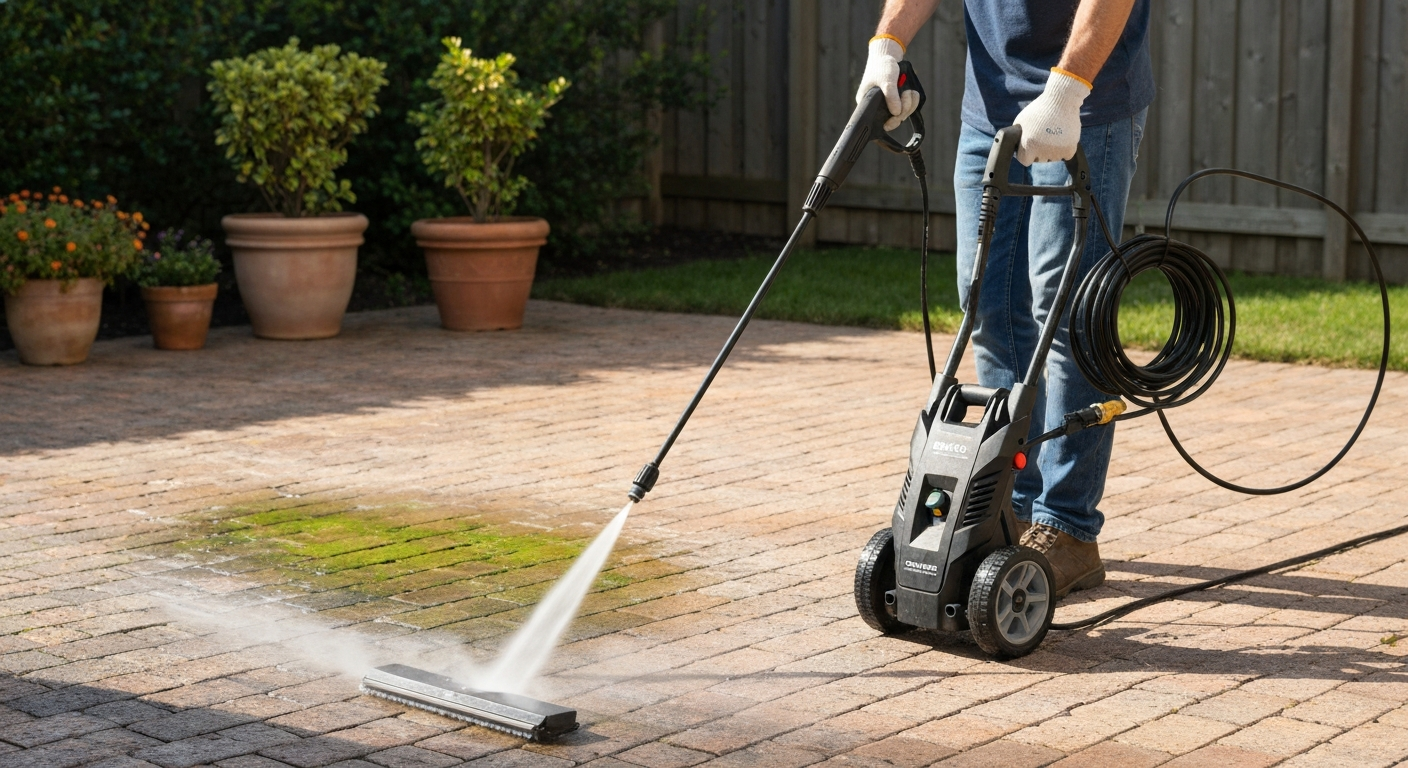
A surface cleaner is the single most impactful accessory you can buy for patio work. Instead of a direct lance jet, a surface cleaner uses two counter-rotating nozzles housed inside a shroud that glide across the surface at consistent height, eliminating the uneven pressure distribution that causes tiger-striping. For brick specifically, it also prevents the nozzle from accidentally dipping into mortar joints at close range. I consider it non-optional for any flat patio surface, and it is genuinely faster than wand-cleaning for anything over about 20 square feet. For model comparisons and hands-on testing, see our pressure washer patio cleaner reviews.
The trade-off is that surface cleaners require adequate GPM to spin the nozzles properly. Use one that is undersized for your machine's flow and you get sluggish rotation and dirty tracks. Size it correctly using the 4 inches-per-GPM rule: a 1.2 GPM machine (Sun Joe SPX3000) suits a 10 to 12 inch cleaner at most, a 1.4 GPM machine suits up to 12 inches, and the 2.5 GPM SIMPSON suits a 15-inch cleaner comfortably. Going above 15 inches on the SIMPSON is possible but you will see slower cleaning speed.
When to use a surface cleaner vs the wand
- Use the surface cleaner for all flat open areas of the patio, including between furniture zones
- Switch to the wand with a 40-degree nozzle for tight corners, edges along walls, and the perimeter row of bricks where the cleaner shroud cannot reach
- Use the wand at very low pressure (or hand-brush) directly on any visibly damaged or crumbling mortar joints
- For raised edging bricks or vertical faces on a raised patio wall, use the wand only with a 40-degree nozzle and keep extra standoff distance
Recommended surface-cleaner attachments
- Greenworks 12-inch surface cleaner: rated to 2,300 PSI, fits standard 1/4-inch quick-connect, ideal for Sun Joe SPX3000 and Ryobi — around $40 to $60
- Karcher Patio Cleaner T 5 or T 7: Karcher-specific connection, excellent nozzle design with minimal swirl marks, designed for K2 through K5 series
- MTM Hydro SC15 15-inch surface cleaner: rated to 4,000 PSI / 5 GPM, 3/8-inch inlet, suits the SIMPSON MegaShot and similar gas units — around $80 to $110
- Mosmatic surface cleaners: commercial-grade with precision inlets and serviceable bearings, high PSI/GPM ratings for heavy-duty jobs; confirm inlet thread (typically 3/8-inch NPTF) before buying
Detergents and eco-friendly cleaners
For general grime and light algae on brick, a diluted sodium hypochlorite solution (1 part bleach to 10 parts water) applied with a low-pressure soap nozzle before washing is the fastest option. Let it dwell for 5 to 10 minutes, then rinse. If you prefer to avoid bleach near garden beds or pets, a pH-neutral brick detergent or an oxygen bleach (sodium percarbonate) product applied and scrubbed in with a stiff brush does an excellent job on organic staining without the runoff concern. Products like Simple Green Oxy Solve and Zep House and Siding cleaner are widely available and brick-safe when used at label dilution rates.
Avoid any detergent labeled for concrete etching or containing muriatic acid unless you are specifically treating efflorescence under professional guidance. Acid-based cleaners dissolve the calcium compounds in mortar as readily as they dissolve the efflorescence salts. For moss and algae that has returned multiple times, a dedicated biocide (quaternary ammonium or potassium soap-based) used after washing prevents regrowth far better than pressure alone. Apply the biocide after the patio is clean and dry, not before washing.
Step-by-step: pressure washing a brick patio properly
- Clear the patio: remove furniture, planters, rugs, and any loose debris. Sweep or blow off dry leaf matter so it does not clog your surface cleaner.
- Protect edges: cover any nearby garden beds, downpipes, and outdoor lighting with a tarp or plastic sheeting if using detergent.
- Pre-soak and apply detergent: connect the soap nozzle (usually black, low pressure), apply your brick cleaner at low pressure from bottom to top on vertical surfaces and in overlapping passes on flat areas. Let it dwell 5 to 10 minutes but do not let it dry.
- Test patch: always run a test on an inconspicuous corner with your chosen nozzle and distance before covering the full patio. Look for loosening mortar, surface abrasion, or color change after drying.
- Attach the surface cleaner: swap to the surface cleaner on the machine and start at one end of the patio in overlapping passes, moving at a steady walking pace. Overlap each pass by about 2 to 3 inches to avoid track marks.
- Clean edges and tight spots with the wand: use a 40-degree nozzle at 12 to 15 inches for all areas the surface cleaner cannot reach. Move in the direction of the brick courses, not across joints.
- Rinse thoroughly: do a final low-pressure rinse over the entire surface to flush detergent residue and dislodged debris toward a drain. Do not let detergent dry on the surface.
- Allow to dry fully: brick needs to dry completely before applying any sealer — typically 24 to 48 hours in warm conditions, longer in cool or humid weather.
- Inspect joints: walk the patio and check mortar joints for any loosening or gaps exposed by washing. Re-point any damaged areas before sealing.
- Apply sealer (optional but recommended): once dry, apply a brick-compatible penetrating sealer (silane-siloxane type) with a brush or roller. Sealer reduces water ingress, slows moss and algae regrowth, and makes the next clean easier.
Avoiding damage: mortar joints, spalling, and the mistakes I see most often
The mortar joint is always the weak point. Even well-maintained mortar softens under sustained water pressure, and once the top layer is eroded, each subsequent cleaning removes more material until you have open channels that hold moisture and accelerate freeze-thaw damage. The safest rule is never to point a lance directly into a joint. Let the surface cleaner do the flat work and reserve wand use for small areas, keeping the nozzle moving at all times.
Spalling (surface flaking of the brick face) happens when high-pressure water forces itself into the brick's pore structure faster than it can escape, or when the surface already has micro-cracks from frost. Softer, older, or handmade bricks are far more susceptible than modern machine-pressed brick. If you see any flaking or pitting after your test patch, stop, reduce pressure further, and consider a chemical clean with a brush instead. The National Park Service guidance is unambiguous on this: the gentlest effective method is always correct for masonry.
- Never use a 0-degree (red) or 15-degree (yellow) nozzle on brick or mortar
- Never use a turbo/rotary nozzle on brick joints
- Never hold the nozzle stationary over one spot
- Do not clean in freezing conditions or when frost is forecast within 24 hours of washing
- Check for loose pointing before you start and re-point before sealing, not after sealing
- Do not use a surface cleaner on bricks with visibly damaged joints — it will accelerate erosion
Sealing and aftercare
Sealing is not mandatory but makes a meaningful difference to how often you need to clean. A penetrating silane-siloxane sealer soaks into the brick's pore structure, repels water and dissolved salts, and dramatically slows biological growth. It does not change the appearance of most brick significantly (unlike acrylic sealers, which leave a sheen). Expect to re-apply every 3 to 5 years depending on traffic and climate. Film-forming (topcoat) sealers look good initially but trap moisture if applied to brick that was not perfectly dry or if they start to crack, so I generally steer homeowners toward penetrating sealers for patios.
For routine maintenance between full cleans, a garden hose rinse after heavy leaf fall and an annual inspection of mortar joints in spring (after any frost damage is visible) is usually sufficient. If moss or algae starts reappearing within 6 months of a clean, it is a sign the surface lacks adequate drainage or the biocide step was skipped. Treat with a diluted quaternary ammonium solution (Patio Magic and similar products in the UK; 30 Seconds Outdoor Cleaner in the US) brushed in and left to work without rinsing.
Rent vs buy: making the call for your situation
Renting a gas pressure washer costs roughly $70 to $95 per day at big-box rental centers like Home Depot (with 4-hour block rates around $45 to $65), and weekly rates typically run $240 to $360. A budget electric like the Sun Joe SPX3000 retails for $150 to $180, so the break-even point against renting is roughly two to three annual uses. If you clean your patio once a year and nothing else, renting probably makes more financial sense in the short term. If you also clean a driveway, deck, garden furniture, or exterior walls, ownership pays for itself quickly.
There are a few scenarios where renting is clearly better regardless of frequency. If your patio is large (over 600 square feet) and heavily soiled, a one-off rental of a commercial gas unit with a hot-water capability will cut the job from a half-day to under two hours. Hot-water pressure washers are almost never worth buying for residential use given their cost ($1,500 and up) but rental units at United Rentals and similar commercial rental companies make them accessible for a single job. Similarly, if you are dealing with a one-time issue like post-construction cleanup or deep rust staining that requires a high-PSI professional unit, rent the right tool rather than buying something overspecified for your regular needs.
| Scenario | Recommendation | Reasoning |
|---|---|---|
| Clean brick patio once a year, no other uses | Rent | 2–3 rentals covers the cost of a budget electric; no storage hassle |
| Clean patio + driveway + deck annually | Buy (midrange electric) | Multiple surfaces justify ownership; break-even within 1–2 seasons |
| Large patio (600+ sq ft), heavy moss/algae | Rent gas unit | Higher GPM and PSI clean faster; one-time rental cheaper than owning a gas unit |
| Contractor or property manager cleaning multiple sites | Buy (gas unit or commercial electric) | High frequency makes ownership essential; triplex pump for longevity |
| Post-construction or one-time deep clean with rust staining | Rent hot-water unit | Hot water dissolves grease/rust far faster; not worth buying for one-off use |
| Regular DIY homeowner with seasonal patio + occasional driveway | Buy budget or midrange electric | Best all-around value; electric is easier to maintain and store |
Troubleshooting common brick patio problems
Mortar loosening after washing
If you notice sand or mortar fragments in the wash runoff or visible erosion in joints after cleaning, the pressure was too high for those joints or the nozzle angle was too aggressive. Switch to a 40-degree nozzle, increase your standoff distance to at least 18 inches, and move faster across the surface. If joints were already in poor condition before washing, no amount of technique adjustment will fully prevent loss, those joints need re-pointing before any future washing.
White residue appearing after washing (efflorescence)
A white powdery film appearing on brick after washing is efflorescence: water-soluble salts migrating to the surface as water evaporates. It is common on brick that was wet for an extended period. Light efflorescence brushes off when dry. Heavier deposits need a diluted efflorescence cleaner (phosphoric acid-based, not muriatic, for DIY use) applied carefully, scrubbed in, then rinsed. Sealing the brick after cleaning significantly reduces future efflorescence by limiting water ingress.
Algae or moss returning quickly after cleaning
If biological growth returns within a season, the cause is almost always inadequate drainage (water pooling in low spots), a shaded area that stays damp for long periods, or the absence of a post-clean biocide treatment. Address drainage first if pooling is visible. Then apply a patio biocide after cleaning and drying. In persistently shaded spots, re-sealing with a good penetrating sealer every two to three years rather than every five is worth the extra effort.
Pressure washer leaving streak or tiger-stripe marks
Tiger-stripes are almost always a sign that you are using a wand instead of a surface cleaner on a flat surface. The concentrated jet leaves higher and lower pressure zones as you sweep. Switch to a surface cleaner and the problem disappears. If you are already using a surface cleaner and still see uneven cleaning, the cleaner nozzles may be partially blocked or the unit is undersized for the machine's GPM, causing inconsistent rotation speed.
Buying checklist before you commit
- Confirm your patio's brick type: modern machine-pressed, softer facing brick, or reclaimed/historic brick — this determines your maximum safe PSI
- Measure the patio area: under 200 sq ft (budget electric is fine), 200–500 sq ft (midrange electric or small surface cleaner), 500 sq ft+ (consider gas or premium electric with larger surface cleaner)
- Check whether you have outdoor power access: gas models require no power outlet and work anywhere, but need more maintenance and produce exhaust
- Check the machine's surface-cleaner compatibility before buying both items: confirm PSI rating and inlet thread size match
- Check pump type: axial pumps (most consumer models) have a typical design life of 250–400 hours; triplex pumps last 3,000–5,000+ hours and are worth the premium if you use the machine heavily
- Factor in accessories: a surface cleaner ($40–$110), a good 25-degree and 40-degree nozzle set, and a quality 25-foot hose extension cover the full job properly
- Check hose length before buying: most consumer machines come with 20 to 25 feet of hose, which is often insufficient for a large patio without moving the machine constantly
- Read the warranty: most budget electrics carry 1 to 2 year warranties; mid and premium electrics often offer 3 years; gas units vary widely by brand
FAQ
What primary authoritative sources are required for safe pressure/ power‑washing guidance for brick patios?
Use preservation and building‑authority guidance (NPS Preservation Briefs, GSA technical procedures), trade association guidance (Brick Industry Association), and government construction specs (e.g., VA/GSA limits). These set safe PSI/nozzle/technique limits and test‑patch protocols for masonry and mortar protection.
Which commercial/manufacturer sources must be consulted for accurate model specs and compatibility?
Collect official product pages and operator manuals for each recommended model (PSI, GPM, pump type, hose length, detergent tank, weight, warranty). Also review surface‑cleaner and accessory manufacturer tech sheets (Mosmatic, Greenworks, etc.) for max PSI/GPM, inlet threads and shaft compatibility.
What industry and contractor sources are needed for surface‑specific PSI/GPM/nozzle guidance?
Use contractor trade sites and specialist guides (Concrete Network, PressureWashersConnect, National Power Washing Authority) to contrast brick vs concrete/stone guidance and to derive practical PSI/GPM/nozzle ranges and surface‑cleaner sizing rules (e.g., '4 in per GPM' rule‑of‑thumb). Cross‑check against preservation sources to avoid overpressure.
What rental‑market and cost data must be gathered for rent‑vs‑buy analysis?
Survey national rental chains (Home Depot Tool Rental, United Rentals) and rental‑price aggregators for daily/half‑day/weekly rates of common gas and commercial washers. Record current local price ranges and calculate break‑even buying horizons using real rental rates and typical homeowner usage scenarios.
What hands‑on testing or field evidence is required to recommend specific models (budget, midrange, premium)?
Perform or reference hands‑on tests that verify real‑world PSI/GPM under load, cleaning performance on brick patios, ease of use, durability (pump type, engine), vibration/noise, and accessory fit (surface cleaner compatibility). Document test conditions: patio size/material, soil/biological residue, nozzle used, distance to surface, and whether a surface cleaner was used.
What data should be included in a transparent review methodology and comparison table?
List inclusion criteria (tested or reviewed within X months, verified specs), test metrics (measured PSI/GPM, cleaning time per sq ft with/without surface cleaner, detergent use, ease of setup, weight, portability, warranty, maintenance needs, pump type, MSRP). Include a comparison table showing PSI, GPM, pump type, surface‑cleaner diameter compatibility, price band, best use case, and rating rationale.
Next Article
Best Pressure Washer for Concrete Patio: Top Picks & Guide
Find the best pressure washer for concrete patios: top models by budget, PSI/GPM ranges, safe step-by-step cleaning.