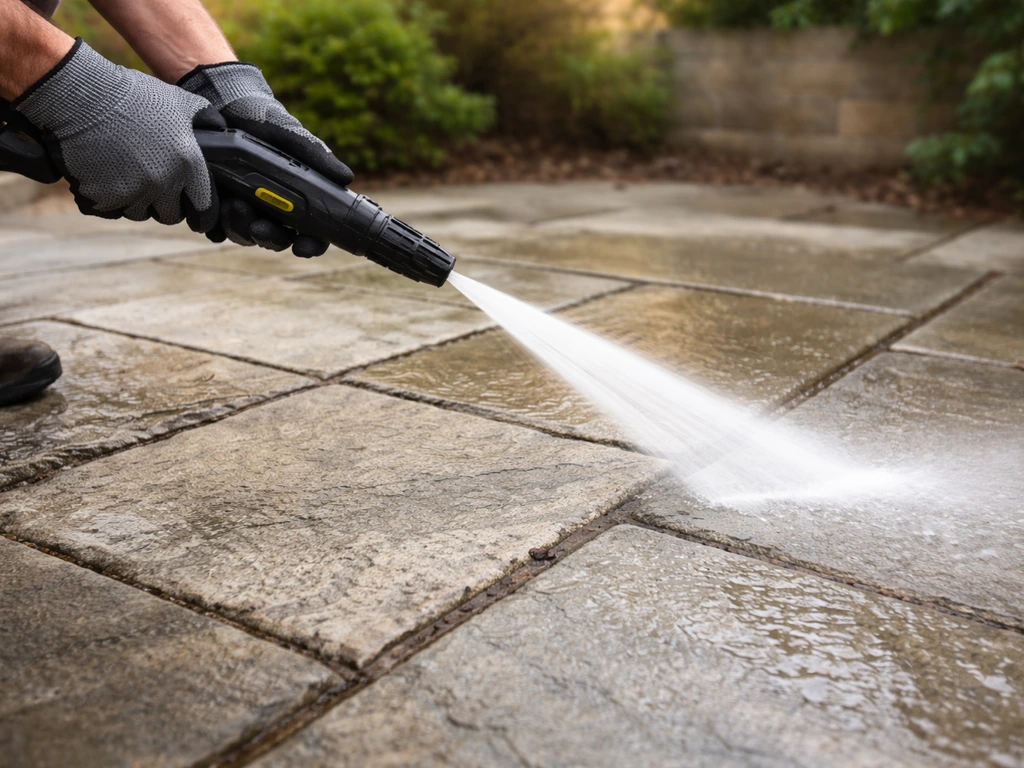
For most concrete patios, you need at least 2,500 PSI and 2.0 GPM to clean effectively without spending half a day on your knees. An electric unit like the Sun Joe SPX3000 (2030 PSI, 1.76 GPM) handles light maintenance and surface grime well, but if you're dealing with embedded oil, years of algae staining, or a large patio that hasn't been touched in a decade, a gas-powered unit in the 3,000–3,500 PSI range is genuinely worth the extra money. This guide walks you through the best models across every budget, how to match PSI and GPM to your actual situation, and everything you need to do the job safely without damaging your concrete.
Best Pressure Washer for Concrete Patio: Top Picks & Guide
Rhea Lang
27 Jul 2026
What this guide covers and who it's for
If you're a homeowner staring at a grimy concrete patio and wondering whether to buy a pressure washer, rent one for the weekend, or just call someone, this is the guide for you. I've tested a range of electric and gas units on concrete surfaces ranging from recently poured slabs to 20-year-old patios with embedded rust and oil, and I'll give you honest guidance based on what actually worked. We'll cover specific model picks at every price point, the PSI and GPM numbers that matter for concrete (not just the headline spec on the box), nozzle and accessory choices, step-by-step technique for a streak-free result, stain-specific advice, and how to avoid the mistakes that crack or pit concrete surfaces. If you're cleaning brick or stone rather than concrete, the same principles largely apply, though the pressure settings differ enough that it's worth checking the sibling guides on this site for brick patios and pressure washing patio slabs specifically.
Quick recommendations at a glance
Not everyone needs to read the full guide before making a decision. Here's where I'd point you based on your situation:
| Use Case | Top Pick | PSI / GPM | Approx. Price |
|---|---|---|---|
| Budget / light maintenance | Sun Joe SPX3000 | 2030 PSI / 1.76 GPM | $150–$180 |
| Mid-range / regular annual cleaning | Kärcher K5 Premium | 2000 PSI / 1.40 GPM | ~$360 |
| Best overall / heavy staining or large patio | Simpson MegaShot MSH3125-S | 3200 PSI / 2.5 GPM | $399–$429 |
| One-time job or large area | Rental gas unit (3000–4000 PSI) | 3000–4000 PSI / 3.0–4.0 GPM | $60–$120/day |
| Severe grease or oil contamination | Commercial hot-water rental or pro hire | 3000+ PSI / hot water | Hire: $150–$300+ |
How to choose the right pressure washer for your concrete patio
The right machine depends on four things: the size of your patio, how often you clean it, the types of stains you're dealing with, and whether buying makes more financial sense than renting. Work through each before you spend any money.
Patio size
For patios under 200 square feet, a mid-range electric unit gives you enough power without the noise and fumes of gas. Once you're looking at 300 square feet or more, the time savings from a gas unit's higher GPM (water flow) become very real. A 2.5 GPM machine clears concrete noticeably faster than a 1.4 GPM machine at similar PSI, because volume moves loosened dirt off the surface. A surface cleaner attachment (more on this below) makes the size difference even more manageable.
Cleaning frequency
If you're cleaning once a year in spring or early summer, the economics of ownership make sense from roughly a mid-range electric machine upward. If it's truly a once-every-few-years event, renting is almost certainly the smarter call. A decent rental gas unit costs $60–$120 per day, so you'd need to use a purchased unit four or five times before breaking even against rentals.
Stain types
Surface dirt, light algae, and general grime come off with 1,800–2,500 PSI cold water and the right detergent. Embedded oil, heavy grease, and old rust stains need 3,000 PSI or more, often combined with a pretreatment. True petroleum-based staining (think dripping barbecue fat over years) is where cold water struggles, and hot water makes a real difference. If grease is your main problem, a commercial hot-water rental is a better investment than buying a cold-water gas unit.
Buy vs. rent
Buy if: you have a large patio or driveway, clean at least once a year, and want to tackle the job on your schedule without queuing at the rental center. Rent if: you need the job done once, you want a machine more powerful than you'd normally buy, or you're dealing with a specific problem (embedded grease, full restoration) that needs commercial-spec equipment. The rental section near the end of this guide covers what to ask for and how to avoid the common rental mistakes.
PSI and GPM explained: the numbers that actually matter
PSI (pounds per square inch) is the cutting force of the water jet. GPM (gallons per minute) is the volume that flushes debris away. You need both. A high-PSI, low-GPM machine can loosen dirt but won't rinse it off efficiently. A high-GPM, low-PSI machine moves a lot of water but may not have enough impact to break the bond of embedded staining. The combination of PSI x GPM, sometimes called cleaning units (CU), gives you a better picture of real-world performance.
| Task | Recommended PSI | Recommended GPM | Notes |
|---|---|---|---|
| Annual maintenance, light surface dirt | 1500–2500 PSI | 1.4–2.0 GPM | Electric units are sufficient; use 25° or 40° nozzle |
| Moderate algae, mold, general grime | 2000–3000 PSI | 1.8–2.5 GPM | Add a concrete-specific detergent or sodium hypochlorite pretreatment |
| Embedded stains, heavy discolouration | 2800–3500 PSI | 2.0–3.0 GPM | Gas unit or strong electric; 15° or 25° nozzle; surface cleaner helps |
| Oil and grease contamination | 3000–3500 PSI + hot water | 2.5–4.0 GPM | Cold water alone often inadequate; hot water or degreaser essential |
| Historic/decorative concrete or exposed aggregate | 300–1200 PSI | Low flow | Follow GSA/preservation guidance; test patch first; wide-angle or fan nozzle |
One number I always check before buying or renting: the GPM at rated PSI, not the separate peak figures. Some machines advertise 3,200 PSI but deliver that only at a much lower GPM than the headline spec implies. Look for the combined spec on the manufacturer's datasheet, not just the marketing copy on the box.
Electric vs. gas vs. commercial hot-water units
Electric pressure washers
Electric units are quieter, lighter, require no fuel mixing or engine maintenance, and can be used indoors or in enclosed spaces. The Sun Joe SPX3000's 14.5-amp induction motor gives you a genuine 2030 PSI, which is enough for regular concrete maintenance. The Kärcher K5 runs a cooled induction motor at 2000 PSI with a nicely engineered wand system, and it's built to handle longer sessions than the cheaper end of the electric market. The honest limitation of electrics is GPM: at 1.4–1.76 GPM, they're slower on large surfaces and may need repeated passes on heavy staining. They're also tethered to a GFCI-protected outlet, which matters for positioning around a patio.
Gas pressure washers
Gas units give you mobility (no extension cord concerns), higher PSI, and higher GPM, which together produce noticeably faster cleaning on concrete. The Simpson MegaShot MSH3125-S runs a Honda GC190 engine with an OEM Technologies axial-cam pump at 3,200 PSI and 2.5 GPM. That combination cleans large concrete patios quickly and handles staining that an electric unit would struggle with. The trade-offs are real: gas units are heavier (the Simpson is around 64 lbs), noisier, need fresh fuel and occasional engine maintenance, and should never be run indoors or in enclosed spaces. For most homeowners cleaning a concrete patio once or twice a year, the extra performance is worth it over a basic electric.
Commercial hot-water units
Hot-water pressure washers (running at 120–300°F) are the standard for commercial concrete cleaning because hot water emulsifies oil and grease far more effectively than cold water at any pressure. Brands like Hotsy and Mi-T-M make contractor-spec machines with triplex pumps, burner systems, and GPM ratings that dwarf consumer units. Unless you run a business or have severe industrial-level contamination, these aren't machines to buy for home use. They're worth renting or hiring a contractor with for a one-time oil-grease remediation job.
When to hire a professional instead
Call a pro when you're dealing with widespread deep oil staining, when you have historic or decorative concrete that needs restoration rather than maintenance cleaning, or when the job is large enough (a long driveway plus a big patio) that renting commercial equipment is the cheaper option anyway. A professional pressure washing service typically costs $150–$300 for a standard concrete patio, and for that price they bring hot water, commercial flow rates, and experience with stain chemistry that saves you a frustrating afternoon.
Top recommended models and how they compare
These are the models I'd actually recommend to a homeowner, based on manufacturer specifications and real-world performance data. Prices listed are approximate retail at time of writing and will vary by retailer and timing. See our pressure washer patio cleaner reviews for a model-by-model breakdown and hands-on results.
| Model | PSI | GPM | Motor/Engine | Weight (approx.) | Price Range | Best For |
|---|---|---|---|---|---|---|
| Sun Joe SPX3000 | 2030 | 1.76 | 14.5A electric induction | ~31 lbs | $150–$180 | Budget / light maintenance |
| Kärcher K5 Premium | 2000 | 1.40 | Cooled electric induction | ~34 lbs | ~$360 | Mid-range / feature-rich electric |
| Simpson MegaShot MSH3125-S | 3200 | 2.5 | Honda GC190 gas | ~64 lbs | $399–$429 | Best overall / heavy staining / large patios |
| Commercial hot-water rental (Hotsy/Mi-T-M type) | 3000–4000+ | 3.0–5.0 | Gas/diesel burner + pump | Heavy (trailer/skid) | $80–$150/day rental | Grease, oil, professional restoration |
Budget, midrange, and premium picks in detail
Best budget pick: Sun Joe SPX3000
The SPX3000 punches above its price bracket for basic concrete maintenance. At $150–$180, you get a 2030 PSI induction motor (not a universal motor, which matters for longevity), five quick-connect nozzle tips, and a built-in detergent tank. On a small to medium patio with typical surface grime, algae, or annual buildup, it does the job. I'd be honest with you though: at 1.76 GPM, it's slow on larger areas, and anything beyond moderate staining will have you going over the same section multiple times. If your patio is under 200 square feet and you're doing an annual spring clean, this is the right call. If you've got a serious mess or a bigger space, move up.
Best midrange pick: Kärcher K5 Premium
At around $360, the Kärcher K5 is a well-engineered machine aimed at homeowners who want something that will last and work reliably. The cooled induction motor handles longer run sessions better than the entry-level end of the market. The adjustable Vario wand and Dirtblaster pencil jet give you good control for switching between rinsing and more aggressive surface cleaning. GPM is slightly lower than the SPX3000 (1.40 GPM), which is worth noting: the K5 isn't about raw volume, it's about consistent quality and engineering. Ideal for homeowners who clean annually, want a European-built machine with good customer support, and may also be using the unit for vehicles and garden furniture as well as the patio. If you're comparing to stone or brick surfaces on the same property, the K5's adjustable pressure makes it versatile across materials. If you also have a stone patio, see our guide to the best pressure washer for stone patio for model recommendations and technique adjustments.
Best overall / premium pick: Simpson MegaShot MSH3125-S
If I could only recommend one machine to a homeowner with a concrete patio who wants a tool that genuinely handles the full range of cleaning tasks, it's the Simpson MegaShot. The Honda GC190 engine is bulletproof and easy to start cold. The OEM Technologies axial-cam pump delivers 3,200 PSI at 2.5 GPM, which puts it comfortably in the contractor guidance range of 2,500–3,500 PSI for concrete patios. At $399–$429, it's not dramatically more expensive than the Kärcher, but the jump in PSI and GPM is significant. It handles embedded stains, oil, stubborn algae, and large surface areas without the frustration of underpowered electrics. The five included quick-connect nozzles cover all standard tasks. The main downsides are weight (64 lbs), noise (wear hearing protection), and the need for fresh fuel and basic engine upkeep.
Must-have features and accessories for concrete
The machine itself is only part of the equation. The right accessories make a noticeable difference in both result quality and working time.
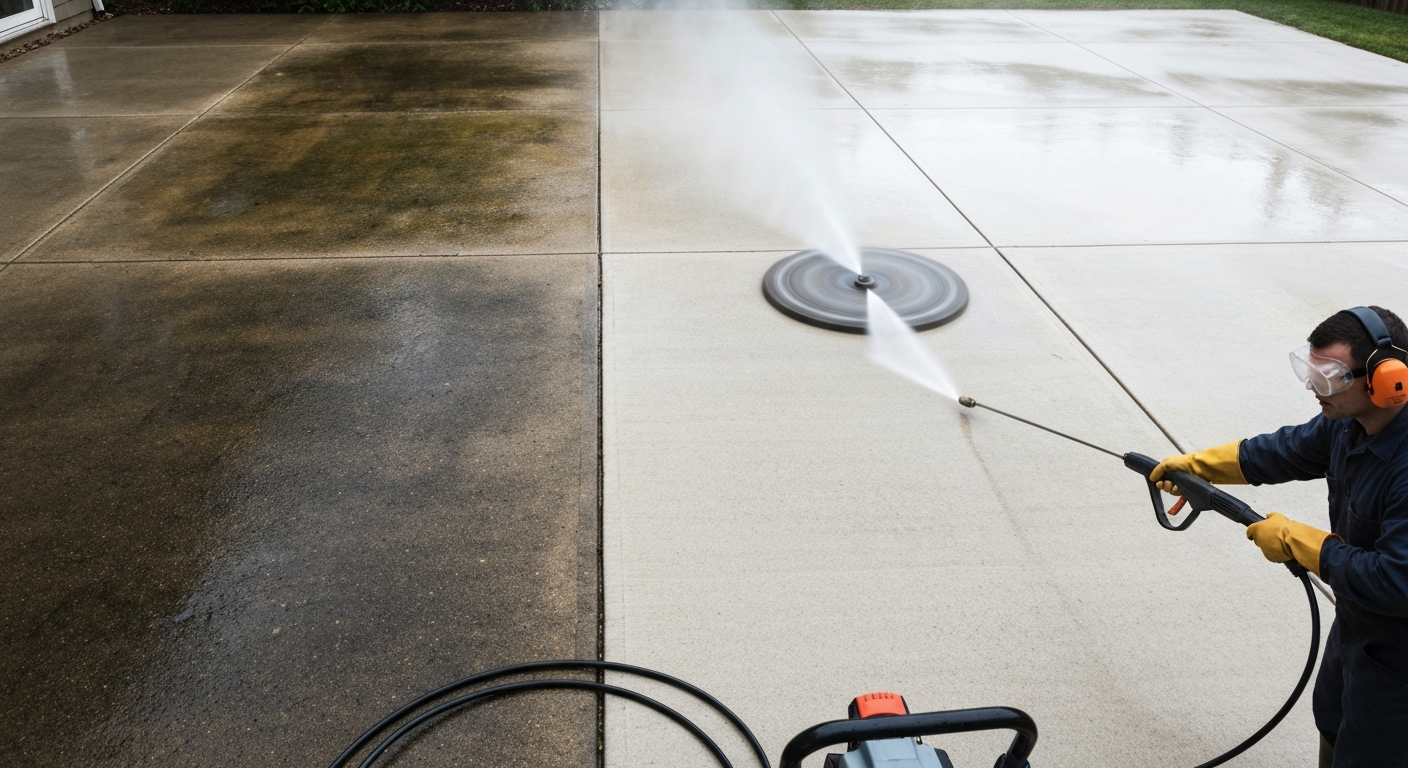
- Surface cleaner attachment (12–20 inch rotary head): probably the single most useful upgrade for concrete patios. It gives a uniform clean without the streaking you get from wand passes, and it cuts working time significantly on any surface larger than a small courtyard. Rental centers stock them; they're also sold separately for $40–$100 and rated for specific PSI ranges (match to your machine).
- Nozzle tips: 0° red (very aggressive, spot use only with distance and caution), 15° yellow (surface stain removal), 25° green (general concrete cleaning), 40° white (rinsing, wide areas), black/soap (low-pressure detergent application). The 25° green tip is your workhorse on concrete.
- Correct hose length: a 25-foot hose is often insufficient for a full patio. Most manufacturers offer 50-foot extension hoses — worth having to avoid dragging the unit constantly.
- Detergent injector and concrete-specific detergent: applying detergent at low pressure through the soap nozzle before pressure washing dramatically improves results, especially on mold, algae, and organic staining.
- GFCI outlet or extension cord: for electric units, always use a GFCI-protected outlet. Never use a standard domestic extension cord — use one rated for the amperage of your machine (14-gauge minimum for a 15-amp circuit).
- Adjustable wand or turbo nozzle: a turbo (rotary) nozzle delivers a 0° pencil jet in a rotating pattern, giving more impact than a standard 15° tip across a wider area — useful for stubborn spots without concentrating risk on one point.
Step-by-step guide to pressure washing your concrete patio
Before you start
- Clear the patio: remove furniture, planters, grills, and anything else that would obstruct or get damaged. Move items well away from the cleaning area.
- Pre-wet and protect plants: thoroughly wet any nearby garden beds, grass edges, and planters. Cover particularly sensitive plants with plastic sheeting. The pressure and any detergent runoff can damage foliage.
- Check for cracks: note any existing cracks or spalling in the concrete before you start. Avoid directing the jet directly into cracks at full pressure — it worsens them.
- Connect and test: connect hoses, check fittings, turn on the water supply before starting the machine, and test on a small inconspicuous section first at lower pressure to confirm you have the right nozzle and distance for your surface.
- Put on PPE: safety glasses or goggles, chemical-resistant gloves (essential when handling detergents or bleach), closed-toe shoes with grip, and hearing protection if using a gas unit. When mixing or applying chemical pretreatments that produce mist, add a respirator rated for the specific product.
The cleaning process
- Apply detergent first (if using): switch to the soap (black) nozzle, apply detergent at low pressure in overlapping passes, and let it dwell for 5–10 minutes without letting it dry on the surface. This pre-treatment does a lot of the chemical work before the pressure jet does the mechanical work.
- Rinse detergent off plants and adjacent surfaces before switching to high pressure.
- Switch to your working nozzle: 25° green for most concrete cleaning, 15° yellow for stubborn spots. For a large patio, attach the surface cleaner at this stage.
- Maintain a consistent distance: for most concrete and most machines, 6–12 inches from the surface is the working range. Start at 12 inches and move closer only if staining isn't clearing. Closer equals more impact but also more risk of surface damage.
- Work in overlapping passes: move the wand or surface cleaner in straight parallel passes with about 50% overlap. Avoid stopping the jet on one spot. On a surface cleaner, keep it moving steadily — pausing causes circular marks.
- Work your way toward the drainage point: always work so you're pushing water toward a drain or the edge of the patio, not trapping it in corners.
- Final rinse: switch to the 40° white nozzle for a final rinse pass to clear all remaining detergent and loosened debris.
- Allow to dry: concrete needs time to dry fully before inspection, sealing, or furniture replacement. On a warm day, allow at least 24 hours.
Stain-specific advice for concrete patios
Mold, algae, and moss
These are the most common concrete patio problems and respond well to a sodium hypochlorite (household bleach) pretreatment diluted to around 1 part bleach to 9 parts water, applied through the soap nozzle and left to dwell for 10 minutes before pressure washing. Don't let it dry. A purpose-made concrete mold and mildew cleaner (look for products containing sodium hypochlorite or quaternary ammonium compounds) works the same way. At 2,000–3,000 PSI with a 25° nozzle, most algae and mold comes away cleanly after pretreatment. Thick moss may need a scrub brush on the residue after the initial pressure wash pass.
Oil and grease stains
Oil is the hardest concrete stain to remove with cold water alone, because pressure alone doesn't emulsify petroleum. For recent spills, absorb as much as possible with cat litter or sand first, then treat with a dedicated concrete degreaser or a trisodium phosphate (TSP) solution. Scrub it in, let it dwell, then pressure wash at 3,000+ PSI. Old embedded oil stains may need multiple treatments. If cold water and degreaser still leave a shadow after two attempts, a hot-water rental is worth it, hot water emulsifies oil in a way that cold water physically cannot at any residential PSI.
Rust stains
Rust stains from metal furniture, tools, or corroding rebar need a chemical pretreatment, not just pressure. Oxalic acid-based concrete rust removers (widely available in hardware stores) are your best tool here. Apply per product instructions, allow the reaction time the label specifies, then rinse at moderate pressure. Pressure washing without pretreatment just etches the concrete without removing the iron oxide staining.
Pet stains and odour
Urine that has soaked into concrete requires an enzymatic cleaner applied before pressure washing, not after. The enzymes break down the organic compounds responsible for the stain and odour. Let the enzymatic cleaner dwell for the time the product specifies (usually 15–30 minutes), then pressure wash at normal cleaning pressure. Skipping the enzymatic pretreatment and just pressure washing distributes the compounds further into the concrete pores without fully removing them.
How to avoid damaging your concrete
Concrete is more vulnerable than it looks. Newly poured concrete (under 12 months old), concrete with existing cracks or spalling, and exposed-aggregate or decorative finishes all need lower pressure than a standard grey slab. I learned this the hard way on a stamped concrete patio where I used a 15° nozzle at 3,000 PSI at 6 inches and left visible etching marks that only showed up once the surface dried. Manufacturers' nozzle charts (see Pressure Washer Nozzle Chart, New‑Line) recommend 0° for very concentrated heavy‑duty spotting, 15°/25° for surface removal, 40° for general rinsing, and advise increasing spray angle or distance to reduce impact on delicate substrates Pressure Washer Nozzle Chart — New‑Line. The rule I follow now: always test a small hidden section first, start at a greater distance than you think you need, and move the nozzle closer only if necessary.
- Never use the 0° red nozzle on concrete surfaces — it concentrates all force into a pinpoint and will etch or pit most concrete at any reasonable working distance.
- Stay above 300 PSI unless you're doing a soft-wash application of chemicals — the GSA guidance for sensitive masonry recommends no more than 300 PSI for low-pressure washing of delicate finishes, which illustrates how far down the scale you can damage stone and decorative surfaces.
- Keep the wand moving at all times. Stopping in one place concentrates the impact and will mark most concrete finishes.
- Keep 6–12 inches minimum distance from the surface for most concrete work. If staining isn't clearing at 6 inches, switch to a pretreatment approach rather than getting closer.
- Don't hold the nozzle at a steep angle to the surface — work at roughly 45 degrees, which helps direct debris away rather than driving it into the surface.
- Avoid pressure washing in freezing temperatures: water driven into hairline cracks and then freezing will expand and worsen the damage.
Safety, environmental, and runoff considerations
Pressure washing runoff is regulated in more places than most homeowners realise. EPA and NPDES stormwater guidance classifies untreated pressure-wash wastewater as a potential pollutant, and many municipalities require that wash water not be discharged directly to storm drains. For homeowners cleaning a residential patio with a mild detergent or bleach solution, the practical approach is to direct runoff to a lawn or garden bed (where soil filtration occurs), not to a driveway gutter that leads to a storm drain. If you're using a strong degreaser or commercial-strength chemicals, check local rules, some cities (Fort Worth being a documented example) require that any water showing an oil sheen be contained and not discharged to storm drains at all. City of Fort Worth, Mobile Commercial Cosmetic Cleaning (Power Washing) Regulation requires that washwater discharged to storm drains show no oil sheen and meet local requirements blank" rel="noopener noreferrer">City of Fort Worth — Mobile Commercial Cosmetic Cleaning (Power Washing) Regulation. When in doubt, collect runoff with a squeegee and absorbent booms or discharge to a sanitary sewer cleanout if permitted locally.
On PPE: OSHA guidance on high-pressure water operations specifies a hazard assessment before work. For a residential homeowner, the practical minimum is safety glasses or goggles (a pressure jet can cause serious eye injury), chemical-resistant gloves when handling any detergent or bleach, closed-toe non-slip shoes, and hearing protection for gas units. If you're spraying chemical mixes that generate significant mist, add a respirator appropriate to the chemical, the SDS for sodium hypochlorite (household bleach) specifically calls out respiratory protection under misting or high-exposure scenarios. That's not overkill; it's what the safety data sheet requires.
After cleaning: maintenance and sealing
Pressure washing opens up the pores of concrete and removes any previous sealer. Once the surface is fully dry (minimum 24 hours in warm conditions, longer in cool or humid weather), it's the ideal time to apply a concrete sealer. A penetrating silane or siloxane sealer provides water repellency and helps prevent future algae and oil penetration. For decorative or coloured concrete, a film-forming acrylic sealer also refreshes the appearance. Sealing extends the interval between deep cleans meaningfully, a sealed concrete patio is noticeably easier to clean annually than an unsealed one. Don't seal over a damp surface; moisture trapped under the sealer causes whitening and adhesion failure.
Renting a pressure washer: what to ask for and what to watch out for
If you're doing a one-time job or a full restoration, renting makes a lot of sense. Home Depot, Sunbelt, and most local equipment rental centers stock gas pressure washers in the 3,000–4,000 PSI range, often with surface cleaner attachments available alongside. Expect to pay $60–$120 per day for a gas unit, with hot-water commercial units running higher. Here's the concise checklist I'd run through before and during any rental:
- Ask specifically for a unit rated at 3,000–3,500 PSI and 3.0+ GPM for a concrete patio job — some rental centers default to showing lower-rated units unless you specify.
- Request a surface cleaner attachment rated for the machine's PSI (usually available for an extra $10–$20/day rental fee) — it makes the job significantly faster and avoids wand streaking.
- Check the machine before leaving the rental center: start it, confirm it runs, check for leaks at hose connections, and verify all nozzle tips are included.
- Ask about fuel: most gas rentals go out with a full tank — confirm this and ask what fuel type the engine requires.
- Understand the rental period: same-day return, 24-hour, or weekend rates vary. A weekend rate is often only marginally more than a day rate and gives you buffer time.
- Check the hose length: rental machines often come with a 25-foot hose. For a large patio, ask for an extension hose or plan your water supply positioning accordingly.
- Document pre-existing damage before starting: note any scratches, dents, or hose kinks on the rental form before you take the machine away.
- Return clean: most rental agreements require you to return the unit clean, with the soap tank emptied. Budget 10–15 minutes at the end of your job for this.
Your buying checklist
Before you commit to a purchase, run through these questions to confirm you're buying the right machine for your actual situation:
- Patio size: under 200 sq ft (electric sufficient) or over 300 sq ft (gas recommended)?
- Stain type: surface grime and algae (electric + detergent works), or embedded oil and grease (gas or hot water needed)?
- Cleaning frequency: once a year or more (ownership makes sense) or once every few years (rent)?
- Power source: GFCI outlet within 50 feet (electric feasible) or need cordless mobility (gas)?
- PSI rating: manufacturer-stated PSI at rated GPM, not peak/max rating at zero flow?
- GPM: at least 1.76 GPM for light maintenance, 2.0–2.5 GPM for most concrete work?
- Weight: can you manoeuvre it around your patio and store it conveniently?
- Accessories included: does it come with a soap nozzle, multiple tip nozzles, and adequate hose length?
- GFCI protection: if electric, are you connecting to a GFCI-protected circuit?
- Surface cleaner: budget for or rent this attachment if cleaning more than 200 sq ft of flat concrete?
FAQ
Which pressure washer is best for cleaning a concrete patio?
“Best” depends on patio size, soil/stain type, budget and storage. For small patios and light cleaning choose a mid‑range electric (quiet, low maintenance). For heavy staining, large areas or frequent use choose a gas consumer unit with 2,500–3,500 PSI and 2.0–4.0 GPM. For persistent oil/grease or commercial jobs, rent or hire a hot‑water (wet steam) unit. Examples: Sun Joe SPX3000 (entry/consumer electric — 2030 PSI, 1.76 GPM) for light jobs; Kärcher K5 (higher‑performance electric — ~2000 PSI, 1.4 GPM) for better build/controls; Simpson MegaShot MSH3125‑S (consumer gas — 3200 PSI, 2.5 GPM) for heavier cleaning. For contractor/hot‑water needs, consider commercial brands (Hotsy/Mi‑T‑M) via rental or pros.
What PSI and GPM ranges should I use for different concrete patio tasks?
Use PSI and GPM appropriate to the job: - Light/general cleaning: ~1,500–2,000 PSI and ~1.2–1.8 GPM (electric units) - Heavy stains/embedded dirt or older concrete: ~2,500–3,500 PSI and 2.0–4.0 GPM (gas consumer/pro units) - Oil, heavy grease, or commercial remediation: hot‑water units (temperature + PSI/GPM) are much more effective than cold water - Delicate situations/historic masonry or fragile concrete: follow low‑pressure or soft‑wash guidance (mockups; sometimes <300 PSI). Always start lower and increase power/distance only as needed.
Electric vs gas vs hot‑water: which should I buy, rent or hire for a patio?
Electric: Best for small patios, occasional use, light soiling — quieter, easier to store, lower maintenance. Gas (cold water): Best for medium/large patios, tougher stains, and where mobility/long hose runs are needed. Hot‑water (rental or pro): Best for oil/grease, restaurants, heavy commercial stains — hot water dramatically improves grease removal and reduces detergent use. Rent when you need a one‑time high‑power or surface‑cleaner/hot‑water unit; hire pros if the job is large, regulated, or you need wastewater capture and disposal.
What features and accessories are must‑have for concrete patio work?
Must‑have features/accessories: - Surface cleaner (12–20+ inch rotating housing) for even, fast cleaning and fewer streaks - Quick‑connect spray tips (0°, 15°, 25°, 40°, soap) and an understanding of their use - Long pressure hose (25–50 ft) to reduce moving the machine - Detergent injector or downstream injector for concrete cleaners/biocides - GFCI protection on electric units and cords - Sturdy wheels, hose/wand storage and an easy‑to‑reach on/off switch - Optional: turbo/DirtBlaster nozzle for stubborn stains (use with caution) - PPE and an SDS for each chemical used
How do I prepare and safely pressure‑wash a concrete patio (step‑by‑step)?
Safe procedure: 1) Inspect patio, remove furniture, plants, and loose debris; sweep and clear drains. 2) Protect nearby plants, lawns, windows, painted surfaces with plastic sheeting; seal storm drains or direct runoff to landscaped areas if permitted. 3) Choose PPE: safety glasses/face shield, chemical‑resistant gloves, closed‑toe shoes, hearing protection for gas units, and respirator if SDS recommends. 4) Pre‑wet surfaces and pretreat stains with recommended detergent/pretreatment; let dwell per label. 5) Select nozzle: start with 40° or a surface cleaner; for deeper cleaning move to 25° or 15° only if needed. Keep wand 12–24 inches away initially; test a small inconspicuous patch. 6) Use even overlapping passes (50% overlap), keep nozzle moving to avoid etching; use a surface cleaner where possible for uniform results. 7) Rinse detergent thoroughly; neutralize if product label instructs. 8) Allow to fully dry before applying sealer (see sealer guidance). 9) Dispose/contain wastewater per local rules; avoid storm drains unless authorized.
What nozzle tips and spray technique should I use to avoid damaging concrete?
Standard quick‑connect tips: 0° (red) — very concentrated, use rarely and from far distance; 15° (yellow) — aggressive scraping; 25° (green) — general concrete cleaning; 40° (white) — gentle rinsing; black — low‑pressure soap. Start with wider angles and greater distance—typically 12–24 in. for concrete. Maintain constant motion (no dwell) and overlap passes ~50%. Test a patch and adjust distance/nozzle before full cleaning. For uniform results, use a surface cleaner whenever possible.
Next Article
Best Pressure Washer for Stone Patio: Choose and Use Today
Pick the best pressure washer for stone patios and follow a safe step-by-step plan for stains, algae, and grime.