Power washing a patio works best when you match your pressure setting to the surface, use the right nozzle, and take 10 minutes to prep before you start. For most concrete patios, 2,000–3,000 PSI with a 25° green tip and a surface cleaner attachment gives you fast, even results without etching. For pavers, brick, or natural stone, drop to 1,500 PSI or below, widen your spray angle, and keep the nozzle moving. Get those fundamentals right and you will clean a standard patio in under an hour without damaging the surface or washing out joint sand.
Power Washing Patio Tips: Complete Guide for Homeowners
Rhea Lang
4 Aug 2026
Is power washing actually right for your patio?
Power washing is the right call for most hard patio surfaces: concrete, clay brick, porcelain, and well-bonded natural stone all respond well to controlled pressure. It removes years of embedded dirt, algae, moss, and grease in a fraction of the time of hand scrubbing, and it does a genuinely thorough job. That said, it is not universally appropriate, and choosing the wrong pressure for your surface is how you end up with etched concrete, spalled brick, or a paver patio with no joint sand left.
Before you fire anything up, identify your surface and its condition. Sealed concrete, porcelain, and engineering brick are robust. Older clay brick, sandstone, slate, and any surface with loose or cracked mortar or sealant need a much more cautious approach, or a different method entirely. If you are unsure, run a quick test patch in an inconspicuous corner at low pressure before committing to the whole patio.
When not to power wash (and what to do instead)
There are situations where power washing will cause more damage than the dirt you are trying to remove. Historic or soft older brick is the clearest example: the National Park Service's preservation guidance is explicit that you should start with the least-aggressive method that gives acceptable results. For older masonry I would stay at or below 1,000 PSI, and even then the risk of fretting the brick face or washing out mortar is real. Many contractors working on period properties skip the pressure washer entirely.
Sandstone and slate are porous and relatively soft. High pressure blasts away the surface layer, opens the pores wider, and actually makes the stone more vulnerable to future staining and biological growth. Loose or failing grout and sealant is another red flag: power washing will strip both completely, leaving your surface exposed and requiring a full re-grout or re-seal before you can use the patio safely.
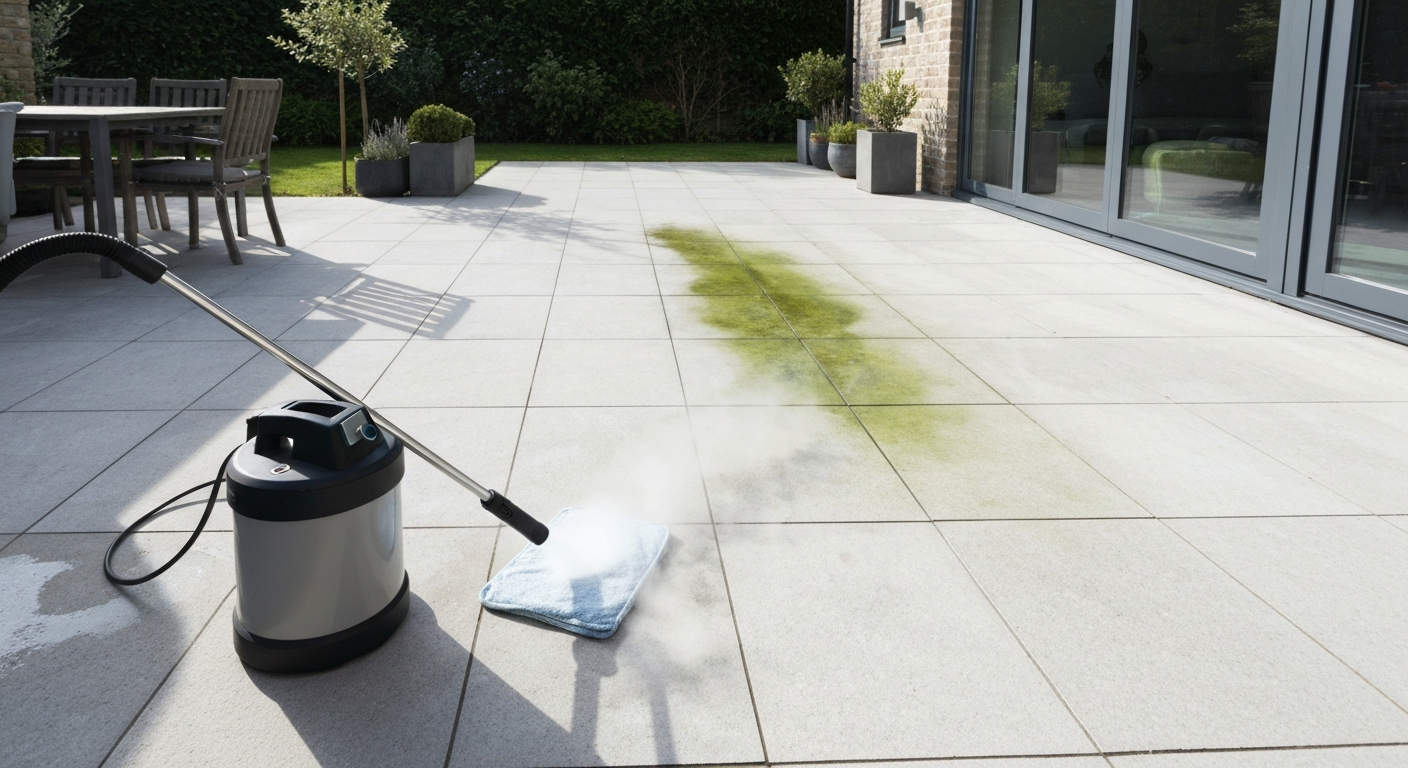
Steam cleaning as an alternative
Steam cleaning uses superheated steam at low pressure (typically under 300 PSI) to kill bacteria, mould, and algae without chemical use and without the surface impact of a standard pressure washer. It is genuinely effective on natural stone, brick, and grout lines, and it is the method I would recommend for anyone with a sandstone or slate patio who wants a deep clean without the risk. The trade-off is speed: steam cleaners cover ground slowly compared to a pressure washer with a surface cleaner.
Soft washing as an alternative
Soft washing uses low pressure (sometimes as low as garden-hose pressure) combined with a chemical solution to do the heavy lifting. The standard soft-wash mix is sodium hypochlorite (bleach) plus a surfactant. The surfactant keeps the solution on the surface long enough for the bleach to kill algae, moss, mildew, and the black streaks caused by gloeocapsa magma bacteria. A typical dilution for light to medium growth is roughly a 1:5 to 1:10 ratio of household bleach to water, with dwell times of 5 to 15 minutes before a low-pressure rinse. For heavier infestations, some professionals use up to 6% sodium hypochlorite solutions. It is chemical-led cleaning rather than pressure-led cleaning, which is exactly what delicate surfaces need.
Pre-clean preparation: clearing the patio before you start
Skipping prep is how you end up blasting wet leaves into your borders and chasing debris around the patio for twice as long as necessary. Remove all furniture, pots, ornaments, and doormats first. Then clear loose debris: sweep with a stiff broom, use a leaf blower to shift anything in the joints and corners, or run over the surface with an outdoor vacuum. For more practical patio cleaning tips, see our step-by-step guide to efficient prep and cleaning. For a step-by-step guide on how to use power washer on patio, consult the detailed how-to covering pressure settings, nozzle choices, ideal distances, and safety precautions. Yes, you can vacuum a patio, and for pavers in particular it is a genuinely useful step because it pulls debris from the joints without disturbing the sand the way blowing and sweeping can.
Once the surface is clear of loose material, look for any obvious problem areas: oil stains, rust marks, heavy moss growth. Pre-treating these spots with an appropriate cleaner before you power wash gives the chemical time to work and reduces the pressure you need to shift the stain. Apply an alkaline degreaser (pH 11 to 13) to oil and grease patches and let it dwell for 5 to 15 minutes. Apply a dedicated moss and algae killer to biological growth if it is heavy. You will still power wash over these areas, but you will get a better result with less effort.
Protecting plants, property, and drainage before you wash
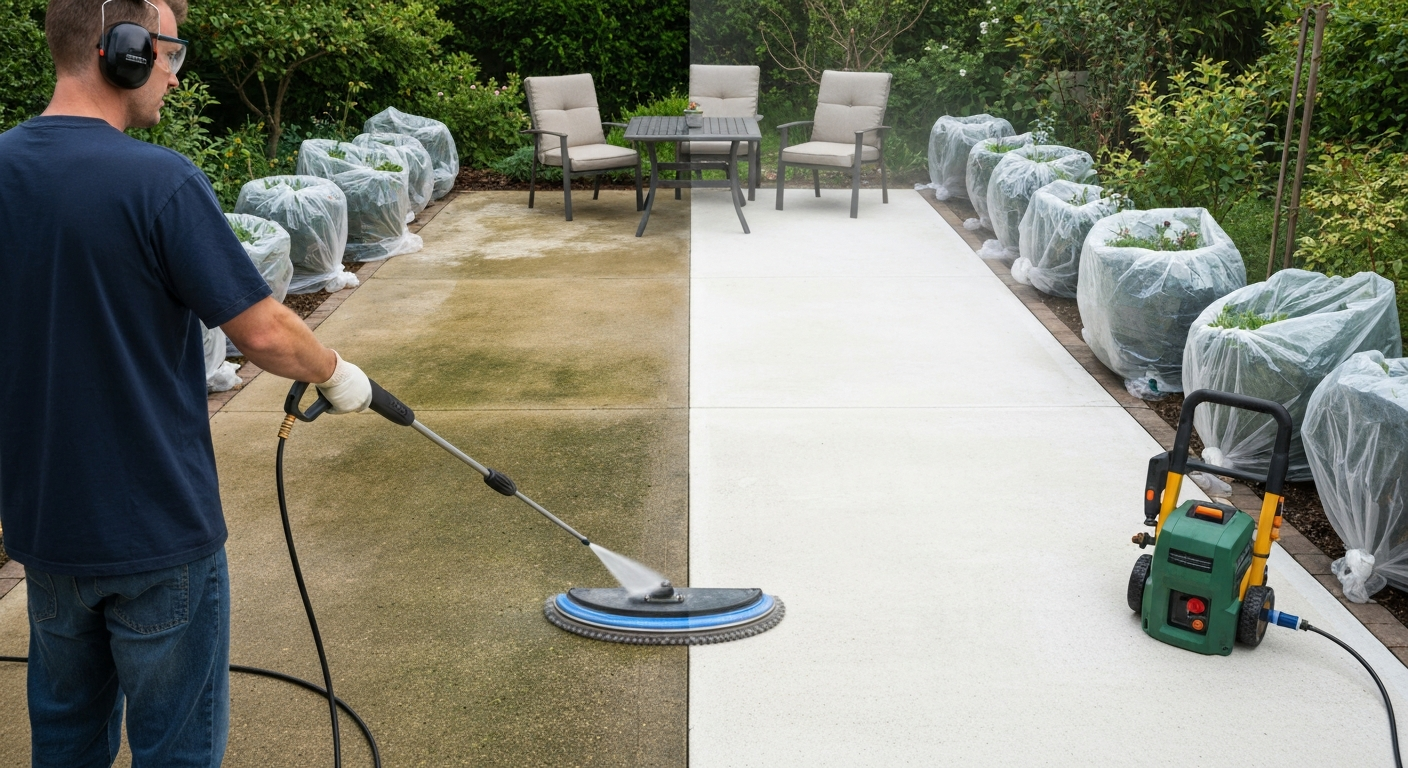
Pressure washing throws contaminated water, chemical runoff, and debris in all directions. A few minutes of protection work saves you from damaging plants, staining fences, or flooding drains with silt and detergent.
- Cover border plants and any pots you cannot move with plastic sheeting or old towels, especially if you are using any chemical cleaners or detergents.
- Close all windows and doors facing the patio, and cover low-level air bricks or vents with tape or plastic.
- Move garden furniture well clear of the spray zone, not just to the edge of the patio.
- Cover any wooden fences, composite decking boards, or rendered walls directly adjacent to the patio: pressure water bounces back and the overspray from a 2,500 PSI machine carries further than you expect.
- Block or cover nearby drain covers temporarily to reduce the volume of silt and cleaning chemical entering the drainage system, then unblock once you rinse with clean water.
- Warn anyone in the garden, especially children and pets, to stay well back. Water and debris from a pressure washer nozzle at close range can cause serious skin lacerations.
If you are using sodium hypochlorite for soft washing, pre-wet any plants or grass at the patio edges beforehand, and rinse them again thoroughly after you finish. The diluted runoff from a standard soft-wash job is unlikely to kill established plants if you flush it through quickly, but concentrated bleach sitting on leaves or grass will cause damage.
Choosing the right equipment: understanding PSI and GPM
Two numbers define what a pressure washer can do: PSI (pounds per square inch, the pressure) and GPM (gallons per minute, the flow rate). Pressure is what loosens dirt; flow is what carries it away. The real measure of cleaning power is the combination of both, expressed as Cleaning Units (CU = PSI x GPM). A machine producing 2,000 PSI at 2.0 GPM delivers 4,000 CU. A machine at 1,500 PSI at 1.2 GPM delivers only 1,800 CU, which is noticeably weaker on anything beyond light surface dirt.
For patio cleaning specifically: light maintenance washing on sealed concrete or porcelain can be done with a good electric machine at 1,800 to 2,300 PSI. A full clean of a large concrete patio, especially one with algae, grease, or embedded grime, benefits from 2,500 to 3,000 PSI and at least 2.0 GPM. Interlocking concrete pavers and most natural stone should be kept below 1,500 PSI. Older brick and soft masonry should be kept at or below 1,000 PSI. Going above these figures is not cleaning more effectively: it is just damaging the surface.
Recommended PSI ranges by surface
| Surface | Recommended PSI | Tip Angle | Notes |
|---|---|---|---|
| Unsealed / standard concrete | 2,000–3,000 PSI | 25° green | Use surface cleaner for large areas; keep nozzle moving |
| Sealed concrete | 1,500–2,500 PSI | 25–40° | High pressure can strip sealant; test first |
| Porcelain paving | 1,500–2,500 PSI | 25–40° | Check grout condition first; avoid turbo nozzles |
| Interlocking concrete pavers | ≤1,500 PSI | 25–40° | Joint sand loss is the main risk; keep nozzle high |
| Clay brick | 500–1,000 PSI | 40° white | Consult mortar/brick spec; never use red or yellow tips |
| Sandstone / soft natural stone | ≤500–800 PSI or steam | 40° or softer | Consider soft washing or steam instead |
| Slate | ≤800–1,000 PSI | 40° | Test patch essential; layers can delaminate |
| Historic / older masonry | ≤500–1,000 PSI | 40° or softer | Follow preservation guidance; least-aggressive method first |
Nozzle types and spray patterns: which tip to use for which job
The nozzle controls how the water pressure is focused. A narrow jet concentrates all the force into a tiny point; a wide fan spreads it across a larger area and reduces impact per square inch. Most machines use a colour-coded quick-connect system that is standard across major brands including Kärcher, Simpson, and Alkota. Kärcher pressure washer manual (nozzle descriptions) lists the standard quick‑connect nozzle colour codes and spray angles used across major brands: Red 0° (pinpoint), Yellow 15°, Green 25°, White 40°, and Black for low‑pressure/soap. The nozzle changes the spray angle, not the pump pressure, so you are choosing how concentrated that pressure is, not increasing or decreasing what the machine produces.
| Nozzle Colour | Spray Angle | Use on Patio | Avoid On |
|---|---|---|---|
| Red | 0° (pinpoint) | Stripping paint, clearing drains | Almost everything patio-related |
| Yellow | 15° | Heavy concrete, rust stains, stubborn grime on dense surfaces | Brick, pavers, natural stone, sealed surfaces |
| Green | 25° | Standard concrete and patio cleaning, most general patio work | Sandstone, soft brick, loose-jointed pavers |
| White | 40° | Brick, pavers, natural stone, rinsing surfaces, pre-treating with soap | Nothing; this is the safe general-use tip |
| Black / Soap | 65° (low pressure) | Applying detergent or soft-wash solution | Not for cleaning under pressure |
As a working rule: start wider than you think you need and step down only if the cleaning result is insufficient. I learned this when I used a yellow tip on a 10-year-old sandstone patio at 2,500 PSI thinking it needed 'more power.' Within three passes I had visibly roughened the surface and opened pores in the stone that took two coats of impregnating sealer to close back down. Start with white (40°) on anything you are unsure about.
Turbo (rotating) nozzles
Turbo nozzles spin a narrow 0° jet in a circular pattern, combining the impact of a red tip with broader coverage. They are fast and effective on dense, heavy-duty concrete but they are genuinely high-impact tools. Avoid them on pavers with loose joint sand, natural stone, soft brick, sealed surfaces, and anything with grout or mortar that is not in perfect condition. If you use one on concrete, maintain a distance of at least 12 inches and keep it moving constantly.
Nozzle distance matters as much as the nozzle angle
Most manufacturers recommend starting at 12 to 24 inches from the surface for sensitive materials and 6 to 12 inches for heavy cleaning of robust surfaces. Halving your standoff distance dramatically increases impact: moving from 18 inches to 9 inches does not just double the force, it increases it by a factor of four or more. If you see the surface reacting badly, step back before you switch to a wider nozzle. Distance is your quickest adjustment.
Electric vs. gas vs. battery pressure washers for patio use
The machine you choose sets the ceiling on what you can achieve, but for most patio jobs the format matters less than matching the output to the task. Here is an honest breakdown of each type.
| Type | Typical PSI | Typical GPM | Best For | Limitations |
|---|---|---|---|---|
| Electric (corded) | 1,400–2,300 PSI | 1.1–1.8 GPM | Small to medium patios, regular maintenance, light algae, general cleaning | Limited by cable and lower flow; less effective on heavy staining |
| Gas (petrol) | 2,700–4,400 PSI | 2.0–4.0 GPM | Large concrete patios, heavily soiled surfaces, commercial or pro-grade work | Heavier, louder, requires fuel and maintenance, overkill for most domestic patios |
| Battery (cordless) | 300–1,000 PSI typically | 0.5–1.0 GPM | Quick rinse-downs, camping, spot cleaning, light deck wash | Not powerful enough for a full patio clean; short run time |
For a typical domestic patio in average condition, a good corded electric machine in the 1,800 to 2,200 PSI range is genuinely enough. The limitation with electric machines is GPM rather than PSI: lower flow rates mean slower cleaning and a greater tendency for dirt to resettle. If you are working on a large or heavily soiled concrete patio, a mid-range gas machine (around 2,700 to 3,200 PSI at 2.0 to 2.5 GPM) makes a noticeable difference in cleaning speed and result. Simpson's Pro Series machines sit around 3,500 to 4,000 PSI at 2.5 to 3.5 GPM, which is genuinely professional territory: more than most domestic jobs need, but effective for concrete restoration or post-winter deep cleans on large driveways.
Battery machines are fine for a quick rinse before a garden party but I would not attempt a full patio clean with one. Run time and pressure both fall short. They are genuinely useful as a supplement to a corded machine, not a replacement.
Surface cleaner attachments: faster, more even results on large areas
A surface cleaner attachment is a rotating disc housing that sits flat on the patio surface and uses two or more spinning spray arms to clean a wide path in a single pass. They are one of the most practically useful patio cleaning accessories you can buy, and they are underused by DIYers who default to the wand.
The main advantages are speed and evenness. A wand leaves stripe marks on concrete (the classic tiger-stripe or zebra pattern from slightly varying pressure and distance). A surface cleaner eliminates that problem entirely because the spray arms rotate at a consistent height and overlap continuously. On a 30 to 40 square metre concrete patio, a surface cleaner typically cuts cleaning time by 40 to 60 percent compared to wand work.
The critical thing most buyers miss is the GPM requirement. Surface cleaner attachments are matched to flow rate, not just PSI. A 30-inch Whirl-A-Way or similar large surface cleaner typically requires 6 GPM or more to spin the arms properly. If your machine only produces 1.5 GPM, fitting a large surface cleaner will result in slow, uneven rotation and poor cleaning. Match the surface cleaner size to your machine's actual GPM output: smaller 10 to 14 inch models are designed for electric machines at lower flow rates, while the large 20 to 30 inch models need a gas machine with higher GPM. Check the manufacturer's GPM rating on any surface cleaner before you buy.
Surface cleaners also help with paver patios because they reduce the direct impingement force on the joints compared to a wand held at close range. That said, they are not risk-free on pavers: even at lower PSI settings, repeated passes over loose joint sand will gradually displace it. Keep passes to what is needed, and plan to re-sand joints after washing regardless.
Step-by-step power washing method for patios
- Clear and sweep the patio. Remove all furniture, pots, and loose debris. Sweep or vacuum the surface. Pre-treat any oil, grease, rust, or heavy biological growth with the appropriate cleaner and allow the correct dwell time.
- Protect the surroundings. Cover plants, close windows, block nearby drains, and warn household members and pets to stay clear.
- Set up your machine. Connect the correct nozzle (start with white 40° if unsure), set the pressure to the conservative end of your surface's recommended range, and check all connections are secure.
- Apply detergent if using one. Switch to the black (65°) soap nozzle. Apply your chosen detergent or soft-wash solution in overlapping passes from the top of any slope or step downwards. Allow the dwell time specified on the product label (typically 5 to 15 minutes).
- Switch to your cleaning nozzle and wash. Work in sections, moving the nozzle in smooth, overlapping strokes, always keeping it moving. On concrete, hold the nozzle 8 to 12 inches from the surface. On pavers, brick, or stone, keep it at 12 to 18 inches minimum. Work with the slope so dirty water runs away from cleaned areas.
- Use a surface cleaner for large flat areas. On concrete or porcelain paving, attach the surface cleaner and work in slow overlapping passes. Check the result after the first pass and adjust speed before continuing.
- Tackle edges and joints with the wand. A surface cleaner will not get into corners, steps, or edges. Use a white or green tip at a safe distance for these areas.
- Final rinse. Switch back to the white 40° tip and rinse the entire surface with clean water, working from the top to the bottom of any slope and pushing dirty water toward the drain.
- Post-wash inspection and re-sanding. Once dry (usually 24 to 48 hours), check paver joints and re-sand any gaps with kiln-dried jointing sand or polymeric sand. Inspect for any surface damage before resealing.
Detergents and cleaners: what actually works for specific stains
Pressure alone does not shift every stain, and using more pressure to compensate for the wrong cleaner is how surfaces get damaged. Match the cleaner type to the problem.
| Stain / Problem | Recommended Cleaner Type | Key Notes |
|---|---|---|
| Algae, moss, mould, black streaks | Sodium hypochlorite + surfactant (soft wash) | 1–6% SH depending on severity; 5–15 min dwell; low-pressure rinse |
| Oil and grease | Alkaline degreaser (pH 11–13) | Apply before washing; 5–15 min dwell; hot water rinsing improves results significantly |
| Rust stains | Oxalic acid or specialist rust remover | Do not use bleach on rust; allow full dwell time; may need repeat application |
| General dirt and grime | Purpose-made pressure washer detergent or diluted TSP alternative | Apply with soap nozzle, allow to dwell 5–10 min, then wash off |
| Pet stains / organic matter | Enzyme-based cleaner | Breaks down organic waste chemically; follow with full pressure wash rinse |
| Efflorescence (white salt deposits) | Dilute white vinegar or specialist efflorescence remover | Do not use acid cleaners on limestone or marble; test first |
Hot-water pressure washers (commercial units that heat the water before it reaches the nozzle) make a measurable difference on grease and oil stains. Kärcher's own testing shows hot water not only cleans faster but allows you to use less detergent for the same result and often at lower working pressures. If you are hiring equipment for a heavy-duty oil job on a concrete patio or driveway, a hot-water unit is worth the extra cost.
Paver-specific advice: protecting joint sand and permeability
Interlocking paver patios require more caution than any other surface. The Interlocking Concrete Pavement Institute (ICPI) and peer-reviewed research on permeable paver maintenance consistently show that high-pressure wand work on pavers displaces joint sand, reduces permeability, and undermines the structural interlock over time. The recommendation is conservative pressure (ideally below 1,500 PSI), wide fan nozzles, greater standoff distances, and surface cleaners or vacuum systems rather than close-range wand work.
In practice: use a surface cleaner set to a lower working pressure, keep your passes slow and single-direction, and expect to re-sand joints with kiln-dried or polymeric jointing sand after every deep clean. Polymeric sand (which hardens when wet) is more resistant to future wash-out and also deters weeds better than standard kiln-dried sand. Sealing the patio after cleaning with a paver-specific sealant locks the surface together and makes future cleaning easier and faster.
After the wash: sealing and maintenance schedule
Power washing opens the surface of most patio materials by removing any existing sealant, oils, and biological residue. That means the patio is at its most porous and vulnerable immediately after washing. Waiting 24 to 48 hours for the surface to dry fully and then applying a suitable sealant is the single most effective thing you can do to extend the time between cleans and reduce future staining and biological growth.
- Allow 24–48 hours minimum drying time before sealing; 48–72 hours in cooler or damp weather.
- Choose the right sealant for your surface: penetrating impregnating sealers for natural stone and brick, film-forming sealers for concrete and pavers for enhanced colour and stain resistance.
- Apply sealant on a dry day with temperatures above 10°C (50°F) for proper curing.
- Re-sand paver joints with kiln-dried or polymeric jointing sand before sealing.
- Plan for re-sealing every 2 to 5 years depending on traffic, exposure, and sealant type.
- Schedule a light maintenance wash annually (or after harsh winters) to prevent biological growth from establishing and to avoid needing high-pressure deep cleans every time.
Safety checklist before you start
- Wear waterproof non-slip footwear: a pressure washer can cause deep lacerations to skin at close range and wet patios are very slippery.
- Use safety glasses or goggles: debris and water ricochet unpredictably from hard surfaces.
- Wear waterproof gloves and clothing: chemical cleaners and dirty pressure-wash water are unpleasant and some are corrosive.
- Never point the nozzle at people, animals, or glass: even at wider angles, close-range water impact from most residential machines can cause injury or break single-glazed panels.
- Keep children and pets indoors during the wash.
- Use an RCD (residual current device) protected extension lead for any electric machine used outdoors.
- Check all hose connections are secure before starting the pump.
- Do not use a gas machine in an enclosed space: carbon monoxide risk is serious and fast-acting.
- Be aware of your surroundings: wet surfaces, hose trip hazards, and the recoil from a high-pressure wand are common causes of slips and falls.
Equipment checklist for a full patio power wash
- Pressure washer matched to surface type (PSI and GPM appropriate for the job)
- Quick-connect nozzle set: red, yellow, green, white, and black/soap nozzles
- Surface cleaner attachment (GPM-matched to your machine)
- Extension lance for awkward corners and steps
- Pressure washer detergent or appropriate chemical cleaner for pre-treatment
- Spray bottle or pump sprayer for applying pre-treatment cleaners
- Stiff broom or outdoor vacuum for pre-sweep
- Plastic sheeting or old towels for covering plants and adjacent surfaces
- Kiln-dried or polymeric jointing sand for post-wash re-sanding of pavers
- Appropriate patio sealant for post-wash application
- Safety glasses, waterproof gloves, non-slip footwear
- RCD adaptor if using corded electric machine outdoors
How much does professional jet washing cost, and when is it worth it?
Professional patio jet washing in the UK typically costs between £100 and £300 for an average domestic patio, depending on size, surface condition, and region. Larger or badly neglected patios, or those requiring chemical treatments for heavy moss or algae, can run higher. In the US, professional pressure washing services for a patio generally range from $100 to $400, with similar variables applying. For a quick overview of typical pricing and what influences it, see how much to jet wash a patio.
Hiring a professional is worth considering in a few specific situations: if your patio surface is high-value natural stone or historic brick where the risk of DIY error is significant; if the patio is severely neglected and needs chemical soft washing followed by pressure washing as a combined treatment; or if you simply do not have access to suitable equipment and do not want to hire. If you do hire, ask whether they re-sand paver joints after washing (many do not as standard), whether they offer sealant application, and what pressure settings they plan to use on your surface type. A contractor who cannot answer that last question confidently is worth reconsidering.
Hiring tips
- Get at least two or three quotes and compare what is included: some quotes cover cleaning only, others include chemical treatment, re-sanding, and sealing.
- Ask specifically what pressure they will use on your surface type, and check it against the recommended ranges in this guide.
- Check for public liability insurance: a contractor working with high-pressure equipment should carry it.
- For soft-wash treatments, ask about the sodium hypochlorite concentration they plan to use and how they will protect your plants.
- Avoid contractors who use only one pressure setting for all surface types: that is a warning sign of a lack of care or experience.
- Time the work for spring or early summer when surfaces have dried out after winter and before the peak of summer algae growth.
Annual maintenance schedule to reduce deep-clean effort
| Season / Timing | Task | Method |
|---|---|---|
| Spring (March–April) | Full wash to clear winter algae, moss, and debris | Power wash appropriate to surface; soft wash if biological growth is heavy |
| Spring (after washing) | Re-sand paver joints, inspect and re-seal if needed | Kiln-dried or polymeric sand; penetrating or film sealant |
| Summer (every 4–6 weeks) | Light rinse and weed control in joints | Garden hose or low-pressure rinse; hand-pull or chemical weed treatment |
| Autumn (September–October) | Leaf clearance and light clean before wet season | Sweep, vacuum, light rinse; treat any new biological growth with moss killer |
| Winter | Keep drains clear; brush off standing water and leaves after storms | Broom or leaf blower; avoid power washing in frost conditions |
| Every 2–5 years | Deep clean and full re-seal | Full power wash, chemical treatment if needed, full re-sand (pavers), re-seal |
FAQ
What PSI, GPM, and nozzle choices should homeowners use for patio power washing?
Match machine power (PSI×GPM) to the surface: light-duty electric units (~1,400–2,300 PSI, 1.1–1.8 GPM) are fine for gentle jobs; consumer gas units (2,700–4,400 PSI, 2.0–4.0 GPM) for heavy concrete. For most patio work use cleaning units rather than max PSI — higher GPM often cleans faster with less dwell time. Use nozzle angle to control impact: wider fan tips (green 25°, white 40°) for delicate surfaces, yellow 15° for moderate cleaning, red 0° and turbo/dirt‑blasters only for robust concrete and with caution. Start at lower pressure and greater nozzle distance and increase only as needed.
When should I choose electric vs. gas pressure washers or hot‑water machines?
Choose electric for small patios and gentle cleaning (quieter, lower maintenance). Pick a gas unit for large or heavily soiled concrete/patio jobs that need higher PSI/GPM. Rent or hire hot‑water equipment for stubborn oil/grease stains — hot water emulsifies oil and reduces chemical needs. For pavers, bricks, and historic or soft stone, prefer lower pressure methods (electric or soft‑wash) to avoid damage.
What is a surface cleaner and when should I use one?
A surface cleaner is a rotating, enclosed attachment with dual or multiple spray bars that delivers even, fast cleaning for flat patios and large areas while preventing wand gouging. Use surface cleaners for concrete and large paver patios when your washer provides the GPM the attachment requires. They reduce streaking and speed the job; verify the cleaner’s GPM/PSI rating matches your machine before use.
How do I protect plants, windows, and nearby property before power washing?
Pre‑wet plants and cover with plastic sheeting to reduce chemical uptake; move pots and delicate items away. Close and tape windows; protect light fixtures and electrical outlets with plastic. Divert runoff by building low berms or using containment if chemicals are used. Rinse exposed vegetation after soft‑wash dwell times and follow label environmental precautions for bleach or strong detergents.
What pre‑clean prep steps should I follow?
1) Sweep or blower the patio and remove loose debris. 2) Remove furniture, grills, and planters. 3) Pretreat stubborn stains with appropriate cleaners (see stain‑specific guidance). 4) Wet surrounding plants and cover them. 5) Sweep or vacuum joint sand loose from pavers if needed—don’t power anything that will strip joint sand before you’re ready to re‑sand.
How do surface‑specific settings and techniques differ (concrete, pavers, brick, natural stone, porcelain)?
Concrete: higher pressures acceptable (2,000–3,500 PSI), use 25–40° fan or surface cleaner, keep wand moving to avoid etching. Pavers/interlocking units: be conservative (often ≤1,500 PSI); use wide fan tip or surface cleaner, avoid turbo nozzles and high‑pressure wand work near joints to prevent sand loss—consider vacuum or soft surface cleaners used by pros. Brick/older masonry: use low pressure (500–1,000 PSI) or soft‑wash; avoid >1,000–1,500 PSI unless manufacturer/preservation guidance allows. Natural stone (sandstone, slate): treat as delicate — low pressure, wide tip, test a small area; soft‑wash often preferred. Porcelain tiles: low to moderate pressure with wide fan tip; check manufacturer guidance for sealed porcelain and grout risks.
Next Article
Can You Steam Clean a Patio? Surfaces, Stains, Risks & Tools
Can you steam clean a patio? Learn when it works, risks, step-by-step method, equipment guidance, and aftercare.