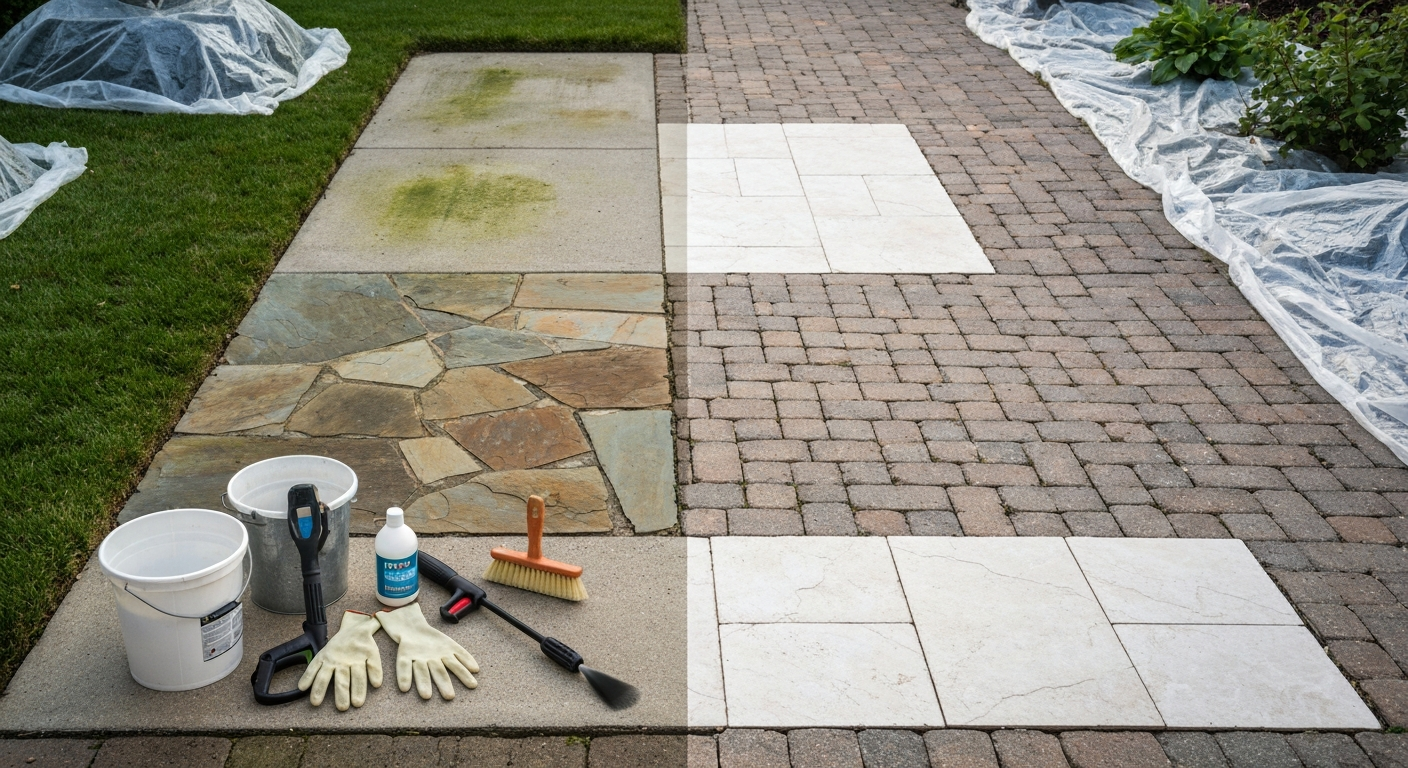
Yes, you can steam clean a patio, and for the right surface and the right type of grime, it works surprisingly well. Steam cuts through grease, kills mold and algae, and lifts pet stains without harsh chemicals. The catch is that steam cleaning is not a one-size-fits-all method. It suits sealed, dense surfaces like porcelain, glazed ceramic, and smooth concrete far better than it suits soft sandstone, crumbling mortar joints, or any patio that has not been repointed recently. This guide covers exactly when steam cleaning is worth doing, which surfaces to avoid, what equipment you actually need, and how it stacks up against pressure washing and chemical cleaners.
Can You Steam Clean a Patio? Surfaces, Stains, Risks & Tools

Rhea Lang
24 Jul 2026
How steam cleaning actually works
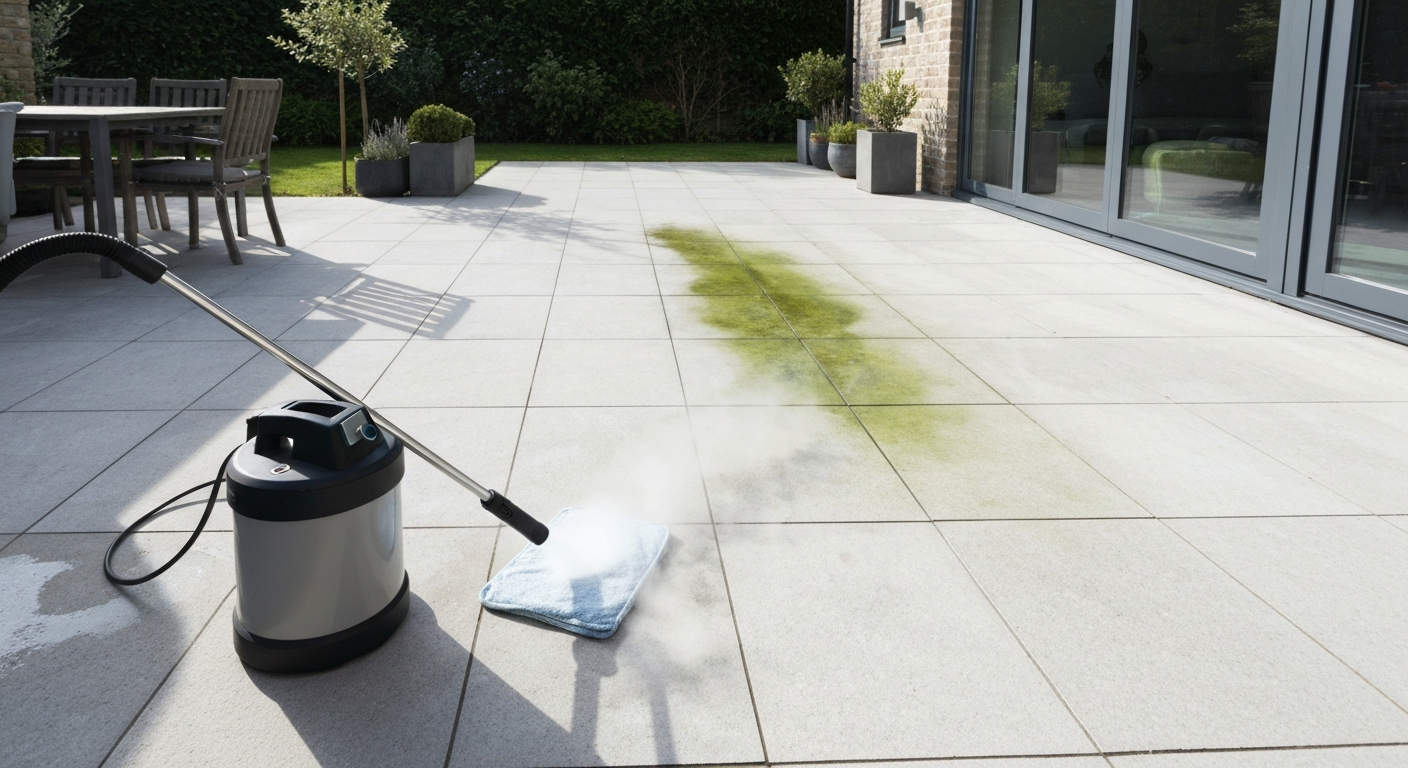
Steam cleaners work by heating water in a sealed boiler until it produces pressurised vapour, which is then pushed through a nozzle or attachment and onto the surface. Consumer and prosumer models typically generate steam at somewhere between 3 to 6 bar (around 45 to 90 psi) and deliver it at temperatures between roughly 100 and 140 degrees Celsius at the output tip. That combination of heat and moisture does a few things at once: it softens and emulsifies fats and grease, it thermally disrupts the cell walls of mold, algae and moss, and it loosens the bond between dried-on debris and the surface below. SSPC painting/cleaning manual (steam/hot‑water 'wet heat' cleaning for grease and precleaning), SSPC guidance describes wet‑heat (steam/hot‑water) cleaning as an established technique to remove oils and greases prior to further work, noting it is usually applied at lower temperatures than dry heat and often requires longer dwell times when contaminants are embedded SSPC painting/cleaning manual (steam/hot‑water 'wet heat' cleaning for grease and precleaning) — SSPC guidance.
What steam cleaning does not rely on is abrasive mechanical force. A pressure washer at 2,000 psi is physically blasting material off a surface. A steam cleaner at 46 to 90 psi is using heat and moisture as the primary mechanism, with the physical pressure playing a secondary role. That distinction matters a lot when you are working on delicate or porous masonry. It also means steam cleaning generally takes longer than pressure washing on heavily soiled surfaces, and it requires closer tool-to-surface contact. Think of it less like hosing something down and more like ironing a stubborn crease out of a fabric.
One thing worth knowing about mold kill specifically: brief steam contact is not the same as sterilisation. Thermal inactivation research shows that many common mold species require sustained exposure in the 60 to 95 degree Celsius range over several minutes to be reliably killed. A quick pass with a steam nozzle raises surface temperature fast, but if you move the tool too quickly, you are not necessarily killing spores deep in porous stone. You are mostly dislodging surface growth. For visible mold on a dense, sealed surface, that is usually enough. For deeply embedded biological growth in porous materials, steam should ideally be combined with a biocide applied after cleaning.
What steam cleaning is actually good at
Here is where steam earns its place as a legitimate patio cleaning method. The stains and surfaces below are where I have consistently seen good results, and where the heat-plus-moisture approach makes practical sense.
Stains and growth steam handles well
- Mold and mildew (surface level): Steam at 100 degrees C or above disrupts surface mold growth effectively on dense, sealed surfaces. Combined with a follow-up biocide, this approach handles mold on porcelain and concrete very well.
- Algae and green slime: The heat kills algae on contact across most patio surfaces. On smooth porcelain tiles, a single slow pass followed by a wipe-down usually leaves the surface clean.
- Moss: Steam softens and kills moss, making it easier to brush away. It does not physically blast the root structure out of gaps the way pressure washing does, so you may need a stiff brush after steaming.
- Grease and cooking fat: This is where steam genuinely outperforms cold-water pressure washing. Hot steam emulsifies grease far more effectively than high-pressure water alone. BBQ drip marks, oil from furniture, cooking spatter: all respond well to steam on sealed concrete or porcelain.
- Pet stains and urine: Steam breaks down the organic compounds in pet waste and deodorises at the same time. I find this particularly useful on smooth concrete and sealed stone where chemical cleaners can leave residue your pets then walk through.
- Light rust staining: Surface rust deposits from metal furniture or fixings can be lifted from porcelain and concrete with steam combined with a brass-bristle brush attachment, though heavy or embedded rust usually needs a specialist acid-based treatment first.
- General grime and sooty deposits: Built-up atmospheric dirt on sheltered patios and walls responds well, particularly in areas that get little rain to self-clean.
Surfaces steam cleaning suits
- Porcelain paving tiles: Dense, low-porosity, and impervious. Steam cleans porcelain brilliantly without risk of surface damage.
- Sealed concrete: The sealant provides a barrier that prevents over-penetration of moisture. Steam cleans well and does not open up the surface.
- Glazed ceramic tiles: Similar logic to porcelain. The glaze seals the surface.
- Smooth, hard natural stone (sealed granite, dense slate): Dense, sealed natural stone handles steam well. Always confirm the stone is sealed and in good condition first.
- Brick (dense, well-pointed, structurally sound): Machine-made dense brick with sound mortar joints handles steam well. Victorian-era soft handmade brick is a different matter (see below).
- Grout lines on porcelain and ceramic: A narrow nozzle or detail brush attachment is very effective at lifting built-up grime from grout.
Surfaces and situations where steam cleaning causes damage
I learned this the hard way early on: just because steam feels gentle compared to a pressure washer does not mean it is safe on every surface. The moisture content and heat can cause real harm to certain patio materials, and some of the damage is invisible until months later when you see spalling, efflorescence, or crumbling joints. Historic England, Conserving War Memorials: Cleaning (technical advice) recommends carrying out test panels, using the mildest effective cleaning method, and avoiding repeated cleaning since it can damage stone and create long‑term conservation issues Historic England — Conserving War Memorials: Cleaning (technical advice).
- Soft or porous natural stone (sandstone, limestone, soft buff stone): These materials absorb moisture readily. Repeated steam exposure drives water deep into the stone and can accelerate frost damage, salt mobilisation, and surface spalling over time. Historic England conservation guidance specifically calls for super-heated, low-pressure, low-flow systems (like the specialist DOFF method) for sensitive masonry, operated by trained professionals, not DIY steam cleaners.
- Unsealed or worn stone: If a sealer has broken down, the stone is essentially open. Steam will penetrate, and depending on the substrate, this can cause long-term problems.
- Weak or crumbling mortar joints: Steam moisture works its way into any gap. If the pointing is already soft or partially missing, steam will accelerate deterioration. Repoint before you clean.
- Terracotta and handmade brick: Highly porous, often with variable firing hardness. Steam can cause surface delamination, particularly on older or frost-damaged pieces.
- Painted or coated surfaces: Unless the coating is specifically designed for high heat and steam, you risk bubbling, peeling or lifting the paint.
- Slippery surfaces mid-clean: Steam leaves surfaces wet. On smooth porcelain especially, this creates a slip hazard. Work in sections and keep pets and children away.
- Any surface you haven't tested first: Every manufacturer guidance I have come across, from Dupray to Kärcher to McCulloch, says the same thing: test on a hidden area first. That advice exists for a reason.
Is steam cleaning right for your patio? A quick decision checklist
Before you hire, buy, or borrow a steam cleaner, run through these questions. They will save you time, money, and potentially a costly surface repair.
- What material is your patio? Porcelain, sealed concrete, glazed ceramic, dense sealed slate: steam is a good fit. Sandstone, limestone, terracotta, or soft/handmade brick: think carefully and consider a gentler chemical approach instead.
- Are your mortar joints sound? Press gently with your finger. If mortar crumbles or is missing in patches, repair it before using any wet cleaning method, including steam.
- Is the surface sealed? Steam on unsealed porous stone is riskier than on sealed surfaces. If you are not sure whether the stone is sealed, pour a few drops of water on it. If they bead, it is sealed. If they soak in within 30 seconds, it is unsealed.
- What type of stain are you dealing with? Grease, surface mold, algae, moss, pet stains: steam is well-suited. Deep-set rust, oil stains that have penetrated unsealed concrete, or heavy limescale: you may need a chemical cleaner first.
- Do you have the time? Steam cleaning a patio is slower than pressure washing. A 20 square metre porcelain patio might take two to three hours with a consumer steamer.
- Do you have children, pets, or delicate planting nearby? Steam cleaning avoids chemicals, which is genuinely useful in these situations. It is one of the strongest practical arguments for choosing steam over chemical cleaners.
- What is your budget? Buying a capable cylinder steam cleaner costs roughly £100 to £300 (or $120 to $400 in the US). Hiring one for a day typically runs £30 to £60 in the UK. Compare this to the cost of hiring a professional jet wash, which typically runs £150 to £400 depending on patio size.
Choosing your equipment: the main types of steam cleaners
Not all steam cleaners are built for outdoor patio work. There is a big practical difference between a handheld kitchen steamer and a cylinder unit with a floor head and extension wand. Here is what each type is actually useful for.
| Type | Best For | Typical Pressure / Temp | Patio Use Verdict |
|---|---|---|---|
| Handheld steamer | Spot cleaning, grout lines, small areas | 2–3.5 bar / 100–120°C | Limited — too slow for full patios, fine for targeted spot work |
| Cylinder steam cleaner (consumer) | Small to medium patios, domestic use | 3–4 bar / 100–130°C | Good all-rounder for sealed porcelain, concrete, glazed tile |
| Cylinder steam cleaner (prosumer/commercial) | Larger patios, frequent use, tougher stains | 4–6 bar / 130–140°C | Strong performer — worth hiring if you only clean once a year |
| Steam mop | Indoor hard floors | 2–3 bar / 100–120°C | Not designed for patios — too low-pressure and slow outdoors |
| Steam-and-scrub unit | Grease, embedded grime, commercial kitchens | 3–5 bar / 110–135°C | Useful where grease is the primary problem (BBQ areas, etc.) |
| DOFF / ThermaTech (specialist) | Sensitive masonry, historic surfaces | ~150°C, very low flow | Professional use only — not a DIY product |
For most homeowners cleaning a standard domestic patio of 15 to 40 square metres, a mid-range cylinder steam cleaner is the most practical choice. Models like the Kärcher SC range, McCulloch MC1275 or MC1385, or Dupray HOME hit a practical sweet spot of boiler capacity, steam pressure, and attachment variety. If you are only doing this once a year, hiring a commercial-grade cylinder unit is often better value than buying a consumer model.
Temperature, pressure and dwell time: the numbers that matter
Getting the temperature and dwell time right is more important than most homeowner guides acknowledge. Too cool and you are not killing biological growth or effectively emulsifying grease. Too much pressure and you risk forcing moisture into joints or disturbing surface sealers. Move the nozzle too fast and you barely raise the surface temperature. Move too slowly and you over-saturate the substrate.
| Surface / Task | Recommended Temp Range | Pressure Guide | Dwell / Pass Speed |
|---|---|---|---|
| Porcelain tiles (mold, algae, general grime) | 120–140°C | 3–5 bar | Slow, overlapping passes — 2 to 4 seconds per 30 cm |
| Sealed concrete (grease, general dirt) | 120–140°C | 3–5 bar | Slow passes; re-steam greasy spots twice |
| Dense sealed slate (algae, grime) | 100–130°C | 3–4 bar | Test first; moderate speed passes |
| Brick (dense, well-pointed) | 100–120°C | 3–4 bar | Keep moving; do not linger on mortar joints |
| Grout lines (tile or stone) | 120–140°C | 3–4 bar | Slow detail work with narrow nozzle or brush |
| Spot-treating pet stains | 120–140°C | 3–4 bar | Hold 5–10 cm from surface; 5–8 seconds per patch |
| Sandstone / limestone (not recommended) | Avoid steam or use DOFF-specialist only | — | Do not DIY steam on these surfaces |
The Dupray HOME, as one example of a well-specified consumer unit, runs at 3.2 bar and 140 degrees Celsius. That is a solid working spec for sealed outdoor surfaces. The Vapamore MR-1000 Forza steps up to around 6 bar and ~140 degrees C, which gives it more authority on embedded stains. Consumer units in the Vapamore Primo range sit around 3.5 bar and 99 to 104 degrees C at the nozzle. For patio work outdoors, where steam dissipates quickly in open air, I generally prefer units at the higher end of the temperature range: the heat does more of the work before it disperses.
Step-by-step: how to steam clean your patio properly
Before you start
- Clear the patio: remove all furniture, planters, and decorative items. Steam is hot enough to damage plastic fittings, stain cushions, and stress ceramic pots.
- Remove loose debris: sweep or blow off leaves, soil, and loose dirt first. Steam will not replace a brush on debris this size, and wet debris smears across your patio surface.
- Protect nearby plants: drape damp towels or plastic sheeting over any planting directly adjacent to the patio edge. Steam itself is not chemically harmful to plants, but repeatedly directing 140-degree vapour at leaves will scorch them.
- Check your joints: look for missing or crumbling mortar before you begin. If you find problem areas, either avoid them during cleaning or repair the pointing first.
- Do a test patch: pick a hidden corner or edge slab and run a steam pass. Wait 10 minutes, then inspect for any colour change, surface pitting, or moisture absorption. Dupray, Kärcher, and McCulloch all recommend this in their manuals, and I do too.
- Fill the boiler with clean, cold tap water: never add detergent, bleach, descaler, or any chemical to the boiler tank itself. More on that below.
The cleaning process
- Allow the steamer to reach operating temperature and pressure before starting (typically 5 to 10 minutes for most cylinder units).
- Attach the appropriate floor head or extension wand. For open patio areas, a wide floor nozzle or rectangular steam head covers more ground efficiently.
- Work in sections of roughly 1 to 2 square metres at a time, moving steadily and keeping the nozzle 5 to 15 cm from the surface depending on the manufacturer's guidance.
- For grease spots or heavy grime, make a second slow pass immediately after the first while the surface is still hot and moisture is present.
- Wipe or brush away dislodged residue as you go. Steam loosens the material but does not carry it away the way a pressure washer does. A stiff outdoor broom or deck brush used immediately after steaming each section clears the loosened debris.
- Move methodically in one direction to avoid re-contaminating cleaned areas.
- After completing the full patio, do a final rinse with a hose or gentle pressure wash at low pressure to clear any remaining loose debris from the surface.
Surface-specific notes
- Porcelain paving: your best-case scenario for steam cleaning. Dense, impervious, and tolerant of heat. Work slowly and the results will be very good.
- Sealed concrete: works well. Pay extra attention to greasy areas near BBQ zones; a second pass usually lifts residue that the first pass loosened.
- Dense slate (sealed): steam responds well here, but test first since slate varies considerably in density and surface finish. Keep the nozzle moving on textured or riven faces.
- Well-pointed brick: effective on surface algae and grime, but keep the nozzle angled to avoid directing prolonged steam into mortar joints. If joints look soft, skip steaming on those sections.
- Sandstone and limestone: I would not use a DIY steam cleaner on these. The risk of moisture-driven spalling and salt mobilisation is real, particularly in colder climates. A pH-neutral chemical cleaner diluted per manufacturer guidance is a safer choice here.
- Grout between tiles: this is where a detail brush or angled nozzle attachment earns its money. Slow, close-range passes on grout lines with a brush attachment produce noticeably better results than a wide floor head.
Attachments, accessories and what to add to the water (and what not to)
Key attachments for patio work
- Wide floor nozzle or steam head: the main tool for covering open patio areas. Most cylinder steam cleaners include one. Look for a rectangular head that can take a microfibre cloth cover.
- Microfibre bonnets or cloth covers: these fit over the floor head and do two useful things. They absorb and remove loosened debris, and as Dupray's own guidance notes, they insulate the steam slightly, delivering a higher effective surface temperature. That is useful when targeting mold or embedded dirt.
- Extension wand: critical for patio use. Without one, you are bent double the whole time. Most cylinder units come with at least one extension; longer wands are available aftermarket.
- Detail nozzle / jet nozzle: for targeting grout lines, corners, and tight spots between paving. A narrow jet concentrates steam pressure onto a small area effectively.
- Angled brush attachment (nylon or brass bristles): combine brushing with steam for scrubbing action without abrasion damage. Brass bristles are harder-wearing and suit dense hard surfaces. Use nylon on softer finishes.
- Scraper tool: useful for removing moss clumps, dried lichen, or residue that steam has softened but not cleared entirely. Most come with plastic or brass scraper heads.
What you can and cannot add to the water
This is where I see a lot of confusion. The rule is simple: do not add anything to the boiler tank. Not detergent, not bleach, not descaler, not vinegar, not any cleaning chemical. McCulloch, Kärcher, Bissell, and Dupray all say this explicitly in their manuals, and for good reason: chemicals in the boiler corrode internal components, void warranties, and can push harmful fumes out through the steam nozzle. The boiler takes water only.
Where chemicals do have a legitimate role is before and after steaming, not inside the machine. Some steam cleaners have a separate detergent reservoir or dispenser built into the floor head or handle, separate from the boiler. If your unit has one of these, check the manufacturer's approved product list before adding anything. Kärcher, for example, specifies approved cleaning concentrates for use in the detergent compartment of compatible models, but these are applied via a separate delivery system, not through the boiler.
Pre-treating stubborn grease: apply a diluted degreaser to the surface, allow it to dwell per the product instructions, then steam over it. The heat accelerates the chemical action and you get better results than either method alone. Pre-treating mold: apply a biocide, dwell for the recommended time, then steam. The heat helps lift surface growth, and the biocide handles residual spores. Descaling the machine itself: if you are in a hard-water area, use the manufacturer's recommended descaling process for the boiler, following the specific procedure in your manual, typically a citric-acid descaling cycle run through the empty machine.
Steam cleaning vs pressure washing vs chemical cleaners
Each method has a genuine use case. The comparison below is based on practical performance, not marketing copy. If you are still weighing up whether steam is the right approach for your patio, or whether you should be looking at pressure washing or a chemical cleaner instead, this breakdown is the place to start. For detailed power washing patio tips, check our dedicated guide.
| Factor | Steam Cleaning | Pressure Washing | Chemical Cleaners |
|---|---|---|---|
| Speed on large areas | Slow (2–4+ hours for 20m²) | Fast (30–90 min for 20m²) | Varies — dwell time needed, then rinsing |
| Grease removal | Excellent | Moderate (cold water), Good (hot wash) | Good with appropriate degreaser |
| Mold / algae kill | Good on dense surfaces | Removes surface growth, does not kill | Excellent with biocide products |
| Risk to delicate surfaces | Low on sealed/dense; High on porous stone | High — can erode joints, lift sealers | Varies — acid cleaners can etch stone |
| Chemical use | None required | None required (but often combined) | Required — correct dilution is critical |
| Suitable for pet-safe / chemical-free areas | Yes | Yes (water only) | Check product — many are pet-safe once dry |
| Equipment cost (DIY) | £100–£300 to buy; £30–£60/day hire | £100–£400 to buy; £40–£80/day hire | £10–£40 per cleaning (products only) |
| Professional hire cost | £150–£300 typical | £150–£400 typical | Included in professional cleaning service |
| Surface damage risk | Low on correct surfaces | Moderate to high if misused | Low to high depending on product/surface match |
My honest recommendation: for a porcelain or sealed concrete patio with grease and surface biological growth, steam cleaning is a genuinely strong method, especially if you want to avoid chemicals. For a large patio covered in heavy moss and algae, pressure washing is faster and more powerful. For guidance on using a pressure washer safely and effectively on patios, see our guide on how to use a power washer on a patio. For deeply embedded biological stains on porous natural stone, a correctly chosen chemical cleaner is safer than either steam or high-pressure water. In practice, combining methods often gives the best result: pre-treat with a biocide, steam to lift and clean, then apply a surface sealer once dry.
Rent, buy, or hire a professional?
If you are cleaning your patio once a year, hiring a commercial-grade cylinder steamer for a day costs roughly £30 to £60 in the UK and gives you access to better equipment than most consumer purchases in that range. If you're comparing options, see our guide on how much to jet wash a patio for typical pressure-washing costs and when hiring a jet washer is a better value. For twice-yearly cleaning or a household that also wants the steamer for indoor use (grout, ovens, upholstery), buying a mid-range unit around £150 to £250 makes sense over a two-to-three year horizon. Buying a cheap £50 steam mop and hoping it will clean a patio is false economy: these units lack the boiler capacity, pressure, and attachment range to do the job properly. If your patio is large (over 50 square metres), has extensive biological growth, or is made of sensitive natural stone, hiring a professional with appropriate equipment is worth every penny of the £150 to £400 it typically costs.
After steam cleaning: drying, re-sanding joints, sealing and prevention
Once you have finished steaming, the patio needs time to dry properly before you do anything else. How long depends on the surface and weather, but allow at least 24 to 48 hours in dry conditions before applying any sealer. Steam cleaning drives moisture into even dense surfaces to some degree, and sealing over damp masonry traps that moisture underneath, which can cause whitening, efflorescence, or sealer failure.
Check the jointing sand or pointing between your pavers after cleaning. Steam cleaning is gentler on joints than pressure washing, but some loosened jointing sand may have been disturbed during cleaning or the follow-up rinse. Top up any depleted kiln-dried jointing sand while the surface is clean and before you apply any sealer. This is worth doing properly: well-maintained joints prevent weed growth, ant ingress, and surface movement.
Sealing is optional but worthwhile after a thorough clean, particularly on porous natural stone or textured concrete that has been stripped back to a clean surface. A good quality impregnating sealer applied to a clean, dry patio will extend the interval between cleans and reduce the depth to which mold, algae, and grease can penetrate. Read the sealer manufacturer's guidance for your specific surface material: what works for porcelain is not necessarily the right product for sandstone or slate.
For ongoing prevention, the most effective habits are also the most boring: keep the patio surface clear of leaves and organic debris (which feed algae and mold), ensure adequate drainage so water does not pool, and do a light clean with a stiff brush and diluted outdoor cleaner every few months rather than leaving the whole job until green growth is established across the surface. If you prefer, you can also vacuum a dry patio to remove leaves and debris, see can I vacuum my patio for advice on suitable vacuums and techniques. A patio that is maintained regularly is genuinely easier to steam clean each time, because you are maintaining rather than recovering. For simple routines and seasonal checklists that make maintenance easy, see our patio cleaning tips to keep surfaces ready for steaming and prevent heavy regrowth.
FAQ
Can you steam clean a patio?
Yes — you can steam clean many patios, and steam is effective at loosening and removing biological growth (mold, algae, moss), light grease/oil, pet stains, and some light rust and surface grime. Success depends on the surface material, how stained the area is, the steam cleaner’s temperature/pressure, and proper technique. Test a small hidden area first and choose the gentlest effective method to avoid damage.
Which patio surfaces are suitable for steam cleaning?
Generally suitable: sealed concrete, concrete pavers, porcelain/ceramic tiles, glazed stone and sealed natural stone (slate, some sandstones) and brick when in good condition and firmly bedded. For softer or historic masonry (soft sandstone, unsealed/decaying stone, historic brick, delicate terracotta) use extreme caution — carry out test panels or consult a conservator.
Which patio surfaces should I avoid steam cleaning?
Avoid or use great caution on: unsealed natural stone (soft sandstones), friable or weathered masonry, unsealed wood decking, painted surfaces that may blister, delicate historic masonry, and surfaces with loose joints or coatings. Don’t use steam on surfaces that manufacturer instructions explicitly forbid (check tiles, pavers, and sealers).
What kinds of stains does steam cleaning remove well?
Steam works well for: algae, moss, and many molds; light grease and cooking oils; fresh pet stains and organic grime; and some light surface rust and mineral film. It’s less effective on deep-set stains, heavy oil/grease ingrained in pores, large rust stains, or paint/epoxy without additional cleaners or scrubbing.
What are the risks of steam cleaning a patio?
Risks include: damaging soft or unsealed stone (scaling, spalling), mobilising salts or efflorescence on masonry, loosening mortar or joint sand, dislodging tiles/pavers via over-wetting, causing burns from hot steam, and degrading some sealers or coatings. Improper technique can also leave residues or incomplete microbial kill if exposure is too brief.
What types of steam cleaners are available and which should I consider?
Types: consumer steam mops/handhelds (low pressure, fine for small sealed tile/porcelain); higher-capacity consumer/prosumer canister steamers (around 3–6 bar nozzle ratings) for larger jobs; commercial/superheated systems (DOFF-style or industrial steam) used by contractors for sensitive masonry. For patios, a mid-range canister or a commercial steam unit provides better temperature and flow than a steam mop. Use professional systems for historic or fragile surfaces.
Next Article
Patio Cleaning Tips: Surface Guide, Costs & Maintenance
Patio cleaning tips: step-by-step methods for concrete, stone, brick & more, stain fixes, pressure‑wash settings, eco‑and