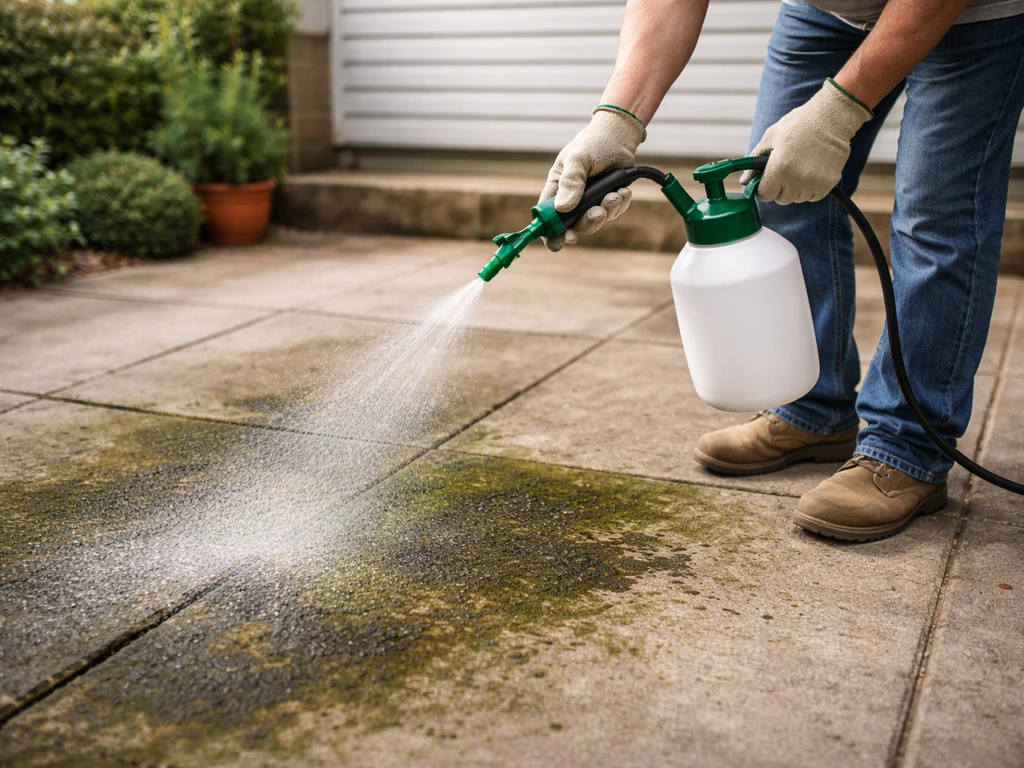
The strongest patio cleaner for most homeowners is a concentrated sodium hypochlorite (bleach-based) biocide for biological growth like mold, algae, and moss, or a high-alkalinity caustic degreaser for oil and grease. For rust stains, an oxalic acid or phosphoric acid formulation is the most powerful option. But "strongest" is surface- and stain-specific, what obliterates algae on concrete can permanently etch sandstone, strip grout from porcelain, or discolor natural slate. The right answer depends on what you're cleaning and what it's made of.
What Is the Strongest Patio Cleaner: Choose by Surface & Stain
Rhea Lang
7 Aug 2026
What "strongest" actually means for patio cleaners
Strength in a patio cleaner isn't one number. It breaks down into four distinct things, and a product that scores high on one can score zero on another.
- Chemical concentration: The active ingredient percentage in the bottle. Sodium hypochlorite in retail bleach runs around 5 to 8% NaOCl. Professional biocidal concentrates can be higher. Oxygen bleach products are built on sodium percarbonate, which releases hydrogen peroxide when dissolved. Concentration matters, but only if the right active ingredient is present for your stain type.
- Oxidizing or redox potential: Bleach-based and peroxide-based cleaners kill organic growth by oxidizing it. Lab testing confirms that hydrogen peroxide and sodium hypochlorite outperform quaternary ammonium compounds against biofilms and algae. For mold and algae on a patio, oxidizers are the heavy hitters.
- pH extremes (alkalinity or acidity): Strong alkaline degreasers (containing sodium hydroxide or potassium hydroxide) break down oils and grease by saponification. Strong acids like muriatic (hydrochloric) or oxalic acid dissolve mineral deposits and rust by chelating iron. Neither does much for biological growth.
- Surfactant and solvent system: Degreasers rely on surfactants to emulsify oils so they can be rinsed away. A high-surfactant formulation lifts grease from porous concrete better than bleach ever will.
- Contact (dwell) time and organic load resistance: Even the strongest cleaner needs time to work, and organic matter (mud, leaves, general grime) dramatically reduces the effective concentration reaching the stain. Heavy soiling requires longer dwell times or pre-rinsing before applying the cleaner.
I learned this distinction the hard way when I used a concentrated bleach product on a heavily muddy concrete path and got disappointing results. The mud had consumed most of the available chlorine before it could tackle the algae underneath. A quick pressure rinse first, then the bleach, and the difference was night and day.
The main types of powerful patio cleaners
Bleach-based biocides (sodium hypochlorite)
These are the fastest-acting biological killers available to a homeowner. Sodium hypochlorite at dilutions from 1:10 to 1:100 will kill surface mold, algae, lichen, and moss quickly. They work best on non-porous or sealed concrete, brick, and hard pavers. The downside is that they're rapidly inactivated by organic material, they can bleach colored surfaces, they corrode metals, and they're incompatible with acids, mixing bleach with an acidic cleaner releases chlorine gas, which is genuinely dangerous. Always use them on their own, never mixed.
Alkaline degreasers (caustic cleaners)
High-pH products containing sodium hydroxide or strong surfactant blends are the go-to for oil, grease, and barbecue stains. They work by breaking down fat molecules chemically. Professional-grade concentrates require dilution (usually specified on the SDS/TDS), gloves, eye protection, and controlled runoff because they're corrosive to skin and can harm plants and aquatic life. On unsealed concrete and brick, they're exceptionally effective. Do not use them on polished or honed natural stone.
Acid cleaners (muriatic, oxalic, phosphoric)
Muriatic acid (hydrochloric acid) is the most aggressive masonry cleaner available without a professional license and removes mineral efflorescence and some deeply embedded stains from concrete fast. Oxalic acid and phosphoric acid are the standard recommendation for rust stains on concrete and masonry because they chelate iron, effectively pulling rust out of the surface. None of these should go anywhere near calcareous natural stones (limestone, marble, travertine, sandstone) because the acid reacts with calcium carbonate and etches or dissolves the surface permanently.
Oxygen-based cleaners (sodium percarbonate)
Products based on sodium percarbonate release hydrogen peroxide when dissolved in water. They're effective against organic stains, algae, and mildew, and considerably gentler on colored surfaces and metals than chlorine bleach. The trade-off is that they typically need longer dwell times (10 to 30 minutes) and more agitation to achieve similar whitening on porous masonry. They're my preferred starting point for sandstone, brick, and colored concrete because the risk of bleaching or surface damage is much lower.
Enzymatic cleaners
Enzyme-based products use biological catalysts to break down organic compounds like pet urine, food waste, and some organic stains. They're slower than chemical oxidizers but work without harsh chemicals and are significantly safer around children, pets, and plants. They're not effective on mineral stains, rust, or heavy biological growth on hard surfaces.
Specialty rust and stain removers
These are formulated specifically for iron staining, tannin stains from leaves, or other stubborn mineral deposits. Most effective ones use oxalic acid, sodium dithionite, or phosphoric acid as their active chemistry. They're targeted products, excellent for their intended use, but don't expect them to handle algae or grease.
Cleaner types at a glance
| Cleaner Type | Active Chemistry | Best For | Avoid On | Relative Strength for Target |
|---|---|---|---|---|
| Bleach/biocide | Sodium hypochlorite (5–8%) | Mold, algae, moss, lichen | Colored stone, metals, sandstone, porcelain grout | Very high (biological) |
| Alkaline degreaser | NaOH, strong surfactants | Oil, grease, BBQ residue, heavy grime | Polished/honed natural stone, painted surfaces | Very high (grease/oil) |
| Muriatic/hydrochloric acid | Hydrochloric acid | Efflorescence, heavy mineral deposits, concrete prep | All calcareous stone, metals, colored concrete | Very high (mineral) |
| Oxalic/phosphoric acid | Oxalic acid, phosphoric acid | Rust stains on concrete, masonry | Calcareous stone, marble, limestone | Very high (rust/iron) |
| Oxygen bleach | Sodium percarbonate | Organic stains, algae, mildew, colored surfaces | Bare aluminum, some metals (prolonged contact) | High (organic/biological) |
| Enzymatic cleaner | Protease/lipase enzymes | Pet stains, urine, food organic stains | Rust, mineral deposits, heavy algae | Moderate (organic only) |
| Specialty rust remover | Oxalic acid, sodium dithionite | Iron/rust stains, tannin staining | Not intended for biological growth or grease | Very high (rust specific) |
How to choose the right cleaner: a stepwise decision framework
Before you buy anything, work through this checklist. For product recommendations, see the best patio cleaner fluid. It takes about two minutes and will stop you from wasting money on the wrong product or damaging your patio.
- Identify your surface material. Is it concrete (poured or precast), natural stone (and if so, which type), brick, porcelain tile, sandstone, slate, or composite decking? Surface type is the first gate — it eliminates certain cleaner classes immediately.
- Identify the stain or problem. Is it green or black biological growth (algae, mold, moss, lichen)? Oil or grease? Rust or orange-brown iron staining? General dirt and grime? Pet urine? Cushion or fabric staining?
- Check whether the surface is sealed or unsealed. Sealed surfaces resist chemical penetration more but can also trap stains underneath the sealant. Unsealed porous surfaces absorb cleaners quickly — dwell time matters more.
- Start with the least aggressive option for your surface type. Mechanical pre-rinse with a pressure washer often removes 50 to 70% of surface dirt before any chemical is needed. Only escalate to strong chemistry if that's not enough.
- Match the cleaner class to the stain type using the table above and the surface compatibility section below.
- Always test in an inconspicuous area, wait 10 minutes, rinse, and check for discoloration, etching, or finish damage before committing to the full surface.
- Read the product SDS (Safety Data Sheet) for dilution ratios, PPE requirements, and incompatibilities before mixing or applying anything.
Surface-by-surface compatibility and recommendations
Poured and precast concrete
Concrete is the most forgiving patio surface for strong cleaners. It handles bleach, alkaline degreasers, oxygen bleach, and diluted acid cleaners reasonably well. For heavy mold and algae, a 1:10 diluted sodium hypochlorite solution applied with a stiff brush or sprayer and left for 10 to 20 minutes is highly effective. For grease, a concentrated alkaline degreaser is the right call. For rust, oxalic acid or a phosphoric acid rust remover is the standard approach. Pressure washing at 2000 to 3500 PSI with a surface cleaner attachment works well for general grime after pre-treatment.
Brick
Brick tolerates bleach and oxygen bleach well for biological growth. Avoid muriatic acid unless you're removing persistent efflorescence, even then, dilute it heavily (roughly 1 part acid to 10 parts water) and rinse immediately. Alkaline degreasers work for oil staining. The mortar joints are usually the most vulnerable part, so avoid prolonged soaking with strong acids.
Natural stone (general)
"Natural stone" covers a huge range. The critical distinction is whether the stone is calcareous (contains calcium carbonate) or siliceous (silicon-based). Calcareous stones react with any acid, so the rule is: no acids, ever. Siliceous stones (granite, slate, some quartzite) are more tolerant but still benefit from pH-neutral or mildly alkaline cleaners.
Sandstone
Sandstone is soft, porous, and easily damaged. No acids, no strong bleach at full concentration, and no high-pressure washing above about 1000 to 1200 PSI. Oxygen bleach (sodium percarbonate) diluted to label instructions is the safest effective option for algae and biological staining. Apply with a soft brush, allow 15 to 20 minutes dwell, and rinse gently. I've seen sandstone flags permanently bleached white by undiluted bleach left on too long, it's not reversible.
Slate
Slate is siliceous and more acid-tolerant than sandstone, but it has a natural layered structure that can delaminate with aggressive pressure washing or strong chemical penetration. Mild to moderate alkaline cleaners and diluted oxygen bleach are safe. Avoid concentrated bleach on colored or calibrated slate because it can strip the natural surface finish and alter the color permanently.
Porcelain pavers and tile
The tile surface itself is highly resistant to most chemicals, but the grout joints are not. Strong acids and concentrated bleach erode grout over time. Tile industry guidance (referencing TCNA standards) recommends pH-neutral or mildly alkaline cleaners for regular maintenance. For stubborn biological staining between joints, a diluted oxygen bleach solution is safer than chlorine bleach. Always test first and avoid leaving strong cleaners sitting in grout joints.
Concrete and block pavers
Concrete pavers handle similar chemistry to poured concrete, but the joint sand is a consideration. High-pressure washing (above 2000 PSI with a direct nozzle) will blast out the polymeric sand between joints. Use a rotary surface cleaner attachment instead of a pencil jet, and plan to re-sand and re-seal joints after a deep clean. Bleach and oxygen bleach both work well here for biological growth.
Stain-specific guidance: matching chemistry to the problem
Mold and algae
Sodium hypochlorite at a 1:10 dilution (1 part bleach to 9 parts water) is the most effective fast-acting treatment on compatible surfaces. Research confirms it outperforms quaternary ammonium compounds against biofilms. A peer‑reviewed study found hydrogen peroxide– and sodium hypochlorite–based oxidizers outperformed quaternary ammonium compounds against biofilms hydrogen peroxide– and sodium hypochlorite–based oxidizers outperform quaternary ammonium compounds against biofilms (peer‑reviewed). Pre-rinse the surface to reduce organic load first. Apply the diluted bleach, let it dwell for 10 to 20 minutes, agitate with a stiff brush if needed, and rinse thoroughly. On more sensitive surfaces (colored concrete, brick, sandstone), switch to an oxygen bleach product and allow 20 to 30 minutes dwell time.
Moss and lichen
Moss and lichen are tougher than algae because they have physical root-like structures (rhizoids) that penetrate surface pores. Strong biocidal bleach works best, but the dead material needs mechanical removal (brushing or pressure washing) after treatment. Some dedicated moss killers use ferrous sulfate or benzalkonium chloride as the active ingredient and are worth considering where bleach might cause discoloration. Always check that any product labeled as an algicide or moss killer carries appropriate EPA registration and follow label directions exactly, off-label dilutions can be both ineffective and legally non-compliant.
Rust stains
Oxidizing cleaners (bleach, oxygen bleach) will not remove rust, in fact, bleach can make rust stains worse by further oxidizing the iron. Use oxalic acid, phosphoric acid, or a proprietary rust remover that chelates iron. Apply to the stain, allow the specified dwell time (typically 5 to 15 minutes), agitate gently, and rinse completely. Do not use on limestone, marble, travertine, or sandstone.
Grease and oil
A concentrated alkaline degreaser is the right choice. Absorb as much fresh oil as possible with cat litter or sand first, then apply the degreaser at the recommended concentration, let it dwell and emulsify the grease (typically 5 to 15 minutes), agitate with a stiff brush, and rinse at higher pressure. One application is often not enough for deep, set oil stains on unsealed concrete, a repeat treatment or poultice method (covering with an absorbent material soaked in degreaser) works better for old stains. For product recommendations and step-by-step usage tips, see our guide to the best patio cleaner for grease.
Dirt and general grime
Honestly, most heavy surface grime on concrete or pavers comes off with a pressure washer and a good general-purpose cleaner that combines surfactants with mild alkalinity. For general dirt and grime, pair a pressure washer with the best patio cleaner for dirt to remove surface soil quickly and efficiently. An oxygen bleach product doubles as a solid general cleaner while also tackling any underlying biological staining. Reserve the harsher chemistry for specific stains that remain after a standard pressure wash and cleaner treatment.
Pet stains
Pet urine soaks into porous concrete and masonry and leaves odor-causing compounds behind that bleach will kill superficially but not fully neutralize. Enzymatic cleaners are the most effective option because they break down uric acid crystals, which are the primary odor source. Apply the enzymatic cleaner liberally, keep the area damp for the dwell time (often 20 to 30 minutes or longer for set stains), and rinse. For heavily contaminated areas, a bleach rinse after the enzymatic treatment can handle residual bacteria.
Cushions and outdoor fabrics
Hard patio cleaner chemistry (bleach, acid, alkaline degreasers) should never go on outdoor cushions or fabric. Bleach will destroy most fabric dyes and can weaken synthetic fibers. Purpose-formulated outdoor fabric cleaners, very diluted oxygen bleach solutions, or mild upholstery enzymatic sprays are the appropriate options. Rinse thoroughly and allow cushions to dry completely upright in sunlight to prevent mildew recurrence. This is a sufficiently different cleaning challenge that it's worth treating separately from hard surface cleaning. For recommendations on products and safe methods, see our guide to the best outdoor patio cushion cleaner.
When NOT to use the strongest cleaners
Strongest is not always best. Here are the situations where powerful cleaners cause real damage and what to use instead.
- Calcareous natural stone (limestone, marble, travertine, some sandstone): Any acid cleaner — including muriatic, oxalic, phosphoric, and even mildly acidic general cleaners — will etch or dissolve the calcium carbonate surface. The damage is permanent and expensive to repair. Use pH-neutral cleaners only.
- Colored or exposed aggregate concrete: Strong bleach and caustic alkaline cleaners can strip pigment from colored concrete or react with aggregates to cause patchy discoloration. Use diluted oxygen bleach and test first.
- Porcelain tile grout joints: Concentrated bleach and strong acids erode grout over repeated use. Switch to diluted oxygen bleach or pH-neutral cleaners for regular maintenance.
- Composite and wood decking: Most chemical degreasers and bleach products are not formulated for wood or composite materials and can raise grain, cause discoloration, or void manufacturer warranties. Use products specifically labeled for decking.
- Near plants, lawns, or water features: Chlorine bleach and alkaline degreasers kill plants and are toxic to aquatic life. Divert runoff, wet surrounding vegetation before and after application, and rinse heavily. The EPA's stormwater guidance specifically cautions against chemical-laden rinse water entering storm drains.
- Sealed surfaces with a fresh coating: Aggressive cleaners strip sealants. If the surface was sealed in the last 12 months, start with a pH-neutral cleaner to preserve the coating.
- If you're unsure of the stone type: Test any cleaner on a small, hidden area and wait 10 to 15 minutes before applying it to the full surface. This is non-negotiable for natural stone.
How to use strong patio cleaners safely: preparation, PPE, and application
Before you start
Read the product SDS (Safety Data Sheet) before opening the container. Every reputable product publishes one, and it tells you the exact PPE required, the recommended dilution range, incompatibilities, and first-aid steps. This is especially important for concentrated professional-grade products. Clear the patio of furniture, planters, and any items that could be damaged by overspray. Wet surrounding plants and lawn with plain water before applying any chemical cleaner, then rinse them again immediately after the job is done.
PPE requirements by cleaner type
| Cleaner Type | Eye Protection | Hand Protection | Respiratory Protection | Clothing |
|---|---|---|---|---|
| Bleach/biocide (diluted, consumer) | Safety glasses or goggles | Nitrile or rubber gloves | Good ventilation; mask in enclosed spaces | Old clothes, long sleeves |
| Alkaline degreaser (concentrated) | Chemical splash goggles | Heavy-duty rubber gloves | Respirator if aerosol/spray | Chemical-resistant apron, long sleeves |
| Muriatic acid | Chemical splash goggles | Heavy-duty rubber/neoprene gloves | Respirator (acid vapors) | Chemical-resistant apron, long sleeves, boots |
| Oxalic/phosphoric acid cleaner | Safety glasses | Nitrile gloves | Good ventilation, mask if spraying | Long sleeves, old clothes |
| Oxygen bleach (sodium percarbonate) | Safety glasses | Nitrile gloves | Good ventilation | Normal outdoor clothing |
| Enzymatic cleaner | Safety glasses (precautionary) | Latex or nitrile gloves | Not typically required | Normal clothing |
Dilution, application, and dwell time
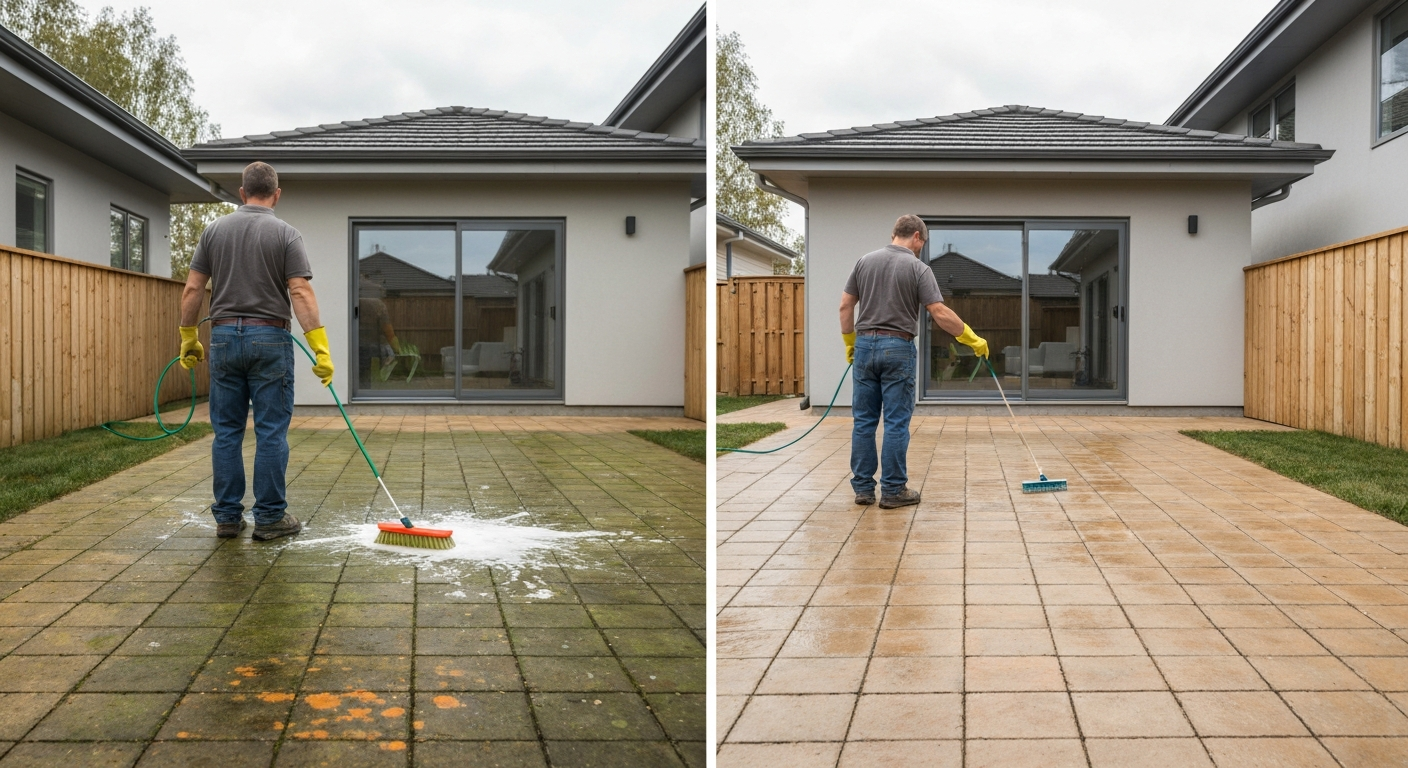
- Pre-rinse the patio thoroughly with a pressure washer or hose. Removing loose dirt and organic debris before applying the cleaner significantly improves effectiveness because organic load rapidly inactivates bleach and oxidizers.
- Mix to the concentration specified on the product label or SDS. Do not assume more is better — overly concentrated bleach, for example, leaves a white residue and can damage surfaces without cleaning more effectively.
- Apply the cleaner with a pump garden sprayer, watering can, or stiff brush, starting from the lowest point of the patio and working upward to avoid run-down staining on cleaned areas.
- Allow the correct dwell time: typically 10 to 20 minutes for bleach-based products, 20 to 30 minutes for oxygen bleach, 5 to 15 minutes for acid rust removers, and longer for enzymatic products on set stains.
- Agitate with a stiff-bristled brush where needed, particularly for textured or porous surfaces where the cleaner needs mechanical help to reach into pores.
- Rinse thoroughly with a pressure washer or strong hose. For acid cleaners, a neutralizing rinse (baking soda solution at about 1 tablespoon per gallon of water) helps bring the surface back to neutral pH before a final water rinse.
- Never mix bleach with any acid, ammonia-based product, or other cleaner. This can release chlorine gas or other toxic byproducts. Use one product at a time and rinse completely before switching chemistries.
- Dispose of unused diluted cleaner according to your local authority's household hazardous waste guidelines. The EPA advises against pouring concentrated cleaning chemicals directly into storm drains or onto ground where they can run off into waterways.
Pressure washer settings to pair with chemical cleaners
Chemical cleaners and pressure washing work best together, the chemistry loosens and kills stains, the pressure physically removes them. For concrete and block pavers, 2000 to 3500 PSI with a rotary surface cleaner attachment gives even cleaning without striping. For brick, 1500 to 2000 PSI with a 25-degree fan nozzle is safer on mortar joints. For sandstone and softer natural stone, stay at or below 1000 to 1200 PSI and use a 40-degree wide fan nozzle. Wood and composite decking: 500 to 1500 PSI maximum with the widest fan nozzle, always moving with the grain. Always start further away and move closer only if needed, it's much easier to increase pressure than to fix etching or grain damage.
Quick DIY and natural alternatives, and where they fall short
White vinegar (roughly 5% acetic acid) works on light efflorescence and mild mildew on concrete, but it's genuinely not strong enough for serious algae or heavy grime. Baking soda paste is fine for spot-cleaning light stains but has minimal cleaning power on porous surfaces. Washing soda (sodium carbonate) is a step up from baking soda and provides useful alkalinity for general cleaning but without the biocidal power of bleach. These are reasonable options for maintenance cleaning on sensitive surfaces or where children and pets are a concern, but if you have years of green algae, embedded grease, or deep rust staining, natural alternatives will save you time and effort only in that they clearly won't work, and you'll move on to proper chemistry sooner.
After the clean: sealing, maintenance, and when to call a professional
A clean patio stays clean much longer if it's sealed afterward. A penetrating silane or siloxane sealer on concrete and natural stone repels water and biological growth and makes future cleaning significantly easier. Re-apply every 2 to 5 years depending on traffic and exposure. For block pavers, re-sand joints with polymeric sand after deep cleaning and seal to lock the sand and discourage weed and moss re-establishment.
For ongoing maintenance, an annual treatment with a diluted oxygen bleach product applied with a pump sprayer, left to dwell, and rinsed off is usually enough to keep biological growth at bay without aggressive chemistry every time. If you need a recommendation, see our guide to the best deck and patio cleaner for surface-specific picks and application tips. Spot-treat any new algae or moss as soon as it appears rather than letting it become an established colony.
Consider calling a professional pressure-washing contractor if your patio is very large, if you're unsure of the stone type, if you have historic or expensive natural stone, or if previous cleaning attempts have left patchy or etched results. Professionals carry the equipment to handle runoff correctly, have experience with difficult surfaces, and can often achieve results that are difficult to replicate with consumer equipment.
FAQ
Short answer: What is the strongest patio cleaner?
There is no single "strongest" universal product — "strongest" depends on the target (biological growth vs. oil vs. rust) and the surface. For killing heavy algae and mold on durable masonry, high‑concentration oxidizers (sodium hypochlorite/bleach at label‑approved dilutions) give the fastest kill. For heavy oil/grease on porous concrete, highly alkaline caustic degreasers (sodium hydroxide or concentrated surfactant/solvent blends) remove the most embedded oil. For rust, oxalic‑acid or specialized acid rust removers chelate iron best. Choose the strongest class that is compatible with your surface and follow PPE, dilution and disposal rules.
How do we define "strongest" for patio cleaners?
"Strongest" can mean different measurable properties: active ingredient and its concentration, oxidizing/redox potential (for bleaches/oxidizers), pH/alkalinity (for acids/caustics), solvent/surfactant power (degreasing), contact (dwell) time, and laboratory‑measured stain removal or log‑reduction of microbes. In practice, available chlorine concentration, high alkalinity for grease removal, and appropriate chelators for rust determine field performance. Organic load and contact time are critical confounders, so product strength alone doesn’t guarantee results.
Which product classes are the most powerful and what are they best for?
Key powerful classes: 1) Chlorine/oxidizing bleaches (sodium hypochlorite) — fast broad‑spectrum kill of algae/mold on non‑reactive surfaces. 2) Oxygen bleach (sodium percarbonate) — gentler oxidizer for organic stains and color‑sensitive surfaces. 3) Caustic/alkaline degreasers (high‑pH cleaners with NaOH or strong surfactants/solvents) — best for heavy oil/grease, especially on concrete. 4) Acid cleaners (muriatic/hydrochloric, oxalic acid) — for rust/mineral stains; use oxalic for rust. 5) Enzymatic cleaners — for pet stains and organic residues. 6) Specialty rust/stain removers — formulated chelants for iron/metal stains.
How do I choose a product by surface (concrete, natural stone, pavers, tile, wood, porcelain)?
Decision framework: - Porous concrete/pavers: tolerate stronger alkali degreasers and higher‑pressure washing; bleach OK for biological growth. - Non‑calcareous natural stone (granite, some slates): limited acid use; oxygen bleach or mild alkaline cleaners preferred. - Calcareous stone (limestone, travertine, marble, some sandstones): avoid acids (muriatic/oxalic) and strong bleach; use pH‑neutral or low‑alkaline cleaners and mechanical cleaning. - Porcelain/tile: use pH‑neutral or mild alkaline cleaners; avoid strong acids/bleach that can damage grout or finishes. - Wood/composite decks: avoid high PSI and strong caustics; use oxygen bleach or wood‑safe cleaners and low pressure. Always test a small hidden area and consult manufacturer/surface guidance before using powerful chemicals.
Which cleaner class should I pick by stain/problem?
Match stain to class: - Heavy algae/mold/moss: sodium hypochlorite (bleach) for fast kill on hard, non‑reactive surfaces; oxygen bleach for color‑sensitive areas. - Oil/grease: concentrated alkaline/caustic degreasers with agitation and dwell. - Rust/iron stains: oxalic acid or dedicated rust removers (follow stone compatibility guidance). - Pet stains/organic odors: enzymatic cleaners to break down organics. - Routine deep clean: oxygen bleach or mild alkaline cleaner plus pressure washing. - Cushions/fabrics: dedicated outdoor fabric cleaner or enzyme/oxygen formulations designed for textiles.
Step‑by‑step safe use: preparation and PPE
Preparation: clear the area, remove furniture and plants or cover them, sweep loose debris, and block storm drains or divert rinse water to lawn/soil when allowed. PPE: chemical‑resistant gloves, eye protection/goggles, long sleeves, chemical‑resistant footwear, and if using concentrated oxidizers/acid/caustics, a respirator rated for chemical vapors/particulates per the product SDS. Read the product SDS/TDS for exact PPE and first‑aid guidance.
Next Article
How to Use Wet and Forget Patio Cleaner Step by Step
Step by step guide to apply Wet and Forget patio cleaner, prep and safety, dwell time, rinse or no rinse, and troublesho