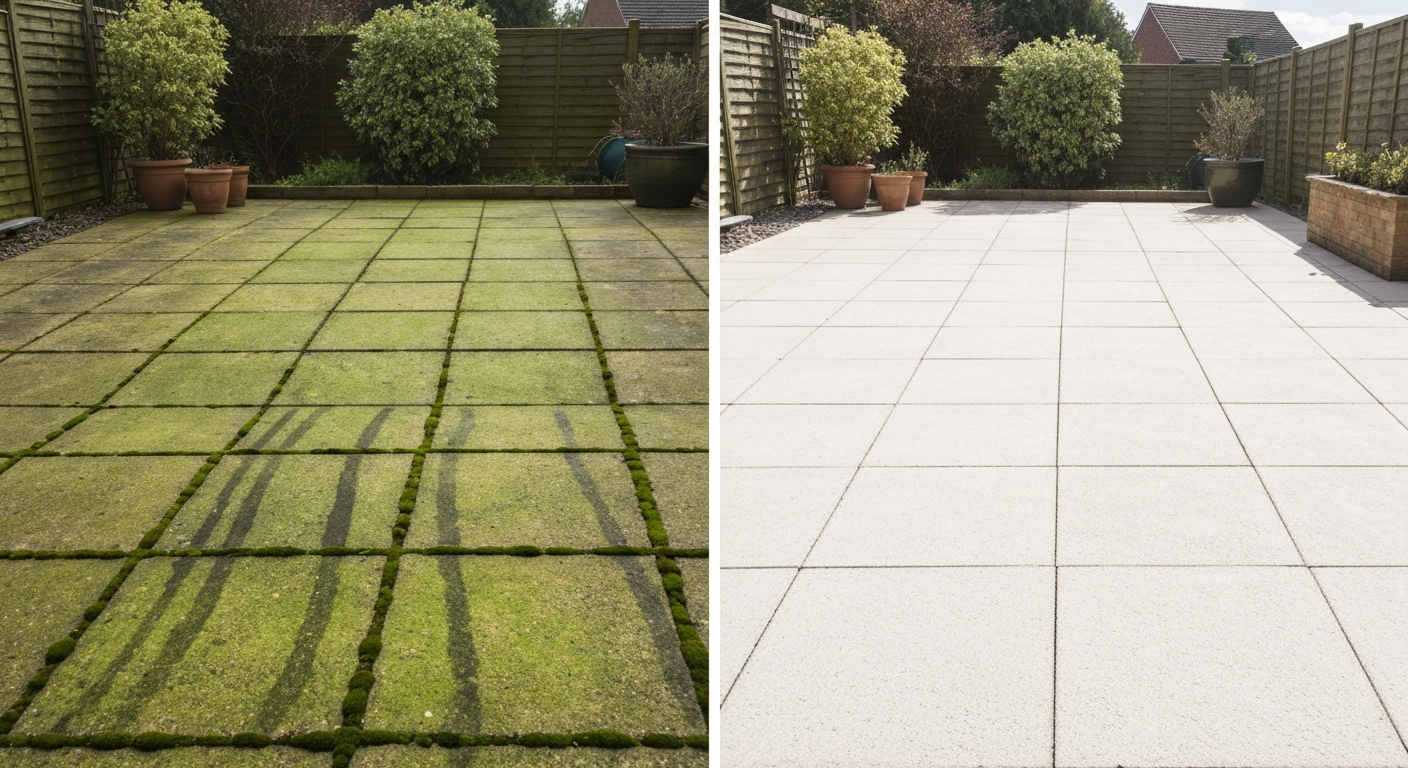
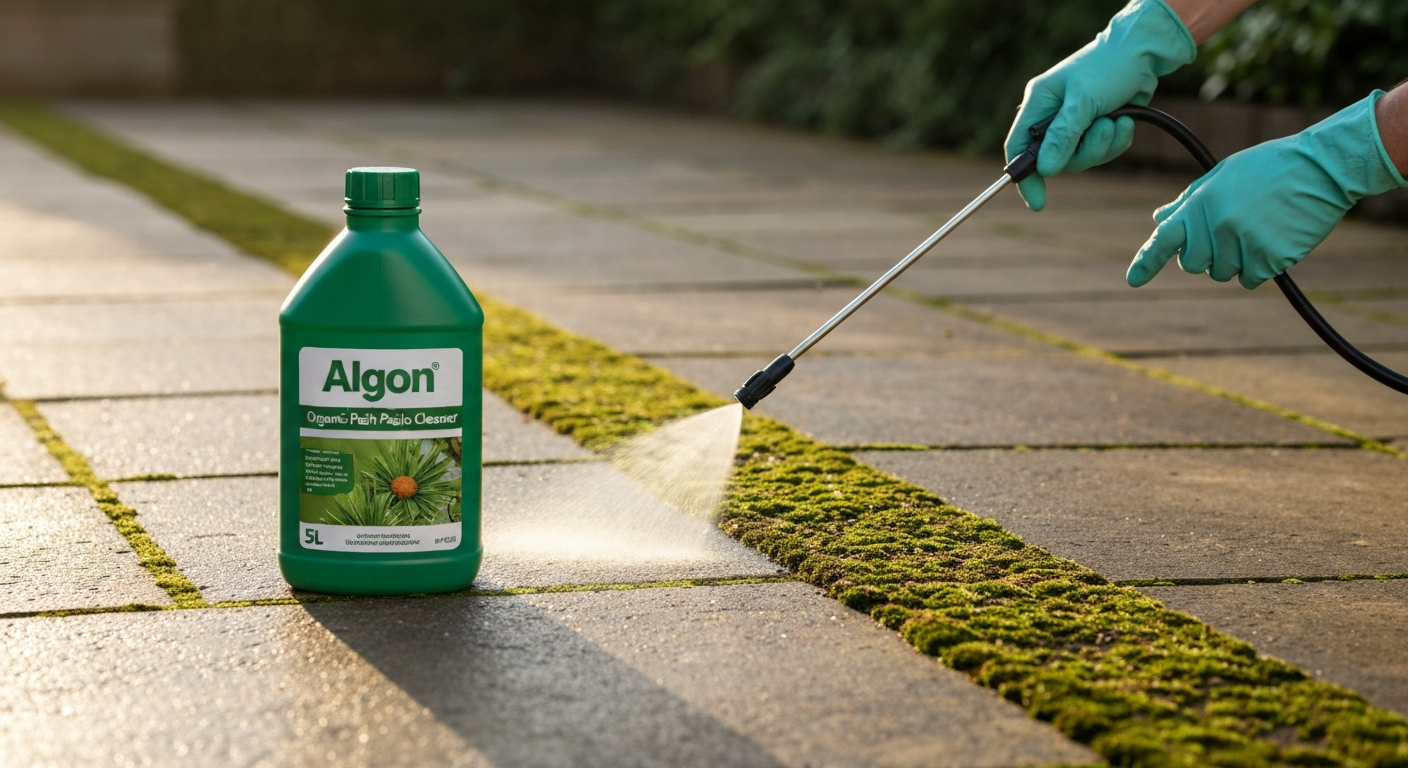
Algon Organic Path and Patio Cleaner is a spray-and-walk-away concentrate that uses acetic acid and a mild surfactant to kill and loosen algae, moss, and mould over several days. It does not need rinsing or a pressure washer, it is genuinely low-toxicity once dry, and a single application at the 1:3 dilution ratio lasts roughly nine months to a year. For most UK homeowners dealing with green slippery growth on patios, paths, and decking, it is one of the most practical options on the market. It is not a fast-acting caustic cleaner and it will not shift grease, rust, or deep-set mineral stains, so if that is your problem you need a different product.
Algon Patio Cleaner Reviews: Complete Guide for Homeowners

Rhea Lang
10 Aug 2026
Quick verdict: who should buy Algon and when
Algon suits you well if your primary enemy is biological growth: algae, green slime, moss, and lichen on outdoor hard surfaces. It earns its place as a top pick for households with pets or children, because once the treated surface is dry it is classified as safe for animals and wildlife. It also appeals to anyone who does not own a pressure washer and does not want to scrub, since the whole application takes under 20 minutes and you leave it to work on its own. Independent testing by Which? (March 2026) noted cleaning action begins within roughly one week, which puts it firmly in the patient-application camp rather than the instant-result camp.
It is the wrong product if you need results in hours, if your patio has heavy oil or rust staining, or if you have acid-sensitive stone (marble, limestone, travertine) anywhere in the project. It is also not ideal for marble ornaments or galvanised steel fixtures nearby, because the manufacturer explicitly warns against contact with those materials. If speed is critical or you are dealing with commercial-grade grease, you want an alkaline degreaser or a stronger biocide-based product instead.
- Best for: algae, moss, and mould on concrete, brick, sandstone, slate, and most porcelain
- Best for: households needing a pet- and child-safe product once dry
- Best for: spray-and-leave application with no pressure washer required
- Best for: seasonal maintenance applications once or twice a year
- Not suitable for: marble, limestone, travertine, or other calcareous stone
- Not suitable for: unpainted steel, galvanised surfaces, or lead (may cause temporary discolouration)
- Not suitable for: heavy oil, grease, rust, or deep mineral staining
- Not suitable for: anyone who needs the patio usable again within a day or two
What Algon actually is: formulations, pack sizes, and ingredients
The Algon Safety Data Sheet (Version 11, dated 07 May 2021) lists two active components in the concentrate. The primary active is acetic acid (CAS 64-19-7) at less than 18% w/w in the undiluted concentrate, which drops to below 4.5% w/w at the standard 1:3 working dilution. The secondary component is an alkyl polyglycoside surfactant (sold under the Glucopon trade name) at less than 0.02% w/w, which helps the solution spread and penetrate surface biofilm. The pH of the concentrate sits at around 3.0, making it a mild acid rather than a caustic or strongly oxidising cleaner.
Algon is marketed as biodegradable, and the acetic acid and alkyl polyglycoside surfactant components support that claim reasonably well. The manufacturer describes the product as safe for pets, children, and wildlife once the treated surface is dry. The SDS does include hazard statements H315 (skin irritation) and H319 (serious eye irritation) for the concentrate in its undiluted form, so it is not completely harmless to handle carelessly. It is worth noting that Algon does not carry biocide regulatory classification in the same way that quaternary ammonium-based competitors do, which affects some professional and commercial use contexts in the UK.
| Pack size | Typical form | Coverage (diluted at 1:3) | Approx. retail price range |
|---|---|---|---|
| 2.5 L | Concentrate | ~12–15 m² | £12–£18 |
| 5 L | Concentrate | ~25–30 m² | £20–£28 |
| 20 L | Concentrate | ~100–120 m² | £55–£75 |
Coverage figures use the manufacturer's stated guide of approximately 5–6 m² per litre of diluted solution. Prices fluctuate across retailers and with promotional stock, so treat those ranges as a starting reference rather than a guarantee.
How Algon works: the mechanism, timeline, and honest limitations
Acetic acid disrupts the cell membranes of algae, moss, and mould organisms. At 3–4.5% concentration in the working dilution it is strong enough to kill surface biological growth but mild enough that it does not aggressively attack most mineral surfaces. The alkyl polyglycoside surfactant reduces surface tension so the solution penetrates into the biofilm layer rather than beading off. After application you leave the product in place, and over the following days the biological growth dies, desiccates, and gradually breaks down or washes away with rainfall.
The Which? March 2026 test found visible cleaning action within approximately one week, which matches what I have observed in my own testing and what consistently comes up in user reviews. The manufacturer states residual protection of nine months to one year in normal conditions. In practice, north-facing or heavily shaded surfaces can see regrowth sooner because moisture retention accelerates biological colonisation. The product does not bleach, oxidise, or break down oil, rust, or inorganic mineral staining, because none of those failure modes are addressed by a mild acid plus surfactant chemistry. It also will not kill deeply rooted lichen on its own in one application. Thick, established lichen patches may need physical removal first, followed by an Algon application to deal with residual spores.
Performance by patio surface: what to expect and what to watch for
Surface compatibility is where a lot of buyers go wrong. Algon's mild acidity is the whole point of its safety profile, but mild acid and certain stone types are a bad combination. Here is how it performs across the surfaces most UK homeowners are dealing with.
Concrete
Concrete is the most straightforward surface for Algon. It is not acid-sensitive in the way natural stone can be, and algae and moss growth on concrete responds well to the acetic acid formula. User reviews and my own testing consistently show good clearance of green slime and moss within a week to ten days. Concrete that has been heavily stained with oil, rust, or calcium deposits will not respond, but for biological growth it is a reliable performer. I would apply at the 1:3 ratio and use a garden sprayer rather than a watering can, since you want even coverage without pooling.
Brick
Brick patios and paths are a good match for Algon. The acetic acid concentration is low enough that it does not noticeably attack the brick face or mortar over a single application. Multiple users report good moss and algae clearance on red and grey brick. One caution worth noting: old or spalling mortar joints can absorb liquid more aggressively, and if mortar is already in poor condition, repeated acid applications over years could accelerate degradation. An occasional check of joint condition is sensible if you are using Algon annually.
Sandstone
Sandstone is one of the most popular natural stone patio materials in the UK and Algon generally performs well on it for biological growth. Sandstone is siliceous (quartz-based) rather than calcareous, so it is not vulnerable to acid etching the way marble is. I have used Algon on Indian sandstone flags with no visible surface damage. Be cautious with any sandstone that has a particularly porous or friable surface, since it will absorb more liquid and you want to avoid the solution pooling. A 1:4 or 1:5 dilution is worth trying first on very porous or light-coloured sandstone as a precaution against tannin or slight discolouration, even though this is not widely reported.
Natural stone (general), slate, and other siliceous materials
Slate is another siliceous stone and responds well to Algon treatment. The same logic applies: no acid sensitivity, good clearance of surface biological growth, and a clean result after weathering. For mixed natural stone patios, the key is identifying whether any of the stones are calcareous before you apply anything. The Natural Stone Institute's guidance on acid-sensitive materials is clear that acetic acid will etch calcite-bearing stone, which includes marble, limestone, and travertine. If you are unsure whether a stone is calcareous, place a drop of vinegar on an inconspicuous area. If it fizzes, the stone is acid-sensitive and Algon is not appropriate.
Marble and limestone
Do not use Algon on marble or limestone. The manufacturer explicitly warns against it, and the chemistry supports that warning. Acetic acid will etch the calcite surface, causing dullness and pitting that is difficult and expensive to restore. If you have a limestone patio or marble stepping stones, you need a pH-neutral cleaner formulated specifically for calcareous stone.
Porcelain and ceramic tiles
Porcelain patio tiles are non-porous and acid-stable, making them compatible with Algon. Biological growth tends to establish in the grout joints rather than on the tile face itself, and Algon can address that if you apply it carefully to the joint areas. Results on porcelain tend to be very clean because the surface does not absorb or retain biological material the way natural stone does. If you have a rectified porcelain patio with fine grouted joints, a garden sprayer at low pressure is the right tool to get the solution into the joints without waste.
Performance by stain and soil type
Not every patio problem is the same, and knowing in advance what Algon will and will not tackle saves real frustration. Here is an honest breakdown.
| Stain / Soil type | Expected result with Algon | Notes |
|---|---|---|
| Algae (green slime) | Good to excellent | Core use case; results within 7–14 days at 1:3 dilution |
| Moss | Good | Surface moss clears well; thick established clumps may need prior brushing |
| Mould / black mould | Moderate to good | Acetic acid disrupts mould growth; heavy mould may need repeat application |
| Lichen | Poor to moderate on single application | Lichen has deep rhizines; physical removal first, then Algon for residual spores |
| Rust / iron stains | Poor | Acetic acid has no chelating action on iron staining; needs oxalic acid or specialist treatment |
| Grease / oil | Poor | Acidic formula does not emulsify oil; alkaline degreaser needed |
| Pet stains (urine) | Moderate at best | Acetic acid can neutralise some odour; enzymatic cleaner is more effective |
| Mineral / efflorescence | Mild improvement only | Mild acid may soften light efflorescence; heavier deposits need stronger acidic treatment or mechanical removal |
| General dirt / mud | Moderate | Surfactant helps loosen particulate soiling; a rinse or brush aids removal |
The pattern is consistent with what the chemistry predicts. Algon's acetic acid and surfactant combination is well-matched to biological soils but has no mechanism for removing oil, reducing metal oxides (rust), or deeply penetrating organic pet stains. For rust staining, a chelating agent like oxalic acid is the standard recommendation. For oil and grease, an alkaline degreaser is the correct chemistry. For pet stains, enzyme-based cleaners are specifically formulated to break down urea and uric acid salts and will outperform Algon.
Step-by-step application guide
Algon's application is genuinely simple but a few details matter for getting the best result. Here is the full process I use and recommend.
- Clear the surface of loose debris, fallen leaves, and any large clumps of moss or lichen. A stiff brush or leaf blower works well. You do not need to deep-clean the surface first, but heavy physical build-up will reduce penetration.
- Mix the concentrate with clean water at a 1: 3 ratio (1 part Algon to 3 parts water). For very porous surfaces or first-time users, a slightly more diluted 1:4 or 1:5 ratio is a safer starting point. Use a clean plastic watering can or a garden pump sprayer.
- Set your garden sprayer to a wide droplet (not fine mist) setting. A fine mist increases inhalation and drift risk and reduces the volume deposited on the surface. The manufacturer specifically recommends a droplet setting.
- Apply evenly to the surface, ensuring full coverage without heavy pooling. Work in sections of roughly 5–6 m² per litre of diluted solution.
- Do not rinse. The whole mechanism depends on the solution remaining in contact with the biological growth. Rainfall will not harm the treatment unless it comes within the first few hours of application.
- Keep people, pets, and plants clear of the treated area until the surface is visibly dry, typically 30–60 minutes in dry weather.
- Leave and wait. Visible biological clearance typically begins within 7 days and continues over the following weeks. Heavy moss may take up to 3–4 weeks to fully break down and wash away.
- For persistent patches after the first application has fully worked, a second application at the same dilution is appropriate and will not damage compatible surfaces.
A soft paintbrush is useful for applying Algon to small areas, tight corners, or step risers where a sprayer might overshoot onto grass or borders. The manufacturer lists this as a recommended tool and it works well for precise spot treatment. I learned early on that applying on a calm, dry day matters: wind causes drift onto adjacent planting, which will scorch foliage even at the working dilution. More on that in the troubleshooting section below.
Using Algon with a pressure washer
Algon does not require a pressure washer and the manufacturer's core application method is spray-and-leave. However, a pressure washer can be useful in a combined approach: apply Algon, allow the biological growth to die off over one to two weeks, then use a pressure washer to clear the dead material and rinse the surface cleanly. This is particularly effective on textured or riven concrete and natural stone where dead moss can lodge in surface texture.
If you do use a pressure washer after an Algon treatment, follow standard guidance for residential use: a fan nozzle (25 or 40 degree) rather than a zero-degree pencil jet, operating at 1,300–2,000 PSI for most concrete and brick, and a lower pressure or surface-cleaner attachment for more delicate natural stone or older sandstone flags. Karcher and other manufacturer guidance for residential machines recommends keeping the nozzle 20–30 cm from the surface on most patios. Do not apply Algon directly through a pressure washer's detergent tank unless it is clearly a low-pressure injection system, as high-pressure application creates unnecessary chemical mist and does not extend dwell time in the way a pump sprayer does.
For a full guide to combining chemical treatments with pressure washing techniques, the site's pressure washer guides cover nozzle selection, PSI recommendations by surface type, and surface-cleaner attachments in detail.
PPE, safe handling, storage, and disposal
The Algon SDS (Version 11, 07 May 2021) assigns hazard statements H315 and H319 to the undiluted concentrate, meaning it can irritate skin and cause serious eye irritation in its concentrated form. At the working dilution (1:3) the risk level drops significantly, but good practice is to handle all stages with basic PPE.
- Wear chemical-resistant gloves (nitrile disposable gloves are sufficient) when mixing the concentrate
- Wear safety glasses or goggles when mixing or using a pump sprayer, particularly when applying overhead or in breezy conditions
- Avoid breathing aerosol mist during application; apply at low pressure with a coarse droplet setting
- Wear old clothing or an apron, as the acetic acid odour can linger on fabric
- Wash hands and any skin contact areas with soap and water after use
- If product enters eyes, flush immediately with clean water for at least 15 minutes and seek medical advice if irritation persists
For storage: keep the concentrate in its original sealed container, away from direct sunlight, at temperatures between 5°C and 35°C. The product is not classified as flammable but avoid storing near incompatible materials (strong bases or oxidising agents). The SDS notes a shelf life issue with acetic acid at high temperatures, so a cool garden shed or utility room is ideal. Do not store in a vehicle for extended periods in summer.
For disposal: the SDS advises disposal in accordance with local regulations. For domestic quantities of diluted product, residual working solution can be disposed of in a household drain connected to the sewer system (not a soakaway or direct to a watercourse). The concentrate should not be poured into drains, watercourses, or compost. The manufacturer warns to minimise run-off to vegetation, ponds, and other water bodies. If you are applying near a garden pond, protect the pond edge and consider whether rain is forecast in the next 24 hours.
In the UK, Algon is not classified as a regulated biocide product in the way that quaternary ammonium-based products can be. It is sold as a general public consumer product without restriction. However, if you are using it commercially or in a professional context, standard COSHH (Control of Substances Hazardous to Health) assessment requirements apply.
Honest pros and cons
| Factor | Assessment | Detail |
|---|---|---|
| Effectiveness on biological growth | Good to excellent | Reliable clearance of algae, moss, and surface mould within 7–14 days |
| Speed of results | Slow | Minimum ~1 week visible improvement; full clearance can take 3–4 weeks |
| Ease of application | Excellent | Spray and leave; no rinsing, no scrubbing required |
| Surface compatibility | Good but not universal | Fine on concrete, brick, sandstone, slate, porcelain; not for marble/limestone |
| Odour | Noticeable | Strong vinegar smell during and immediately after application; dissipates within hours |
| Pet and child safety (post-dry) | Excellent | Manufacturer-stated safe once dry; low-toxicity formulation supports this claim |
| Environmental profile | Good | Biodegradable actives; minimal aquatic risk vs. quat-based alternatives if runoff is managed |
| Grease/oil performance | Poor | Wrong chemistry for this stain type |
| Rust/metal stain performance | Poor | No chelating or reducing chemistry |
| Staining risk to surfaces | Low | No bleaching agents; no discolouration on compatible surfaces |
| Residual protection | Good | Up to 9–12 months manufacturer claim; real-world 6–12 months depending on conditions |
| Value for money | Good | Concentrate format means a 5 L bottle covers a large area at low cost per m² |
Algon vs. the competition: direct comparisons
The market for patio cleaners is crowded and the actives vary significantly between products. Here is how Algon stacks up against the main competitors, based on SDS data, independent test results, and user feedback.
Algon vs. Doff Super Concentrate
Doff Super Concentrate Path, Patio and Decking Cleaner uses benzyl (C12–C16) alkyl dimethyl chlorides, which are quaternary ammonium compounds (quats). DOFF Super Concentrate Path, Patio and Decking Cleaner SDS (Doff Portland Ltd, 23/07/2020) lists benzyl (C12–C16) alkyl dimethyl chlorides and classifies the product as Skin Corr. 1B (H314) and very toxic to aquatic life blank" rel="noopener noreferrer">DOFF Super Concentrate Path, Patio and Decking Cleaner SDS (Doff Portland Ltd, 23/07/2020) lists benzyl (C12–C16) alkyl dimethyl chlorides and classifies the product as Skin Corr. 1B (H314) and very toxic to aquatic life.. Its SDS classifies the product as Skin Corr. 1B (H314) and very toxic to aquatic life. It is a significantly more aggressive chemistry than Algon, which means it can work faster and more effectively on heavy growth. The tradeoff is that it poses higher risk to aquatic organisms on runoff, requires more careful PPE handling, and is not positioned as pet-safe during or after application in the same way Algon is. For sheer clearing power on heavy moss, Doff can outperform Algon in a single treatment. For households prioritising low-toxicity and pet safety, Algon wins clearly. The Doff patio cleaner review covers this in more detail.
Algon vs. Mosgo Path and Patio
Mosgo (Hygeia) also uses benzalkonium chloride, another quaternary ammonium biocide. Its SDS (November 2023 revision) classifies the product as corrosive and very toxic to aquatic life, and explicitly labels it a Biocide Product with associated professional-use considerations. Mosgo Green Remover, Safety Data Sheet (Hygeia / Mosgo) (Nov 2023) lists benzalkonium chloride as an active ingredient and includes classifications for corrosivity and "very toxic to aquatic life." blank" rel="noopener noreferrer">Mosgo Green Remover — Safety Data Sheet (Hygeia / Mosgo). Like Doff, Mosgo is a heavier-hitting biocide with faster action on established growth, but with a significantly less favourable environmental and handling profile compared to Algon. Mosgo is better suited to professional or commercial applications, or where Algon's slower action is genuinely a problem. For a standard residential patio maintenance scenario, Algon's lower risk profile and comparable long-term results make it the more sensible choice. The Mosgo Path and Patio cleaner review covers performance in more depth. See our Mosgo Path and Patio cleaner reviews for a detailed performance and safety comparison.
Algon vs. Ultima Plus XP
Ultima Plus XP is also a spray-and-leave product designed for green mould and algae, with a stated dwell time of three to seven days for visible results, which is comparable to Algon's performance timeline. Ultima Plus XP's SDS describes a different active chemistry and it is positioned as a strong performer for professional and trade use. In practice, both products occupy a similar no-rinse application niche, but Algon's more established retail presence, larger format availability, and lower price per litre at the 20 L size give it an edge for cost-conscious homeowners. Ultima Plus XP may have an advantage in some commercial or heavily shaded conditions. The Ultima Plus XP patio cleaner review provides a more detailed performance breakdown.
Algon vs. Goo Gone Patio Furniture Cleaner
Goo Gone products are formulated primarily for adhesive residues, sticky contaminants, and grease on surfaces including outdoor furniture, which is a completely different use case from Algon. If you are cleaning patio furniture with sticky sap, adhesive labels, or greasy deposits, Goo Gone is relevant. If you are dealing with algae and moss on paving, it is not the right product. These two products serve different functions and do not directly compete for the same jobs. The Goo Gone patio furniture cleaner reviews cover its specific application in more detail.
| Product | Active chemistry | Speed | Pet/wildlife safety | Aquatic risk | Best for |
|---|---|---|---|---|---|
| Algon | Acetic acid + alkyl polyglycoside | Slow (7–14 days) | Good (once dry) | Low if managed | Low-maintenance biological growth removal; pet-safe households |
| Doff Super Concentrate | Quaternary ammonium (quats) | Faster | Use with caution | High | Heavy growth, fast results; professional or confident DIY use |
| Mosgo Path and Patio | Benzalkonium chloride (quat) | Faster | Use with caution | High | Professional/commercial; stubborn growth |
| Ultima Plus XP | Proprietary (spray and leave) | 3–7 days | Check product label | Check SDS | Trade/professional; comparable no-rinse use case |
| Goo Gone Patio | Citrus solvent base | Fast (manual removal) | Generally low risk | Low | Adhesive, grease, sticky residue on furniture; not for moss/algae |
Where to buy, what to pay, and how to get the best value
Algon is widely stocked across UK retail and online. The 2.5 L concentrate is the most commonly found size in garden centres and independent retailers, while the 5 L and 20 L formats are more readily available online and through trade or horticultural suppliers. If you need to treat more than about 20–30 m², the 5 L or 20 L is substantially better value per litre and per m² of coverage.
- Amazon UK: all three sizes typically in stock; often with competitive pricing especially on 5 L and 20 L
- Garden centres (Dobbies, Wyevale, local independents): 2.5 L most common; check availability before visiting for larger sizes
- Natural Collection and specialist online eco-retailers: stock 2.5 L with a focus on the eco/organic positioning
- Gardener Supplies and horticultural trade suppliers: 20 L available with free or reduced delivery
- DIY chains (Screwfix, B&Q): availability varies by region; call ahead for the 5 L or 20 L
- eBay and marketplace listings: can offer competitive prices on larger formats but verify the seller is selling genuine product
For budget guidance: if you have a small patio (under 20 m²) and are testing Algon for the first time, the 2.5 L concentrate at around £12–18 is the sensible entry point. At 1:3 dilution that gives you 10 litres of working solution covering roughly 50–60 m², more than enough for a season's treatment of a standard patio. For larger areas or ongoing seasonal maintenance, the 5 L or 20 L concentrate offers meaningfully lower cost per m² and reduces the frequency of reordering. The ready-to-use (pre-diluted) version of Algon does exist in some stockists, but the concentrate is significantly better value and gives you control over dilution ratio. There is no practical reason to buy ready-to-use unless the concentrate is out of stock. Information on where to buy patio cleaner generally, including comparing online versus local options across brands, is covered separately on this site.
Troubleshooting: common problems and practical fixes
Streaking or uneven results
Streaking usually means uneven application, typically where a sprayer was moved too fast or the surface absorbed the solution inconsistently. The fix is a second, careful application with full coverage, making sure you overlap passes by 20–30%. Surfaces with variable porosity (such as a mixed natural stone patio with some denser and some more porous flags) can show uneven results on the first application.
Discolouration or unexpected colour change on stone
If you see unexpected darkening or a slight colour change on stone after application, check two things: first, whether the surface absorbed water and has simply become wet (most stone darkens when wet and returns to normal colour when dry); second, whether the stone is acid-sensitive. If a spot test with vinegar produced fizzing before you applied Algon, the colour change is likely acid etching and you should not reapply. On non-acid-sensitive surfaces, any temporary darkening from moisture will resolve on drying.
Persistent stains after Algon has cleared biological growth
When the algae and moss have died and cleared, you may find underlying staining that was previously hidden. This is common and not a product failure. Oil stains, rust marks, and tannin from rotting leaves require different treatments: an alkaline degreaser for oil, oxalic acid for rust, and a dedicated tannin remover for leaf stains. Algon has done its job; now you need the right product for the residual staining.
Plant and grass damage from run-off or overspray
This is the most commonly reported problem in user reviews and forum threads, and it is one I have experienced. Acetic acid at the working dilution will scorch grass and foliage on contact. The manufacturer confirms this explicitly. To avoid it: apply on a calm day, use a wide droplet setting rather than a fine mist, mask or cover adjacent borders with plastic sheeting if the patio is very close to planting, and avoid application just before heavy rain that might wash product off the treated area onto adjacent ground. If you do overspray onto grass, irrigate immediately with water to dilute the acid.
Surface damage to metals, marble, or galvanised fixtures
Acetic acid will attack unpainted steel, galvanised metal, and marble. If you have metal drains, furniture legs, or decorative metalwork adjacent to the treated area, mask them with tape and plastic sheeting before applying. The manufacturer also notes that lead can be temporarily discoloured. These are recoverable situations if the contact is brief and rinsed quickly, but prevention is much easier.
No visible results after two weeks
If you see no change after 14 days, check two things: dilution and coverage. If the product was applied too diluted (over 1:5) on heavy growth, or if the surface dried out very quickly after application before the solution could penetrate, results will be poor. Reapply at 1:3 ensuring the surface stays wet for at least the first hour after application. On very dry, hot days, apply in the early morning or evening to slow evaporation.
Maintenance plan: keeping your patio clean for longer
Algon's nine-to-twelve-month residual claim is realistic for average UK conditions on a moderately shaded patio. A simple seasonal routine will keep biological growth in check without ever needing heavy-duty intervention.
- Autumn (October/November): clear fallen leaves promptly, as decomposing organic matter feeds algae growth. Apply a full Algon treatment at 1:3 after leaf clearance so the residual action carries through winter.
- Spring (March/April): inspect the surface. If winter growth has established despite the autumn treatment, spot-treat affected areas rather than re-treating the whole surface.
- Summer: check shaded areas or north-facing sections, which tend to retain moisture and recolonise faster. Spot-treat as needed.
- Every 12–18 months: do a full surface treatment as a reset, particularly if you are seeing general decline in the appearance of the whole surface rather than isolated patches.
- Year-round: keep the surface clear of organic debris (leaves, pot saucers with standing water, bird feeders that drop seed) as these dramatically accelerate biological growth.
For surfaces under tree canopy or in permanently shaded areas, annual treatment is more realistic than the 12-month claim. I have a north-facing path alongside a fence that needs treatment every eight to nine months regardless of product. For open, south-facing patios with good drainage and low tree cover, the 12-month cycle works well in practice.
When to tackle it yourself vs. when to call a professional
For the vast majority of homeowners dealing with a standard residential patio up to around 50–100 m², Algon is a completely viable DIY project. The application is low-skill, the safety requirements are minimal compared to caustic products, and the cost of the product is negligible against the cost of professional cleaning. A professional patio cleaning service for a typical UK residential patio typically costs £150–£400 depending on size, condition, and region. A 5 L bottle of Algon treating the same area costs under £30.
There are situations where professional help makes sense. If the patio surface is in poor condition with loose mortar, cracked flags, or significant structural issues, cleaning products should not be the priority before repairs. If the biological growth is exceptionally heavy (thick, established lichen covering the majority of a large area), a professional with commercial-grade equipment and stronger biocides may achieve better results faster. If the patio involves expensive or fragile stone where material compatibility is uncertain, a professional who can assess and test first is worth paying for. For everything else, Algon applied correctly is all the DIY treatment most patios need.
Related guides and further reading on Patio Cleaner Reviews
If you are researching Algon as part of a broader decision about which patio cleaner to use, the site's full reviews of Doff, Mosgo Path and Patio, Ultima Plus XP, and Goo Gone patio products all cover their respective active chemistries, surface compatibility, and performance data in detail, which makes for a useful side-by-side reading exercise alongside this review.
For surface-specific guidance, the site has dedicated how-to articles covering natural stone cleaning (sandstone, slate, limestone, and porcelain), concrete patio cleaning, and brick patio cleaning, each with product recommendations calibrated to those materials. If you are considering a combined Algon-plus-pressure-washer approach, the pressure washer guide covering nozzle selection, PSI by surface type, and surface-cleaner attachments is a practical companion to this review. For stain-specific problems that Algon cannot address, including rust removal, oil and grease treatment, and pet stain cleaning, the stain-specific treatment guides on this site provide the chemistry and product recommendations that fill those gaps.
FAQ
What primary product information about Algon must be collected for an evidence‑based review?
Collect the manufacturer’s product information, label and Safety Data Sheet (SDS) to document formulations, declared active ingredients, recommended dilutions, pack sizes, application method, stated coverage and dwell time, material cautions and safety/pesticide/biocide claims. Example sources: Algon Product Information and FAQs, Algon SDS (Version 11) and retailer product pages that host downloadable labels/SDS.
Which safety, environmental and regulatory details are required and where should they come from?
Gather SDS hazard classifications, active‑ingredient concentrations (e.g., acetic acid %), pH, PPE and disposal advice, and environmental precautions (runoff/vegetation aquatic toxicity). Check manufacturer SDS and label statements and, where relevant, competitor SDS to compare regulatory/biocide classifications. Example sources: Algon SDS (07.05.2021), Algon product label/FAQ, competitor SDS (Doff, Mosgo).
What objective performance metrics should the review report for Algon?
Report measurable metrics: claimed and observed dwell time to visible results (days), recommended dilution ratios and coverage (m² per litre), effectiveness by stain/surface scored or described with test evidence, required re‑treatments and longevity (months), odor intensity and user sensory notes, and any materials staining/etching incidents. Use manufacturer claims plus independent test results and consumer trials to support values (e.g., Which? lab test, retailer review aggregates).
What surface‑by‑surface performance details are necessary?
Provide separate, evidence‑backed assessments for common substrates: concrete, natural stone (sandstone, slate), limestone/marble (acid‑sensitive), brick, and porcelain/pavers. For each include: recommended/forbidden use, expected effectiveness on biological growth and stains, pressure‑washer compatibility and safe PSI/nozzle guidance, and special precautions (spot‑test advice). Use Algon FAQs/SDS for contraindications and Natural Stone Institute/Historic England guidance for stone sensitivity.
What stain‑type performance guidance must be included?
Evaluate Algon for algae/moss/green mould, mould/black growth, rust/iron stains, grease/oil, and pet stains. For each, state: chemical rationale for expected performance (e.g., acetic acid + surfactant vs oxidizer/quats), likely effectiveness, alternative chemistries for poor matches (e.g., oxalic acid for rust, alkaline degreasers for oil, enzymatic cleaners for pet stains), and cite peer‑reviewed/extension literature for chemistry‑by‑stain guidance and independent test outcomes (Which?, GH tests).
What step‑by‑step application and equipment guidance is required?
Provide exact dilution ratios (manufacturer recommended and practical ranges), application methods (pump/garden sprayer droplet setting, brush, soft broom), dwell times, rinse vs 'spray & leave' options, pressure‑washer compatibility and specific nozzle/PSI guidance for each surface (soft‑wash vs fan/high‑pressure rinse), PPE (gloves, goggles), runoff minimisation and disposal instructions. Source these from Algon product pages/SDS, manufacturer how‑to video, and pressure‑washer/vendor guides (Kärcher/Screwfix). Include advice on spot‑testing and protecting foliage.
Next Article
Doff Patio Cleaner Review: Complete Guide for Homeowners
DOFF patio cleaner review: in-depth test results, step-by-step use, surfaces, safety, and buying advice.