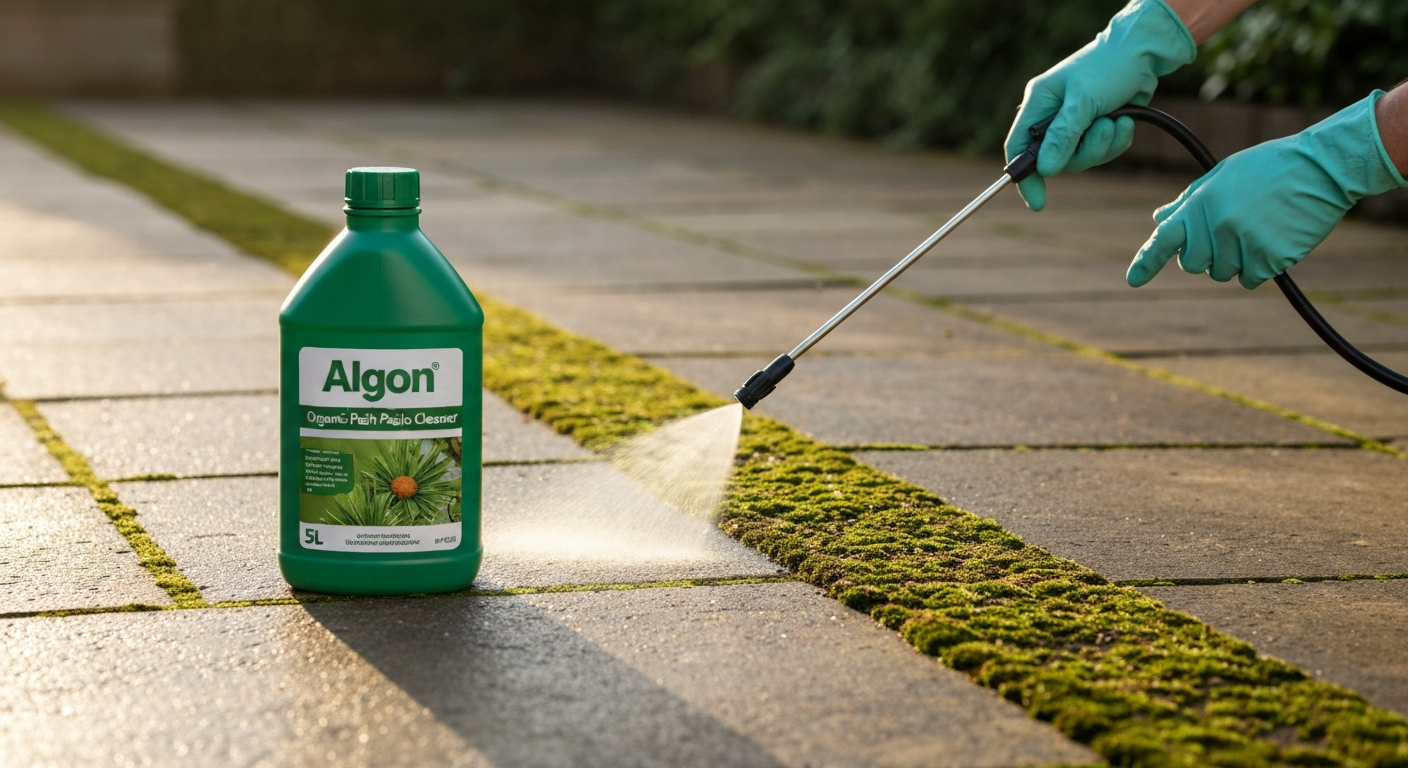
Mosgo Path & Patio Cleaner is a quaternary ammonium biocide (benzalkonium chloride) that works by killing moss, algae, lichen and mould at the root rather than just bleaching the surface. You mix 1 litre of concentrate with 2 litres of water, spray it onto a dry surface, and leave it. No power washing needed. It covers roughly 20 m² per litre of concentrate and is sold in 2.5 L and 5 L packs at most UK garden retailers for somewhere between £8 and £22 depending on size and seller. It genuinely works on green growth, but it is not a universal patio cleaner, rust, grease and pet stains are a stretch, and you need to be careful around plants, drains and pets while it dries. If your main problem is moss and algae on concrete, brick or stone paths, Mosgo is a solid, low-effort option. If you have sandstone, porcelain or a heavy mixed-stain problem, read on before you buy.
Mosgo Path and Patio Cleaner Reviews: Honest Homeowner Guide

Quick verdict: is Mosgo worth it for your patio?
For most UK homeowners dealing with green, slippery paths and patios, Mosgo delivers exactly what it promises. The spray-and-walk-away approach is genuinely convenient, especially if you do not own a pressure washer or want a low-effort autumn and spring treatment. The product scores highest on moss and algae removal, reasonable on lichen and mould, and lower on non-biological stains like rust, grease or pet urine. The environmental classification (H400/H411, very toxic to aquatic life) means you need to think about runoff, and the product is not marketed as pet-safe in the way that some competitors are. It is not the cheapest option per treated square metre, but the ease of use tips the value equation in its favour for most people. If you want a head-to-head comparison with Algon, Doff, Goo Gone or Ultima Plus XP, I have that later in the article.
What Mosgo actually is and how it's sold
Mosgo Path & Patio Cleaner is manufactured by Chemigro and sold under the 'spray and walk away' positioning. The active ingredient is benzalkonium chloride, a quaternary ammonium compound (QAC) that disrupts cell membranes in algae, moss, lichen and fungal biofilms. Peer-reviewed research on QACs confirms they are genuinely effective against photosynthetic colonisers on stone and masonry surfaces, which is consistent with what you will observe in practice. The product is sold as a ready-to-dilute concentrate, not a ready-to-use spray, so you will need a watering can with a fine rose or a knapsack sprayer to apply it properly. Pack sizes in UK retail are 2.5 L and 5 L. You will find it at Homebase, Wilko, OnBuy and eBay, with pricing ranging from around £8 for a 2.5 L bottle to around £22 for 5 L depending on the retailer and any promotions running at the time.
What Mosgo removes: the honest performance breakdown
The product's core strength is biological growth. Moss, algae and lichen are where it earns its reputation. The benzalkonium chloride kills the organisms rather than simply washing them away, which means regrowth is slower than after a basic jet-wash. Mould on paving joints and underneath furniture is also well within its effective range. Where the marketing stretches credibility a little is with claims around rust, grease and pet stains, these are not biological in nature, and a biocide formulation is simply not the right chemistry for them. You might see marginal improvement on light organic pet-stain residues, but if rust or oil stains are your primary problem, you need a dedicated product for those.
| Stain / Growth Type | Mosgo Effectiveness | Notes |
|---|---|---|
| Moss | High | Core use case; kills at root, slow regrowth |
| Green algae | High | Effective across concrete, stone, brick |
| Lichen | Moderate-High | May need a second application on thick lichen |
| Mould / fungal biofilm | Moderate-High | Works well in joints and shaded spots |
| Black algae / dark staining | Moderate | Improvement visible but may need repeat treatment |
| Rust stains | Low | Not the right chemistry; use a dedicated rust remover |
| Grease / oil stains | Low | No degreasing action; needs a separate product |
| Pet urine stains | Low-Moderate | Light organic residue may improve; heavy staining will not |
Surface compatibility: what you can and cannot treat
Mosgo is broadly compatible with hard outdoor surfaces, but 'broadly compatible' does not mean 'safe on everything without checking first.' Always do a test patch on an inconspicuous area before committing to the full surface, particularly with natural stone. Manufacturers like Marshalls explicitly warn that some chemical cleaners can affect the surface finish and potentially void warranties on their products, so checking your paving manufacturer's aftercare guidance is not optional if your installation is under warranty.
| Surface | Compatibility | Notes / Cautions |
|---|---|---|
| Concrete paving | Good | Reliable workhorse surface for Mosgo |
| Brick / block paving | Good | Test mortar joints first; repoint if necessary after |
| Natural stone (general) | Use with caution | Test patch essential; some stones absorb unevenly |
| Sandstone | Caution | Porous and soft; test patch mandatory, risk of staining |
| Slate | Moderate | Usually fine but surface colour can be temporarily altered |
| Limestone / York stone | Caution | Alkaline surfaces can react; always test first |
| Porcelain | Generally good | Non-porous, low absorption risk; rinse thoroughly |
| Decking (timber) | Not recommended | Mosgo is formulated for hard paving, not wood |
| Tarmac / asphalt | Not recommended | Surface chemistry incompatible |
I learned the hard way with a client's Indian sandstone that what looks like a safe test result after 10 minutes can show up as a tide-mark stain after the surface fully dries. Leave your test patch for at least 24 hours and in full daylight before proceeding. With porcelain tiles, you are in better shape, the non-porous surface means the product sits on top rather than penetrating, but you still want to rinse it off thoroughly rather than let it pool and dry.
Before you start: prep checklist
Getting the prep right makes a genuine difference to results. Mosgo is designed to be applied to a dry surface, so timing matters. A common mistake is applying it straight after a rain shower or early in the morning when the paving is still damp from dew, the diluted product will not penetrate as effectively and you will waste concentrate.
- Tools: watering can with a fine rose head or a garden knapsack sprayer (a coarse rose will result in uneven coverage and waste product), stiff-bristled brush or deck scrubber for stubborn areas, garden hose for final rinse
- PPE: chemical-resistant gloves (nitrile or rubber), safety goggles, old clothing that covers skin — the SDS (P280) specifically requires eye and skin protection; if using in an enclosed or poorly ventilated space, add a respirator
- Site prep: remove loose debris, leaves and dirt from the surface before application; dry weeds or moss clumps can stop the product reaching the paving itself
- Plant and pet protection: move or cover any potted plants adjacent to the treatment area; keep pets and children off the surface until fully dry
- Drain protection: block or cover nearby drain grates with a rag or drain cover before you start — Mosgo is classified as H400 (very toxic to aquatic life) and you do not want runoff entering drains before it has broken down
- Test patch: apply diluted product to a 30 cm x 30 cm inconspicuous area, leave for 24 hours and assess before proceeding to the full surface
- Weather check: apply on a dry day with no rain forecast for at least 4 hours; temperatures above 5°C improve biocidal performance
How to apply Mosgo: step-by-step
- Mix the concentrate: combine 1 part Mosgo concentrate with 2 parts clean water (1:2 ratio). For a knapsack sprayer, 1 L concentrate mixed with 2 L water gives you 3 L of working solution ready to apply.
- Check the surface is dry: run your hand across the paving. It should feel dry to the touch. If there is visible moisture, wait. Applying to a damp surface dilutes the product further and reduces contact time.
- Apply evenly: using a watering can with a fine rose or a low-pressure sprayer set to a wide fan, apply the working solution across the surface. Aim for even, wet coverage without large puddles pooling in low spots.
- Dwell time — leave it alone: this is the 'walk away' part. Do not scrub, rinse or walk on the treated surface for at least 24 hours. For heavy moss or thick lichen, 48 hours gives better penetration.
- Scrub if needed: for stubborn areas or textured surfaces with deep-set growth, a stiff brush after the dwell period can help dislodge dead material. This is optional on smooth surfaces.
- Rinse: once the dwell period is complete and the surface has been lightly brushed if needed, rinse with a garden hose using plenty of water. Work from the highest point to the lowest and direct water away from drains where possible.
- Remove dead material: dead moss and algae will often loosen over the days following treatment. A stiff brush or a gentle sweep will clear the residue. Some of this will happen naturally with rainfall.
Dilution, coverage and practical tips
The manufacturer specifies a 1:2 dilution (1 part concentrate to 2 parts water), meaning a 2.5 L bottle gives you 7.5 L of working solution. At the stated coverage rate of roughly 20 m² per litre of concentrate, a 2. Use OECD, ISO and CEN surface‑disinfection and algal‑growth test frameworks as the basis for dose–response and contact‑time measurements; see Chemical disinfection in healthcare settings: critical aspects for the development of global strategies (review referencing EN/ISO/OECD test frameworks). 5 L bottle should treat around 50 m², about the size of a typical UK back garden patio. A 5 L bottle covers approximately 100 m², which works out well for larger driveways or combined path-and-patio areas.
In practice, textured, rough or heavily mossy surfaces will drink more product than the stated rate. On a smooth concrete slab with light algae, you might get closer to 25 m² per litre. On a deeply textured riven slate or heavily colonised brick, expect 15 m² or less. Factor this into your quantity calculation before you buy, especially if you are dealing with a large or heavily affected area.
- Do not be tempted to dilute further to stretch coverage — the 1: 2 ratio is the working minimum for biocidal effectiveness; over-diluting means you may see no results
- Apply in the morning on a forecast-dry day so the product has the full day to work before temperatures drop overnight
- Autumn (September to November) and early spring (February to March) are the optimal UK application windows when moss and algae are actively growing and most vulnerable
- A second application 4 to 6 weeks after the first is recommended for surfaces with heavy lichen or persistent black algae
- Annual preventative treatment is more effective (and cheaper) than waiting for heavy re-colonisation to build up
- Store unmixed concentrate above 5°C, keep the lid sealed and use within 24 months of purchase
Safety and environmental considerations
This section matters more with Mosgo than with some competitors, and I want to be straight about it rather than burying the facts. The active ingredient, benzalkonium chloride, is classified under the SDS as an environmentally hazardous substance (UN3082) with H400 (very toxic to aquatic life) and H411 (toxic to aquatic life with long lasting effects) hazard statements. Peer-reviewed studies confirm that QACs including benzalkonium chloride can mobilise into urban stormwater runoff after patio biocide application, and at environmental concentrations they are toxic to freshwater algae and other aquatic organisms. This is a real concern, not a box-ticking exercise.
- Always wear nitrile or rubber gloves and eye protection during mixing and application (P280 requirement from the SDS)
- In the event of skin contact, wash with soap and water immediately (P302+P352); for eye contact or if swallowed, seek immediate medical attention (P310)
- Block nearby drains before application and do not allow untreated runoff to reach watercourses, storm drains or garden ponds
- Keep pets off the treated surface until it is completely dry — benzalkonium chloride is irritating to mucous membranes and skin, and pets that walk on wet product and then groom themselves may ingest a harmful dose
- Protect garden borders: wet down adjacent soil and plant beds before application, and cover low-growing plants with sheeting if they are close to the treated edge
- Dispose of leftover mixed solution by diluting heavily with water and applying to a non-draining surface such as a gravel border away from drains; do not pour concentrate down a household drain
- Do not use near ornamental ponds, water features or any surface that drains directly to a watercourse
What results to expect: the realistic before-and-after timeline
One of the most common complaints people have with Mosgo is that they apply it, look at the surface the next day, and think nothing has happened. That is normal, and it is actually how the product is supposed to work. The biocide kills the organisms, but the dead material does not disappear instantly. Here is a realistic timeline of what to expect.
| Timeframe | What You Should See |
|---|---|
| Immediately after application | Surface looks wet; no visible change to growth |
| 24–48 hours | Moss may begin to lighten or turn yellow-brown at the edges; algae film starts to dull |
| 3–7 days | Moss visibly dying (brown/black); algae film breaking down; lichen may start to shrink |
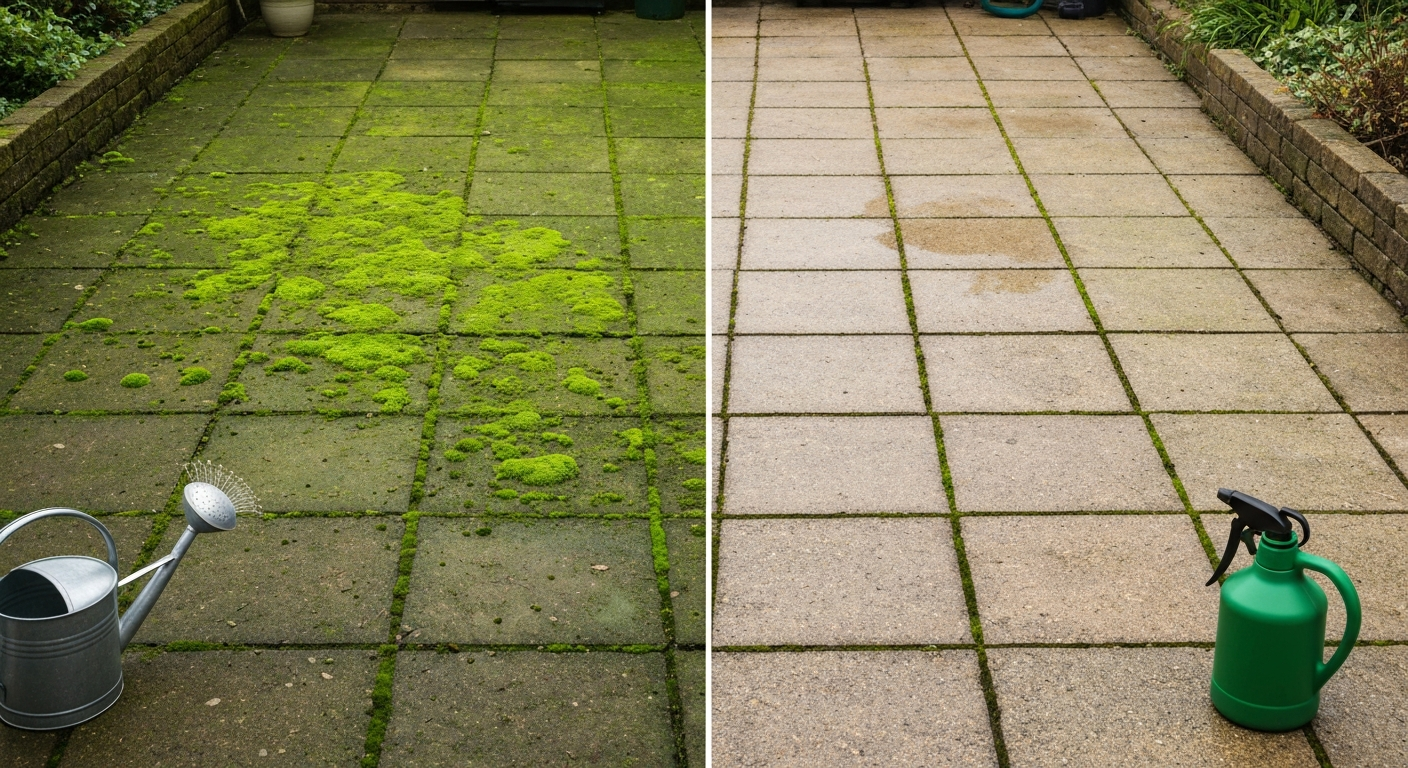
| 2–4 weeks | Dead moss loosening from the surface; significant colour change toward clean paving underneath |
| 4–8 weeks | Most organic growth removed or easily brushed/rinsed off; surface noticeably cleaner |
| 3–6 months | Continued slow clearing of stubborn lichen; preventative effect slows regrowth |
| 6–12 months | On actively managed patios, regrowth significantly delayed vs untreated surfaces |
The 'spray and walk away' claim is accurate in the sense that you do not need to pressure-wash immediately after application. It is not accurate if it creates the expectation of an overnight transformation. Budget at least 4 to 8 weeks to assess full results, especially on thickly colonised surfaces. A light scrub and hose-down at the 3-to-4-week mark helps speed up the removal of dead material and reveals how well the product has worked.
Image suggestions for before-and-after documentation
If you are documenting your own results or this article is being illustrated with site photography, the most useful shots are: a close-up macro shot of the paving surface before treatment showing moss or algae texture clearly; a wide shot of the full area at day zero; the same wide shot at 2 weeks showing the browning effect; and a final shot at 6 to 8 weeks after a brush-down showing the cleaned surface. Including a measuring tape or reference object in the frame helps give scale. For application shots, a photograph of the diluted solution being poured into a watering can rose and the even spray pattern being applied across a section of paving are both practically useful for readers following the guide.
Pros and cons: the honest tradeoffs
- PRO: Genuinely effective on moss, algae and lichen — the QAC chemistry is well-supported by independent research
- PRO: No pressure washer required — low equipment overhead for the application itself
- PRO: Good coverage rate (up to 20 m² per litre of concentrate) makes it cost-competitive for large areas
- PRO: Available widely at UK retailers (Homebase, Wilko, OnBuy, eBay) in practical pack sizes
- PRO: Slow-regrowth effect reduces how often you need to retreat compared to a basic jet-wash
- CON: H400/H411 environmental classification is a genuine concern, especially near ponds, borders or fast-draining patios
- CON: Not pet-safe while wet — requires keeping animals off the treated area until fully dry
- CON: Does not address rust, grease or heavy non-biological staining
- CON: Results take weeks, not hours — not suitable if you need a quick clean before an event
- CON: Requires care on porous natural stone (sandstone, limestone) — test patches are non-optional
- CON: No independent third-party efficacy testing published by the manufacturer to verify coverage and performance claims
Pricing, value and where to buy
Mosgo is widely available across UK garden and DIY retail channels. Based on current listings, a 2.5 L bottle sits in the £8 to £12 range and a 5 L bottle runs from around £15 to £22 depending on the retailer and whether any promotions are active. At the 20 m² per litre coverage rate, a 2.5 L bottle covering 50 m² at roughly £10 works out to about 20p per square metre treated. That is reasonable value for a biocide treatment, though it is worth noting that some competitors (including Algon) can be bought in larger bulk packs at lower per-litre cost. For online purchases, OnBuy and eBay often undercut Homebase and Wilko on price, particularly on the 5 L size. For those who prefer to buy in-store and collect immediately, Homebase and Wilko are the most reliably stocked. If you want to compare physical retail options and the best current pricing, the where to buy patio cleaner resource on this site covers current UK stockists across multiple product lines.
Mosgo vs the competition: head-to-head comparison
Mosgo does not exist in isolation. The UK market has several well-established competitors, and depending on your surface, stain type and environmental concerns, one of them may suit you better. Here is how Mosgo stacks up against the four closest alternatives. For another relevant comparison, see goo gone patio furniture cleaner reviews.
| Product | Active Chemistry | Target Growth | Dilution | Pet Safe (as marketed) | Environmental Classification | Approx Cost (2.5 L) | Ease of Use |
|---|---|---|---|---|---|---|---|
| Mosgo Path & Patio Cleaner | Benzalkonium chloride (QAC) | Moss, algae, lichen, mould | 1:2 | No (toxic while wet) | H400/H411 aquatic hazard | ~£10 | High (spray and walk away) |
| Algon Organic Path & Patio Cleaner | Organic acid blend | Algae, moss, lichen | 1:3 | Yes (marketed as pet safe) | Lower environmental risk | ~£12 | High (dilute and apply) |
| Doff Patio Cleaner | Sodium hypochlorite (bleach-based) | Algae, mould, staining | Ready to use or diluted | No | Moderate (bleach) | ~£8 | Moderate (rinse required) |
| Goo Gone Patio Furniture Cleaner | Citrus-based surfactant | Grease, grime, surface dirt | Ready to use | Generally yes | Low | ~£9 | High (spray and wipe) |
| Ultima Plus XP Patio Cleaner | Quaternary ammonium + surfactant blend | Moss, algae, mould, general dirt | 1:10 to 1:20 | Check SDS | Moderate aquatic hazard | ~£15 | High (dilute and apply) |
The clearest alternative to Mosgo is Algon. If pet safety is a priority, or you are treating a surface that drains quickly into a garden border or near a pond, Algon's organic acid formulation and 'pet safe' marketing give it a meaningful advantage over Mosgo. Performance on moss and algae is broadly comparable between the two products, though Algon tends to work more slowly. If you want a detailed look at how Algon performs across surface types, the Algon patio cleaner review on this site covers it fully. For general grime, grease and surface dirt rather than biological growth, Goo Gone Patio Furniture Cleaner is a more appropriate product and is worth a look for mixed-stain situations. Ultima Plus XP offers a more aggressive dilution ratio (up to 1:20) that can make it very cost-effective for large areas, and it handles mixed dirt and biological growth together, the Ultima Plus XP patio cleaner review has more detail on that. See our Ultima Plus XP patio cleaner reviews for full details on dilution ratios, performance and cost‑effectiveness. Doff is the budget option and works well for a quick algae and mould knockback but requires more rinsing and tends to bleach rather than kill, so regrowth returns faster.
Practical alternatives: when to skip Mosgo entirely
Pressure washing
A pressure washer removes moss, algae and loose contamination immediately and visibly, which is the main practical advantage over a slow-acting biocide like Mosgo. If you need results before a garden party this weekend, pressure washing is the right tool. The trade-off is that pressure washing without a follow-up biocide treatment means regrowth returns faster, you are removing the growth physically rather than killing it. Karcher and other manufacturers advise against running bleach-based or corrosive chemical cleaners through domestic pressure washer units, so pairing a machine with a QAC biocide requires care around detergent compatibility. For most domestic patios, pressure washing combined with an annual Mosgo treatment gives the best combination of immediate visual results and long-term prevention.
Oxygen-bleach mixes (sodium percarbonate)
Sodium percarbonate (the active ingredient in products like OxiClean and many branded patio powders) releases hydrogen peroxide on contact with water and has good activity against algae, mould and general organic staining. It breaks down into oxygen, water and soda ash with minimal persistent environmental impact, making it a lower-environmental-risk option than benzalkonium chloride. The practical downside is that it requires more manual effort, mixing, applying as a paste or solution, scrubbing, and rinsing, and it does not have the same multi-week residual prevention effect as a QAC biocide. For a one-off heavy clean on a heavily stained surface where you then plan to seal the paving, oxygen bleach is a strong choice. For ongoing annual maintenance with minimal labour, Mosgo has the edge.
Professional cleaning services
For large areas (over 100 m²), severely neglected surfaces, delicate natural stone where chemical compatibility is genuinely uncertain, or anywhere with complex drainage situations, hiring a professional soft-washing or patio cleaning service is worth considering. Professionals have commercial-grade low-pressure biocide application equipment, experience with surface-specific chemistry, and the ability to neutralise and contain runoff. Expect to pay £3 to £8 per square metre for a professional clean, which quickly exceeds the DIY cost for small areas but becomes more reasonable for large or complex jobs.
Troubleshooting common problems
No visible improvement after 4 weeks
The most common cause is application to a damp surface, over-dilution, or insufficient coverage. Check that you mixed at the correct 1:2 ratio, that the surface was genuinely dry, and that you applied enough solution to achieve wet coverage rather than a light mist. A second full-rate application after a dry period of at least 48 hours usually resolves this. Thick lichen, particularly orange or grey lichen on natural stone, is the hardest target and may need two or three treatments several weeks apart.
White residue or tide marks after rinsing
Tide marks and white residue are usually the result of product drying before rinsing, particularly on porous surfaces like sandstone or textured concrete. If you see this, scrub the affected area with a stiff brush and warm water. A dilute white vinegar solution (roughly 1:10 in water) can help dissolve the residue if plain water does not shift it. To avoid this in future, do not allow the working solution to dry completely on porous surfaces in hot or windy conditions, rinse within 24 to 48 hours of application rather than leaving it indefinitely.
Surface discoloration after treatment
Temporary darkening or colour change on natural stone is common during the treatment process and usually resolves as the surface dries fully. Permanent discoloration is most likely to occur on sandstone, limestone or unfinished clay pavers and is typically caused by the chemistry interacting with iron minerals or organic compounds in the stone. This reinforces why the test patch step is non-negotiable on natural stone. If permanent discoloration has already occurred, consult the original paving manufacturer for their recommended restoration approach, as some discoloration can be addressed with a specialist stone poultice or light acid treatment, but that is a surface-specific repair job, not a Mosgo issue per se.
Stubborn black spots or dark algae that will not shift
Deep-seated black algae (often Gloeocapsa magma or similar cyanobacterial species) on concrete is one of the hardest targets for any patio biocide. Mosgo can weaken the biofilm, but thick deposits may need a combination approach: apply Mosgo at full rate, leave for 48 hours, then follow with a light pressure wash to physically remove the dead material, then apply a second Mosgo treatment and leave for another 4 weeks. This two-stage approach consistently outperforms either method used in isolation.
FAQ
What primary documents and authoritative sources should I collect before reviewing Mosgo Path & Patio Cleaner?
Collect the product Technical Data Sheet (TDS), Safety Data Sheet (SDS), and the manufacturer product page (application/dilution/coverage claims). Add retailer listings for pack sizes/pricing (Homebase, Wilko, etc.). Obtain competitor TDS/SDS (Algon, Doff, Ultima Plus XP, Goo Gone) and independent standards/guidance (ISO/OECD/CEN test methods, stone manufacturer aftercare like Marshalls). Finally gather peer‑reviewed literature on quaternary ammonium compounds (QACs) and environmental fate/toxicity.
Which laboratory and field tests are required to evaluate performance (what stains it removes)?
Use a combination of controlled lab assays and real‑world field panels: (1) Laboratory: ISO/OECD algal growth inhibition or carrier/surface tests to measure dose–response (EC50) vs representative algae and fungal species; (2) Field panels: replicate treated areas on common substrates inoculated or exhibiting moss, algae, lichen, mould, rust, grease and pet stains; include untreated controls and competitor treatments; (3) Measure endpoints at standardized contact times (1 h, 24 h, 7 d, 28 d, 3–12 months), record % cover reduction, regrowth rate, and visible stain removal; (4) Quantify required application volume (mL/m²), dilution, and number of passes for removal of non‑biological stains (grease, rust).
How should I design field trials to produce reproducible, actionable results?
Use randomized blocks across representative substrates (concrete, natural stone, brick, sandstone, slate, porcelain). For each stain type include n≥3 replicates per treatment (Mosgo at recommended dilution, stronger/weaker dilutions, competitor products, pressure wash, oxygen‑bleach mix, and untreated control). Standardize: surface area (e.g., 1 m² panels), application volume (mL/m²), ambient conditions (temperature, rain), contact time, and post‑treatment rinsing. Photograph with fixed camera position, scale and lighting at baseline and each timepoint; log weather and any subsequent cleaning actions. Run tests across seasons where possible to capture regrowth.
What performance metrics and observations should be recorded?
Record: percent visible stain/biomass reduction (image analysis or grid scoring), time to first visible improvement, contact time required, number of treatments, residual staining or discoloration, effects on surface texture/colour, need for mechanical assistance (scrubbing/pressure wash), and longevity (months until re‑colonisation). For non‑biological stains measure stain lightening (colorimetry if available) and any chemical reactions (e.g., bleaching, efflorescence).
What safety and environmental evidence is essential to include?
Cite the SDS for PPE and emergency measures (eye/skin protection, inhalation risks), and transport/classification (e.g., UN3082). Review peer‑reviewed ecotoxicology literature on QACs (toxicity to algae, persistence, runoff risk). Include runoff mitigation guidance (avoid application before rain, block drains, collect washings), legal/disposal considerations, and manufacturer restrictions for use near watercourses. If possible include field runoff monitoring or cite relevant studies on benzalkonium chloride mobilisation.
How do I verify manufacturer operational claims like "spray and walk away" and coverage figures?
Measure real coverage by applying the recommended dilution and recording treated area per litre (m²/L) under typical homeowner spraying methods (pump sprayer, knapsack) and compare to claimed ~20 m²/L. Test efficacy with single application to see whether "spray and walk away" achieves acceptable removal within advertised timeframe; document cases where repeat treatments or mechanical help are needed. Report practical deviations (wind, surface porosity, heavy biofilm).
Algon Patio Cleaner Reviews: Complete Guide for Homeowners
Algon patio cleaner reviews: real-world verdict, surface-by-surface performance, step-by-step use & buying advice.