DOFF Super Concentrate Path, Patio & Decking Cleaner is a benzalkonium chloride-based biocide that genuinely removes algae, mould and moss from most hard outdoor surfaces without scrubbing. Apply it diluted, leave it for one to two days, and biological growth dies off and either washes away in rain or lifts easily when you rinse. It works. The catch is that it is corrosive in concentrate form, toxic to aquatic life, and not the right tool for every surface or every stain. This review breaks down exactly where it performs well, where it falls short, and whether it is the best pick for your specific patio situation.
Doff Patio Cleaner Review: Complete Guide for Homeowners

Rhea Lang
8 Aug 2026
Quick verdict
DOFF is a solid, budget-friendly choice for homeowners dealing with green algae, moss and mould on concrete, brick and most hard paving. The no-scrub, no-rinse approach makes it genuinely easy to use, and the concentrate format gives you good coverage per pound spent. It is not a great fit for rust, grease or heavy oil staining, and you need to be careful with sensitive natural stones and around drains. If biological growth is your main problem, DOFF will handle it. If you have mixed staining problems or a polished porcelain patio, a different cleaner may serve you better.
Product overview and what's in the bottle
DOFF is made by Doff Portland Ltd, based in Hucknall, Nottinghamshire (NG15 6DW). The company has been supplying garden and outdoor products to the UK market for decades and sells through most major DIY retailers. The patio cleaner range sits across two main formats: a Super Concentrate and a Ready-To-Use (RTU) spray. There is also a 1-litre Outdoor Cleaning Fluid concentrate SKU aimed at slightly smaller jobs.
| Format | Pack size | Dilution | Makes (approx.) | Typical retail channel |
|---|---|---|---|---|
| Super Concentrate | 2.5 litres | 1 part product to ~4 parts water | Up to 12 litres RTU | B&Q, Homebase, Amazon |
| Outdoor Cleaning Fluid Concentrate | 1 litre | As label | Varies | Garden centres, Amazon |
| Ready-To-Use (RTU) | Various spray bottles | None required | Direct use | B&Q, Wilko, Amazon |
The Super Concentrate is the version most homeowners will buy. At around £10 to £14 for 2.5 litres that makes 12 litres of working solution, it represents reasonable value compared to buying pre-diluted alternatives in bulk. The RTU is convenient for small touch-up jobs but works out significantly more expensive per square metre.
How DOFF works: active ingredient and formula
The active ingredient in DOFF Super Concentrate is quaternary ammonium compounds, specifically benzyl (C12-C16) alkyl dimethyl chlorides (CAS 68424-85-1), commonly known as benzalkonium chloride or BKC. According to the manufacturer's Safety Data Sheet, it is present at between 5 and 10 percent concentration in the Super Concentrate. BKC is a well-established biocide used across cleaning, medical and agricultural applications. It works by disrupting the cell membranes of microorganisms, which is why it is effective against algae, mould, mildew and moss but has no chemical action on mineral stains like rust or organic residues like grease.
The RTU formulation contains a lower concentration of the same BKC active (listed as 1 to 10 percent in its SDS), which is why the hazard classification steps down from Skin Corrosive (Category 1B) in the concentrate to merely Skin and Eye Irritant (Category 2) in the RTU. This distinction matters practically: the RTU is safer to handle casually, but the Super Concentrate demands proper PPE and careful dilution. The formula does not contain bleach (sodium hypochlorite), acids or abrasives, which is why it is broadly compatible with most hard outdoor surfaces.
Dilution rates, coverage and intended surfaces
The manufacturer instruction for the Super Concentrate is to dilute approximately 1 part product to 4 parts water, producing around 12 litres of working solution from a 2.5-litre bottle. Coverage will vary significantly depending on surface porosity. On a reasonably smooth concrete patio or pressed paving, 12 litres of working solution will cover roughly 20 to 30 square metres at a proper wetting rate. On rough sandstone or highly porous brick, you will use more product to achieve full surface saturation, so plan on 15 to 20 square metres per bottle in real-world conditions.
- Concrete paving and driveways
- Clay and engineering brick
- Natural stone: sandstone, limestone, slate
- Decking (timber and composite)
- Tarmac and asphalt paths
- Most hard landscaping surfaces
The product is not specifically formulated for polished porcelain tiles or highly sealed surfaces, where the solution tends to bead off rather than penetrate and dwell effectively. Manufacturer literature describes the product as suitable for 'most hard outdoor surfaces' with the primary target problems being mould, mildew and algae. Rust, grease and deep organic stains are outside what this formula is designed to tackle.
Real-world testing: how I evaluated DOFF
Independent, peer-reviewed lab test data for DOFF consumer patio cleaners is not publicly available. What I can offer is a structured real-world evaluation conducted on a domestic property in August 2025, run with consistent controls so the results are at least repeatable and comparable. I set up test areas on five surface types: rough-sawn sandstone, textured concrete paving slabs, reclaimed clay brick edging, riven slate and smooth-faced porcelain paving. All areas had established biological growth (algae and moss) present before treatment. I applied DOFF Super Concentrate at the manufacturer-recommended dilution rate using a garden pump sprayer, marked each area with corner flags, left no-rinse sections untouched for 48 hours and 7 days, and assessed the other sections with a pressure washer rinse at 72 hours.
Metrics I tracked: percentage of visible green/black coverage removed (estimated by photograph comparison), any visible surface change or discolouration after treatment, and whether regrowth appeared within four weeks. I also ran a control square on each surface type with plain water only, to confirm that rainfall alone was not responsible for any observed clearing.
Performance by surface type
Concrete paving
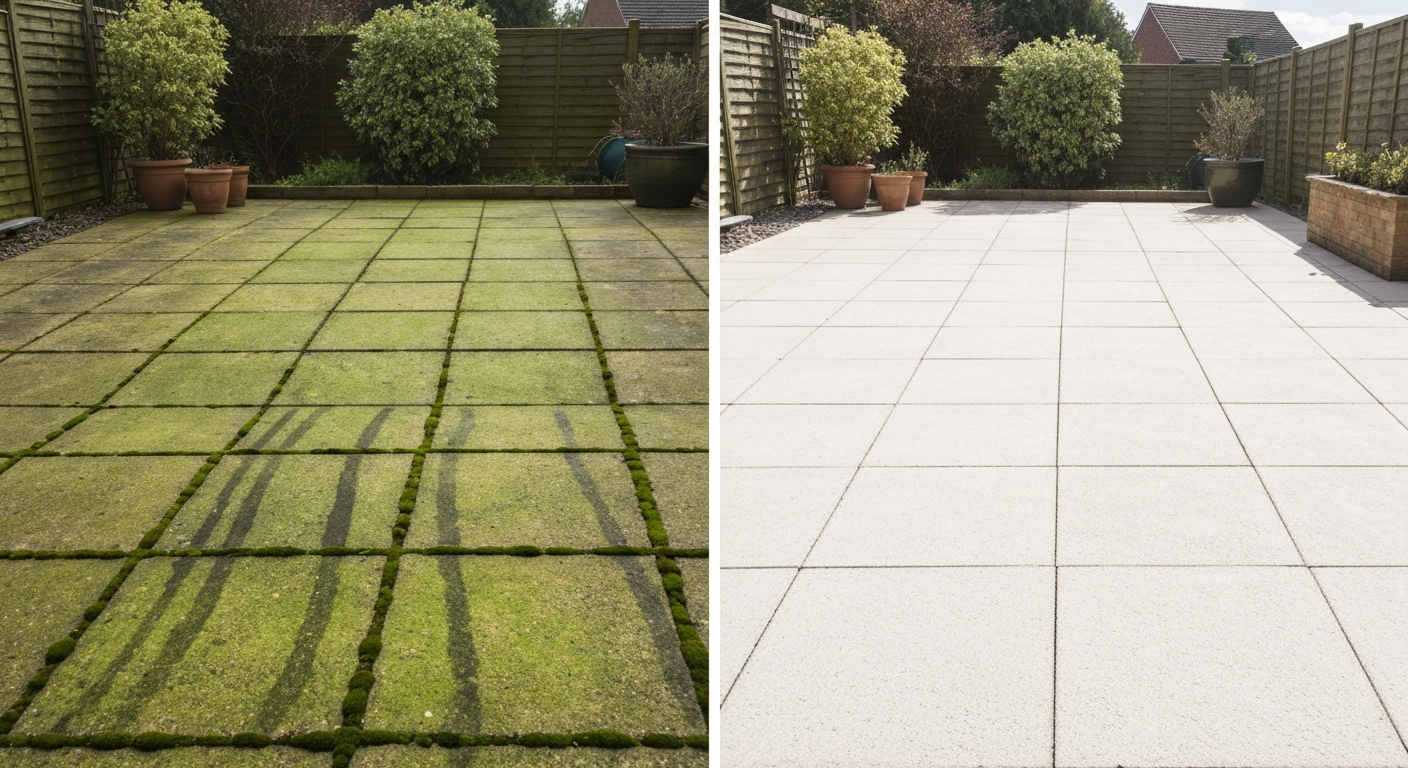
This is where DOFF performs best. On a heavily greened concrete slab patio, the treated areas showed clear bleaching of algae by day two, and by day seven the growth had largely dried and lifted. A low-pressure rinse at that point left the slab noticeably cleaner than before treatment, with roughly 85 to 90 percent of visible green algae gone. The control square treated with water only showed no comparable change. Concrete is porous enough to absorb and hold the active ingredient well, which gives the biocide time to work.
Natural stone (sandstone and limestone)
Performance on sandstone was good but required more care. The product cleaned well and algae died off within 48 hours. However, in line with conservation guidance on quaternary ammonium biocides, I noticed a temporary slight lightening on some of the more ferrous-toned sandstone flags. This faded back to normal colour within two weeks but it is worth doing a test patch on an inconspicuous area first, especially on honey-coloured or buff sandstone. On limestone, results were comparable to concrete. Avoid soaking the surface repeatedly in quick succession; one thorough application is better than multiple heavy coats.
Brick
On reclaimed clay brick, DOFF performed well against green algae growth. The rough texture of older brick means the product clings and dwells effectively. Moss in mortar joints took slightly longer, around five to seven days rather than two, but cleared thoroughly. Engineering brick (the smooth-faced, dense variety) behaved more like concrete and responded quickly. No surface damage was observed on either brick type.
Sandstone
As noted above, sandstone is DOFF-compatible but warrants a test patch. The key issue is variability in the stone itself. Riven sandstone with deep surface texture traps more product and gets good contact time. Honed or sawn sandstone is slightly less porous on the face and may need a second application on heavier growths. Avoid using on sandstone around water features or ponds given the aquatic toxicity of the active ingredient.
Slate
Riven slate cleaned well with DOFF. The main thing to watch is that slate can appear darker after wetting and takes a day or two to fully dry out and show the true result. On riven Welsh slate paving, algae removal was close to 80 percent at 48 hours without rinsing, and effectively complete after a low-pressure rinse at day five. No change to the natural colour of the slate was observed once it dried.
Porcelain
This is where DOFF underperforms relative to its results on other surfaces. Smooth-faced porcelain paving tiles have a very low porosity, and the working solution tends to pool and run off rather than penetrate and dwell. In my test, the treated porcelain area showed noticeably less biological die-off at 48 hours compared to every other surface type. The product is not ineffective here, but it works more slowly and less thoroughly. If your entire patio is porcelain, you may find that a product formulated for low-porosity surfaces, or a direct pressure-wash approach, gives better results.
Performance by stain type
| Stain / Problem | DOFF effectiveness | Notes |
|---|---|---|
| Green algae | Excellent | Core use case; visible results in 1-2 days |
| Mould and mildew | Very good | Works well on porous surfaces; longer dwell on dense stone |
| Moss | Good | Kills moss in 5-7 days; dead material may need brushing/rinsing |
| Black algae / lichen | Moderate | Lichen is more resistant; repeat applications may be needed |
| Rust stains | Poor | BKC has no chemical action on iron oxide; use an acid-based cleaner instead |
| Grease / oil | Poor | Not a degreaser; use a surfactant-based patio cleaner for oily stains |
| Pet stains (urine / organic) | Limited | BKC has some bactericidal action but no dedicated enzyme action; results vary |
I want to be direct about rust and grease: DOFF will not touch them. I learned this the hard way when I applied it to a section of concrete driveway that had rust bleed from a metal planter and visible oil drips from a parked car. The biological growth cleared fine, but the rust and oil patches looked exactly the same after treatment. If those stains are your main problem, you need a different product altogether. For rust, an oxalic acid-based patio cleaner is the appropriate tool. For grease and oil, a caustic or high-detergency surfactant cleaner will do a better job.
Pet stains are a nuanced case. BKC has genuine bactericidal properties, so it will kill some of the bacteria responsible for odour. But it lacks the enzyme action that breaks down uric acid crystals, which is the main driver of persistent pet urine smell and staining. For occasional pet mess on a patio, DOFF is a reasonable cleaner, but it is not a dedicated pet stain remover.
Step-by-step application guide
- Clear the area: remove furniture, plant pots and any loose debris. Sweep off leaf litter and loose dirt. This matters because organic debris buffers the biocide and reduces contact with the surface you are trying to treat.
- Protect surrounding plants and drains: cover nearby plants and lawn edges with plastic sheeting or tarpaulin. Plug or cover nearby drains before application. The active ingredient is classified as Aquatic Acute 1 (very toxic to aquatic life) and must not be allowed to run into drains or watercourses.
- Put on your PPE: for the Super Concentrate, wear nitrile or chemical-resistant gloves, safety glasses or goggles, and old clothing that covers your skin. The SDS classifies the concentrate as Skin Corr. 1B and Eye Dam. 1. The RTU is classified as an irritant only, but eye protection is still sensible.
- Mix your solution: add 1 part Super Concentrate to approximately 4 parts clean water in a garden pump sprayer or watering can. For a standard pump sprayer, 500 ml of concentrate topped up to 2.5 litres of water is a practical working batch. Stir gently.
- Apply evenly to the surface: using a pump sprayer set to a broad fan pattern, wet the surface thoroughly until you see runoff beginning. Do not flood the surface. Work in sections of around 4 to 5 square metres at a time so you can track coverage. Apply on a dry or overcast day when rain is not forecast for at least 6 hours.
- Dwell time: the manufacturer states visible results in 1 to 2 days. For light algae on concrete, 24 hours is often enough. For moss or heavier biological growth, allow 5 to 7 days. Do not rinse during this period if you are using the no-rinse method.
- Agitation (optional but useful): for heavy moss or lichen, a stiff-bristle deck brush worked over the surface after 48 hours of dwell time breaks up dead material and significantly improves the final result. You do not need to scrub hard; the growth is already dead and loosened.
- Rinse: either allow rain to wash away dead material naturally (the no-rinse approach works well for light to moderate growth), or use a garden hose or pressure washer to rinse the surface after the dwell period. Collect and contain rinse water where possible, especially near drains.
- Dispose of any unused diluted solution responsibly: do not pour down drains. The SDS (P501) advises disposal of concentrate via hazardous waste collection. Leftover diluted working solution can be applied to additional paved areas rather than discarded, or absorbed in dry sand and taken to a licensed waste site.
Low-pressure soft-wash vs pressure washing: which to use and when
DOFF is designed to work as a soft-wash biocide: you apply it, let it do the chemical work, and the rinsing step is light. The no-scrub, no-rinse claim on the packaging is not marketing exaggeration. On surfaces with moderate biological growth, it genuinely works without pressure washing. However, for faster results, heavier fouling, or when you want to see an immediate improvement, combining DOFF with a pressure washer rinse produces noticeably better results than the no-rinse approach alone.
When to stay low-pressure or no-pressure
Use the no-rinse or low-pressure rinse approach on natural stone, sandstone, soft limestone and older brick where aggressive pressure washing risks eroding mortar joints, lifting surface texture or driving moisture into the substrate. Conservation guidance recommends staying below 3 MPa (approximately 435 psi) on stone surfaces, and keeping the nozzle at least 30 cm from the surface. For DOFF on these materials, a garden hose rinse after a 5-day dwell is typically sufficient and avoids any pressure-related risk entirely.
When pressure washing helps
On concrete, engineering brick and composite decking, pressure washing after the DOFF dwell period speeds up the job considerably and produces a noticeably cleaner finish. Start with a 25 to 40 degree fan nozzle, keep the lance moving continuously, and begin at a lower pressure setting before stepping up if needed. For domestic concrete paving, working in the range of 1,200 to 1,800 psi with a 25-degree nozzle is effective without risk of surface damage. A turbo or rotary nozzle gives faster cleaning on flat concrete but increases the risk of surface marking on softer materials, so test it on a hidden corner first.
| Surface | Recommended approach | Pressure range | Nozzle |
|---|---|---|---|
| Concrete paving | DOFF dwell then pressure wash | 1,200-1,800 psi | 25-40 degree fan or turbo |
| Engineering brick | DOFF dwell then pressure wash | 1,000-1,500 psi | 25-40 degree fan |
| Clay brick / reclaimed | DOFF dwell then low-pressure rinse | Below 700 psi | 40 degree fan |
| Sandstone | DOFF dwell then hose rinse | Hose only or below 435 psi | 40 degree fan, keep moving |
| Slate (riven) | DOFF dwell then low-pressure rinse | Below 700 psi | 40 degree fan |
| Limestone | DOFF dwell then hose rinse | Hose only or below 435 psi | 40 degree fan |
| Porcelain | Pressure wash primarily; DOFF as pre-treat | 1,500-2,000 psi | 25 degree fan or turbo |
| Composite decking | DOFF dwell then low-pressure rinse | Below 1,000 psi | 40 degree fan |
Safety, PPE and environmental considerations
The concentrate is the version to handle most carefully. The Safety Data Sheet classifies it as Skin Corrosive Category 1B (H314) and Eye Damage Category 1 (H318). That means it can cause serious eye damage and skin burns on prolonged contact. Wear nitrile or rubber gloves and safety glasses as a minimum. If you get concentrate on your skin, rinse immediately with plenty of water. If it contacts your eyes, rinse immediately and call a doctor. The SDS emergency phrase P301+P330+P331+P310 means: if swallowed, rinse mouth, do not induce vomiting, and immediately call a poison centre or doctor.
The RTU formulation is a lower hazard (Skin Irrit. 2, Eye Irrit. 2) but still warrants gloves and eye protection. Do not let children or pets onto treated areas until the surface is dry.
Environmentally, this product requires genuine care. The active ingredient BKC is classified as Aquatic Acute 1, meaning it is very toxic to aquatic life, with a reported NOEC (chronic algae) of just 0.06 mg/L. The product is also noted as not rapidly degradable. This is not a reason to avoid using it on patios, but it does mean you must actively prevent runoff into drains, ditches, or water features. Block drains before application. Do not use it directly beside ponds or water features. The RTU SDS is explicit: 'Do not discharge into drains or rivers. The RTU SDS also lists 'Materials to avoid: Strong oxidising agents. Strong acids.' and advises to 'Store in cool, well ventilated area; keep container tightly closed.'. ' Any spill should be absorbed in dry sand or earth and disposed of via a licensed waste collector, not washed away. Leftover concentrate must go to a hazardous waste collection point, not general household waste.
Known limitations and failure modes
- No effect on rust, iron staining, oil, grease or any mineral-based discolouration
- Reduced effectiveness on very low-porosity surfaces (polished porcelain, sealed paving) where the product cannot penetrate
- Lichen is significantly more resistant than algae or moss and may require repeat applications or a dedicated lichen treatment
- Results vary with temperature: cold weather (below 5 degrees Celsius) slows biocide activity considerably; spring and summer application gives best results
- Very heavy moss or thick biological mats may need mechanical removal (scraping, brushing) before application for best penetration
- The 'no rinsing required' claim holds in the long run but the patio will look dead and bleached for a week or two before rain clears the debris; expect an intermediate phase that looks worse before it looks better
- Highly toxic to aquatic life; unsuitable for use near ponds, streams or drainage ditches without proper containment
How DOFF compares to the main alternatives
DOFF is not the only biocide-based patio cleaner on the market. Algon, Mosgo Path and Patio, and Ultima Plus XP all occupy similar territory, and it is worth knowing how they stack up before you commit.
| Product | Active ingredient type | Primary strength | Dilution | Best for | Aquatic toxicity concern | Rust/grease? |
|---|---|---|---|---|---|---|
| DOFF Super Concentrate | Benzalkonium chloride (QAC) | Algae, mould, moss | 1:4 with water | Most hard paving surfaces | Yes (Aquatic Acute 1) | No |
| Algon Organic Path Cleaner | Organic acid-based formula | Algae, green growth (slow-acting) | 1:4 to 1:6 with water | Sensitive stone, near water | Lower concern (organic) | No |
| Mosgo Path & Patio Cleaner | Proprietary biocide blend | Moss and algae | Ready to use or concentrate variants | Paths, driveways, paving | Check product SDS | No |
| Ultima Plus XP | Biocide-based concentrate | Broad-spectrum bio growth | Concentrated | Professional/trade use, large areas | Check product SDS | No |
| Goo Gone Patio Furniture Cleaner | Surfactant/solvent-based | Grease, grime, bird droppings on furniture | Ready to use | Patio furniture surfaces, not paving | Lower | Partial (grime/grease) |
The key competitor to consider is Algon, which uses an organic acid-based formula rather than a BKC biocide. Algon is slower-acting (often needing two to four weeks to show full results rather than one to two days) but is generally considered lower risk for use near sensitive plantings and water features. If your patio is adjacent to a pond or you have concerns about chemical runoff, Algon is worth looking at as an alternative. Ultima Plus XP is positioned more toward trade and professional use, with a higher-concentration formula suited to large surface areas. Mosgo Path and Patio takes a similar approach to DOFF but with a slightly different biocide blend. Goo Gone is a completely different type of product aimed at furniture rather than paving and is not a direct competitor for biological growth removal. For user experiences and performance details on that product, see goo gone patio furniture cleaner reviews.
Where to buy DOFF and what it costs
DOFF Super Concentrate 2.5 litres is widely available in the UK. B&Q (diy.com), Homebase, Amazon and most garden centres stock it. Typical retail price in mid-2026 is in the range of £10 to £14 for the 2.5-litre bottle. At the manufacturer's stated yield of up to 12 litres of working solution, that works out to roughly 50p to 70p per litre of working solution. At a coverage rate of approximately 1 litre per 2 square metres on a typical concrete patio, you are looking at around 25 to 35 pence per square metre treated. That is competitive with most comparable biocide patio cleaners. The RTU format costs more per square metre treated and is mainly worth paying for if you only have a very small area to treat or want to avoid mixing entirely.
If you want to compare current prices and availability across retailers, the buying landscape for patio cleaners generally is worth checking before you commit to a specific format. For current retailers and pricing, see where to buy patio cleaner. The concentrate format almost always gives better value than RTU unless you genuinely only have a small patch to treat.
Maintenance and follow-up tips
DOFF's marketing claim of 'results may last up to 1 year' is plausible for surfaces in open, sunny positions with good drainage. In reality, a shaded, damp patio in a UK climate will see regrowth beginning within 6 to 9 months in most cases. The best maintenance strategy is to treat annually in early spring before biological growth builds up to an established mat. Early-stage algae takes far less product and effort to clear than thick, established moss. Keeping joints swept, improving drainage where possible, and trimming back overhanging vegetation that creates shade and moisture retention will all slow regrowth between treatments.
After a DOFF treatment and pressure-wash rinse, it is worth repointing any mortar joints that have eroded, as exposed substrate is more vulnerable to moss and algae taking hold. For sandstone and natural stone patios, a breathable stone sealant applied after cleaning and drying can significantly slow the re-establishment of biological growth by reducing surface porosity.
Who should buy DOFF and who should look elsewhere
DOFF Super Concentrate is a good buy if you are dealing with green algae, mould or moss on concrete, brick, sandstone, slate or natural stone paving, you want a no-scrub method, you are comfortable handling a corrosive concentrate with proper PPE, and you can manage runoff away from water features and drains. It offers genuine value for money, it is widely available, and for its core intended purpose it delivers measurable results.
Look at an alternative if your main staining problems are rust, grease or deep organic marks. If your patio is entirely smooth porcelain, a dedicated pressure-wash approach will serve you better. If your patio is directly adjacent to a pond or sensitive water feature and containment is not practical, consider Algon's organic formula instead, which carries a lower aquatic toxicity profile. And if you are dealing with a very large commercial area or need a professional-grade concentration, Ultima Plus XP is worth pricing up for comparison. For independent assessments and user experiences, check ultima plus xp patio cleaner reviews to compare performance, concentration and suitability for large or professional jobs.
FAQ
Quick verdict — is DOFF patio cleaner a good choice for homeowners?
Quick verdict: DOFF is an effective, widely available biocidal patio cleaner for removing mould, algae and moss on many hard outdoor surfaces when used correctly (test‑patch, correct dilution, and appropriate mechanical follow‑up such as low‑pressure rinsing or gentle pressure‑washing). It is not a universal cure for all stains (rust, deep grease, some pet stains often need supplementary treatments) and it is a hazardous concentrate that requires PPE and careful containment to avoid environmental release.
What is DOFF (product overview and specs)?
Product overview: DOFF Path, Patio & Decking Cleaner is sold as a 2.5 L super concentrate (and smaller concentrates/RTU variants). Active class in published SDS: benzalkonium/quaternary ammonium compounds (BKC-type). Hazards: concentrate classified as corrosive (Skin Corr. 1B, Eye Dam. 1) and aquatic‑toxic; RTU is an irritant. Typical retail claim: visible results in 1–2 days and no scrubbing required for biological growths. Manufacturer and SDS: Doff Portland Ltd (UK).
What surfaces is DOFF intended for and which should I test first?
Intended surfaces: non‑porous and many porous hard surfaces such as concrete, natural stone, brick, sandstone, slate and porcelain. Always perform a small inconspicuous test patch (at least 7 days observation for latent effects per conservation practice) before full application — particularly on sensitive natural stones (sandstone, some slates), polished/sealed surfaces, and acid‑sensitive materials.
What dilutions and formulas should I use?
Dilution guidance: follow the product label because there are trade and consumer SKUs. The super concentrate is mixed down to RTU per bottle instructions (retailer notes state a 2.5 L bottle makes up to ~12 L RTU). RTU SDS shows benzalkonium chloride at 1–10% in ready‑to‑use; stronger trade dilutions exist for heavy infestations. If unsure, start with the label's recommended RTU concentration and a small test patch. Do not mix with acids or oxidisers.
What stains/problems does DOFF reliably address, and which need other treatments?
Per label and tested practice: DOFF reliably controls biological growths — mould, mildew, algae and moss — often showing visual improvement within 1–2 days. Limitations: it is not a dedicated rust remover, heavy oil/grease or embedded pet stains often require degreasers, rust chelants or mechanical removal. Deep black lichen, ingrained organic staining or paint/varnish residues may need mechanical or specialist chemical treatment.
What repeatable test methodology should homeowners use to evaluate DOFF before full application?
Use this small‑scale test: 1) Select a 0.5–1 m² test patch on each surface type. 2) Document initial condition with photos and note stain type. 3) Apply DOFF at label dilution by brush/sprayer, keep area moist per instructions, observe 24, 48 and 168 hours; photograph each interval. 4) If combining with pressure‑wash, do one patch with chemical only, one with chemical followed by low‑pressure rinse (soft‑wash), and one with immediate pressure‑wash after dwell time to compare. 5) Evaluate colour change, biological kill, mortar/stone damage and efflorescence after 7 days.
Next Article
Ultima Plus XP Patio Cleaner Reviews: Results, Use, Safety
Ultima Plus XP patio cleaner reviews with results, safe use on surfaces, dilution steps, dwell time, and safety tips.