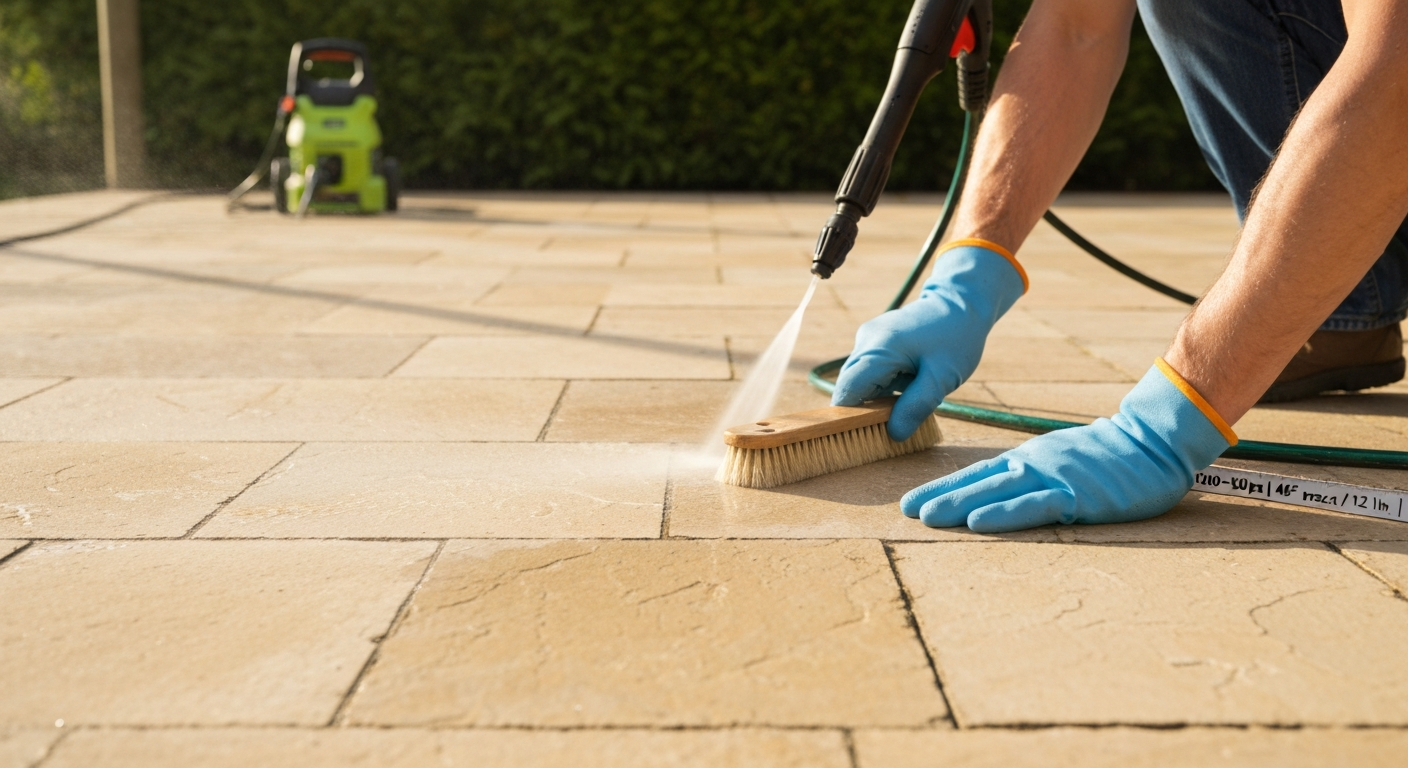
For most sandstone patios, a pH-neutral stone cleaner (pH 6–8) applied with a soft brush, left to dwell for 10–20 minutes, and rinsed with a pressure washer set to 1,200–1,500 psi using a 40-degree white nozzle at 30 cm (12 inches) from the surface is the safest and most effective approach. For heavy algae and moss, a diluted biocide like Wet & Forget gets results without scrubbing. For organic stains and pet mess, an enzymatic cleaner wins every time. Avoid anything strongly acidic or alkaline until you have tested it on a hidden area, sandstone is porous and unforgiving of mistakes.
Best Sandstone Patio Cleaner: Top Picks, Tools & How‑To

Rhea Lang
14 Jul 2026
Best sandstone patio cleaners at a glance
| Product | Type | Best for | pH | Dilution | Dwell time |
|---|---|---|---|---|---|
| Resiblock Patio Magic | Biocide / biological | Algae, moss, lichen | Neutral | 1:5 with water | 24–72 hours |
| Wet & Forget Outdoor | Biocide | Moss, algae, mould — no-scrub | Neutral–mildly alkaline | 1:5 with water | Days to weeks |
| LTP Grimex | Chemical (pH-neutral detergent) | General grime, oil, traffic stains | Neutral | Neat or 1:4 with water | 5–15 minutes |
| Simple Green Oxy Solve Concrete & Driveway | Oxidising cleaner | Heavy grease, organic build-up | Neutral–mildly alkaline (~8–9) | 1:10 with water | 10 minutes |
| Nature's Miracle Advanced Stain & Odour Remover | Enzymatic | Pet urine, faeces, organic odours | Neutral | Neat or 1:2 with water | 10–30 minutes (repeat for old stains) |
| Rocco & Roxie Professional Strength | Enzymatic | Pet stains, vomit, biological soils | Neutral | Neat | 10–30 minutes |
| Evapo-Rust Gel | Chelating rust remover | Rust stains | Neutral chelant | Neat (gel applied as poultice) | 1–4 hours, rinse thoroughly |
| White vinegar (5% acetic acid) | Natural acid | Light mineral deposits — with caution | ~pH 2.5 | 1:1 with water minimum | 5 minutes maximum — test first |
Who this guide is for, and why sandstone needs its own rules
This guide is aimed at homeowners and DIYers who have a sandstone patio, whether that is riven Indian sandstone, buff/honey natural sandstone, or a more rustic sawn finish, and want to clean it safely without causing damage. It is also useful if you are about to clean for the first time and want to know what to avoid before you make an expensive mistake.
Sandstone behaves completely differently from concrete, porcelain, or brick. It is a sedimentary rock made up of sand-sized grains held together by a mineral cement, and that cement is the critical variable. Some sandstones have a silica-based cement (relatively acid-resistant), but many have a calcareous (calcium carbonate) cement that will etch and dissolve if you put anything acidic on it. The problem is you often cannot tell which type you have just by looking at it, so the safe rule is: always assume your sandstone may contain calcareous cement and treat it accordingly.
Because sandstone is so porous, it is what scientists call 'bioreceptive', it actively encourages colonisation by algae, lichens, fungi and moss. Those organisms produce organic acids (oxalic acid is the main culprit) that work away at the mineral cement over time, causing pitting. This is not just a cosmetic problem. Left untreated, biodeterioration can permanently roughen and weaken the surface. This is why routine cleaning and maintenance matter more with sandstone than with harder, denser materials like porcelain or sealed concrete. Historic England's conservation guidance makes this point clearly, warning that over-vigorous cleaning can itself cause irreversible damage, so you are caught between two risks: doing too little and doing too much.
If you have a patio made of Indian sandstone specifically, there is a sibling guide on this site dedicated to the best patio cleaner for Indian sandstone, which covers the particular challenges of that popular material in more depth. For other stone surfaces, the patio stone cleaner review guide covers a broader range of stone types. And if you have a mix of surfaces including brick, the best patio brick cleaner guide is worth a look.
How to choose the right sandstone patio cleaner
With sandstone, the buying criteria are not the same as for concrete or brick. Here is what actually matters when you are standing in front of a shelf of patio cleaners.
pH: the single most important number on the label
Always check the Safety Data Sheet (SDS) or Technical Data Sheet (TDS) before buying. For sandstone, you want a product with a pH between 6 and 9 in its working dilution. Strongly alkaline cleaners (pH 11–12+) are designed for concrete and can break down the organic material binding some sandstone grain cements. Strongly acidic products (pH below 4) will etch any calcareous cement present. Many driveway and concrete cleaners, including popular brands like Zep Heavy-Duty Powdered Concrete Cleaner, are formulated at pH 11–12, which puts them firmly off-limits for sandstone unless the manufacturer explicitly says otherwise.
Match the cleaner to the stain type
No single cleaner does everything well on sandstone. Biological growth (moss, algae, lichen) responds best to biocidal or enzymatic products. Organic stains like pet urine or bird droppings need enzymes. Rust stains need a chelating agent or carefully applied poultice. Grease and traffic film respond to mild alkaline or oxidising cleaners (carefully diluted). Buying a 'multi-surface patio blast' product and hoping for the best is how people end up with bleached patches or stripped sealers.
Sealer compatibility
If your sandstone is sealed, and it should be, given how porous it is, you need to check that your cleaner is compatible with the sealer type. Penetrating/impregnating sealers (silane, siloxane, or fluoropolymer) are the recommended type for sandstone because they preserve breathability. Film-forming sealers (acrylics, polyurethanes) are generally discouraged for sandstone because they can trap moisture. Some cleaners, particularly strong degreasers and solvent-containing products, can strip sealers. If in doubt, contact the sealer manufacturer and check the product SDS.
Eco-preference and plant safety
If your patio is surrounded by borders or lawn, run-off from biocide products or strong alkaline cleaners can harm plants. Enzymatic cleaners and pH-neutral detergent cleaners are the most plant-friendly options. Biocides like Wet & Forget are generally safe once dry but the manufacturer's instructions advise protecting plants from run-off during application. Always dilute as instructed and pre-wet adjacent planting before you start.
How sandstone compares to brick, slab, and Indian sandstone
| Surface | Porosity | Acid sensitivity | Pressure tolerance | Recommended cleaner pH |
|---|---|---|---|---|
| Sandstone (general) | High | High (calcareous cement risk) | Low — max 1,500 psi | 6–9 |
| Indian sandstone | High | High | Low — max 1,500 psi | 6–9 |
| Brick | Medium–high | Medium (depends on type) | Medium — up to 2,000 psi | 6–10 |
| Concrete slab | Low–medium | Low–medium | High — up to 3,000+ psi | 7–12 |
| Porcelain slab | Very low | Very low | High — up to 3,000+ psi | 6–12 |
The key takeaway from this comparison is that sandstone and Indian sandstone sit at the most sensitive end of the spectrum for both acid sensitivity and pressure tolerance. For another relevant comparison, see patio stone cleaner review. The best patio slab cleaner for a concrete or porcelain surface would very likely damage a sandstone patio if used at the same concentration and pressure, which is why purpose-specific guidance matters.
Top chemical cleaners for sandstone patios
When I say 'chemical cleaners' here, I mean purpose-formulated products that use surfactants, oxidising agents, or targeted active ingredients rather than biological or enzymatic action. These are what you reach for when you need reliable, fast results on general grime, grease, or traffic staining.
LTP Grimex, best all-rounder for general cleaning
LTP Grimex is the product I come back to most often for sandstone general cleans. It is a pH-neutral, water-based cleaner formulated specifically for natural stone. It handles traffic grime, oil spots, and general build-up without risk to the stone or existing sealer. Diluted 1:4 with water for regular maintenance, or used neat for stubborn staining, it is one of the few products I would trust on sandstone without a test patch first (though I still do one out of habit).
- Pros: pH-neutral, safe for sealed and unsealed sandstone, works on oil and general grime, widely available in the UK
- Cons: Not a biocide — will not kill moss or algae; less effective on embedded rust or pet stains
- Dilution: 1:4 (water to Grimex) for maintenance; neat for stubborn spots
- Dwell time: 5–15 minutes
- Application: Apply with a stiff brush or garden sprayer, agitate gently, rinse thoroughly
Simple Green Oxy Solve Concrete and Driveway Cleaner, for heavy grease
Simple Green Oxy Solve uses an oxidising formula (hydrogen peroxide based) rather than a strong alkali, which makes it considerably safer for stone than many driveway cleaners. The manufacturer lists it as compatible with pressure washers and natural stone. I have used it on sandstone affected by cooking oil run-off from an outdoor kitchen, diluted 1:10 with water, and it performed well without any visible damage or colour change. That said, always test first: at this dilution the pH should sit around 8–9, which is fine, but do not use it neat on sandstone.
- Pros: Effective on grease and heavy organic soils; safer chemistry than solvent or high-alkali alternatives; biodegradable formula
- Cons: Can slightly alter appearance on very pale/buff sandstone if used too concentrated; not widely stocked in UK retailers (easier to find in the US)
- Dilution: 1:10 with water for sandstone (do not use neat)
- Dwell time: 10 minutes — do not allow to dry on surface
- Application: Apply with brush or sprayer, agitate, rinse immediately and thoroughly
Resiblock Patio Magic, for biological staining
Resiblock Patio Magic is a biocidal cleaner specifically designed for patios and paving. It uses benzalkonium chloride as its active ingredient to kill algae, moss and lichen. For sandstone with significant biological growth, the kind of green or black coating that develops on shaded patios, this is one of the most effective chemical options available. The spray-and-wait approach (apply at 1:5 dilution, leave for 24–72 hours, then brush or rinse) means no high-pressure scrubbing that could damage the stone surface.
- Pros: Very effective on algae, moss and lichen; no-scrub application; works on textured/riven sandstone surfaces where brushing is difficult
- Cons: Biocide — protect plants from run-off; needs 24–72 hours to work; dead growth needs to be brushed off after treatment; not effective on non-biological stains
- Dilution: 1:5 with water
- Dwell time: 24–72 hours before rinsing
- Application: Spray evenly, protect adjacent planting, leave to work, brush off dead growth and rinse with low-pressure water
Top natural cleaners for sandstone patios
Natural and homemade cleaners are popular, and some work well on sandstone, but a few of the most commonly recommended ones can actually cause damage. Here is what I have found actually works, and where to be careful.
White vinegar, effective but use with extreme caution
Vinegar (5% acetic acid) is the most commonly recommended natural cleaner on the internet, and on sandstone it is also one of the most commonly misused ones. I learned this the hard way when a reader sent me photos of a beautifully pitted, now-irreversibly etched buff sandstone patio after a neat vinegar clean. If your sandstone has any calcareous cement content, vinegar will etch it. Stone care specialists like Laticrete's Stonetech division explicitly warn against acidic household cleaners on stone that may contain calcareous cement. If you want to try it at all, dilute at least 1:1 with water, limit dwell time to a strict 5 minutes, and rinse very thoroughly. Only use it for light mineral deposits or water marks, and only after a test patch confirms no reaction.
- Pros: Low cost, widely available, no specialist equipment needed, effective on light lime scale and water marks if used carefully
- Cons: pH ~2.5 — will etch calcareous cement; can cause irreversible pitting and colour change; strips sealers; absolutely cannot be used neat on unknown sandstone
- Dilution: Minimum 1:1 with water — only use on confirmed silica-cemented sandstone
- Dwell time: 5 minutes maximum
- Application: Apply with soft cloth or brush, monitor constantly for fizzing or colour change, rinse immediately and thoroughly with clean water
Citric acid solution, a gentler acid for specific jobs
Citric acid (typically used as a 5–10% solution in warm water) is a slightly milder option than acetic acid for removing lime scale and hard water deposits. The same calcareous cement warning applies, test first, always. However, for sandstone that you have confirmed is silica-cemented (often indicated in the supplier's stone spec sheet), a 5% citric acid solution can shift calcium deposits and efflorescence without the harsh bite of stronger acids. Do not leave it on for more than 5–10 minutes and rinse thoroughly.
- Pros: Milder than hydrochloric or acetic acid; biodegradable; effective on lime scale and efflorescence
- Cons: Still acidic — will etch calcareous cement; not suitable for unknown sandstone without testing; ineffective on biological growth or oil/grease
- Dilution: 5% solution (50g per litre of warm water)
- Dwell time: 5–10 minutes — do not allow to dry on surface
- Application: Apply sparingly with a soft brush, work in small sections, rinse very thoroughly with clean water
Soda crystals (washing soda), for grease without strong alkali risk
Soda crystals (sodium carbonate) dissolved in hot water create a mild alkaline solution (pH around 11 at full concentration, but significantly lower at working dilution) that is effective on grease and organic soils. At a dilution of 1:10 (roughly 1 tablespoon per litre), the effective pH drops to around 9–10, which sits at the upper edge of safe for sandstone. I use this on heavily trafficked areas with cooking grease when I do not want to use a commercial product. The key is to keep it dilute, work quickly, and rinse thoroughly. Do not use soda crystals neat or at high concentration on sandstone.
- Pros: Cheap, widely available, genuinely effective on grease at working dilution; no harsh fumes
- Cons: Still alkaline at concentration — must be kept dilute; not a biocide; does not address rust or pet stains
- Dilution: 1 tablespoon per litre of hot water
- Dwell time: 5–10 minutes
- Application: Apply with soft brush, agitate gently, rinse thoroughly with clean water
Top enzymatic and biological cleaners for organic stains
Enzymatic cleaners are my first choice for pet stains, bird droppings, food residue, and any organic staining with an odour component. They work by using specific enzymes (proteases for protein stains, lipases for fat/oil, amylases for starch)) to biochemically break down the organic material rather than just bleaching or scrubbing it away. On porous sandstone, this matters, enzymes can follow the stain down into the pores rather than just treating the surface.
Nature's Miracle Advanced Stain and Odour Remover
Nature's Miracle is the benchmark product I test others against for pet stains on porous surfaces. The enzyme blend is effective on urine, faeces, vomit, and blood. On sandstone, I apply it neat to the stained area, work it into the pores with a soft brush, cover it with a damp cloth to stop it drying out (this extends the enzyme activity), and leave it for at least 30 minutes. For old, set-in stains, I repeat the process. It does not discolour sandstone and is genuinely pH-neutral.
- Pros: Excellent on pet stains and organic odours; pH-neutral, safe for sealed sandstone; effective on porous surfaces when applied correctly
- Cons: Multiple applications needed for old stains; no effect on rust, mineral deposits, or biological growth (algae/moss); more expensive than basic cleaners
- Dilution: Neat for most applications; can dilute 1:2 with water for light surface stains
- Dwell time: 10–30 minutes; cover with damp cloth to prevent premature drying
- Application: Saturate the stained area, work in with soft brush, keep moist, rinse thoroughly after dwell time
Rocco and Roxie Professional Strength
Rocco and Roxie is a strong alternative to Nature's Miracle with a broadly similar enzyme formula but a slightly different surfactant package that I find handles grease-combined pet stains (common around outdoor feeding stations) slightly better. It is chlorine-free, which matters for sandstone as chlorine-based products can bleach iron-bearing minerals in the stone, causing colour change. Apply neat, allow to dwell, keep moist, rinse well.
- Pros: Chlorine-free; effective on combined organic/grease stains; pH-neutral; works well on porous surfaces
- Cons: More expensive per litre than dilutable options; not effective on inorganic stains
- Dilution: Neat
- Dwell time: 10–30 minutes
- Application: Saturate, agitate with soft brush, keep moist during dwell, rinse thoroughly
Wet and Forget Outdoor, the slow-release biological treatment
Wet and Forget occupies an interesting category: it is neither purely enzymatic nor a harsh biocide scrub. It uses a dilute benzalkonium chloride solution (the active ingredient also in Resiblock Patio Magic) in a very gentle, low-concentration formulation that you spray on and genuinely leave. It takes days or weeks to work visibly, but for moss and algae on textured riven sandstone where scrubbing risks surface damage, the no-scrub approach is genuinely valuable. Manufacturer guidance and independent product summaries recommend a spray‑and‑wait approach for Wet & Forget and similar biocides and note dilution, repeat‑intervals, and plant‑protection precautions; see How to spray Wet & Forget using a pressure washer, Pressure Washer Universe (product use summary) How to spray Wet & Forget using a pressure washer — Pressure Washer Universe (product use summary). It also provides residual protection for several months, reducing regrowth.
- Pros: No scrubbing required; reduces re-colonisation after treatment; safe for textured/delicate sandstone surfaces; low active concentration reduces chemical risk
- Cons: Slow-acting (days to weeks, not hours); does not handle grease, rust, or pet stains; requires protection of plants from run-off
- Dilution: 1:5 with water
- Dwell time: Allow several days to several weeks; do not rinse immediately
- Application: Mix in a garden sprayer, apply evenly to dry or slightly damp surface, leave to work naturally, reapply every 6–12 months for prevention
Tools: brushes, scrapers, brooms and pressure-washer settings
Even the best cleaner will underperform if you use the wrong tool, and the wrong tool can damage sandstone even before you bring water near it. Here is what I actually use and recommend.
Brushes and manual tools
| Tool | Best for | Pros | Cons |
|---|---|---|---|
| Soft-bristle deck brush (natural fibre or nylon) | General scrubbing on flat slabs | Gentle on stone surface; good coverage area | Less effective in textured/riven joints |
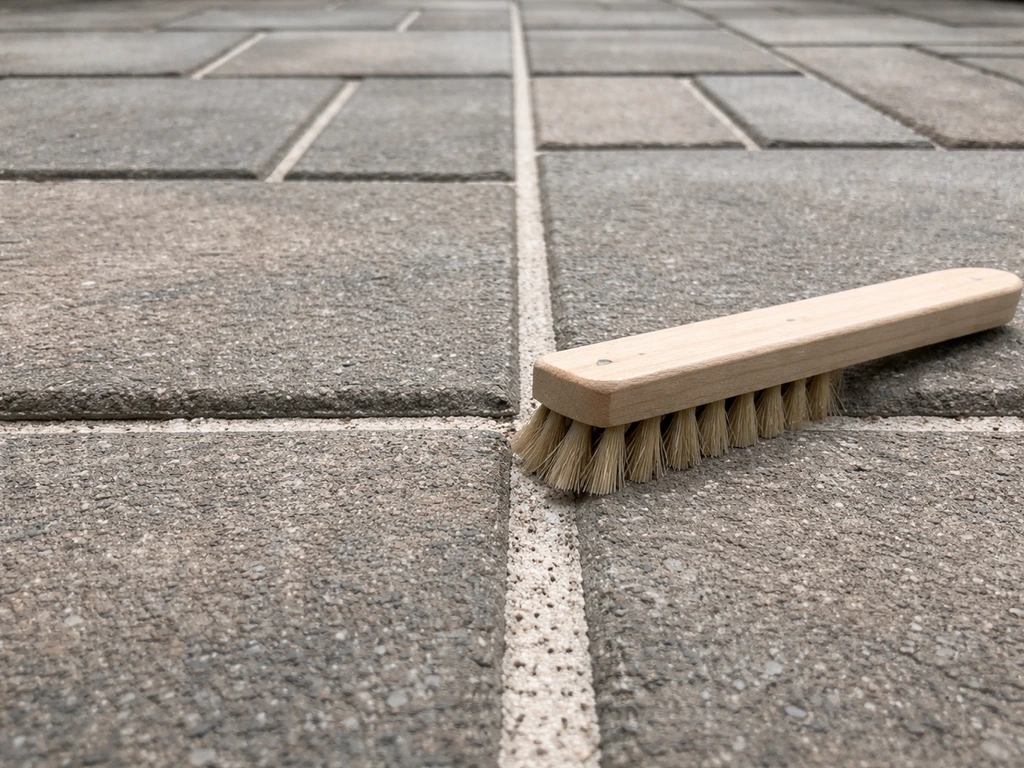
| Stiff nylon grout brush | Cleaning patio joints and grout lines | Gets into narrow joints; durable | Aggressive on very soft sandstone faces — use carefully |
| Long-handled stiff broom (PVC bristle) | Sweeping loose debris before cleaning | Fast debris removal; no risk to stone | Not a cleaner — prep use only |
| Plastic scraper or putty knife | Lifting moss clumps and compacted debris from joints | Targeted removal without scratching (plastic vs. metal) | Metal scrapers risk scratching — use plastic only on sandstone |
| Deck mop or sponge mop | Applying and spreading liquid cleaners on flat surfaces | Even coverage; good for no-scrub treatments like Wet & Forget | Less useful on riven/textured surfaces |
For grout and joint cleaning on sandstone, a stiff nylon grout brush is the right tool, but use it on the joints themselves, not across the face of the stone. For product comparisons and user feedback on specific grout brushes, see brush in patio grout reviews. The best approach to patio grout brushing is a topic covered in more depth in the best brush in patio grout guide on this site, which is worth reading if joint maintenance is a significant part of your project.
Pressure washer settings for sandstone
Karcher's own instruction manual for their K5 series classifies sandstone as a sensitive surface and specifies their 'soft wash' setting. Professional guidance from paving specialists consistently puts the safe working pressure range for Indian and softer sandstones at 1,200–1,600 psi (80–110 bar), using a 25–40 degree fan nozzle with a minimum stand-off distance of 30 cm (12 inches) from the surface. I always start at the lower end (1,200 psi, 40-degree white nozzle, 30 cm) and only increase pressure if clearly needed.
| Nozzle colour | Angle | Recommended for sandstone? | Notes |
|---|---|---|---|
| Red | 0° | No | Extremely high impact — will erode sandstone grain |
| Yellow | 15° | No | Too concentrated for stone surfaces |
| Green | 25° | Caution — use at maximum stand-off distance | Only for harder sandstone at low pressure setting |
| White | 40° | Yes — recommended | Wide fan, low impact — best choice for sandstone |
| Black (soap) | Low pressure | Yes — for detergent application | Apply cleaner at low pressure before rinsing with white nozzle |
Surface cleaner attachments
A rotating surface cleaner attachment (like those from Simpson or Karcher) is genuinely useful for large sandstone patios because it delivers faster, more even cleaning than a single lance nozzle, and avoids the 'tramline' streaking you can get from wanding. Consumer models support pressure washers in the 2,200–3,700 psi range, but for sandstone you should use them at the lower pressure settings your machine supports. The rotating disc also reduces the risk of accidentally holding the wand too close to one spot. Check the surface cleaner's minimum GPM (gallons per minute) requirement, most need at least 2 GPM to spin properly.
Before you start: sandstone-specific prep, test patches, and safety
Every guide says 'do a test patch' and most people skip it. I get it, it feels like faff. But on sandstone specifically, the consequences of skipping it can be a permanent bleached or etched area on a very visible patio. The five minutes it takes to test a hidden area is the most important thing in this entire guide.
How to do a proper test patch
- Choose an area that is normally hidden — under a garden bench or in a corner covered by a planter.
- Apply your cleaner at the intended dilution and leave it for the full dwell time.
- Rinse thoroughly and allow to dry completely (at least 24 hours, ideally 48 hours — wet sandstone looks darker and hides colour changes).
- Inspect for: any colour change, surface roughening, loss of grains or texture, or reaction with existing sealer (whitening or clouding).
- If there is any adverse reaction, do not proceed — contact the manufacturer or consult a stone specialist.
Protecting plants and surrounding surfaces
Before applying any cleaner, sweep the patio thoroughly to remove loose debris. Pre-wet any adjacent planting, lawn edges, or gravel borders with clean water, this dilutes any run-off and reduces the chance of chemical damage. Cover sensitive plants with plastic sheeting if using biocide or alkaline cleaners. If cleaning near painted surfaces, fences, or rendered walls, mask them off or pre-wet them and rinse promptly after cleaning.
Safety gear
- Chemical-resistant gloves (nitrile or rubber) — for all cleaning products, including 'natural' ones
- Safety glasses or goggles — essential when pressure washing or using spray applicators
- Old clothing or waterproof trousers — pressure washing and spray applications will soak you
- Non-slip footwear — wet stone surfaces are extremely slippery
- Knee pads — useful for close-up scrubbing work on grout and joints
Dealing with rust stains: the poultice method
Rust on sandstone deserves its own note because it is one of the most common problems and one of the most commonly mistreated ones. The instinct is to apply a rust remover directly and rinse it off, but on porous stone this can actually drive iron compounds deeper into the pores rather than removing them. Conservation guidance from Historic England and stone care specialists is consistent: for rust stains on porous stone, a poultice application is far more effective. Mix an absorbent material (diatomaceous earth or white paper pulp) with a chelating rust remover like Evapo-Rust Gel or a dilute oxalic acid solution (5–10%), apply it as a thick paste over the stain, cover with plastic film to keep it moist, and leave it for 1–4 hours. The poultice draws the iron compounds out of the stone as it dries rather than spreading them. Rinse thoroughly after removal. Always test first, and treat rust jobs as individual spot treatments rather than broad applications.
Sandstone cleaning schedule and long-term maintenance
Sandstone is much easier to maintain than to restore. A simple annual cleaning routine, combined with a good penetrating sealer applied every 2–3 years, will keep most sandstone patios in excellent condition without ever needing harsh chemicals or high-pressure work. Here is the maintenance schedule I recommend:
| Frequency | Task | Product / method |
|---|---|---|
| Weekly (in season) | Sweep loose debris, leaves and soil | Soft broom — dry sweep |
| Monthly | Rinse with garden hose to remove soluble residues | Garden hose, low pressure |
| Every 3–6 months | Full clean with pH-neutral detergent cleaner | LTP Grimex or similar, soft brush, rinse |
| Annually (spring or autumn) | Biocide treatment for algae/moss prevention | Wet & Forget or Resiblock Patio Magic at maintenance dilution |
| Every 2–3 years | Re-seal with penetrating impregnating sealer | Silane/siloxane or fluoropolymer penetrating sealer |
| As needed | Spot-treat stains immediately | Enzymatic cleaner for organics; poultice for rust; pH-neutral detergent for grease |
The single most important preventive measure is sealing. A good penetrating sealer dramatically reduces the sandstone's bioreceptiveness, it makes it harder for algae and moss to establish, reduces stain penetration, and makes routine cleaning far easier. Always clean thoroughly and allow the stone to dry completely (at least 48 hours of dry weather) before applying sealer. Film-forming sealers are not recommended for sandstone, they can trap moisture, cause delamination, and alter the stone's appearance in ways that are difficult to reverse.
FAQ
What are the safest, most effective categories of sandstone patio cleaners for homeowners?
Three safe/effective categories: 1) Stone‑specific chemical cleaners (water‑based alkaline or manufacturer stone detergents) — best for grease/oil and heavy soiling when used at recommended dilutions; 2) Biocide/oxidising or proprietary algal/moss removers (e.g., Wet & Forget style, sodium hypochlorite blends) — good for biological growth but use with plant/runoff care; 3) Enzymatic/biological cleaners (pet‑stain brands) — best for organic stains/odours. For rust, use chelating rust removers or controlled poultices (oxalic/chelants) applied locally and removed according to instructions. Always test a small inconspicuous area first and consult product SDS/TDS for substrate warnings.
Which specific cleaner types should I avoid on sandstone?
Avoid strong mineral acids (undiluted muriatic/industrial acid), household vinegar/lemon on unknown stone, and high‑pH concrete cleaners unless the product specifically lists natural stone/sandstone compatibility. Also avoid film‑forming sealers on open‑textured sandstone and abrasive scouring which raises grain or causes pitting.
What are recommended dilution ratios and dwell times for common cleaners?
General guidance (always follow product label): - Stone‑safe alkaline patio detergent: 1:10 to 1:20 (detergent:water); dwell 5–15 minutes, agitate, then rinse. - Biocide/algaecide (ready‑mix): apply neat or 1:4–1:10 per label; dwell 24–72 hours for kill and weathering (repeat if needed). - Household bleach (if used cautiously): 1:10 (bleach:water) for green algae/mould; dwell 5–15 minutes, then rinse. - Enzymatic cleaners (pet stains): apply neat or per label to saturate stain; dwell 10–30 minutes, blot or agitate and repeat for older stains. - Chelating rust remover (evapo‑rust style): follow manufacturer (often neat or gel); dwell as directed, sometimes several hours, repeating until stain lifts. For poultices with oxalic/chelants: paste applied, covered, left 12–48 hours, then removed and neutralised. Always trial first and avoid prolonged acid contact on calcareous cements.
When should I use pressure washing versus gentle/manual methods?
Use gentle/manual methods (soft brushes, detergents, enzyme sprays, biocides) for regular cleaning, delicate or weathered sandstone, and for localized stains. Use pressure washing when soiling is widespread and stone is sound; select low pressure and wide fan nozzles. If unsure, start with manual cleaning + biocide. Pressure washing risks grain loss and etching if pressure is too high or wand too close.
What pressure‑washer settings and nozzles are safe for sandstone?
Recommended consumer settings: 1,200–1,600 psi (80–110 bar) maximum for softer/Indian sandstones when cleaning patios; use 25°–40° (green/white) fan nozzles, keep the lance at least 300 mm (12 in) from the surface, and move steadily. Use soap/black nozzle for low‑pressure detergent application and wide‑angle for final rinse. For very sensitive or historic stone, avoid pressure washing and use manual cleaning or call a conservator.
Which tools should I buy or use for sandstone patios?
Essentials: - Soft‑to‑medium bristle patio brush and narrow grout brush. - Plastic‑ or rubber‑edge scraper for hardened deposits. - Garden sprayer for biocides/enzyme solutions. - Pressure washer with adjustable pressure, detergent feed, and 25–40° nozzles; optional surface cleaner attachment for even cleaning (use with care on sandstone). - Poultice materials (cellulose or attapulgite clay, plastic film) and plastic tools for localized chemical work. - Personal protective equipment (gloves, eye protection, mask) and plant protection covers for runoff.
Next Article
Brush in Patio Grout Reviews: Best Brushes and How to Use Them
Brush in patio grout reviews with top brush picks and step-by-step use tips to clean joints safely.