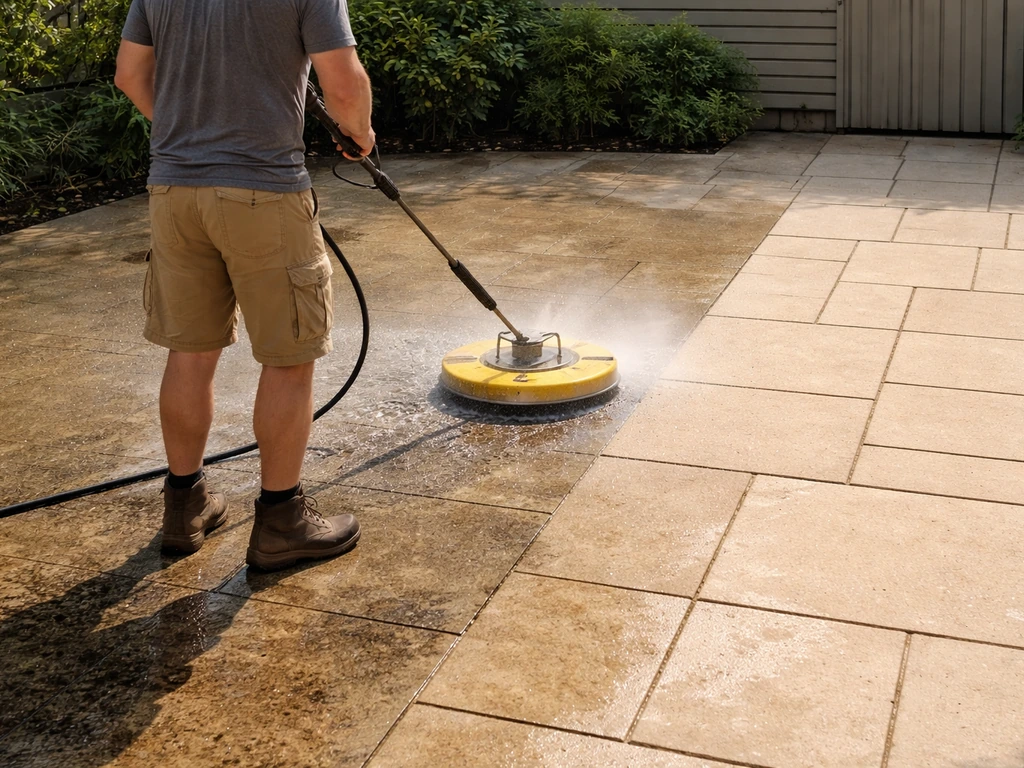
The Kärcher T5 T-Racer patio cleaner attachment works well for most homeowners tackling algae, mold, green growth, and general grime on hard patio surfaces. If you are wondering, "is karcher patio cleaner any good," the Kärcher T5 T-Racer is generally a strong pick for flat patio surfaces, especially algae and general grime. It cleans faster and more evenly than a standard pressure washer lance, leaves far fewer streaks when used correctly, and the adjustable nozzle height dial means you can use it on everything from concrete to more sensitive surfaces like timber decking. That said, it won't replace pre-treatment on heavy biological growth, it struggles at the very edges of paving where the hood can't fully overlap, and you need to match it to a compatible pressure washer or the results will disappoint.
Karcher T5 Patio Cleaner Review: Results, Setup, and Tips

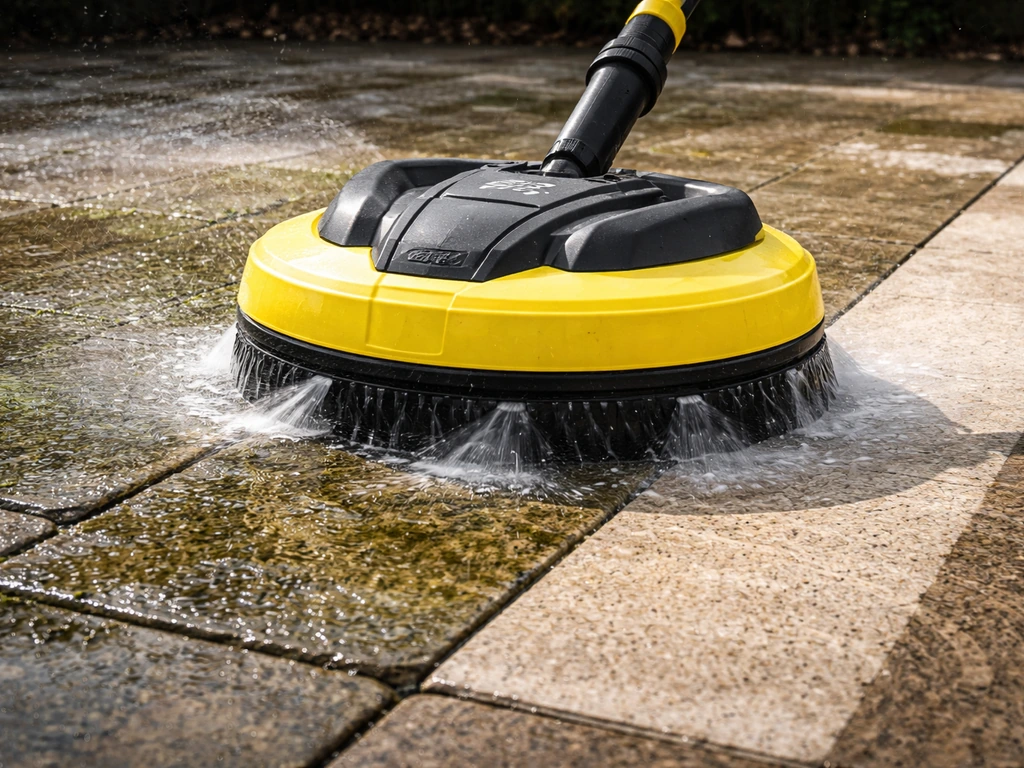
What the Kärcher T5 actually is
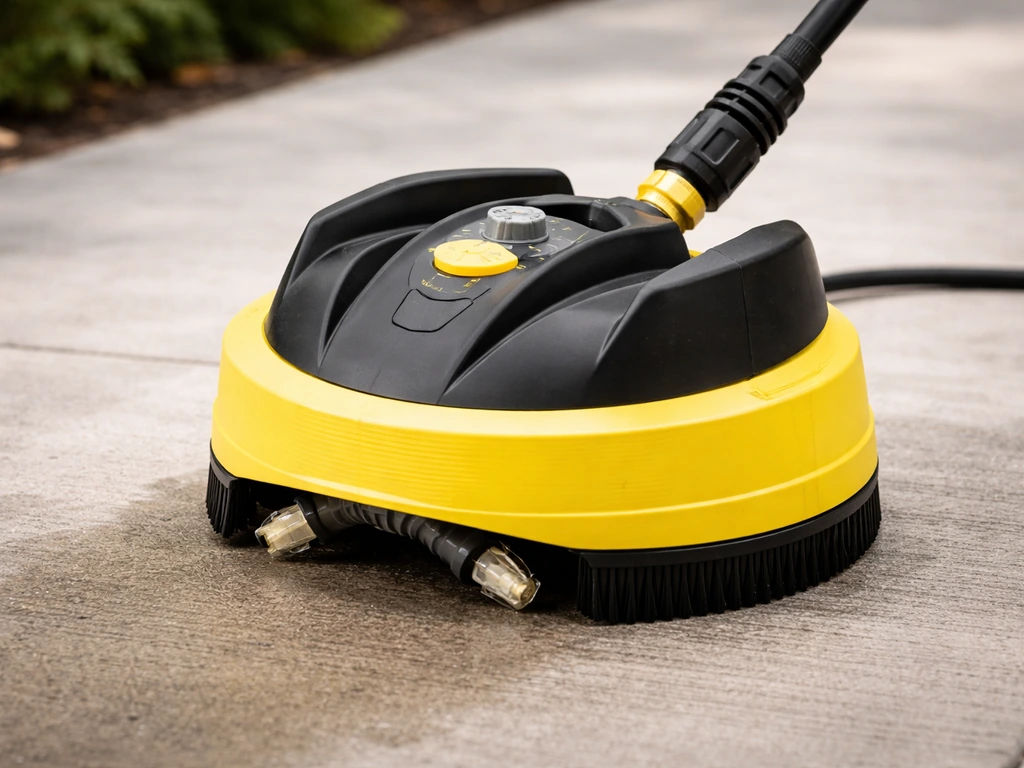
The T5 T-Racer is a surface cleaner attachment, not a standalone machine. You connect it to the high-pressure gun on your existing Kärcher pressure washer (or any compatible unit with an industry-standard quick-connect fitting) and it replaces the standard lance for flat surface work. Inside the hood there's a rotating arm carrying two flat-jet nozzles. As water flows through, the arm spins and those nozzles sweep back and forth across the surface in a tight, overlapping pattern. The enclosed hood contains the spray, so you get very little splash-back compared to an open lance, and the cleaning path is even rather than the typical fan-spray stripe.
The key feature on the T5 is the adjustable nozzle height dial. Kärcher labels the two extremes HARD and SOFT. HARD brings the nozzles closer to the surface for robust materials like concrete, stone, and tiles. SOFT raises them slightly to drop the effective pressure, which matters if you're working on timber, composite decking, or more fragile surfaces. This single dial does a lot of heavy lifting in terms of preventing damage if you use it correctly.
Compatibility is the first thing to check before buying. The T5 works via a standard quick-connect fitting, which most modern Kärcher electric pressure washers use. The real limiting factor is your washer's PSI and GPM output. Too low and the rotor arm won't spin with enough force to clean properly. The T5 is suited to Kärcher's mid-range electric machines rather than the lightest entry-level models, and it's a different product from the larger T350 or T450 attachments, which are designed for higher-output machines and cover a wider cleaning path.
How it performs on typical patio messes
On green algae and general surface grime, the T5 is genuinely impressive. I've used it across multiple seasons now and it consistently lifts a full winter's worth of algae growth in a single slow pass on concrete and clay brick paving. The twin-nozzle rotating pattern means you don't get the characteristic streak lines you see when using a fan jet lance, which is probably the biggest practical upgrade over standard pressure washing for patio work.
Speed is noticeably better than manual scrubbing or chemical-only approaches. A 30-square-metre patio that would take an afternoon with a stiff brush and patio cleaner takes about 45 minutes to an hour with the T5, including setup and rinsing edges separately. The pace you walk matters: too fast and you leave patches, too slow and you can etch softer stones. I found a slow, steady walking pace (roughly one square metre every 8-10 seconds) gave the best consistent results.
Mold and mildew on concrete responds well, especially if you use a detergent pre-treatment and give it 10-15 minutes of dwell time before running the T5 over it. Without pre-treatment on heavy mold colonisation, you'll often need a second pass and may still see faint discolouration that takes a few days of UV exposure to fully disappear. Grease stains and rust marks are a different story. The T5 doesn't remove those without a specific degreaser or rust treatment applied first. It lifts the top layer but the stain itself stays put if you go in dry.
One honest limitation: the hood edge. The T5 doesn't clean right to the very edge of a slab or up against a wall. There's a lip of around 3-4cm that the rotating arm simply can't reach. You'll need to go back over joints, borders, and edges with a lance or a detail nozzle afterward. It's not a deal-breaker but it adds time, and I learned this the hard way on my first use when I assumed the T5 would handle everything in one pass.
Which surfaces you can use it on
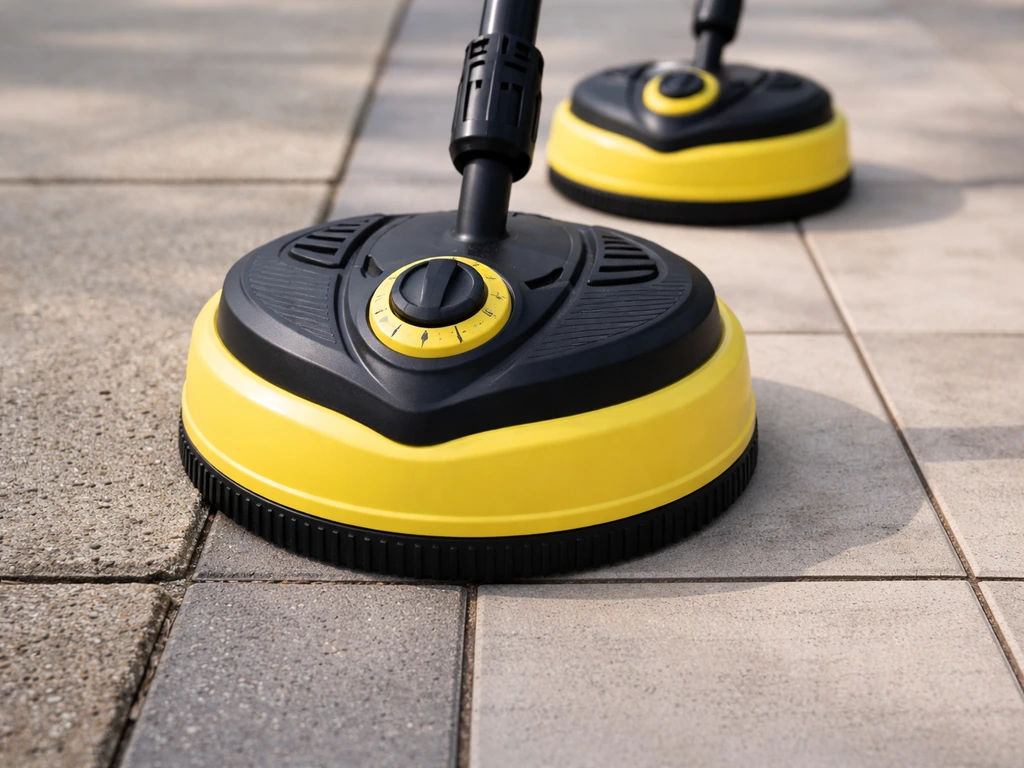
Kärcher's own documentation lists tiles, stone, concrete, plastic, and wood as suitable surfaces. In practice, the dial adjustment makes this a wider list than many surface cleaner attachments. Here's how it plays out across the surfaces most patio owners actually have:
| Surface | Dial Setting | Notes |
|---|---|---|
| Concrete paving | HARD | Handles well. Multiple passes fine. Pre-treat heavy moss/algae. |
| Clay brick | HARD | Good results. Avoid lingering on loose mortar joints. |
| Natural stone (granite, limestone) | HARD to mid | Works well. Test a small area first on softer limestone. |
| Sandstone/York stone | SOFT | Risk of surface etching. Use lightest setting, single pass only. |
| Slate | SOFT to mid | Can flake on poor-quality slate. Low pressure, keep moving. |
| Porcelain paving | HARD to mid | Very forgiving surface. Excellent results with T5. |
| Concrete block paving | HARD | Good, but re-sand joints after cleaning. |
| Timber/composite decking | SOFT | Use with care. Always move with the grain. Single pass. |
| Plastic/resin surfaces | SOFT | Fine for general cleaning. Avoid excessive dwell. |
Sandstone deserves special attention. It's one of the most common patio materials in UK gardens and one of the most easily damaged by pressure washing. On sandstone, keep the T5 on the SOFT setting, maintain a steady pace, and never let the unit sit still. Even a brief pause can leave a visible mark. If your sandstone is old or already flaking, I'd honestly recommend a lower-pressure chemical-only approach instead.
Porcelain paving is at the other end of the scale. It's extremely hard and dense, so you can run the T5 on the HARD setting with confidence. This is probably the easiest surface to get great results on. Grout lines in porcelain can still harbour algae growth, and the T5 handles those better than a wide fan jet because the rotating nozzles direct water into narrow gaps.
How to set it up and use it properly
Setup and connection
- Check your pressure washer is compatible: confirm it has a standard quick-connect fitting on the high-pressure gun and that its output falls within the T5's rated PSI and GPM range.
- Attach the extension tube to your high-pressure gun first. Kärcher recommends using the extension tube when cleaning floors so you're not bent over double, and it also improves the angle for consistent hood contact.
- Click the T5 onto the end of the extension tube. You should hear a positive click from the quick-connect. Give it a gentle tug to confirm it's locked before turning the water on.
- Set the nozzle height dial before you start. Choose HARD for concrete, stone, and porcelain. Move to mid or SOFT for timber, sandstone, or softer surfaces.
- If you're using a detergent, apply it first with the pressure washer's foam/detergent setting or a garden sprayer, leave it to dwell for 10-15 minutes, then switch to the T5 for the rinse/clean pass.
Technique that actually avoids streaks and lines
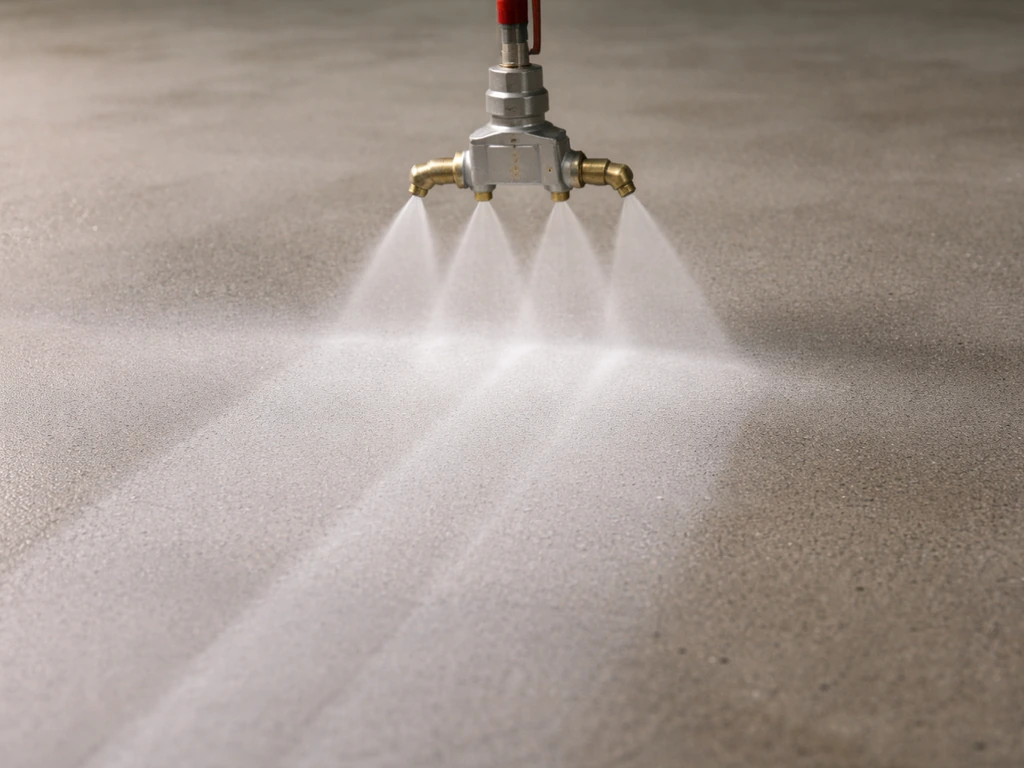
Unlock the trigger gun and pull it to start before you lower the T5 to the surface. This lets the rotor arm reach full spin speed before it contacts the ground, which gives you a cleaner start without a pressure spike on one spot. Keep the hood flat and in full contact with the surface throughout. Tilting it causes uneven pressure distribution and visible marks.
Work in overlapping passes, each one overlapping the previous by around 5cm. Think of it like mowing a lawn. Go in straight lines if you can, keep the pace consistent, and don't stop mid-pass. Stopping in one spot is the most common cause of circular etching marks, particularly on softer stone. Kärcher’s T-Racer manual warns not to stay in one place and to keep the unit moving to avoid damage and uneven results Stopping in one spot is the most common cause of circular etching marks. The Kärcher manual is explicit on this point: keep the unit moving at all times.
After each pass, lift the T5 slightly off the surface before releasing the trigger, rather than cutting the pressure while it's still in contact. This prevents a pressure backwash that can leave a mark at the end of each row. Finish the main field with the T5, then go back and clean the edges and joints with a detail nozzle or a turbo nozzle attachment.
T5 vs other cleaning options: when it's the right choice
The T5 sits in a specific sweet spot. If you are specifically looking for a Karcher T150 patio cleaner review, this is the kind of performance-and-usage detail that helps you decide whether it matches your patio mess and machine. It's better than a standard lance for almost all flat surface work because the enclosed hood eliminates streaking and reduces splash-back. It's faster and less physically demanding than scrubbing with chemicals alone. But it's not always the right tool, and it's worth being clear about when alternatives win.
| Method | Best for | Where T5 wins | Where T5 loses |
|---|---|---|---|
| T5 T-Racer | Large, flat paved areas with algae/grime | Speed, evenness, low splash | Edges, grease, rust, small areas |
| Pressure washer lance (fan jet) | Detail work, edges, walls | Flexibility, zero extra cost | Streaks, splash-back, arm fatigue |
| Chemical cleaner only (no pressure washing) | Sandstone, delicate surfaces, no pressure washer | Safe for fragile materials, easy | Slow, needs scrubbing, residue disposal |
| Larger surface cleaner (T350/T450) | Very large patio areas, commercial use | Wider path, faster on big areas | Overkill for small patios, costs more |
| Manual scrubbing + patio cleaner | Budget option, small areas | Cheapest, no equipment needed | Hard work, slow, inconsistent results |
If you're deciding between the T5 and a larger Kärcher patio cleaner attachment like the T350, the honest answer is that for a typical home patio under 50 square metres, the T5 is usually sufficient and the cost difference is meaningful. If you are comparing options, you may also want to look up the karcher t350 patio cleaner best price before deciding larger Kärcher patio cleaner attachment like the T350. The T350 makes more sense if you have a large driveway or terrace to clean regularly, or if your pressure washer's output comfortably supports it. On the other end, if you only have a very small courtyard or you're primarily dealing with delicate sandstone or slate, a quality patio cleaning chemical applied carefully and rinsed gently may give you better results with less risk.
The comparison with other patio cleaner attachments (non-Kärcher surface cleaners or generic attachments) generally comes out in the T5's favour for build quality and the adjustable height feature. Cheap generic surface cleaners often spin inconsistently, which defeats the entire purpose of using one. The T5's twin-nozzle design and quality bearings maintain consistent spin across a cleaning session in a way that budget alternatives often don't sustain. If you want a patio cleaner attachment review focused on real-world results, the Karcher T5 is one of the most consistently well-regarded options twin-nozzle design.
Keeping it working and getting good value
Maintenance after each use
After every session, run clean water through the T5 for 30-60 seconds before disconnecting. This flushes any detergent or debris from the nozzles and the rotor arm. Then disconnect it and rinse the outside of the hood. The inside of the hood collects algae and grime during use, and if you store it dirty, that biological material degrades the plastic and can clog the nozzle ports over time.
The rotor arm bearings are the main wear component. If the arm starts spinning unevenly or slowly even when your pressure washer is running at full pressure, the first thing to check is whether debris has got into the bearing housing. A toothpick or fine brush can clear the housing, and in many cases that restores full spin speed. If the arm still spins sluggishly after cleaning, the bearing itself may need replacing. Kärcher sells replacement rotors for the T5 separately, and it's worth buying one spare if you use the attachment regularly.
Common troubleshooting
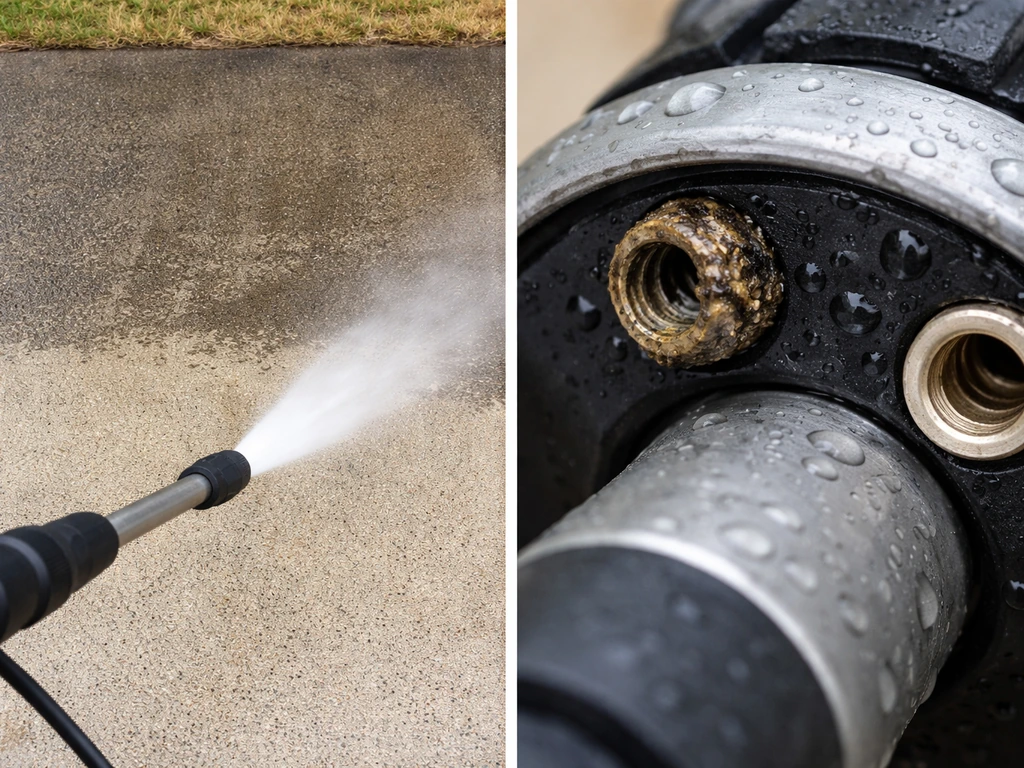
- Uneven cleaning or visible stripes: usually caused by walking too fast, insufficient overlap between passes, or a partially blocked nozzle. Check nozzle ports first, then slow your pace.
- Rotor not spinning: check water flow rate from your pressure washer. If the GPM is too low, the arm won't spin consistently. Also check for debris in the rotor housing.
- Circular marks on surface: you paused too long in one spot. This is more visible on softer stone. Keep moving and it won't happen.
- Splashing from under the hood edge: the hood isn't sitting flat on the surface. Tilt adjustment on the extension tube can help, or reduce pressure slightly.
- Nozzles clogging: mineral deposits from hard water. Remove the nozzle tips and soak in white vinegar for 30 minutes, then flush through.
Buying considerations
Before buying the T5, confirm three things: your pressure washer uses a standard quick-connect fitting (most modern Kärcher machines do, but check your model), the machine's output is within the T5's recommended range (check the Kärcher website for your specific washer model), and you have an extension tube or it's included in the bundle. Some sellers offer the T5 with an extension tube included; others sell it as the head only. The extension tube makes a real practical difference when cleaning floors.
On value: the T5 sits at the budget-friendly end of Kärcher's surface cleaner range, which makes it one of the more accessible attachment upgrades for homeowners who already own a compatible mid-range Kärcher electric washer. Given how significantly it improves flat surface cleaning versus a standard lance (both in quality of result and in reducing arm fatigue over a long session), it's one of the accessories I'd genuinely recommend as a first upgrade for regular patio maintenance. If you find yourself cleaning more than twice a year or covering larger areas, the investment pays back quickly in time saved and a noticeably better finish.
FAQ
Can I use the Kärcher T5 patio cleaner on a pressure washer that is not Kärcher?
Yes, but only if it has an industry-standard quick-connect fitting and sufficient output. The deciding factor is whether your washer’s PSI and GPM can keep the rotor arm spinning at a strong, consistent speed. If the arm feels like it is bogging down mid-pass or leaving streaky patches, your washer output is likely too low for the T5.
What should I do if the T5 leaves streaks even when I keep it moving?
First, verify overlap is about 5 cm each pass, and keep the hood perfectly flat with full contact. Streaking also happens if you start spraying while the hood is already on the surface (before the rotor reaches speed) or if you have inconsistent walking pace. Finally, check nozzle height setting, using SOFT on sensitive stone to avoid surface etching that can look like uneven cleaning.
Will the T5 remove moss and algae from the joints between paving slabs?
It can improve joint cleaning because the twin nozzles shoot into narrow gaps, but it will not always fully solve heavy, established growth in grout lines. For persistent joint algae, apply detergent pre-treatment, let it dwell 10 to 15 minutes, then do a careful second pass on the joints using a detail nozzle or turbo nozzle after the main area.
How do I avoid circular marks or “burn spots” on softer stone like sandstone?
Do not stop mid-pass, and never let the hood sit still on the surface. On softer materials, use the SOFT setting and maintain a steady pace so the nozzles do not dwell in one spot. If you accidentally pause, keep moving, and consider a shorter, lighter pass rather than repeated aggressive passes over the same area.
Do I need to pre-treat before using the T5 on mold and mildew?
For light discoloration, you may get good results with water pressure alone, but for heavier mold and mildew pre-treatment usually saves time. Apply detergent, allow 10 to 15 minutes of dwell time, then run the T5. Without dwell time, you may need multiple passes and faint staining can remain for several days as UV exposure works on the remaining residues.
What detergents or chemicals should I use with the T5, and what should I avoid?
Use a patio cleaning detergent that is compatible with pressure washer equipment and targeted at the growth you are removing (algae or general grime). Avoid using strong solvents or aggressive degreasers through the T5 unless the product instructions explicitly say it is safe for pressure washer surface-cleaner use, since some chemicals can damage seals or leave residue that requires extra rinsing.
Why doesn’t the T5 clean right up to walls or the edges of slabs?
The hood has a lip, and the rotating arm cannot reach the extreme perimeter. Plan to do an edge pass afterward with a lance or a detail nozzle, especially along borders, steps, and tight wall areas. Trying to “force” the T5 into corners usually causes uneven pressure and visible marks.
How should I start and stop the T5 during a cleaning row?
Unlock the trigger and pull it so the rotor reaches full spin speed before lowering the hood to the surface. When finishing a row, lift the T5 slightly off the surface before releasing the trigger, instead of cutting pressure while it is still in contact, to reduce end-of-row backwash marks.
Is an extension tube required for good results on patios?
Not always, but it often makes the difference between comfortable, controlled use and awkward positioning. Confirm whether your bundle includes the extension tube, since it helps maintain proper hood contact and walking posture, particularly on floor-level outdoor patios where bending can lead to tilting and uneven cleaning.
How can I tell if the rotor arm bearings are wearing out or clogged?
If the arm spins unevenly or slowly even when your washer is at full pressure, check for debris in the bearing housing. Cleaning out the housing with a fine brush or toothpick can restore performance. If it still spins sluggishly after clearing debris, the bearing may need replacement, and it can be worth keeping a spare rotor available for frequent users.
What maintenance should I do at the end of each session?
Flush clean water through the T5 for about 30 to 60 seconds before disconnecting to clear detergent and debris from the nozzles and rotor area. Then rinse the outside of the hood. Storing it dirty can let biological material degrade and clog nozzle ports over time.
Should I choose the T5 or a larger surface cleaner like the T350?
For typical home patios under around 50 square metres, the T5 is usually sufficient and more cost-effective. A larger attachment like the T350 becomes more worthwhile when you have a bigger driveway or terrace and your pressure washer output comfortably supports the larger unit’s cleaning demands. If your washer is lower-output or your space is small, the T5’s size can be the better fit.
Is Karcher Patio Cleaner Any Good? Real Results Guide
Practical verdict on whether Karcher patio cleaner works, which surfaces it suits, expected results, and how to use it s