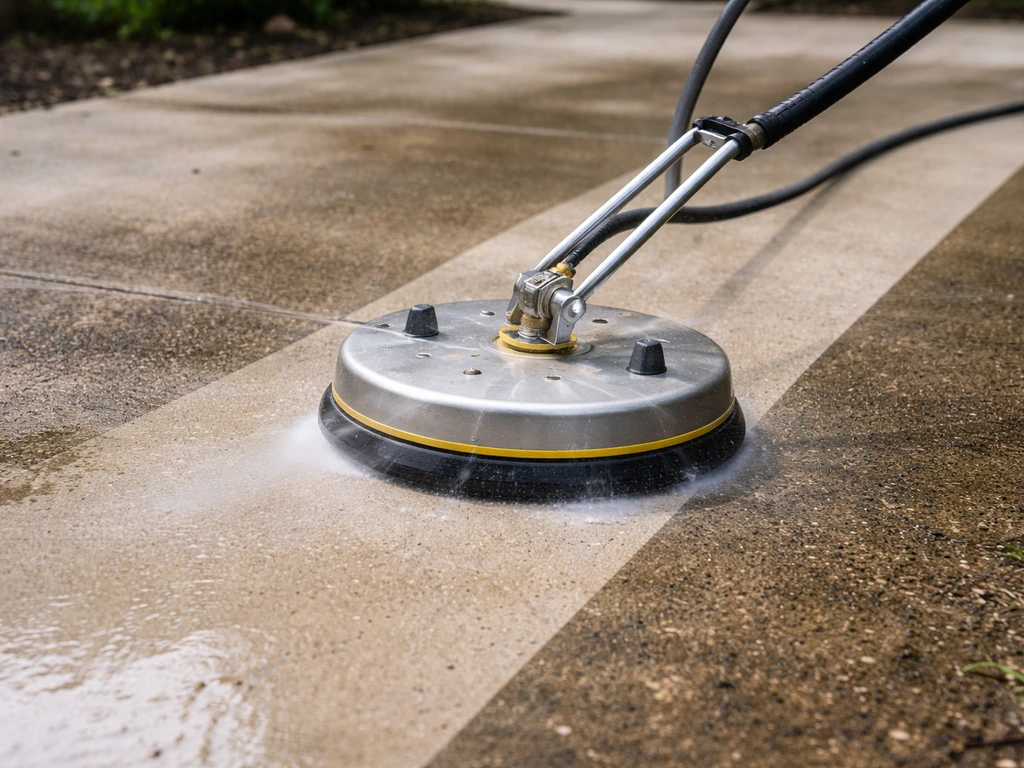
The Nilfisk Patio Plus is a rotary patio cleaning attachment (article number 126411376, instruction document 126412102 d from August 2014) designed to connect to compatible Nilfisk pressure washers and blast patios clean without the spray-stripe mess you get from a standard lance. If you just need the manual, head to Nilfisk's official support site, search your model number or the document code 126412102, and download the PDF directly. If you already have the unit in your hands and just want to get started safely today, this guide walks you through everything the manual covers: setup, surface-by-surface technique, troubleshooting, and storage.
Nilfisk Patio Plus Manual Guide: Setup, Use, and Care
Rhea Lang
14 Jun 2026
What the Nilfisk Patio Plus actually is
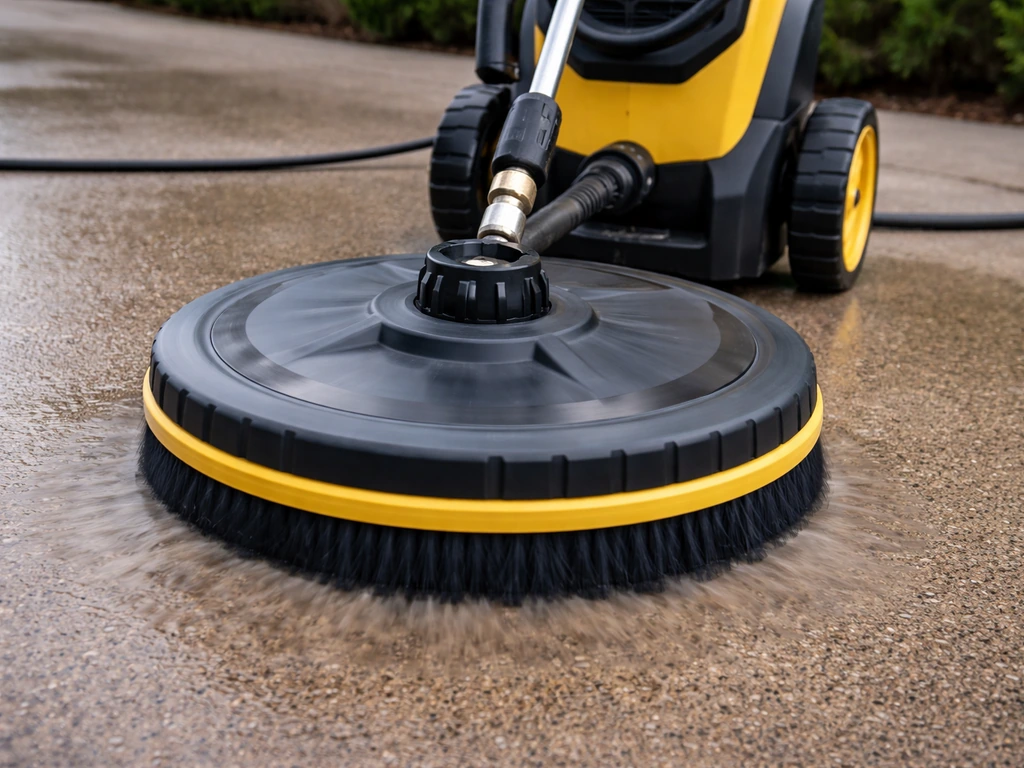
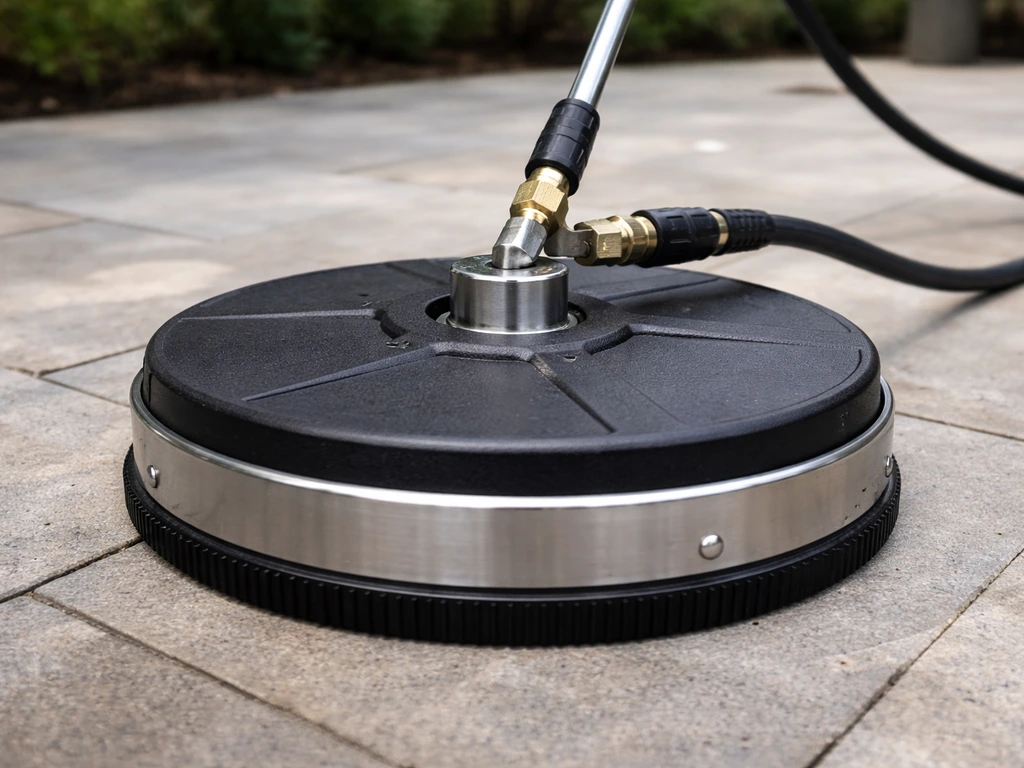
The Patio Plus is a pressure washer accessory, not a standalone machine. It is a rotating disc-style patio cleaner that fits onto compatible Nilfisk pressure washers via a quick-connect coupling. Inside the shroud, spinning nozzles blast water downward in a controlled pattern, cleaning a wide swathe of surface without the tiger-stripe lines you get when waving a standard nozzle back and forth. The official instruction sheet covers the accessory itself, not the host pressure washer, so you actually need two documents: the Patio Plus sheet (126412102 d) and your specific pressure washer's manual.
One thing worth knowing upfront: Nilfisk labels this accessory under the 'PRO product range' in the manual, which means it runs at high pressure. The instruction sheet even flags this specifically, warning that the Patio Plus tends to lift from the surface during use because of that high performance. That is not a defect. It is just the way the unit behaves when power is set too high for the surface you are cleaning, and the fix is simple: dial the power down a notch.
Finding the right manual for your exact model
Before you do anything else, flip the Patio Plus over and look for the rating plate or label on the unit. You are looking for two things: the article number and any language or variant code. [The core Patio Plus article number is 126411376](https://www. wap-nilfisk-alto-shop.
de/media/pdf/fb/8c/18/ETPatio-Cleaners2018. pdf) and the instruction sheet number is 126412102 d (August 2014 edition). There are two language-set variants of that same instruction sheet: one covers EN, FR, NL, DE, SV, DA, ES, IT, and HU, while a separate sheet covers FI, RU, LV, LT, ET, HR, CS, and PL. The Nilfisk Patio Plus instruction sheet is identified as “Patio Plus” with document number “126412102 d (08.
2014)” and includes multiple languages (EN-FR-NL-DE-SV-DA-ES-IT-HU) “Patio Plus” document number “126412102 d (08. 2014)” and includes multiple languages.
The mechanical guidance in both is identical, so if you are reading the English version you have what you need regardless of which language pack came in your box.
To download the correct manual, go to Nilfisk's official support or documentation portal (nilfisk.com, then navigate to Support and Manuals or Spare Parts). Search either '126411376' (the product article number) or '126412102' (the instruction sheet number). You can also search 'Patio Plus patio cleaner' from the accessories section. If the Nilfisk site does not surface it immediately, try ManualsLib.com, where the document is indexed. Always cross-check the document number on the front page of any PDF you download against '126412102 d (08.2014)' to confirm you have the right version and not an older revision.
Also check the manual for your host pressure washer separately. The Patio Plus sheet tells you how to use the attachment; the pressure washer manual tells you which nozzle sockets and flow rates are compatible. Running an accessory on an incompatible machine is how connectors crack and warranties disappear.
Safety checks before you switch anything on
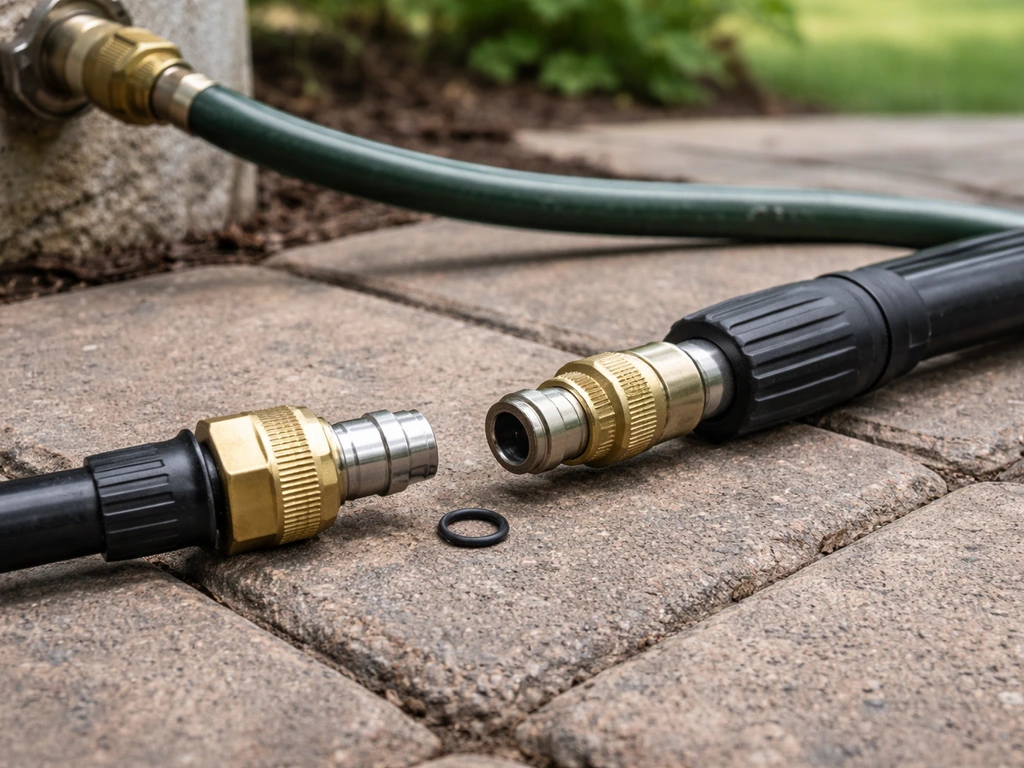
The Patio Plus manual is fairly direct about what not to do, and some of these are easy to overlook in the rush to get cleaning. Run through this list before every session, not just the first time.
- Do not use the Patio Plus for scouring or scrubbing. The spinning nozzles are for surface cleaning only. Pushing it hard into grout lines or using it like a scrubbing brush will damage both the surface and the unit.
- Do not run it over free-standing corners. Raised edges, lips on steps, and protruding slab corners can catch the skirt and flip the head, which at pressure is a hazard.
- Never put your hand under the cabinet while the unit is running. The nozzles spin fast and the water pressure underneath the shroud is substantial, even when it looks idle.
- Check the quick-connect coupling on both the pressure washer and the Patio Plus before starting. A loose or partially engaged connector can blow off under pressure.
- Inspect the hose from the pressure washer to the attachment for any kinks, cuts, or worn patches before each use.
- Wear closed-toe shoes. High-pressure water hitting your foot is a genuine injury risk, and the Patio Plus skirt does not fully contain overspray at edges.
Once you have done those checks, make sure your pressure washer is on a stable, flat surface and that the water supply is fully connected and flowing before you pull the trigger. Running a pressure washer dry, even briefly, can damage the pump.
Getting set up and cleaning: attachments, water, and technique by surface
Fitting the attachment and nozzle
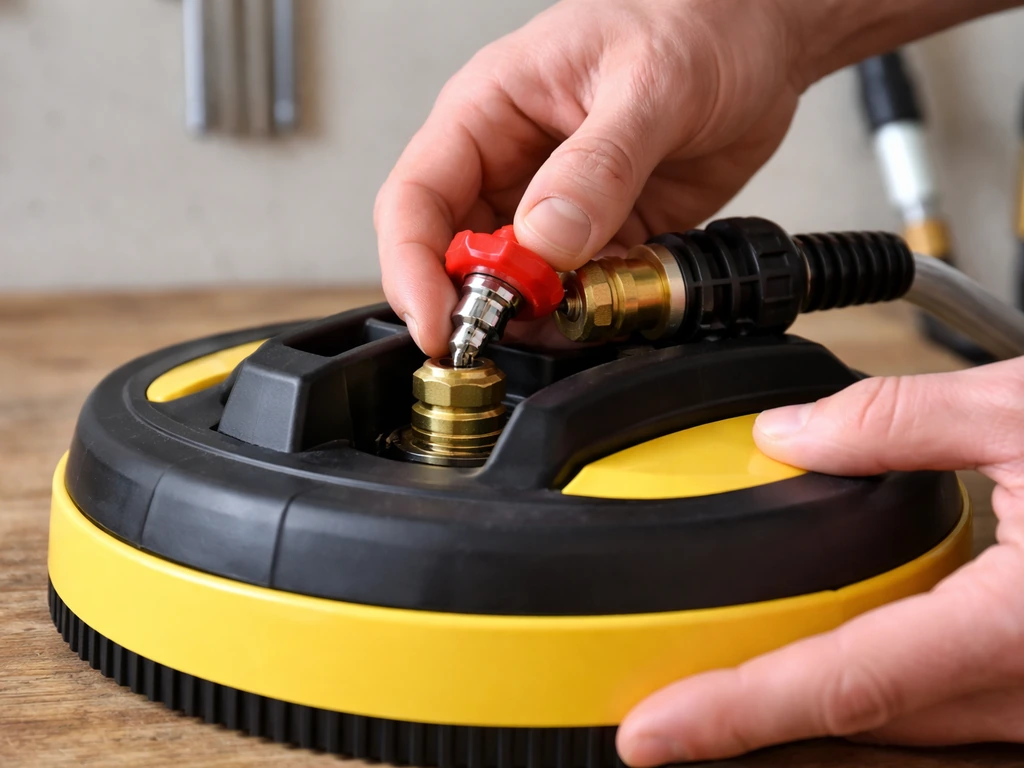
The Patio Plus manual specifically instructs you to choose the correct nozzle before mounting, referring you to the nozzle allocation schema inside the instruction sheet (Section 2). This is not optional. Using the wrong nozzle changes the spray pattern and pressure distribution, and using a nozzle that is too narrow for the rotary head can actually cause the unit to behave erratically.
Match the nozzle to the guidance in the schema, click it into position until it locks, then attach the Patio Plus to the pressure washer quick-connect. If you are wondering how to attach a Ryobi patio cleaner to your pressure washer, focus on matching the quick-connect or coupler style and using the correct nozzle so the head seals and spins properly attach the Patio Plus to a pressure washer quick-connect.
Give it a firm tug to confirm it is seated.
Water supply and detergent
The Patio Plus runs off your pressure washer's water supply, so there is no separate tank. If your pressure washer has a detergent tank or detergent injection, you can use it in conjunction with the Patio Plus, but apply detergent at low pressure before switching to the patio cleaner head.
If you need a quick guide on how to use a Ryobi patio cleaner, follow the same basic approach: pick the right nozzle, apply detergent at low pressure if your model supports it, then switch to the cleaner head for the rinse and scrubbing phase how to use ryobi patio cleaner.
Spray the detergent with the standard lance, let it dwell for three to five minutes (longer for heavy algae or moss buildup), then switch to the Patio Plus for the rinse and clean phase. Do not try to inject detergent through the spinning head at high pressure: it wastes chemical, reduces dwell effectiveness, and can leave residue patterned onto the surface.
Power settings and technique for different patio surfaces
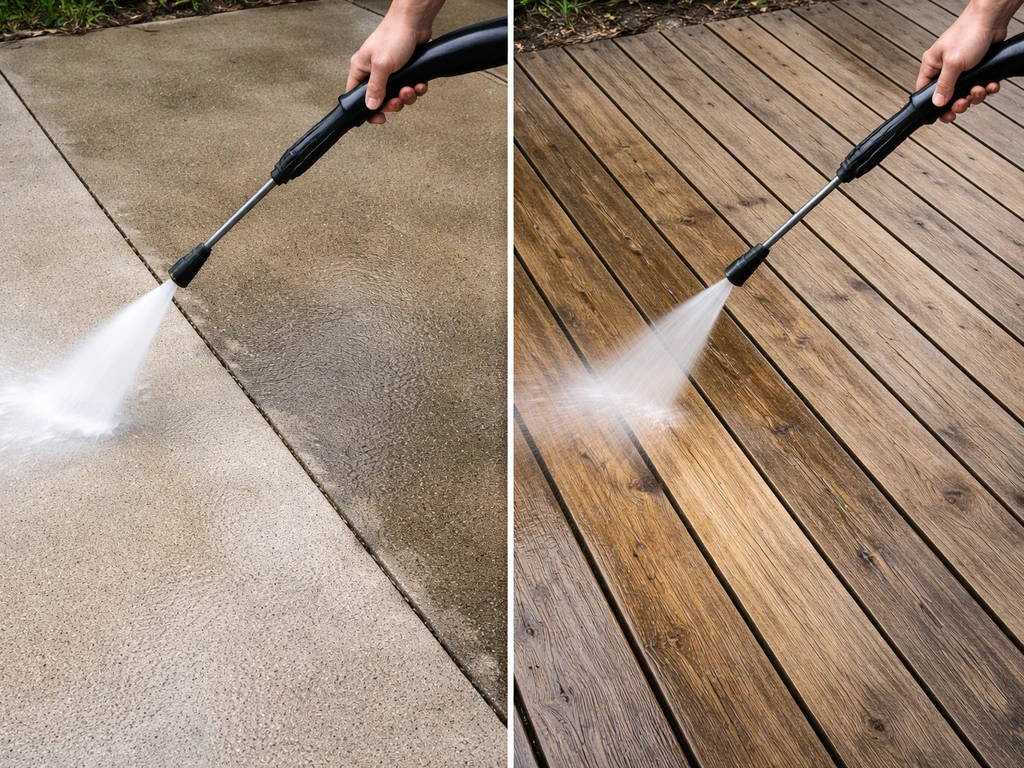
The manual gives clear guidance here, and it is practical advice that matches real-world results. For hard surfaces like concrete, use maximum power. For softer surfaces like wood decking, drop to reduced power. The instruction sheet also tells you to test on a small area first to find the optimal position and power setting, which is genuinely good advice because even within 'concrete' there is a wide variation: a fresh smooth concrete slab can handle full power comfortably, while an older textured concrete with loose aggregate on the surface might start pulling grit at the same setting.
| Surface type | Recommended power | Key watch-out |
|---|---|---|
| Concrete | Maximum | Check for loose aggregate on older slabs before full power |
| Brick / engineering brick | Maximum to medium | Watch mortar joints on older brickwork, especially lime mortar |
| Natural stone (sandstone, limestone) | Reduced to medium | Sandstone is soft and strips surface texture fast at full pressure |
| Slate | Medium | Slate can flake along natural cleave lines under high pressure |
| Porcelain paving | Maximum | Dense and non-porous, handles full pressure well; check grout joints |
| Timber decking | Reduced | Go with the grain; high pressure across the grain raises fibres badly |
Move the Patio Plus at a steady, consistent pace. Hovering over one spot strips the surface; moving too fast leaves patches of algae or staining. Overlap each pass by about 20 percent. On sloped patios, work from the top downward so dirty water runs ahead of the clean area, not back over cleaned sections.
If the unit starts lifting from the surface during cleaning, the manual is explicit: lower the power. This is especially common on slightly uneven slab surfaces where one edge of the Patio Plus skirt lifts slightly, letting the pressure underneath push the whole head up. Reducing pressure keeps it planted and actually gives you more consistent contact with the patio, which means a better clean.
Troubleshooting common Patio Plus problems
No suction or detergent not drawing
If your pressure washer has a detergent pickup tube and detergent is not drawing through, check three things in order: the pickup tube filter (usually a small mesh screen at the bottom of the tube) for blockage, the detergent nozzle fitted to the lance (you need a low-pressure nozzle for detergent injection, not the high-pressure nozzle), and whether the detergent container is actually below the intake level. Detergent injection on most Nilfisk machines is venturi-based and requires a specific low-pressure setting to work. Switching to the Patio Plus head while the pickup tube is in the detergent bottle does nothing useful: the accessory does not use the same venturi path.
Low pressure or weak cleaning performance
Weak pressure through the Patio Plus is almost always caused by one of four things: a partially blocked inlet filter on the pressure washer, a kinked hose between the machine and the accessory, an incorrectly fitted nozzle in the Patio Plus head, or insufficient mains water flow to the pressure washer. Work through them in that order. Check and rinse the inlet filter first since it is the quickest win, especially if you are drawing from a garden tap with moderate flow. If the mains pressure at your tap is below roughly two bar, some Nilfisk machines will not reach full output regardless of the accessory you are using.
Leaks at the connection point
Leaks where the Patio Plus connects to the pressure washer lance or hose are nearly always a worn or missing O-ring. Disconnect everything, dry the connectors, and inspect the O-ring inside the female quick-connect fitting. Nilfisk replacement O-rings are cheap and widely available. Do not run the unit with a leak at the connection: the escaping water reduces pressure inside the head and the connector can work loose under vibration.
The head spins unevenly or not at all
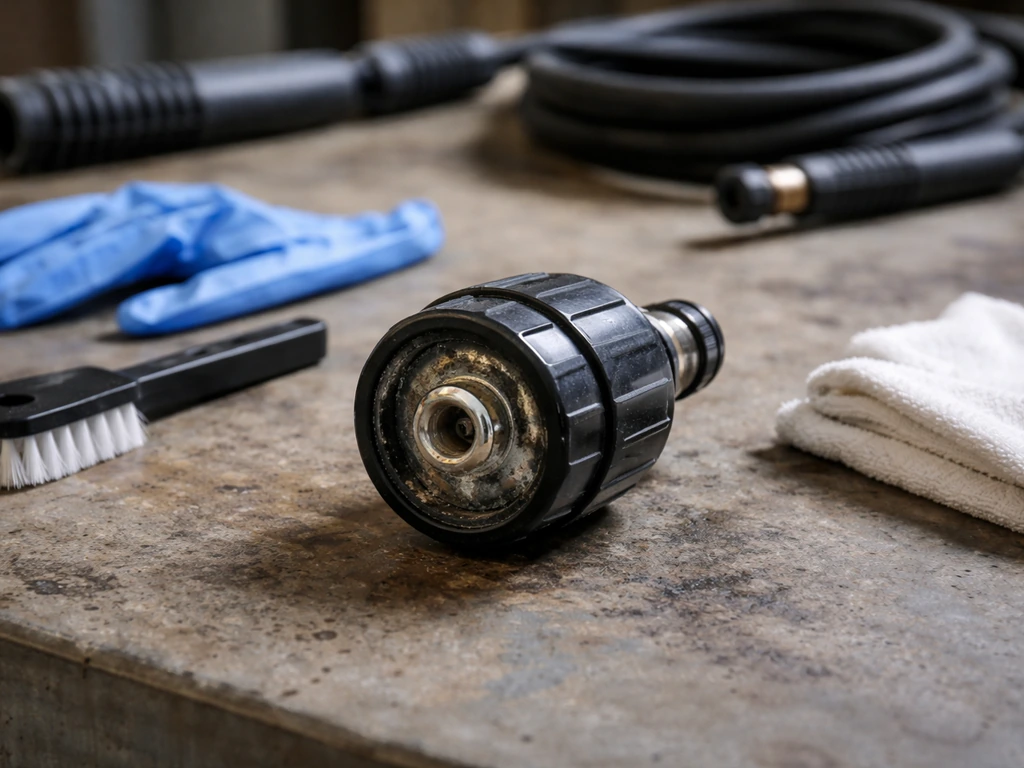
If the rotating head inside the Patio Plus is sluggish or stops spinning, the most common cause is a blocked nozzle inside the head. Disconnect from the pressure washer (with the machine off and pressure released), remove the nozzle as instructed in the manual's mounting section, and clear any debris with a thin nozzle-cleaning needle or a short blast of water in reverse. Mineral deposits from hard water can also build up over time inside the nozzle orifice and reduce flow enough to stop the rotation. A short soak in a descaling solution fixes this without damaging the nozzle.
Patio Plus lifting off the surface
As already covered, this is a known behaviour the Nilfisk manual specifically warns about. Lower the power output on your pressure washer. If you are already at a reduced setting and the unit still lifts, check that the skirt seal around the base of the housing is intact and not cracked or deformed. A damaged skirt loses the partial seal that keeps the head pressed to the surface.
Maintenance and storage to keep it running well
After every session, run clean water through the pressure washer and the Patio Plus for about 30 seconds before disconnecting. This flushes any detergent residue out of the pump, hoses, and internal nozzles. Detergent left sitting inside the unit corrodes seals over time, which is why machines develop leaks after a season or two of use when people skip this step.
Disconnect the Patio Plus from the lance and rinse the connection points with clean water. Check the quick-connect fittings for grit or debris that could score the O-ring on the next connection. Store the Patio Plus with the nozzle removed if possible, so there is no pressure on the nozzle seat during storage.
For winter storage, make sure there is no water trapped inside the unit. Water left in an accessory in a garage that drops below freezing will expand, crack the plastic housing, and split the internal water paths. Tilt the unit in multiple directions to drain it fully, then store it somewhere that does not freeze. If you are in a region with hard winters, wrapping the hose connectors loosely in a cloth bag keeps grit and moisture out of the quick-connect sockets.
- Flush clean water through after every session before disconnecting
- Inspect and clean the inlet filter on the pressure washer every few uses
- Check O-rings on quick-connect fittings at the start of each season and replace if flattened or cracked
- Remove nozzles for winter storage to avoid seated corrosion
- Drain all water before freezing temperatures and store in a frost-free location
- Wipe down the skirt seal and check for cracks or deformation before each use
No manual? Here is the quick-start guidance you need right now
If you cannot locate the physical manual and the PDF download is proving difficult, here is the core operating workflow drawn directly from the Patio Plus instruction sheet. This is not a substitute for the full document long-term, but it will get you set up safely today.
- Identify your nozzle: Check the nozzle allocation schema in the original manual (or the Nilfisk support site) and fit the correct nozzle for your pressure washer's bar rating. Lock it in firmly before connecting the head to the lance.
- Connect to the pressure washer: Use the quick-connect coupling. Pull back the collar, push the Patio Plus connector in fully, and release the collar. Give it a firm tug to confirm it is locked.
- Check water supply: Make sure the garden tap is fully open and water is flowing before starting the machine. A restricted water supply is the most common cause of poor performance.
- Set power for your surface: Start at reduced power. Test on a small, inconspicuous area first. Increase power only for hard surfaces like concrete or porcelain. Stay at reduced power for sandstone, natural stone, and timber.
- If the head lifts from the surface: Reduce power immediately. Do not force it back down by pressing harder. Lower pressure resolves the lifting issue.
- Safety zones: Keep hands and feet clear of the underside of the head while running. Do not run the unit over raised slab edges or step corners. Stay alert for the skirt catching on any protrusion.
- After cleaning: Run clean water through for 30 seconds, then switch off the machine and release pressure before disconnecting. Drain and store in a frost-free location.
The Patio Plus is genuinely effective on the surfaces this site covers most often: concrete, brick, and porcelain all respond well at high pressure, while sandstone and slate need care at reduced settings.
If you are also weighing up other patio cleaning options, including battery-powered alternatives or different pressure washer accessories, the Nilfisk Power Patio Cleaner is another Nilfisk variant worth comparing, and the broader category of cordless patio cleaners covers a different style of tool entirely if a mains-powered pressure washer does not suit your setup.
If you are specifically shopping by cordless patio cleaner reviews, compare how each model handles power, run time, and real-world stain removal on your surface type. The Nilfisk Power Patio Cleaner review focuses on how well this type of cleaner performs, what to expect from the power settings, and which surfaces it handles best.
If you want a broader take on how this type of pressure-washer patio cleaner performs in real use, check out our Ryobi Patio Cleaner review.
The key thing to take away: the manual for this accessory is short, practical, and freely available using document number 126412102 d. Download it, keep a copy on your phone, and refer to the nozzle allocation schema and power guidance every time you switch surfaces. Most of the common problems people have with the Patio Plus, including lifting, weak pressure, and leaks, trace back to either a missed nozzle selection step or a power setting that is not matched to the surface. Get those two things right and the unit does exactly what it is supposed to.
FAQ
Can I use detergent with the Nilfisk Patio Plus, or do I need to clean without chemicals?
Yes. If you are going to use detergent, apply it with the pressure washer lance first at low pressure, then switch to the Patio Plus head for rinse and scrubbing. Avoid trying to draw detergent through the spinning head, because it does not use the same injector path and can leave patterned residue.
How do I know which nozzle to use for the Nilfisk patio plus manual setup, if my pressure washer already has a default nozzle?
Use the nozzle allocation chart in the Patio Plus instruction sheet, not only your pressure washer nozzle advice. Even if the machine accepts high-pressure nozzles, an incorrectly sized nozzle can disrupt flow through the rotary head and cause erratic spinning or uneven cleaning.
What’s the safest way to start using the Patio Plus so I don’t run it dry or strain the connections?
Do not operate it at idle with no water flow. Make sure the water supply is running before pulling the trigger, and keep the machine on a stable surface to prevent vibration from loosening the quick-connect under load.
What should I check if lowering the pressure does not stop the Patio Plus from lifting off the patio?
If it lifts and you already lowered pressure, inspect the skirt seal (the base ring around the housing). A cracked, deformed, or missing skirt seal reduces the partial seal needed to keep the head pressed down, which means it will keep lifting even at lower settings.
Why does the Patio Plus feel underpowered when I connect it, even after I set the nozzle and pressure correctly?
A weak clean is often from water supply limitations rather than the accessory itself. If you are on a garden tap, verify your supply meets the machine’s required flow, and remember that if your tap pressure is around two bar or lower, some Nilfisk models will not deliver full output even with the correct Patio Plus.
My Patio Plus spins sluggishly, what’s the best way to diagnose a blockage or mineral buildup in the internal nozzle?
Clear blockages by removing the nozzle inside the head as the manual describes, then clean debris or hard-water deposits. A short soak in descaling solution can restore flow if the nozzle orifice is restricted, and it is safer than aggressive tools that could enlarge or damage the orifice.
What should I do if there’s a leak where the Patio Plus connects to the pressure washer?
If you see or hear water around the quick-connect, you likely have a worn or incorrect O-ring. Disconnect, dry the fittings, inspect the O-ring inside the female connector, replace it if it is missing or damaged, and do not run the accessory with a leaking connection.
How should I move the rotary head for even results, especially on algae-stained concrete?
Yes, and the best habit is to overlap passes by about 20 percent while keeping a steady pace. Hovering or pausing on one spot will strip the surface, while moving too fast can leave missed streaks where algae or staining remains.
Why isn’t detergent drawing through my pickup tube when using the Patio Plus?
If your detergent pickup tube is not drawing chemical, check the tube filter first, then confirm you installed the low-pressure detergent nozzle on the lance. Also verify the detergent container height is below the intake level, since venturi injection depends on correct pressure and setup.
How should I store the Nilfisk Patio Plus for winter to prevent damage from freezing water?
For winter, fully drain the accessory and prevent freezing. Tilt it in multiple directions to remove trapped water, store it in a non-freezing area, and if needed wrap connectors to keep grit and moisture out of the quick-connect sockets.
What’s the most important post-cleaning step in the Patio Plus manual to avoid future leaks?
Flush clean water through the pressure washer and Patio Plus for about 30 seconds after each session, then disconnect and rinse the connection points. Leaving detergent inside can cause corrosion and seal leaks later, which often shows up after a season if flushing is skipped.
Next Article
Nilfisk Power Patio Cleaner Review and How to Use It
Nilfisk Power Patio Cleaner review with setup, pressure settings, technique, troubleshooting, and care for streak-free r