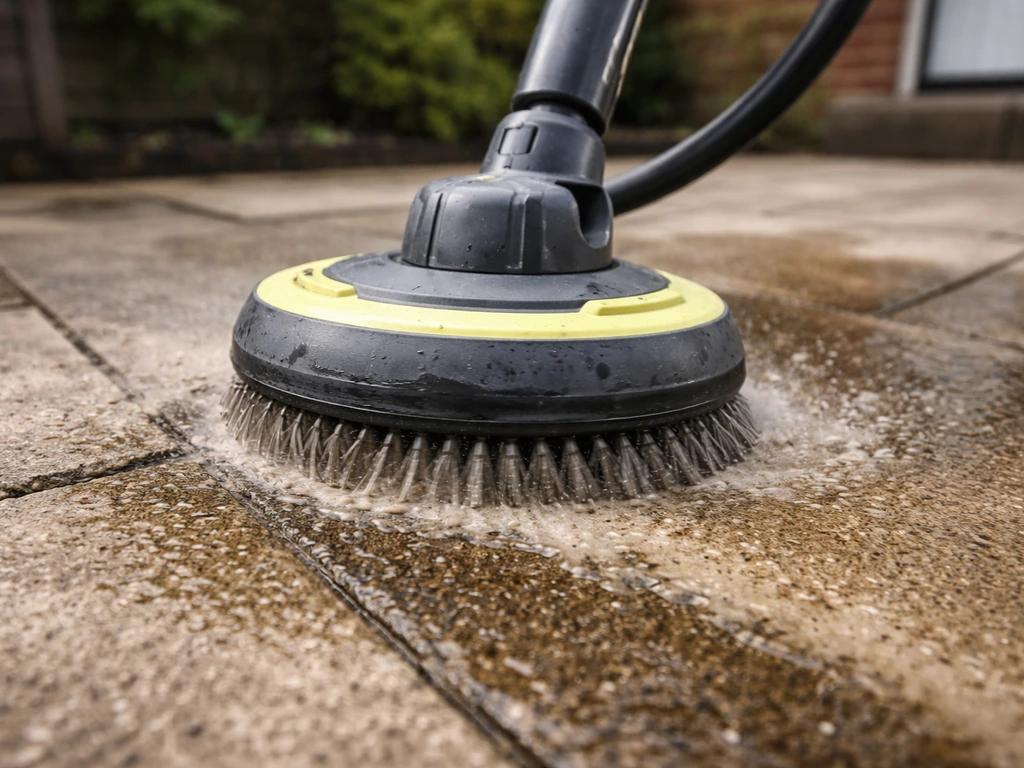
The Nilfisk Power Patio Cleaner is worth buying if you already own a compatible Nilfisk pressure washer and you're cleaning large paved areas regularly. It delivers noticeably better results than a standard lance nozzle, covers roughly 30 cm per pass, and the adjustable pressure dial makes it usable on surfaces from concrete to wood without wrecking anything. That said, it won't fix badly stained grease or rust on its own, and there's a known seal wear issue to watch for after heavy use. If that matches your situation, read on for the full picture.
Nilfisk Power Patio Cleaner Review and How to Use It

Rhea Lang
31 May 2026
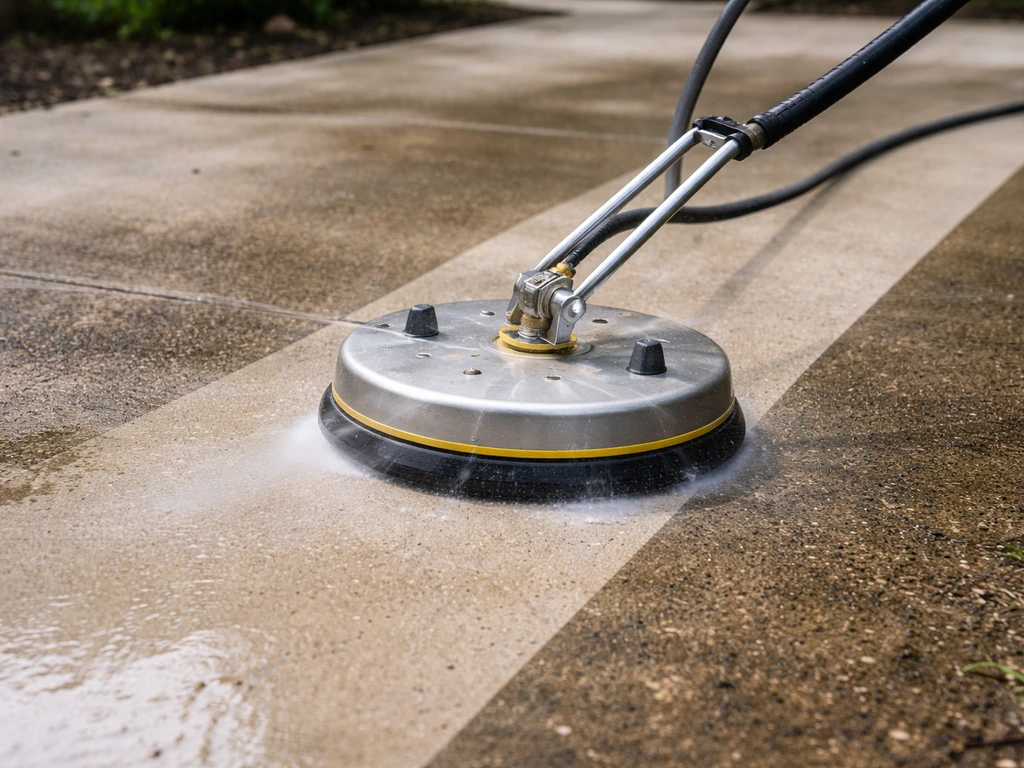
What the Nilfisk Power Patio Cleaner actually is
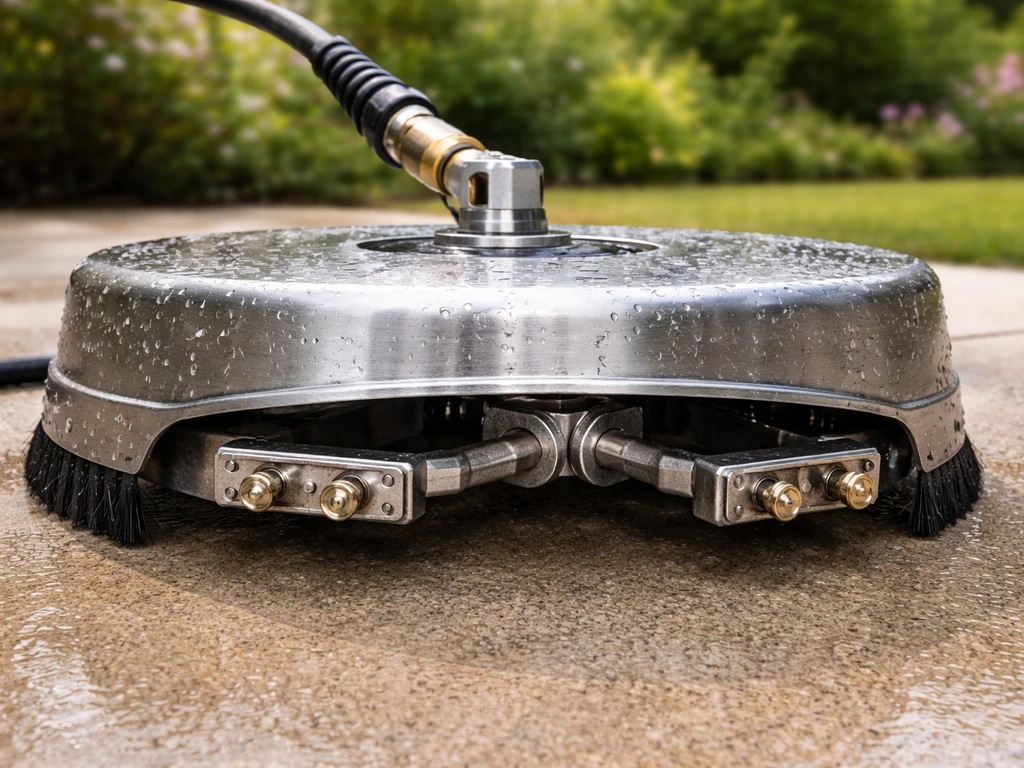
The Nilfisk Power Patio Cleaner (sold under SKU 128500954 or 128500955 depending on the retailer) is a rotating surface cleaner attachment that connects to your Nilfisk pressure washer via a bayonet coupling. It's not a standalone machine. Think of it as a spinning nozzle head inside a shroud that directs the water downward and outward across a wide cleaning arc, rather than blasting a single jet at one spot. That design is what makes it faster and more even than a standard lance.
It comes with two sets of nozzles: standard gentle cleaning nozzles for everyday dirt and algae, and the so-called Dirt Hammer nozzles for ingrained, stubborn grime. An extension lance is also included so you can reach further along fences, walls, and low surfaces without crouching. There's a pressure adjustment dial mounted on the top of the unit, which is genuinely useful rather than a marketing gimmick. Nilfisk lists the intended surfaces as patios, driveways, paving, decking, fences, and walls.
Compatibility and setup: what pressure washers it fits
This is the first thing you need to check before buying. The Power Patio uses a bayonet coupling, which is Nilfisk's own connection standard. It is not a universal 1/4-inch quick-connect fitting. If you have a non-Nilfisk pressure washer, this attachment almost certainly will not connect without an adapter, and even then it's not guaranteed.
Officially compatible machines span Nilfisk's domestic range: Compact, Dynamic, Core, Excellent, and Premium series. More specifically, Machine Mart's listing confirms compatibility with the C105, C110, C120, C125, C130, C135, E130, E140, E145, Core series, and Premium series. If your model isn't on that list, check the bayonet coupling style on your spray gun before ordering.
How to connect it
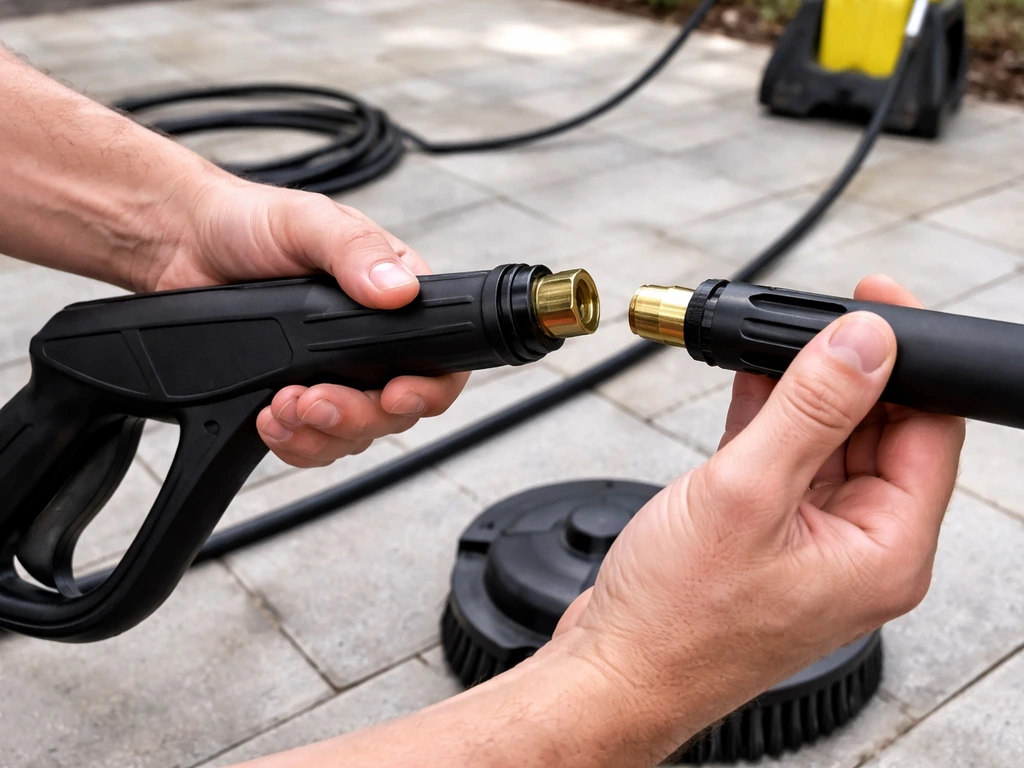
- Switch off and depressurise your pressure washer before attaching anything.
- Remove your existing lance or nozzle from the spray gun's bayonet fitting.
- If you want extra reach, attach the included extension lance to the spray gun first, then connect the Power Patio head to the end of it.
- Line up the bayonet pins and push the Power Patio head onto the fitting, then twist to lock. You'll feel it click into place.
- Set the pressure dial on top to the lowest setting before you start the machine.
- Turn on the washer, squeeze the trigger briefly to purge air from the line, then adjust the pressure dial upward to your desired level.
Nilfisk has an official tutorial video specifically covering nozzle swapping on the Power Patio, which is worth watching once before your first session. Swapping between the standard and Dirt Hammer nozzles takes about 30 seconds once you've done it a couple of times.
Performance review: what to actually expect
In practical use, the Power Patio cleans noticeably better than a standard rotating turbo nozzle for large flat areas. The rotating head covers approximately 30 cm of width per pass, which means you're moving through a medium-sized patio meaningfully faster than you would with a pencil jet. A Danish 2025 roundup that tested it against competing surface cleaners rated it best in test specifically because it left no streak lines while still shifting stubborn grime. That tracks with my own experience: the enclosed shroud design keeps the water directed downward and prevents the chaotic splash you get from an open nozzle.
The Dirt Hammer nozzles add genuine extra cleaning power for deeply ingrained grime. They're not just a marketing extra. For a patio that hasn't been cleaned in two or three years and has black algae embedded between joints, they make a real difference. That said, the standard nozzles handle anything recently cleaned or lightly soiled without needing to switch.
One honest caveat: the cleaning width of around 30 cm means a large driveway still takes a while. This is not a commercial-grade wide-deck surface cleaner. It's a domestic tool that covers roughly 0.4 square metres per slow pass. For a 20-square-metre patio, budget 30 to 45 minutes including overlap passes and edge work.
How to use it on different patio surfaces
Concrete and paving slabs
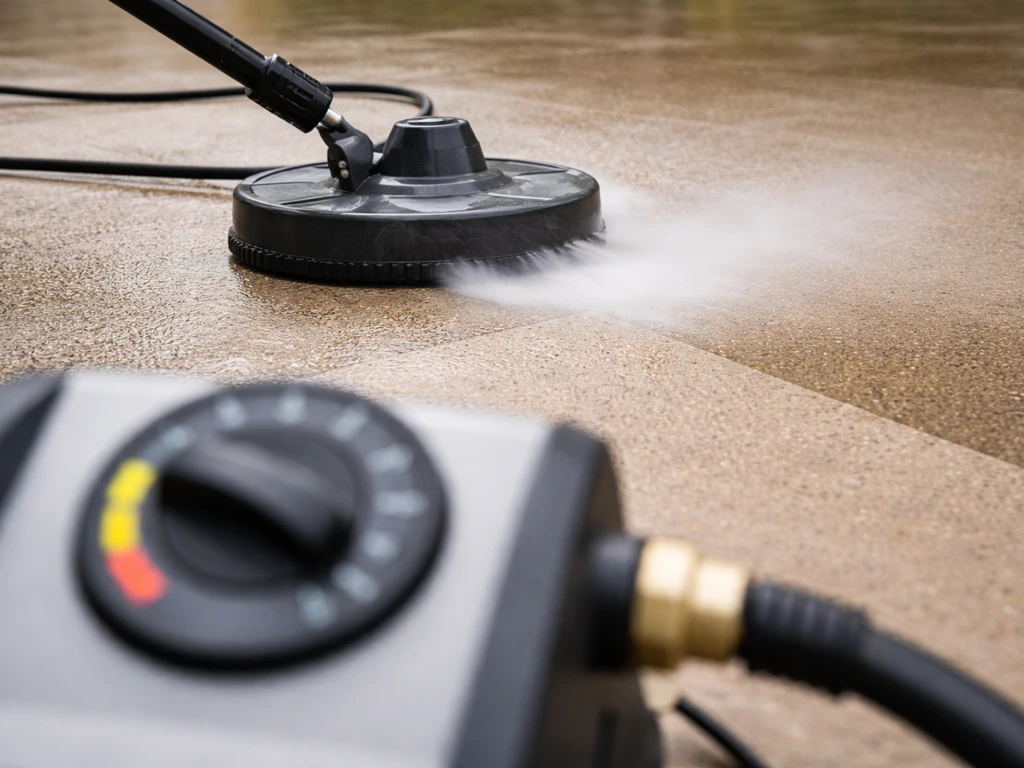
Concrete handles the most pressure, so start with the dial at around 60 to 70 percent and use the standard nozzles for general cleaning. For ingrained grime or black staining, switch to the Dirt Hammer nozzles and take your time with slow, overlapping passes. Keep the head flat and about 5 to 8 cm off the surface. Go too high and you lose cleaning power; go too low and you risk blasting out jointing sand.
Brick and natural stone
Natural stone and brick are more porous and can be softer than concrete, so drop the pressure dial to around 50 percent and stick with the standard nozzles first. Move the head in slow, consistent overlapping stripes. Avoid holding it stationary over one spot as the concentrated rotation can etch softer stone. If you have deep staining, pre-treat with a suitable stone cleaner and let it dwell before going over it with the Power Patio.
Sandstone
Sandstone is the surface where the adjustable pressure dial earns its keep. To use a Ryobi patio cleaner, make sure it’s compatible with your pressure washer, then fit the correct nozzle, set an appropriate pressure for your surface, and use overlapping passes to avoid streaks how to use Ryobi patio cleaner. Drop it right down to 30 to 40 percent and use gentle nozzles only. Never use the Dirt Hammer nozzles on sandstone. The material is soft enough that even standard pressure washing can visibly erode the surface texture if you linger. Keep the head moving constantly. If a patch isn't clearing, the answer is more chemical pre-treatment, not more pressure.
Slate
Slate is reasonably hard but can be slippery and the surface can flake along natural grain lines if you catch it at the wrong angle. Use 40 to 50 percent pressure on the dial, standard nozzles, and keep passes parallel to the grain direction rather than across it. Check a small inconspicuous area first on older or thin slate tiles.
Porcelain tiles
Porcelain is actually the most forgiving surface for pressure washing because the material itself is very dense and non-porous. The bigger concern here is grout. Set pressure to 50 percent and use the standard nozzles. Avoid hovering over grout lines, especially if the grout is older or already showing signs of cracking. Keep the head moving smoothly and the porcelain faces will come up looking new.
What it handles well and where it falls short
| Cleaning task | Power Patio result | Notes |
|---|---|---|
| Green algae and moss | Excellent | Standard nozzles remove light growth; Dirt Hammer cuts through heavy embedded algae |
| Mildew and black spot | Good to excellent | Dirt Hammer nozzles needed for old, deep staining; may need pre-treatment first |
| General dirt and grime | Excellent | Standard nozzles handle this well with no pre-treatment needed |
| Grease and oil stains | Poor to fair | Pressure alone won't shift grease; you need a degreaser applied before cleaning |
| Rust stains | Poor | Rust requires a dedicated rust remover chemical; the Power Patio can rinse but not lift it |
| Pet stains and odour | Fair | Surface staining clears; odour requires an enzymatic cleaner applied separately |
| Paint or sealant residue | Poor | Not designed for this; specialist strippers needed first |
The honest summary: the Power Patio is outstanding at removing biological growth (algae, moss, mildew, green staining) and general outdoor grime from large flat surfaces. That covers the majority of what most patios actually need. Where it struggles is anything chemical in nature: grease, rust, pet urine odour, and paint residue all require a chemical pre-treatment first, and the Power Patio becomes the rinse tool rather than the cleaner itself.
Technique and settings to get streak-free results
Streaks and uneven patches are almost always a technique problem rather than a product fault. The main causes are moving too fast, not overlapping passes, or varying your distance from the surface mid-pass.
- Keep the head at a consistent 5 to 8 cm from the surface. Higher than 10 cm and you start losing pressure at the contact point.
- Overlap each pass by at least 5 cm with the previous one. If you see a line between passes, you're not overlapping enough.
- Move at a slow, steady walking pace. Rushing leaves dirty patches; going too slow can over-clean one strip next to an under-cleaned one.
- Always work in a consistent direction: parallel stripes across the whole surface rather than random back-and-forth.
- Do a final light pass at low pressure in one direction over the whole surface to blend any minor variation.
- On soft surfaces like sandstone or decking, reduce pressure to 30 to 40 percent on the dial and keep moving constantly.
- The attachment can be used in both horizontal and vertical orientations, which is useful for walls and vertical fencing.
If you're working near planted borders, Nilfisk's own guidance is to rinse nearby plants with clean water before and after you clean, especially if you're using any detergent. The Power Patio significantly reduces spray splash compared to an open nozzle, which is one of its underrated practical advantages near garden beds.
Troubleshooting and after-use care
Clogged jets
If the head is spinning but cleaning unevenly or leaving a pattern of cleaned and uncleaned strips, one of the nozzle jets is likely partially blocked. Remove the nozzle set from the head, rinse under clean water, and use a thin needle or nozzle cleaning tool to clear the jet holes. Don't use anything that could widen the orifice. Refit and test. This is more likely if you've been cleaning sandy or gritty surfaces where fine debris can be sucked back into the jets when the washer is turned off.
Uneven cleaning and streak lines
If you're getting a visible striped pattern on the surface after cleaning, the most common cause is moving too quickly or holding the head at an inconsistent height. Slow down, lower the head slightly, and make sure you're overlapping your passes. If the issue persists, check that the head is rotating freely: the spinning mechanism should spin with no resistance when you hold the unit up and blow gently through the water inlet.
Water spraying upward rather than downward
This is the seal wear issue flagged in a German March 2025 review update. After intensive use over about a year, the internal seal in the top section of the Power Patio can crack, causing water to escape upward through the body rather than being directed out through the nozzle head. You'll notice it as a sudden spray hitting your legs or torso rather than the floor. At that point the seal needs replacing or the unit needs to be assessed by Nilfisk service. It's a known weakness rather than a rare defect, so if you're using this tool heavily every few weeks, check for early signs of seal wear (slight weeping at the body join) before it becomes a full failure.
After-use care and storage
- After use, turn off the washer and squeeze the trigger to release residual pressure in the line before disconnecting.
- Detach the Power Patio head and rinse the nozzle sets under clean tap water to clear any grit or detergent residue.
- Dry the nozzles before storing to prevent mineral deposits building up in the jet holes.
- Store the head indoors or in a dry shed rather than leaving it attached to the washer outside. UV degradation affects the plastic over time.
- Inspect the bayonet coupling and internal seal area every few months if you use it frequently. Wipe the coupling clean before re-attaching.
Is it worth buying? The honest verdict
If you already own a compatible Nilfisk pressure washer from the C-series, E-series, Core, or Premium range and you have a reasonably large patio or driveway to clean one to two times a year, the Power Patio is a straightforward yes. The no-streak results on flat surfaces, the dual nozzle system, and the pressure dial make it genuinely more capable than cleaning with a standard lance. The fact that a 2025 independent test rated it best in class for streak-free cleaning on paved surfaces backs up what you'd experience hands-on. If you're still weighing options beyond this Nilfisk unit, cordless patio cleaner reviews can help you compare results, runtime, and ease of use across brands.
The case against it: if you don't already own a Nilfisk washer, you can't use it without also buying one (or finding an adapter, which isn't always reliable). For a quick overview of how the Nilfisk Power Patio manual addresses nozzle changes and care, see the nilfisk patio plus manual guide. The seal wear issue after heavy use is worth knowing about, so this isn't a buy-once-never-think-about-it tool if you're a professional or a very frequent user. And if your patio problems are primarily grease, rust, or pet staining, the Power Patio is only part of the solution. You'll still need the right pre-treatment chemical to do the heavy lifting.
For homeowners considering alternatives: if you're not tied to the Nilfisk ecosystem, similar surface cleaner attachments exist from other brands. Ryobi also produces a patio cleaner attachment in a comparable format, and there are cordless patio cleaner options worth evaluating if you don't want to run a hose-fed pressure washer at all. Each suits a slightly different situation depending on your washer setup and how often you're cleaning.
Your next practical steps
- Check your Nilfisk model number against the compatibility list: C105 to C135, E130 to E145, Core, and Premium series all work. If you're on that list, you're good to go.
- Decide whether to buy as a standalone accessory (SKU 128500954 or 128500955) or check if it's included in a bundled washer kit.
- Before your first clean, identify what your patio surface is and set your starting pressure dial accordingly: low for sandstone and wood, medium for brick and slate, higher for concrete.
- Pre-treat any oil, rust, or heavy biological staining with an appropriate chemical cleaner and allow dwell time before starting the Power Patio.
- Plan your cleaning pattern in parallel overlapping stripes and budget around 30 to 45 minutes for a 20-square-metre area.
- After use, rinse and dry the nozzles, store the head indoors, and add a quick inspection of the seal area to your routine if you're using it every month or more.
FAQ
Can I use the Nilfisk Power Patio cleaner with a non-Nilfisk pressure washer using an adapter?
It will only work reliably if you can match Nilfisk’s bayonet coupling, not just a generic quick-connect. Even if an adapter fits physically, some setups do not seat fully or do not lock consistently, which can cause leaks or weak pressure at the head.
What pressure setting should I start with, and what if the surface still doesn’t clean?
Start around 60 to 70 percent on concrete, then slow your passes and overlap more before increasing pressure. If it still won’t improve, switch to the Dirt Hammer nozzles for ingrained grime, or use chemical pre-treatment, because higher pressure alone can streak or damage softer surfaces.
How do I avoid blasting out jointing sand between paving slabs?
Keep the head flat and maintain the 5 to 8 cm standoff, do not linger in one spot, and do not increase pressure to compensate for poor contact. If sand starts washing away, pause and pre-clean with appropriate chemicals, then rinse lightly with fewer passes.
Do I need to pre-wet the patio before using the Power Patio?
Pre-wetting helps reduce spotting and makes algae and mildew lift more evenly, especially on porous or already-dry surfaces. Wet the area first, then clean with the standard nozzles, and only switch to Dirt Hammer when the embedded areas remain dark after a couple of overlapping passes.
Which nozzle should I use for algae, moss, and green staining?
Use the standard gentle nozzles first, since they’re intended for everyday dirt and biological growth. If growth is deeply embedded, switch to Dirt Hammer and take slower overlapping passes, but plan on chemical treatment if the staining returns quickly.
Can I use detergents or patio cleaner chemicals with this attachment?
Yes, but rinse nearby plants before and after cleaning, and avoid dwelling with detergent on grout or softer stone. Also, if you see residue after rinsing, reduce chemical strength and increase rinse passes rather than trying to solve it with more pressure.
Will it remove grease, rust, pet urine odour, or paint residue by itself?
Usually no. These types of contamination are chemical in nature, so the Power Patio is mainly a rinse and lift tool after you apply the correct pre-treatment. Plan on letting the chemical dwell per the product instructions, then use the attachment for controlled rinsing.
Why am I getting striped patches or streaks after cleaning?
Most streaking comes from technique, moving too fast, inconsistent height, or insufficient overlap. Slow down, keep the head parallel to the surface, maintain a consistent standoff, and make a final light pass with steady overlap to blend the pattern.
The head spins, but cleaning looks uneven. What should I check first?
Inspect the nozzle jets, one of them is often partially blocked. Remove the nozzle set, rinse the jets with clean water, and clear the holes with a thin cleaning tool without enlarging the orifice, then refit and test on a small area.
How can I tell if seal wear is starting?
Watch for early signs like slight weeping at the body join or water escaping in an unexpected direction. If you notice sudden spray aimed toward your legs or torso rather than the floor, stop and have the seal assessed or replaced by service.
Is it safe to use on sandstone, and what’s the biggest mistake people make there?
Use the dial lower, roughly 30 to 40 percent, and only use gentle nozzles. The biggest mistake is using Dirt Hammer on sandstone or lingering in place, both can visibly erode the surface texture and make future cleaning harder.
Can I use it on slate without damaging the surface?
Yes, but keep pressure moderate (around 40 to 50 percent), use standard nozzles, and follow the grain direction with your passes. Test a small inconspicuous area first on older or thin tiles, and avoid crossing grain at a sharp angle.
What’s the best approach for porcelain and grout lines?
Use moderate pressure (about 50 percent) with standard nozzles and avoid hovering over grout lines, especially if grout is cracked or older. Keep the head moving smoothly across porcelain faces, then do grout carefully with minimal dwelling and additional gentle rinses if needed.
How long should a typical patio take, and how do I estimate coverage?
Because the cleaning width is about 30 cm per pass, total time depends on how much overlap and edge work you do. For a roughly 20-square-metre patio, a common range is 30 to 45 minutes, plan extra time if the surface has deep staining between joints.
How do I store and maintain it to reduce blockages and wear?
After gritty jobs, flush the head with clean water, then run the unit briefly to clear fine debris from the jets. Keep the nozzle jets clean, and periodically check for any weeping at the body join to catch seal issues before they escalate.
Next Article
Ryobi Patio Cleaner Review UK: Wire Brush, Setup and Tips
Ryobi patio cleaner review UK with wire brush setup, technique, and surface-specific tips for concrete, stone, brick and