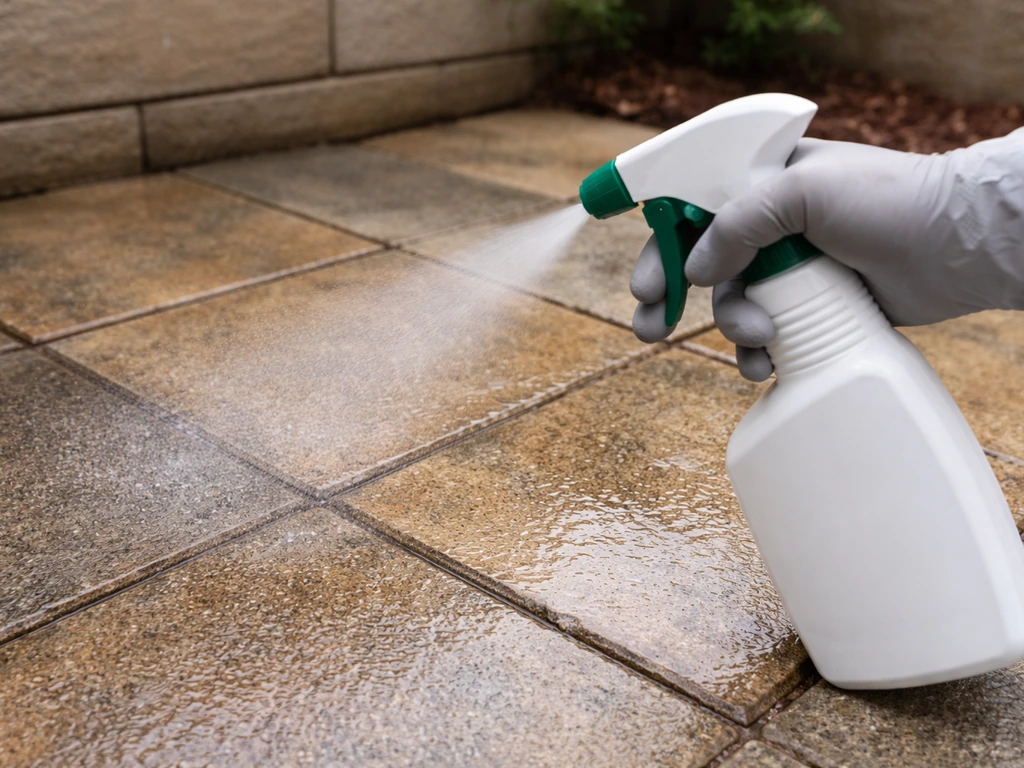
Apply patio cleaner on a cool, overcast day with no rain forecast for at least four hours. Dilute the product as directed on the label (some need mixing, some don't), wet down any nearby plants first, then soak the patio surface thoroughly and let the cleaner dwell for the recommended time before rinsing or leaving it to work naturally. That basic sequence works for most cleaners, but the details, especially the dilution ratio, dwell time, rinsing requirement, and pressure you use, vary a lot depending on your surface material and what you're cleaning.
Patio Cleaner How to Use It Safely on Any Surface
Rhea Lang
29 Apr 2026
Choose the right patio cleaner for your surface and stain
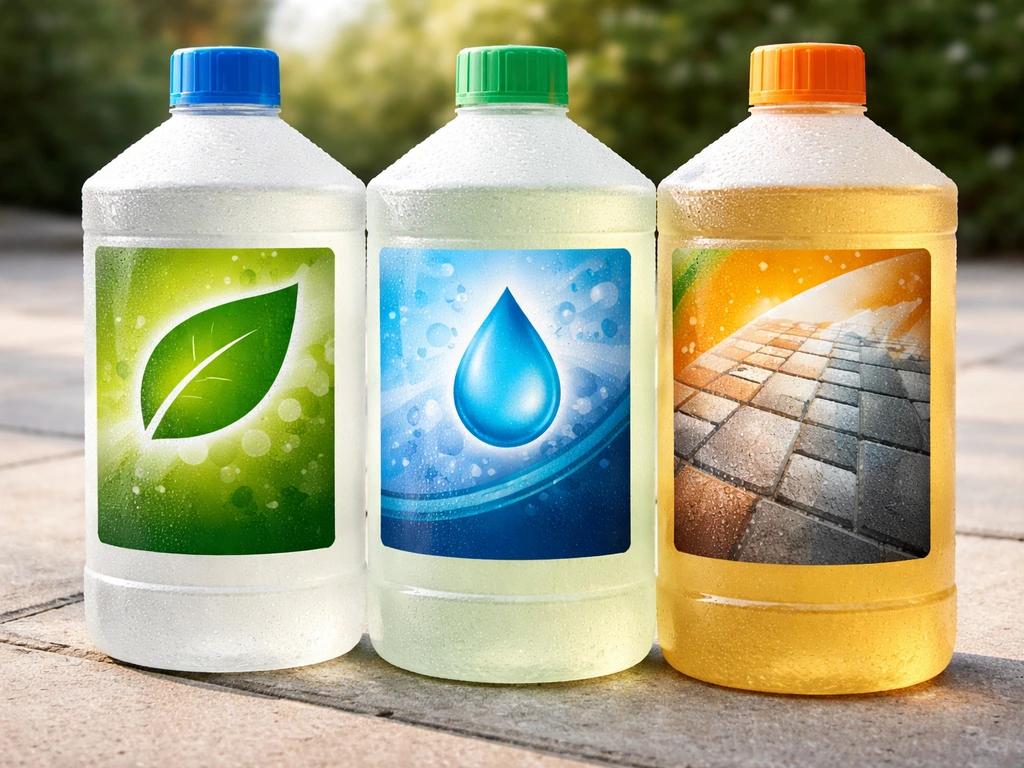
Getting this part right saves you a lot of time and avoids accidental damage. A cleaner that works brilliantly on concrete can strip the sealant off sandstone or etch the surface of slate. The same goes for stain type: a general moss and algae cleaner won't touch a rust stain, and a heavy-duty degreaser is overkill for light green algae.
The three main cleaner categories you'll come across are biocidal/algaecide cleaners (for organic growth like moss, algae, and lichen), oxidising or acidic cleaners (for rust, mineral deposits, and tough staining), and surfactant-based degreasers (for oil, grease, and food stains). Some products combine approaches, but most are built around one of these.
| Surface Type | Compatible Cleaner Types | Avoid |
|---|---|---|
| Concrete | Most cleaner types, including acidic and biocidal | Nothing specific, but test sealant compatibility first |
| Brick | Biocidal, general-purpose, diluted acid cleaners | Highly concentrated acids that can erode mortar |
| Sandstone | pH-neutral or near-neutral biocidal cleaners only | Acidic cleaners, bleach-based products |
| Slate | Gentle pH-neutral cleaners, biocidal sprays | Acidic or strong alkaline cleaners |
| Limestone/Marble | pH-neutral only (bleach-free, acid-free) | Any acid, including vinegar |
| Porcelain/Ceramic Tile | Most cleaners including biocidal and general-purpose | Highly abrasive formulas |
| Indian Sandstone | pH-neutral biocidal cleaners | Bleach, acids, anything not stone-safe |
A product like Wet & Forget Outdoor Concentrate is specifically marketed as bleach-free and nearly pH-neutral, which is why it lists compatibility with sandstone, limestone, marble, slate, and ceramic tiles. That makes it one of the safer options across multiple surface types. Something like 30 SECONDS Outdoor Cleaner is more aggressive and better suited to concrete, brick, and harder surfaces where you want fast visible results and are happy to rinse afterward.
If you're dealing with a stain you can't immediately identify, start with the gentlest option first and escalate. If you want to go from product choice into the exact application workflow, see also how to apply patio cleaner for a step-by-step process. You can always apply a stronger cleaner if the first pass doesn't shift it, but you can't un-etch a sandstone slab.
Read and prep: labels, dilution, safety, and area protection
I know it's tempting to skip the label and just spray, but patio cleaners vary more than you'd think. Some come ready to use straight from the bottle, others need significant dilution, and getting this wrong either wastes product or risks surface damage. Wet & Forget Concentrate, for example, calls for a 1:5 ratio (one part product to five parts water). 30 SECONDS Outdoor Cleaner concentrate is diluted 1:1 (equal parts cleaner and water). Those are very different concentrations, and using them neat when they should be diluted is both wasteful and potentially harmful to stone surfaces.
Before you open anything, run through this checklist:
- Read the full label, including dilution ratio, application method, dwell time, and whether rinsing is required
- Check weather: aim for a cool, dry, overcast day with no rain for at least four to five hours after application. Hot sunny days cause product to evaporate too quickly, reducing effectiveness
- Choose a calm day with minimal wind, especially for spray applications, to avoid drift onto plants or painted surfaces
- Wear protective gloves and eye protection, even with milder products
- Move or cover any outdoor furniture, cushions, or fabric items
- Wet down surrounding plants, lawn edges, and garden borders thoroughly before you start. This dilutes any overspray that reaches them
- Cover delicate ornamental plants or potted flowers with plastic sheeting if they're very close to the treatment area
- Sweep or brush off any loose debris, leaves, and dirt from the patio surface first. Cleaner works on the surface, not through a pile of organic matter
If your patio is near a pond or water feature, this is worth taking seriously. Most biocidal cleaners are harmful to aquatic life. Either shield the water feature completely or use a product explicitly rated as safe around water.
Step-by-step application (spray, brush, soak)
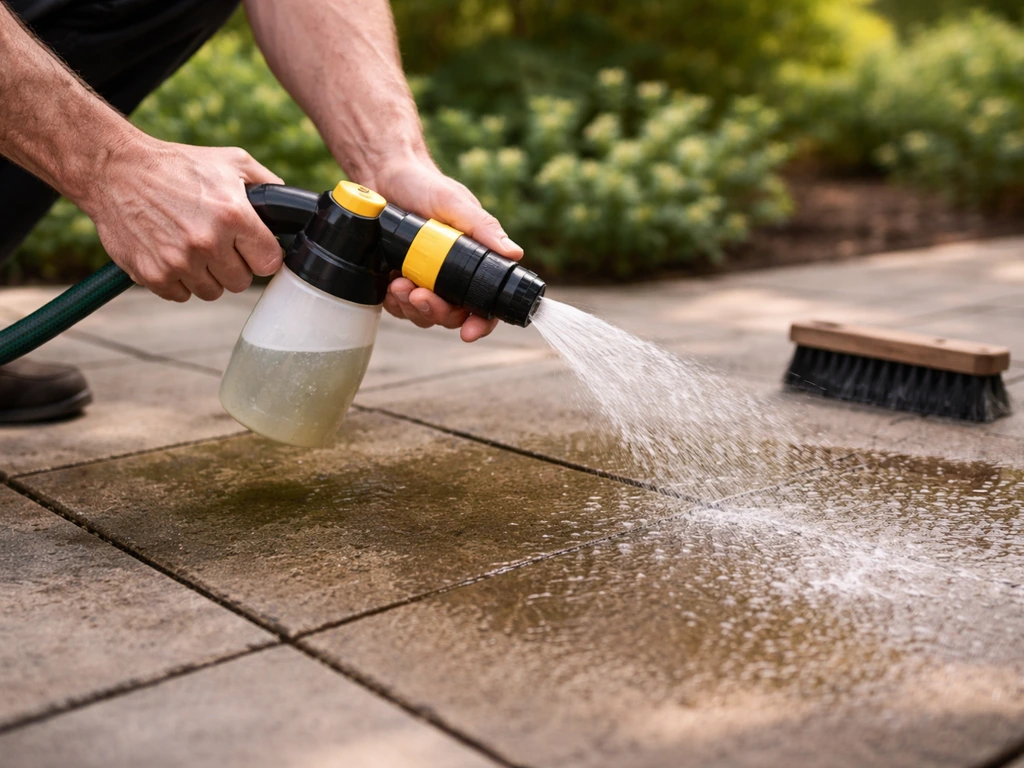
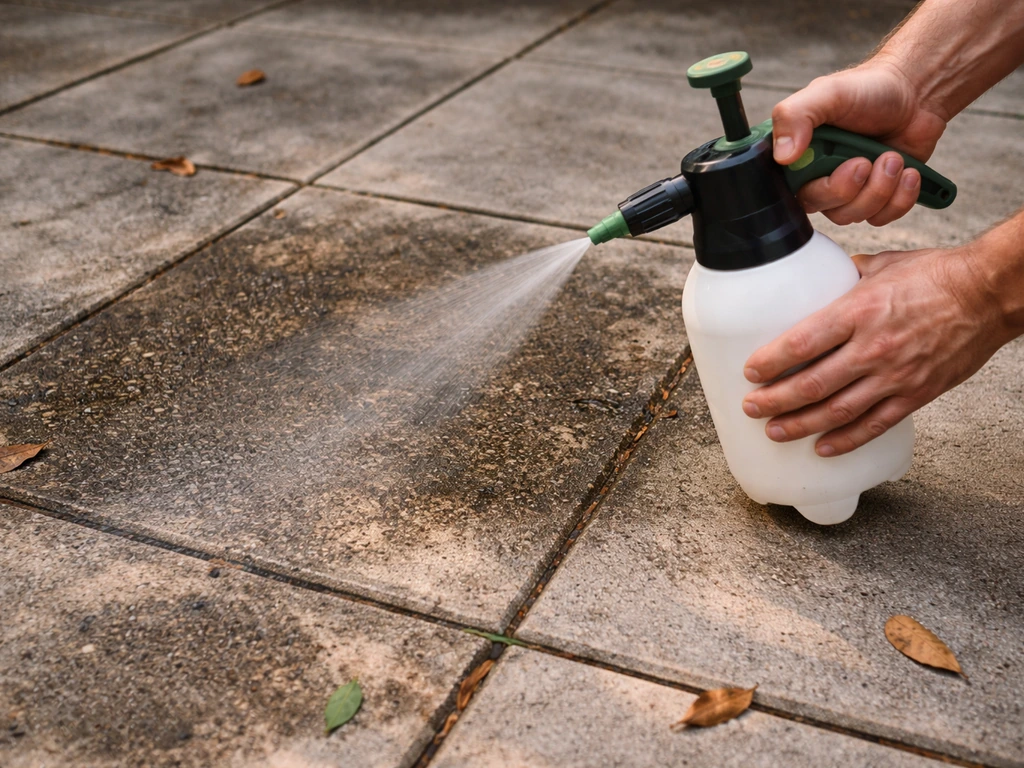
The application method depends on the product type and the size of your patio. For most homeowners, a garden sprayer or hose-end diluter is the most efficient approach. A pump-up garden sprayer gives you the most control over coverage and is ideal for concentrated products you've pre-mixed. Some products, like those designed for use with a hose-end attachment, do the diluting automatically as water flows through.
- Pre-soak the patio surface with plain water if the label recommends it, or if you're working on a porous surface like sandstone or limestone. This helps the cleaner penetrate rather than just sitting on the surface
- Mix the concentrate with water in your garden sprayer at the ratio specified on the label. Don't guess, measure it
- Apply the cleaner evenly across the surface in overlapping passes, working from one end to the other. You want full, even coverage with no dry patches
- On vertical surfaces or raised edges, apply from the bottom up to prevent streaking from run-off
- For stubborn patches (thick moss, heavy staining), apply a second, heavier coat directly to those areas immediately after the first pass
- If the label says to keep the surface wet during application (some products like Spray & Forget specify this), work in smaller sections and reapply before any area dries
- On heavily textured or porous surfaces, use a stiff brush or broom to work the cleaner into grooves and gaps after spraying. This is especially useful in mortar joints between bricks or in deeply textured concrete
- For grease or oil stains, apply the cleaner and use a scrubbing brush to agitate immediately, rather than leaving it to soak passively
Avoid applying cleaner on a surface that's already wet from rain unless the label specifically allows it. Dilution from existing moisture reduces concentration and effectiveness. This is one of those things I learned from a frustrating afternoon watching expensive product slide straight off a damp, rain-soaked slab.
Let it dwell, agitate, and rinse correctly (including pressure washing)
Dwell time is where patio cleaners actually do their work, and cutting it short is one of the most common reasons a first application disappoints. The contact time lets the active ingredients penetrate organic growth (moss, algae) or break down staining compounds before you disturb them. How long that takes depends entirely on the product and the severity of the problem.
"No-rinse" products like Wet & Forget and Spray & Forget work over days and weeks through repeated rainfall and weather exposure. To answer the question directly: yes, patio cleaner can work, but only if you choose the right type for the stain and use the correct dilution and dwell time patio cleaner work. You apply them, leave them, and the growth dies back gradually. You don't pressure wash afterward, and you don't hose them off. This approach is low effort but slow, and it works best for ongoing maintenance or light growth rather than a patio that's completely overrun with thick moss.
"Rinse-required" products like 30 SECONDS Outdoor Cleaner work much faster (often within minutes to a couple of hours) but need a proper rinse once the contact time is up. If you're wondering whether patio cleaner works, the key is matching the right dwell time to the stain and surface so the active ingredients can do the job. The label is explicit: once the dwell time has elapsed, rinse thoroughly with a garden hose. Leaving these products on too long can cause surface discolouration, especially on lighter stone.
Here's a practical guide to rinsing approach by surface:
| Surface | Rinse Method | Pressure Washer Safe? | Notes |
|---|---|---|---|
| Concrete | Garden hose or pressure washer | Yes, up to 2500–3000 PSI with wide fan tip | Most durable surface, handles aggressive rinsing |
| Brick | Garden hose or pressure washer | Yes, use wide fan tip, avoid mortar joints directly | Avoid close-range high pressure on older soft bricks |
| Sandstone | Gentle garden hose only | No or very low pressure only (under 1000 PSI) | High pressure strips surface, opens pores, accelerates future staining |
| Slate | Garden hose, low pressure only | Low pressure only, wide fan | Avoid concentrated jets that can flake or chip surface layers |
| Limestone/Marble | Gentle garden hose only | No | Extremely sensitive, even moderate pressure can mark surface |
| Porcelain/Ceramic | Garden hose or pressure washer | Yes, but use moderate pressure and check grout first | Grout is often more vulnerable than the tile itself |
When pressure washing after a chemical cleaner, always use a wide fan tip (25 to 40 degree nozzle) rather than a pinpoint or zero-degree nozzle. Keep the wand moving and maintain a consistent distance (usually 20 to 30 cm from the surface). On softer materials, a surface cleaner attachment is worth using because it distributes pressure evenly and prevents the streaking you get from single-nozzle passes.
Tackle common problems: mold, algae, moss, rust, grease, pet stains
Different stains need different approaches, and a one-size cleaner rarely covers all of them. Here's how to handle the most common ones specifically.
Mold and algae
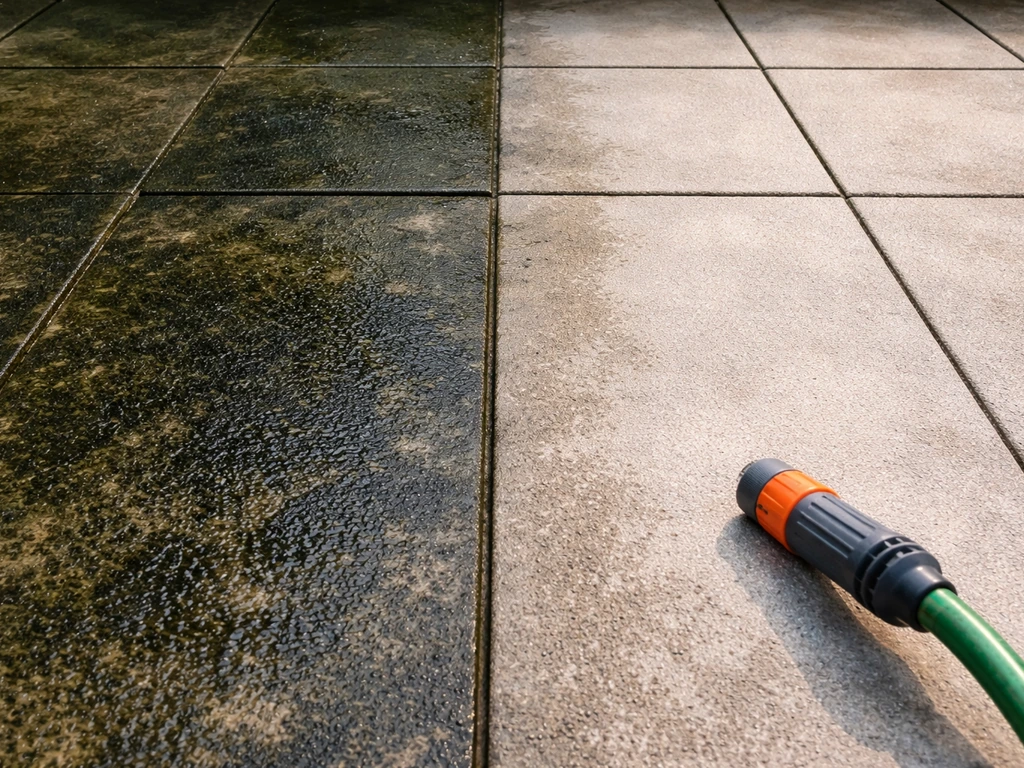
These are the most common patio problems and the ones most standard patio cleaners are built to handle. Algae usually shows as green or black slippery patches. Mold appears as dark grey or black growth, often in shaded corners. Biocidal cleaners (products containing quaternary ammonium compounds or benzalkonium chloride) kill both. Apply generously, allow full dwell time, then rinse or leave depending on product type. On dark or persistent black algae, you may need two applications.
Moss
Moss requires a longer dwell time than algae because it has a more complex root-like structure. Apply your biocidal cleaner, let it sit for at least 24 to 48 hours if possible (longer for heavy growth), then use a stiff-bristled brush or a pressure washer (on appropriate surfaces) to remove the dead material. Don't try to scrape or brush live moss off first. Let the cleaner kill it, and removal becomes dramatically easier.
Rust stains
Rust stains come from metal furniture, plant pots, or fixtures left in contact with the surface. These need an oxalic acid-based cleaner or a specialist rust remover, not a standard biocidal patio cleaner. Apply it directly to the stain, leave it to dwell (typically 10 to 30 minutes, check the label), then scrub and rinse. For rust stains, Dynamic Stone Tools recommends applying a stone-safe rust remover, following the dwell time on the label, then rinsing thoroughly follow the dwell time on the label, then rinse thoroughly. On sandstone or limestone, check that the rust remover is stone-safe before applying, as many oxalic acid products are fine on concrete but damaging to softer stone.
Grease and oil
BBQ grease, cooking oil, and vehicle oil stains need a degreaser with strong surfactants. Apply it to a dry surface (water repels degreasers), scrub with a stiff brush, leave for 10 to 20 minutes, then rinse. For old, set-in grease stains, apply the degreaser, cover with an absorbent material like cat litter or sawdust for 30 minutes to draw oil to the surface, sweep it off, then clean with the degreaser a second time.
Pet stains and urine
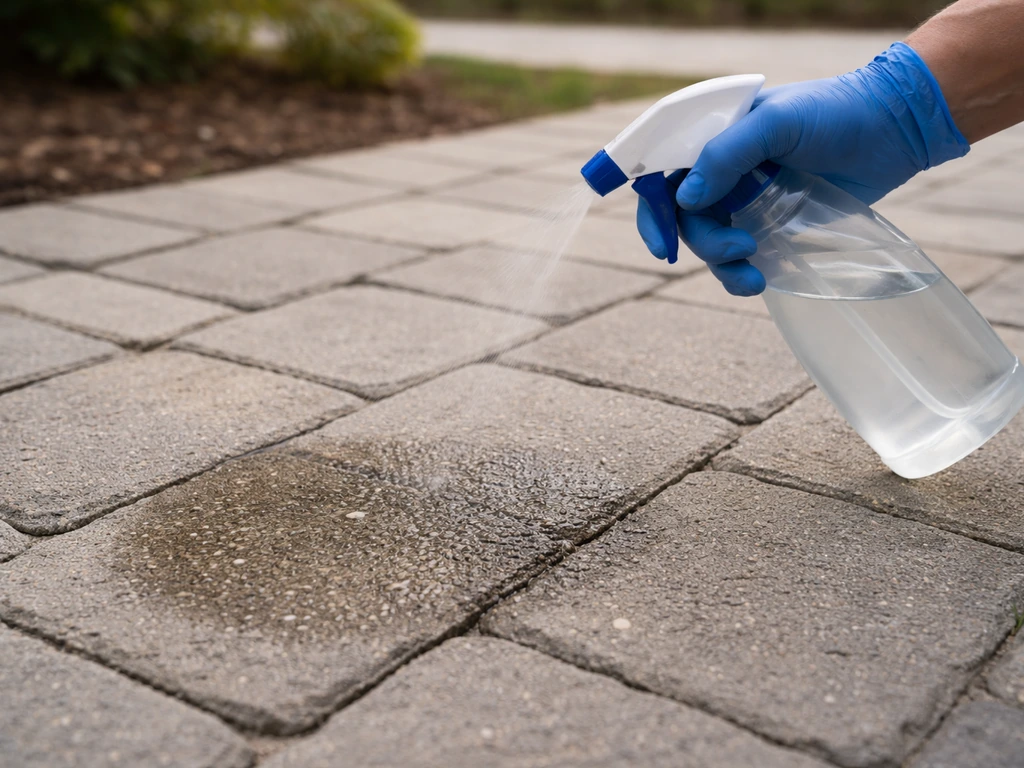
Urine on patios is a genuine challenge because the odour compounds soak into porous surfaces. Standard cleaners won't fully eliminate the smell, and anything with bleach or strong chemicals is a risk if pets use the area. Look for an enzymatic cleaner designed specifically for pet waste. These use biological enzymes to break down urine proteins at the source rather than just masking the smell. Apply generously, let it soak in for at least 15 to 20 minutes, then rinse. Once the patio has dried, let your pets back on only after you're satisfied there's no residue.
Drying, repeat passes, and finish/maintenance to prevent re-growth
After rinsing, let the surface dry fully before assessing the result. Some staining and organic residue will look much better once dry, and things that look bad when wet (tannin marks, light discolouration) often disappear. Give it at least 24 hours of dry weather before you decide whether a second pass is needed.
If the first application hasn't cleared everything, don't immediately double down with a stronger product. Repeat the same process with the same cleaner first. A second application often shifts what the first loosened but couldn't fully remove, particularly with heavy moss or thick algae. Only consider escalating to a stronger product if two applications of the correct cleaner have made no difference.
For long-term maintenance, the most effective thing you can do is apply a patio sealer after cleaning. Sealers create a protective barrier that makes it much harder for moss, algae, and dirt to take hold. On concrete and porcelain they're straightforward to apply. On natural stone like sandstone or slate, use an impregnating sealer specifically rated for that material, not a surface coat sealer. Re-seal every two to three years depending on foot traffic and weather exposure.
Beyond sealing, these habits make a real difference in keeping growth from coming back:
- Apply a maintenance dose of a no-rinse biocidal cleaner once a year (autumn is ideal) before winter conditions accelerate moss and algae growth
- Clear fallen leaves quickly. Decomposing leaves are one of the biggest contributors to organic staining and accelerate algae growth
- Improve drainage if water regularly pools on the surface. Standing water is the main reason algae returns quickly after cleaning
- Move plant pots regularly to prevent the damp, shaded conditions underneath that moss and mold love
- Rinse off grease and spills promptly rather than letting them soak in and set
How long you leave patio cleaner to dwell and whether you need to rinse at all are two of the questions I get asked most often, and the honest answer is that it depends entirely on the product. Always go back to the label for that specific cleaner rather than applying a general rule. The application steps covered here will see you through most situations, but if you're also curious about how patio cleaners work at a chemistry level or want to make a DIY version, those are worth exploring separately once you've got the basics of application dialled in. Once you understand how the product works, you can also look at how to make patio cleaner at home safely and effectively for your specific surface.
FAQ
Can I use patio cleaner on a damp patio or after morning dew?
For most patio cleaners, the surface should start clean of loose debris and dry enough that the chemistry is at label strength. If you have heavy puddling or water is still standing, pause and let it drain, then re-wet only the areas the label allows (some products require a fully dry surface, especially degreasers).
What if it starts raining while the cleaner is dwelling?
Yes, but only if the label allows it and you can still maintain the specified contact time. In practice, that means you should avoid running water over the treated area immediately after spraying, and you should not use a pressure washer until the dwell period is complete for rinse-required products.
How do I avoid wasting patio cleaner when I mix concentrate?
The fastest way to ruin results is to use the wrong dilution or to “top up” the mix with more water to save product. Measure concentrate accurately (use a marked container or measuring jug), mix thoroughly, and discard any leftover mixture if the label doesn’t specify that it remains effective after a certain time.
How can I tell whether to do a second application or switch products?
Signs you should re-clean instead of escalating are patches that improve but remain stained, or areas where algae strips off only after brushing. Signs you should switch approach are stains that never change after two correct applications (for example, rust that needs an oxalic or specialist remover, or grease that needs a surfactant degreaser).
Do no-rinse patio cleaners need to be hosed off to prevent streaking?
For no-rinse products, you generally should not hose them down to “see progress.” If you’re getting streaks or patchy whitening, it’s usually from uneven coverage or drying patterns. Reapply to the missed sections later rather than over-wetting the whole patio.
Why do I get streaks or light patches after using patio cleaner?
To prevent streaks, apply in a consistent direction and keep a steady spray pattern so coverage is uniform. Also avoid treating only the edges of patches; work the product across the affected zone so the active ingredients contact the full surface evenly.
How do I pressure wash safely after patio cleaning?
When you pressure wash after a chemical cleaner, protect joints and grout lines. Use lower pressure and a wider fan, and keep the wand slightly farther away on softer materials like sandstone or limestone. If you see surface pitting or powdery residue, stop and reassess, because that often means you used too much pressure or an unsuitable chemistry.
Will patio cleaner damage a sealed concrete, stone, or paver surface?
If you have a sealed surface, test in a hidden spot first because some cleaners can dull the finish or weaken sealers. If the label does not specifically mention sealed stone or sealed pavers, treat it as not compatible and choose a product marketed as safe for sealed surfaces, or consider light agitation without harsh chemicals.
What should I do to protect nearby furniture, metal, and plants during application?
Yes, if the active ingredient can interact with certain finishes or metals. Rust removers, in particular, can be unsafe for surrounding fixtures and may discolor adjacent stone. Cover or remove nearby metal items, and rinse immediately if any product splashes onto unintended surfaces.
Why do some oil and grease stains get worse after cleaning?
For degreasers, apply to a dry surface so the surfactants can cling to oil and grease. Wet surfaces can make oil float and spread, which increases the stain size and reduces the cleaner’s effectiveness.
Is there a single dwell time for all patio cleaners?
Use product-specific guidance. A common pattern is longer dwell for moss and heavy growth, shorter for oxidizers, and minutes for many rinse-required cleaners, but the reliable method is to follow the label and only brush after the cleaner has had time to kill or break down the stain.
When can I apply a sealer after using patio cleaner?
Yes, but do it after the patio is fully dry and the cleaner has had time to reveal true color (often up to 24 hours). If you seal too soon, trapped moisture and residue can cause cloudy patches, reduced adhesion, or rapid re-growth.
Next Article
How to Apply Patio Cleaner: Step-by-Step by Surface
Choose patio cleaner by material and stain, then apply with correct dilution, coverage, dwell time, and safe rinse to pr