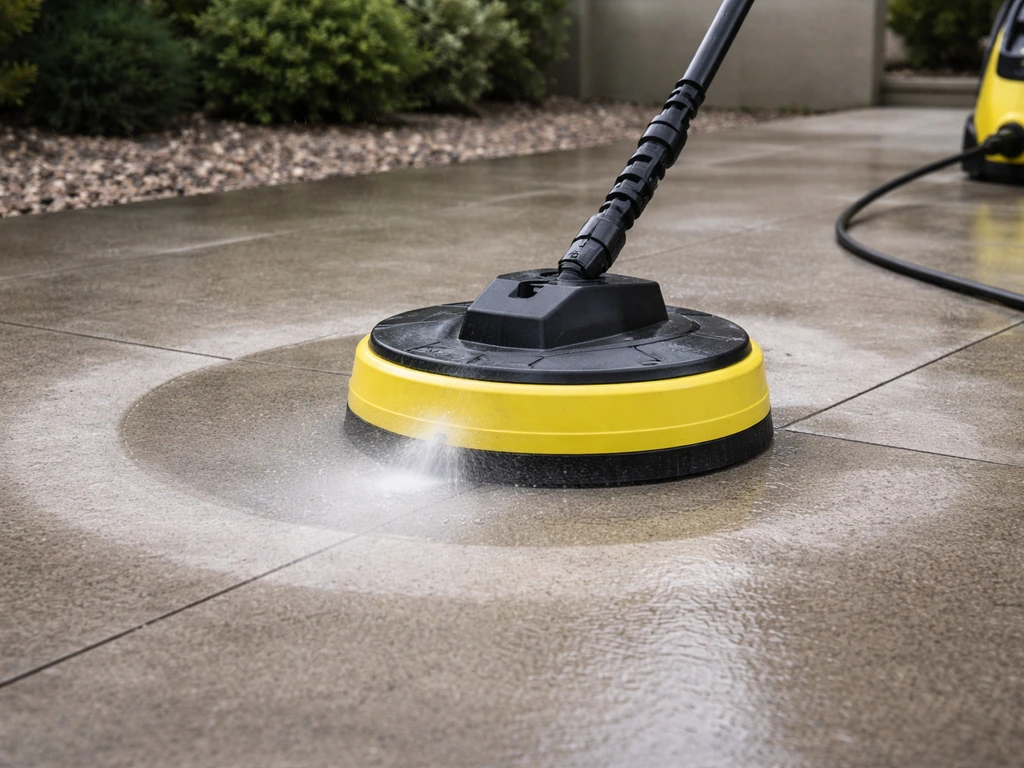
Attach the Kärcher T-Racer (T 350 or similar surface cleaner) to your K4's spray gun via the bayonet quick-connect, set the Vario Power lance to the right pressure for your surface, keep the cleaner moving steadily, and you'll clean a full patio in a fraction of the time a standard nozzle takes, with far less splash-back. The K4 runs at 110 bar (11 MPa) with a 6.3 L/min flow rate, which sits comfortably in the T-Racer's operating window, so you're working with a genuinely well-matched combination.
How to Use Patio Cleaner with Kärcher K4: Setup & Tips
Rhea Lang
14 Jul 2026
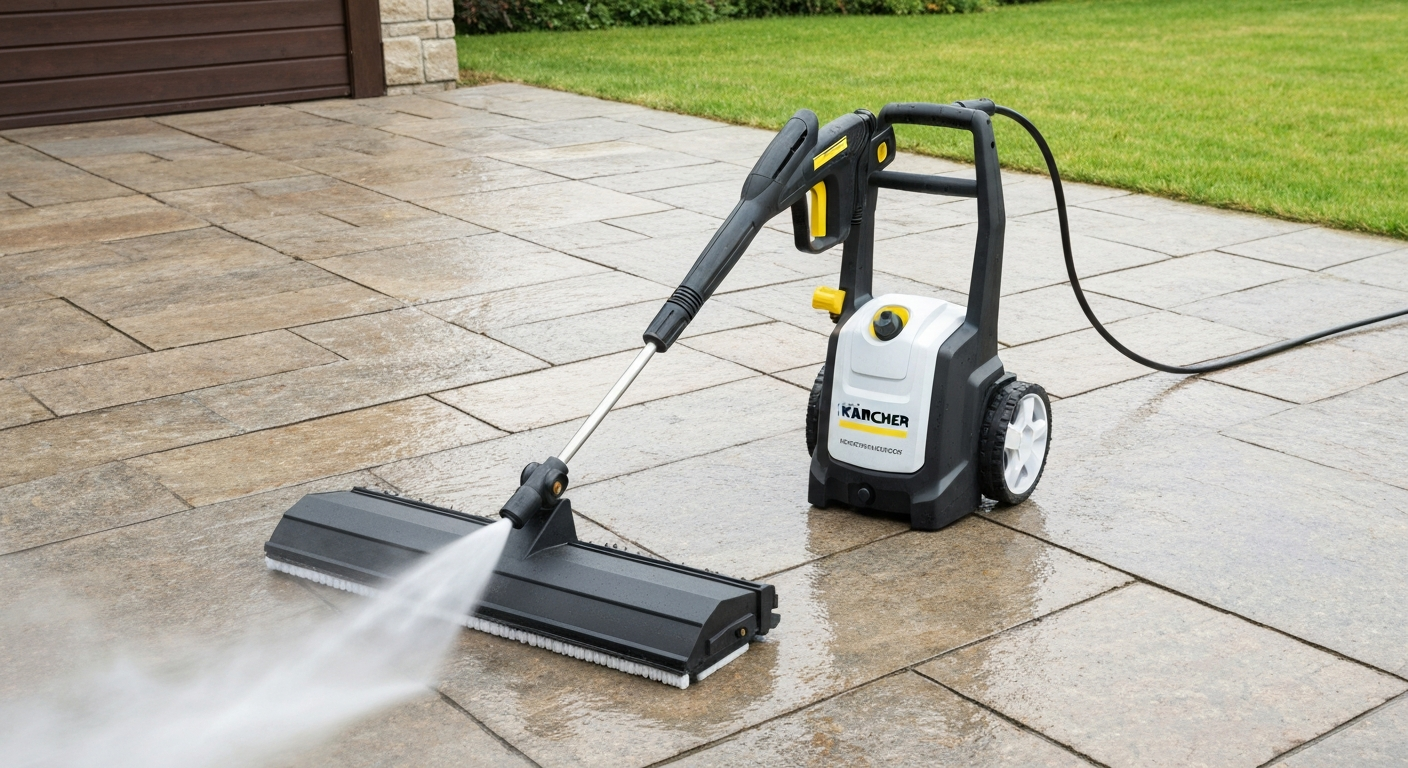
What a Kärcher patio cleaner is and when the K4 is the right machine
A Kärcher patio cleaner (surface cleaner) is a disc-shaped attachment with two rotating flat-jet nozzles inside a splash guard. Water spins the rotor, creating what Kärcher calls a 'hovercraft effect' that lets you glide the unit across hard surfaces. The result is even cleaning without the stripe marks you get from a standard lance, and vastly less spray bouncing back at you. The T 350 T-Racer weighs around 1.5 kg and is the model you'll most commonly pair with a K4.
The K4 is a strong match for this accessory. It delivers enough pressure and flow to keep the T-Racer's rotor spinning consistently, which is exactly what you need for clean, streak-free results. I'd use it any time the patio hasn't had a deep clean in a year or more, after a wet winter that's brought on serious moss or algae, or any time you want a thorough job without spending hours on your knees scrubbing. For a light rinse-off between proper cleans, a fan nozzle is quicker; for heavy encrusted grease or oil, you'll want chemical pre-treatment regardless of which nozzle you use.
Compatibility: which patio cleaner models and fittings work with the K4
Kärcher's own product page lists the T 350 T-Racer as compatible with the full Home & Garden pressure washer range from K2 through to K7, so the K4 Power Control and Premium Power Control are both confirmed. The T-Racer attaches to the spray gun using a bayonet quick-connect (push in, rotate 90 degrees until it clicks). For step-by-step instructions on how to attach kärcher patio cleaner, see the related internal guide (ref: 6bbb792c-b416-439e-8ed0-e5bf34618e5e). All current K4 models ship with a trigger gun that accepts this fitting directly, no adapter needed.
There is one exception worth knowing: Kärcher pressure washers manufactured before 1991 need an additional adapter to run current T-Racer accessories. If you've picked up a secondhand Kärcher produced between the early 1990s and approximately 2010, check whether the gun uses the older M/96/97-series connector. If so, Kärcher's Adapter M (part number 2.643-950.0) is the official solution and is still widely available.
Compared to the K2 and K3, the K4 has higher flow and pressure. The K2 runs at around 110 bar but with a lower flow rate, while the K3 sits in a similar range to the K4 but typically with a slightly lower maximum flow. In practice, all three will drive the T-Racer adequately, but the K4 gives the rotor a little more headroom on dense surfaces like thick concrete. If you're reading this after using a K3 setup, the process is essentially identical; the K2 is also the same procedure, though you may want to work slightly more slowly on heavily soiled areas since the cleaning power margin is a bit narrower. For step-by-step instructions specific to the K3, see our guide on how to use patio cleaner with Karcher K3.
| Model | Operating Pressure | Flow Rate | T-Racer Compatible | Adapter Needed |
|---|---|---|---|---|
| K2 | 110 bar (11 MPa) | ~4.8 L/min | Yes | No (modern guns) |
| K3 | 120 bar (12 MPa) | ~5.2–6.0 L/min | Yes | No (modern guns) |
| K4 Power Control | 110 bar (11 MPa) | 6.3 L/min | Yes | No |
| K4 Premium Power Control | 110 bar (11 MPa) | 6.3 L/min | Yes | No |
| Pre-2010 models (any) | Varies | Varies | Yes (with adapter) | Yes — Adapter M (2.643-950.0) |
Before you start: safety, PPE and machine checks
Running 110 bar through a spinning rotor arm is not something you want to approach casually. I always run through the same pre-clean checklist before switching on, and I'd suggest you do the same.
- Wear safety glasses or goggles — even with the splash guard, fine spray and debris can come back at you
- Waterproof gloves protect your hands from both the spray and any detergent you're applying
- Closed-toe waterproof footwear; flip-flops and high-pressure water are a bad combination
- Check the garden hose: Kärcher recommends a 1/2-inch (12.5 mm) diameter inlet hose of 5–10 m length, with an inlet water supply of at least 8 L/min. If your mains flow is weaker than this, the machine will cavitate and the rotor won't spin evenly
- Inlet pressure must fall between 0.2 and 1.2 MPa (roughly 30–175 psi); direct connection to a gravity-fed tank is likely too low unless the tank is elevated
- Inspect the high-pressure hose for cracks or kinks before every session
- Check that the spray gun safety lock is engaged before connecting any attachment
- Remove any loose items, plant pots, or furniture from the area being cleaned — the splash guard contains most spray but debris can still travel
- Never use acetone, undiluted acids, or solvents with the K4 — Kärcher explicitly warns these corrode machine materials
- Clear the drain path so dirty runoff doesn't pool on the surface you've just cleaned
How to attach the T-Racer patio cleaner to the K4
- Ensure the K4 is switched off and the trigger gun safety lock is on before handling any attachment.
- Connect the high-pressure hose to the machine's pump outlet — push and twist until it clicks and seats firmly.
- Connect the other end of the high-pressure hose to the trigger gun's inlet, again push-and-twist to secure.
- Take the T-Racer and align the bayonet connector on its inlet stem with the quick-connect socket on the trigger gun.
- Push the T-Racer connector firmly into the gun socket and rotate 90 degrees clockwise. You'll feel and hear it lock into place. Some T-Racer models also have a union nut — if yours does, hand-tighten it after the bayonet click.
- Tug the connection gently to confirm it's locked. A loose connection at 110 bar will cause the accessory to eject under pressure.
- Connect the inlet garden hose to the K4's water inlet. Turn on the tap fully before starting the machine.
- Switch the K4 on and squeeze the trigger briefly (pointing at the ground, away from people) to prime the system and purge any air. The T-Racer rotor should begin spinning once water flows through it.
If you're unsure about any step in the connection process, there's a dedicated guide covering the attachment procedure in more detail, including what to do if the connector feels stiff or won't lock, which covers common fitting issues in depth.
Initial setup and settings before you switch on
The K4 Power Control comes with a Vario Power (VP) lance and a Dirt Blaster lance as standard. For patio cleaning with the T-Racer, you won't be using the lances at all, the T-Racer replaces them and connects directly to the gun. However, if you plan to use detergent via the K4's Plug 'n' Clean system, you'll need to switch to the Vario Power lance briefly to apply it (more on that in the detergent section).
The T-Racer itself has a rotor arm height adjustment. Set it to HARD for durable surfaces like concrete, brick, and porcelain. Set it to SOFT for more sensitive surfaces like sandstone or slate. This adjustment changes the distance between the spinning nozzles and the surface, effectively modifying the working pressure at the surface level without you having to change anything on the machine.
The K4's maximum permissible pressure is 13 MPa (130 bar), and its rated operating pressure is 110 bar. At full pressure with the T-Racer on HARD mode, you have a powerful setup. Before you fire it up on anything you haven't cleaned before, test a small, inconspicuous patch first, especially on natural stone or older surfaces. The manual also notes that surfaces can be damaged when the jet is too close or when an unsuitable setting is used, and this is one area where I've seen people cause real damage to riven slate by being impatient.
Operating technique: how to actually clean the patio
Once you're set up and the system is primed, here is the method that consistently gives me the best results on a standard patio session.
- Start at the end of the patio furthest from the drain or exit point and work towards it, so you're always pushing dirty water ahead of you, not walking back through it.
- Hold the T-Racer flat against the surface. It glides more smoothly than you'd expect — the hovercraft effect is real. Apply gentle downward pressure but let the machine do the work.
- Move in parallel passes, overlapping each pass by about 5–10 cm (2–4 inches). This overlap prevents unclean strips between passes, which is the main cause of the 'dirty lines' people complain about.
- Keep a consistent, steady pace — roughly the speed of a slow walk. Moving too fast leaves patches of ingrained dirt; moving too slowly risks etching or surface damage, especially on softer stone.
- Do not stop moving while the trigger is held. Kärcher's operating instructions are explicit: do not linger on one spot. The concentrated pressure from two spinning nozzles at a standstill will damage most surfaces.
- Avoid running the T-Racer over raised edges, lips, or exposed grout ridges at speed — the rotor arm can clip them and either damage the surface or break the nozzle arm.
- Once you've covered the full area, do a final rinse pass with the fan nozzle on the Vario Power lance to flush the surface clean and remove any loosened debris sitting in joints or low spots.
- Rinse from the highest point down towards the drain, working the fan nozzle in wide sweeping motions.
Using patio cleaner fluid with the K4
Choosing the right detergent
For most domestic patios, Kärcher's own Concrete & Driveway Cleaner (product code 645100) is a solid first choice for concrete and brick surfaces. It runs at pH 10.5–11.5 (alkaline), which is effective on organic growth (moss, algae, mould) and general traffic grime. For timber decking adjacent to the patio, Kärcher's Deck & Fence Cleaner (product code 645200) is similarly alkaline (pH 10.5–11.5) and designed for wood fibre without stripping it. Kärcher Deck & Fence Cleaner, Safety Data Sheet (SDS), Feb 18, 2025 (Kärcher) (product code 645200) reports a pH of approximately 10.5–11.5 and lists eye irritation and mild skin irritation hazard statements, along with recommended PPE and environmental precautions Kärcher Deck & Fence Cleaner — Safety Data Sheet (SDS), Feb 18, 2025 (Kärcher). Both are formulated to work through the Plug 'n' Clean bottle system. For calcareous natural stones, sandstone, limestone, marble, travertine, avoid any acid-based or rust-removing cleaners entirely. Acidic chemicals cause irreversible etching on these materials. Use a pH-neutral, stone-safe cleaner instead, and drop to lower pressure.
Applying detergent with the K4 system
The K4 applies detergent at low pressure only, through the Vario Power lance set to MIX. This means you cannot apply detergent through the T-Racer itself. The workflow is: detergent application first (via VP lance at MIX), then swap to the T-Racer for the high-pressure clean and rinse. For step-by-step instructions on preparing and applying Kärcher patio cleaner fluid with the K4, see how to use Kärcher patio cleaner fluid. The K4's detergent flow rate is approximately 0.3 L/min, so coverage is deliberate rather than drenching.
- Attach the Plug 'n' Clean detergent bottle to the VP lance before you begin.
- Set the Vario Power lance to MIX (low-pressure detergent mode).
- Apply detergent to a dry surface — wet surfaces dilute the product and reduce dwell effectiveness.
- Work in manageable sections (around 4–6 square metres at a time) so the detergent doesn't dry before you rinse it. If it dries on the surface, it can leave residue and potentially damage some stone types.
- Allow the detergent to dwell for 2–5 minutes depending on the level of soiling and the product instructions. Do not walk away and forget about it.
- Switch back to the T-Racer (or the VP lance set to high pressure for rinsing) and clean the section thoroughly before moving on to the next.
- Finish with a clean-water rinse pass to remove all detergent residue.
If you want to pre-spray a chemical treatment (such as a biocide or moss killer) rather than the Kärcher Plug 'n' Clean detergent, do that as a separate step with a garden sprayer the day before. Let it work overnight, then run the T-Racer clean the following day. This is often more effective for heavy biological growth because the biocide has time to break down the cell structure of the moss or algae before you pressure wash.
Surface-specific cleaning plans
Concrete
Concrete is the most forgiving surface to clean with a K4 and T-Racer. Set the rotor to HARD, run full operating pressure, and use Kärcher's Concrete & Driveway Cleaner (pH 10.5–11.5) for anything beyond plain dirt. Here's how I approach the common stain types:
| Stain Type | Chemical Approach | Technique Notes |
|---|---|---|
| Mould / black spot | Alkaline cleaner (pH 10.5–11.5) or dedicated fungicidal wash | Pre-spray, 5 min dwell, T-Racer on HARD at full pressure |
| Algae (green slime) | Alkaline cleaner or diluted sodium hypochlorite solution (pre-spray) | Apply day before with garden sprayer, pressure wash the next day |
| Moss | Biocide pre-spray (apply and leave 24–48 hrs) | Dead moss lifts easily with T-Racer; live moss may need second pass |
| Rust stains | Oxalic acid-based rust remover (applied by hand/garden sprayer, NOT via K4 Plug 'n' Clean) | Dwell 10–15 min, agitate with stiff brush, rinse with T-Racer. Never use on calcareous stone. |
| Grease / oil | Alkaline degreaser, neat or light dilution | Apply to dry surface, agitate lightly with brush, 5–10 min dwell, T-Racer rinse |
| Pet urine stains | Enzyme-based cleaner or alkaline patio cleaner | Enzyme cleaners need longer dwell (15–20 min); rinse thoroughly |
One thing I've learned the hard way with concrete rust stains: an off-the-shelf rust remover from a hardware shop will almost always be acid-based. Never run it through the K4's detergent system, Kärcher explicitly warns against using acids through the machine. Apply it by hand with a garden sprayer or brush, let it dwell, then rinse with the T-Racer.
Brick
Brick responds well to the T-Racer on HARD setting, but old or reclaimed brick can be softer and more porous than modern engineering brick. Start on a test patch. Use an alkaline cleaner for mould and algae. Avoid acids on calcium silicate or handmade bricks, which can be chemically reactive. Mortar joints on older walls are vulnerable, keep the T-Racer flat and avoid directing water directly into joints at an angle.
Sandstone
Sandstone is where people cause the most accidental damage. Many sandstones are calcareous (calcium-carbonate containing), which means acids will etch them permanently. Always use a pH-neutral or mildly alkaline stone-safe cleaner. Set the T-Racer to SOFT and reduce machine pressure slightly if your K4 has a pressure-adjustable setting. Keep passes slow and even. Never blast at a tight angle or let the rotor spin over the same spot twice without moving.
Slate
Slate is generally acid-resistant but the surface can be layered and can flake if subjected to high pressure at close range on riven (split) faces. Use SOFT mode on the T-Racer. A pH-neutral cleaner is safest. For algae or moss on slate, a biocide pre-spray the day before works well and reduces the pressure required during the main clean.
Porcelain paving
Porcelain is the easiest natural-look surface to maintain. It's dense, low-porosity, and acid-resistant. The T-Racer on HARD at full K4 pressure works perfectly. A pH-neutral or mildly alkaline cleaner handles organic growth and traffic marks without issue. The main risk with porcelain is the grout joints, standard grey mortar grouting can be eroded by repeated high-pressure treatment directly into the joint, so keep the T-Racer flat and moving.
Natural stone (limestone, marble, travertine)
These are calcareous stones and among the most acid-sensitive materials you'll encounter. Never use rust removers, citric acid-based cleaners, or any pH-acidic product on them. Stick to pH-neutral stone cleaners, set the T-Racer to SOFT, and reduce pressure where possible. If there's heavy biological growth, a biocide pre-spray followed by low-pressure rinse is the safest route. Aggressive pressure washing on polished limestone will dull the surface finish.
Troubleshooting: attachment problems and the T-Racer not spinning
In my experience, most T-Racer problems fall into one of four categories: it won't connect properly, it connects but the rotor doesn't spin, it spins unevenly and leaves marks, or it leaks at the connection. Here's what to check for each.
| Problem | Likely Cause | Fix |
|---|---|---|
| Won't click into gun connector | Bayonet mis-aligned or debris in socket | Clean the socket, realign and push firmly before rotating |
| Rotor not spinning at all | Blocked nozzles or insufficient water pressure/flow | Check inlet supply is fully open (8 L/min minimum); remove nozzles, flush with water, inspect for blockage |
| Rotor spinning but leaving stripes | One nozzle partially blocked or worn | Remove clip, withdraw nozzle, flush both nozzles and compare spray pattern — replace if damaged |
| Leaking at gun connection | Worn O-ring on connector stem | Inspect and replace the O-ring on the T-Racer's inlet connector |
| Low pressure / weak clean | Inlet water supply below 8 L/min or hose too narrow | Check hose diameter (must be 1/2"), ensure supply valve is fully open |
| T-Racer vibrating excessively | Rotor arm clipped a surface edge and is bent or cracked | Inspect rotor arm for physical damage; replace if bent |
The 'not spinning' issue is the most common one I see asked about, and in almost every case it's either a blocked nozzle or insufficient water supply. Before assuming the accessory is faulty, confirm your mains flow rate meets the 8 L/min minimum the K4 requires at the inlet. A flow rate below that means the machine is starved, and the T-Racer rotor simply won't spin consistently. For step-by-step checks and fixes, see our troubleshooting guide titled "why is my karcher patio cleaner not spinning.". There's a full guide on T-Racer not spinning problems elsewhere on this site if you need to dig deeper. For step-by-step troubleshooting, see our guide on karcher patio cleaner attachment problems.
Cleaning and maintaining the T-Racer between uses
The T-Racer is a sealed, fairly low-maintenance accessory, but a few minutes of care after each use will significantly extend its life and keep the nozzles performing properly. See the T‑Racer manual, nozzle removal, cleaning and replacement (Kärcher) for step‑by‑step instructions to remove the clip, withdraw the high‑pressure nozzles, flush them with water, inspect for damage and replace if needed T‑Racer manual — nozzle removal, cleaning and replacement (Kärcher).
- After cleaning, run clean water through the T-Racer for 30–60 seconds to flush out any detergent residue from the nozzles and internal channels.
- To clean the nozzles, remove the retaining clip on the nozzle port, withdraw the nozzle, and flush it under a tap. Inspect the nozzle tip for physical damage or wear — a deformed nozzle hole changes the spray pattern and causes uneven cleaning.
- Check the rotor arm for cracks, especially if it's been run over surface edges. A cracked arm will cause vibration and uneven pressure.
- Wipe down the splash guard with a damp cloth to remove dirt and debris.
- Store the T-Racer indoors or in a dry shed. Prolonged outdoor storage allows UV degradation of the plastic housing and can cause seals to harden.
- Before storing the K4 for winter, flush both the machine and the T-Racer with clean water, then run a frost-protection solution through the machine if it will be stored in a space that drops below 0°C.
T-Racer vs other nozzles: when to use what
The T-Racer is the right tool for a thorough periodic clean of hard patio surfaces, but it's not always the fastest or best choice for every task. Here's how I decide what to reach for.
| Situation | Best Tool | Why |
|---|---|---|
| Deep clean of large concrete or brick patio | T-Racer (HARD mode) | Fastest coverage, no stripe marks, less splash-back |
| Sensitive stone (sandstone, slate, limestone) | T-Racer (SOFT mode) or fan nozzle at reduced pressure | SOFT mode protects surface; fan nozzle gives more control |
| Spot-cleaning a small grease stain | Fan nozzle or VP lance at high pressure | T-Racer overkill for small areas; lance gives targeted control |
| Reaching walls, fences, or vertical surfaces | Fan nozzle on VP lance | T-Racer only works flat on horizontal surfaces |
| Removing built-up moss on path edges | Dirt Blaster lance (on concrete/brick only) | Concentrated rotating jet cuts through thick buildup — never use on soft stone |
| Quick rinse after light leaf litter | Fan nozzle | T-Racer is unnecessary for surface-level debris |
| Deck or treated timber | Fan nozzle at low-medium pressure | T-Racer can be too aggressive on soft wood grain — maintain 30 cm minimum distance on painted/treated surfaces |
When to call a professional instead
The K4 with a T-Racer handles the vast majority of domestic patio cleaning tasks. But there are situations where bringing in a professional makes more sense, either to protect the surface or because the job genuinely needs more power or specialist chemistry than a home machine can deliver.
- Extensive rust staining on natural stone that requires acid treatment — professionals can apply and neutralise correctly without surface damage
- Polished or honed limestone, marble, or travertine that has already been etched or dulled — this needs specialist stone restoration, not pressure washing
- Patios with badly degraded or crumbling pointing — high pressure will accelerate the damage; re-pointing should happen before cleaning
- Very large commercial-scale areas where a K4 would take many hours — a commercial-grade machine with a larger surface cleaner will be much faster
- Surfaces with asbestos-containing materials (older textured coatings or some older fibre-cement materials) — do not pressure wash; get a specialist assessment first
- Any situation where you're unsure of the surface material or finish and a test patch gives unclear or worrying results
FAQ
Which Kärcher patio cleaners are compatible with a K4 and do I need adapters for older machines (K2/K3 or pre‑2010)?
Most Kärcher T‑Racer/T‑350 style patio cleaners are compatible with K4 models. Modern K2–K7 machines use the Quick‑Connect/standard bayonet or union‑nut connection; K4 supports these. Older spray guns and pre‑2010 machines can require Kärcher Adapter M (part 2.643‑950.0) or a specific adapter noted in the T‑Racer manual. Very old machines (pre‑1991) may need a different adapter per the T‑Racer instructions. Always check the cleaner’s compatibility list and your K4 spray‑gun coupling before purchase.
How do I attach a T‑Racer / patio cleaner to a Kärcher K4 step‑by‑step?
1) Turn off and depressurise the washer (switch off, pull trigger, disconnect water). 2) Fit the patio cleaner onto the trigger gun/lance: push the cleaner’s connector into the gun, engage the bayonet and rotate 90° (or screw the union nut if supplied) until secure. 3) For models with height settings, select HARD for durable surfaces or SOFT for sensitive surfaces. 4) Reconnect the water, switch on the machine and test at a distance. Ensure the cleaner seats correctly and the rotor arms spin before working on the whole area.
What are safe operating pressures, water supply and lance settings to use with a K4 and patio cleaner?
K4 typical operating pressure ≈11 MPa (110 bar) with max 13 MPa. Use the K4 within its normal operating setting; the patio cleaner is designed to work with K‑class home washers including K4. Ensure mains water supply meets K4 minimum inlet flow (~8 L/min). When using detergents set the Vario Power lance to MIX/low pressure; for rinsing set to higher pressure. Maintain recommended spray distances (typically 20–40 cm; follow manual minimums for painted/sensitive surfaces — often ≥30 cm).
What is the correct technique for using a patio cleaner (movement, speed, distance)?
Keep the patio cleaner moving in overlapping passes; do not linger on a single spot. Move at a steady pace so the rotating jets clean evenly; hovercraft effect makes it easy to glide. Maintain a consistent distance (start ~25–40 cm and adjust based on results and surface sensitivity). Avoid running the head over exposed edges or extremely uneven surfaces to prevent rotor arm damage.
How should I use detergents with the K4 and patio cleaner (which products, dilution and sequence)?
Use Kärcher Plug ’n’ Clean detergents where supported (e.g., Concrete & Driveway, Deck & Fence). Operate detergent at low pressure (Vario lance on MIX), apply sparingly to a dry or slightly damp surface, allow short dwell time (do not let detergent dry), then switch to high pressure and rinse thoroughly with the patio cleaner. Follow the detergent SDS/label for dilution — Kärcher patio detergents are typically concentrated and applied via Plug ’n’ Clean (detergent flow ≈0.3 L/min on K4). Do not use solvents, acetone or undiluted acids — these can damage the machine and surfaces.
Which detergents are safe for different surface types and what pH precautions should I take?
Concrete, driveway and decking cleaners from Kärcher are alkaline (pH ≈10.5–11.5) and suitable for hard, non‑acid‑sensitive surfaces like concrete, some sandstones and brick. For calcareous natural stone (marble, limestone, some sandstones) avoid acidic cleaners and strong alkalis—use pH‑neutral, stone‑safe detergents. For porcelain and sealed surfaces you can use mild alkaline detergents or pH‑neutral cleaners. Always test a small inconspicuous area first and follow manufacturer/SDS instructions and environmental precautions.
Next Article
Karcher Patio Cleaner Attachment Problems: Fixes, Setup, Maintenance
Troubleshoot Karcher patio cleaner attachment issues: setup, clog fixes, leaks, uneven streaks, surface-safe pressure, m