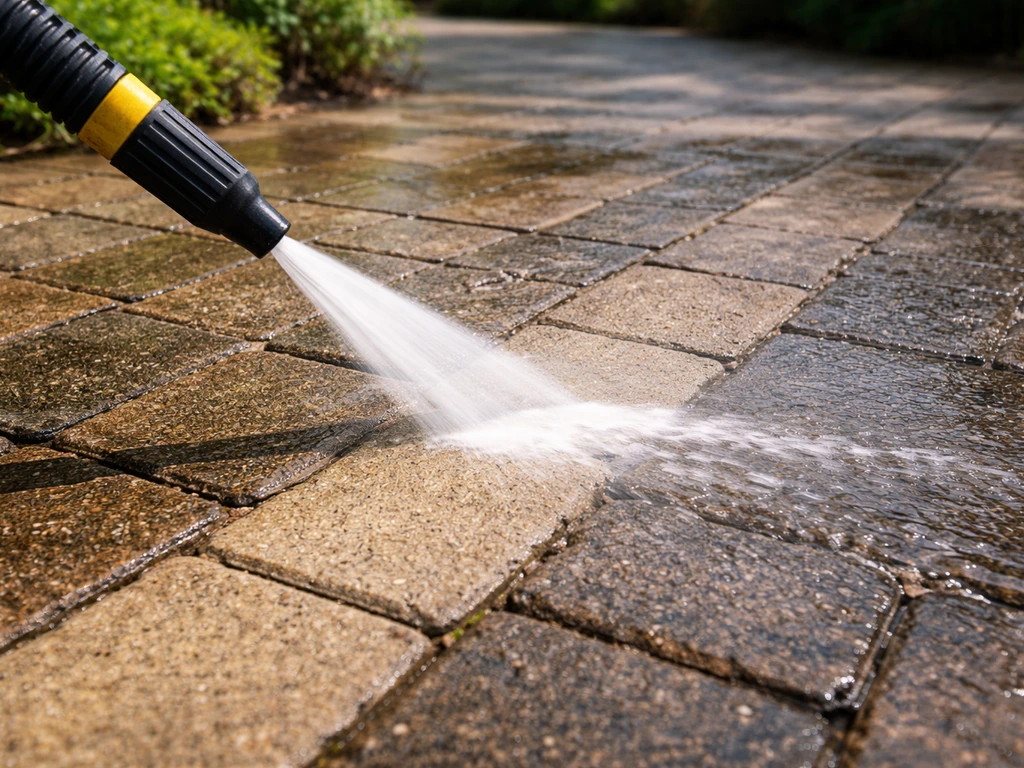
For most patios and driveways, a cold-water electric pressure washer in the 130–160 bar (1,900–2,300 PSI) range paired with a surface cleaner attachment will handle almost everything you throw at it: moss, algae, ground-in grime, tyre marks and general weathering. In the UK, the Kärcher K5 Premium (around £270–£300) is the sweet spot for most homeowners, while budget shoppers get solid results from the Nilfisk Core 140 (around £130–£150), and anyone with a larger driveway or greasy garage apron should look at a petrol unit like the Kärcher HD 5/15 C (from around £600 hire-or-buy) or at minimum hire a hot-water machine for a day.
Best pressure washer for patios and driveways: Buyer's guide
Rhea Lang
19 Jul 2026
Top picks at a glance
These are the machines I keep coming back to after testing across concrete driveways, sandstone patios, block paving and porcelain tiles. They cover three real-world budgets and are all available from mainstream UK retailers including Screwfix, Toolstation and the Kärcher website.
- Budget (under £150): Nilfisk Core 140 — 140 bar, 8 l/min, reliable axial pump, widely stocked at Toolstation and Amazon UK. Good for smaller patios and occasional use.
- Mid-range (£200–£350): Kärcher K5 Premium — 145 bar, 9.5 l/min, induction motor (longer lifespan than universal motors), compatible with Kärcher's T-Racer surface cleaner. My main go-to recommendation.
- Premium / prosumer (£350–£600+): Nilfisk MC 2C-120/400 or Kärcher HD 5/15 C — triplex or semi-pro pump, higher flow rates, suitable for large driveways and regular use.
- Cordless pick: Ryobi RY120BWV 40V — no cable hassle, genuinely useful for the patio when a socket is far away, though flow rate (around 5.3 l/min) means it is slower than a corded unit on big areas.
- Petrol pick (large driveways/rural use): Honda-engined machines from brands like Hyundai or BE Power (HHY) — 200+ bar, 12–15 l/min, no extension lead needed, but noisy and require more maintenance.
Comparison table: specs, ideal surfaces and quick verdict
| Model | Max bar / PSI | Flow (l/min) | Pump type | Best for | UK price (approx.) | Verdict |
|---|---|---|---|---|---|---|
| Nilfisk Core 140 | 140 bar / 2,030 PSI | 7.5 l/min | Axial | Small patios, paving slabs, driveways (occasional) | £130–£150 | Best budget buy |
| Kärcher K4 Full Control | 130 bar / 1,885 PSI | 8 l/min | Axial (induction) | Patios, paving, light concrete | £200–£230 | Best entry induction motor |
| Kärcher K5 Premium | 145 bar / 2,100 PSI | 9.5 l/min | Axial (induction) | Most patios, driveways, block paving | £270–£300 | Best all-rounder |
| Nilfisk MC 2C-120/400 | 120 bar / 1,740 PSI | 10 l/min | Semi-pro axial | Large driveways, regular use | £380–£420 | Best for frequent heavy use |
| Ryobi RY120BWV 40V | 69 bar / 1,000 PSI | 5.3 l/min | Axial (battery) | Patios, decking, garden furniture | £220–£260 (bare) | Best cordless |
| Hyundai HYW3000P (petrol) | 207 bar / 3,000 PSI | 12 l/min | Axial | Large driveways, concrete, tarmac | £380–£450 | Best petrol for DIY |
| Kärcher HDS 5/12 C (hot water, hire) | 120 bar / 1,740 PSI | 10 l/min | Triplex | Grease, oil, biofilm on driveways | £80–£120/day hire | Best hot-water option |
What the numbers actually mean: PSI, bar, GPM and cleaning units
PSI (pounds per square inch) and bar both measure water pressure at the nozzle. Most UK spec sheets use bar, so 1 bar = 14.5 PSI for conversion. Pressure alone does not tell you how fast a machine will clean, though. Flow rate in litres per minute (l/min) or gallons per minute (GPM, 1 GPM = 4.55 l/min) tells you how much water volume is hitting the surface. The useful shorthand used across the industry is Cleaning Units (CU): PSI multiplied by GPM. A machine running at 2,000 PSI and 2 GPM gives you 4,000 CU; another at 1,500 PSI but 3 GPM gives 4,500 CU. That second machine will cover area faster even though its pressure is lower. Always check both figures when comparing models.
For everyday patio and driveway cleaning, 100–145 bar (1,450–2,100 PSI) with 7–10 l/min is a practical target. You do not need 3,000 PSI to clean block paving, and in fact that level of pressure risks blasting out jointing sand and etching softer stones. I have seen homeowners use cheap high-PSI petrol washers on sandstone slabs and regret it within ten minutes. Match pressure to the surface, not the size of your driveway.
Electric vs petrol: which power type suits you?
Corded electric machines dominate the domestic UK market and for good reason. They start instantly, need minimal maintenance, produce no exhaust fumes, and almost every UK home has a 13-amp socket within reach of a 10-metre hose. The main limitation is the extension-lead run. Always use an RCD-protected lead for any portable mains appliance used outdoors, as the HSE makes clear for electrical safety. Never use an indoor extension drum wound up on the reel since that can cause the cable to overheat.
Cordless electric (battery) machines solve the cable problem but trade flow rate for freedom. A 40V or 36V lithium-ion unit like the Ryobi RY120BWV is genuinely useful for patios, decking and garden furniture, but its roughly 5 l/min flow means a large driveway takes noticeably longer than with a corded machine. Runtime on one charge is typically 20–30 minutes of continuous use, so budget for a spare battery.
Petrol machines give the highest pressure and flow rates, require no mains supply and are ideal for large rural driveways, farm tracks or anywhere a socket is genuinely not available. The trade-offs are real: they are loud (often above 85 dB where hearing protection becomes necessary), produce exhaust emissions that make enclosed or semi-enclosed use impractical, require petrol storage, oil checks and carburettor maintenance, and are heavier to move around. If you live in an urban area and primarily clean a domestic driveway and patio, a corded electric unit with a surface cleaner will clean faster and with far less hassle than a petrol machine.
| Power type | Typical pressure | Pros | Cons | Best for |
|---|---|---|---|---|
| Corded electric | 100–160 bar | Easy start, quiet, low maintenance, indoor/outdoor, RCD protection available | Extension lead needed, cord management on large areas | Most domestic patios and driveways |
| Cordless electric | 40–80 bar | No cable, portable, quiet | Lower flow, limited runtime, higher cost per performance | Smaller patios, decking, furniture |
| Petrol | 150–250+ bar | High flow, no mains needed, works anywhere | Noisy (>85 dB), fumes, heavier, more maintenance | Large driveways, rural properties, commercial |
Hot water vs cold water: when the upgrade is worth it
Cold water is fine for moss, algae, dirt and most surface staining. Hot water (typically 60–155°C at the nozzle in commercial units) is demonstrably more effective at removing grease, motor oil, cooking fats and biofilm because the heat breaks down the molecular bonds holding them to the surface. If your driveway doubles as a working surface for vehicles and has ground-in oil stains, or if you are cleaning a greasy garage apron or a restaurant terrace, a hot-water machine will do in minutes what a cold unit and strong degreaser might take repeated passes to achieve.
Hot-water domestic pressure washers do exist (the Kärcher HDS range for example) but they are expensive to buy outright, heavier, and the burner system adds maintenance complexity. My practical advice for most homeowners: hire a hot-water machine for the once-or-twice-a-year deep clean of a heavily soiled driveway (around £80–£120 per day from most hire centres), and own a good cold-water machine for routine maintenance. For a patio with no oil staining, hot water is rarely worth the extra cost.
Nozzle tips and spray angles: choosing the right one for each surface
The colour-coded nozzle kit that comes with most machines is more important than many buyers realise. Angle controls how concentrated the impact energy is: the same machine at the same pressure delivers very different results through a 15-degree tip versus a 40-degree tip. I use the 0-degree red nozzle only for clearing badly blocked drain surrounds where I am absolutely certain the surface can take it. For general patio and driveway work I almost never use anything narrower than 25 degrees.
| Nozzle colour | Angle | Use case | Safe distance (guide) | Surfaces to avoid |
|---|---|---|---|---|
| Red | 0° | Point cleaning, unblocking drains | 30 cm minimum | Everything except very hard concrete/metal |
| Yellow | 15° | Removing tough deposits, heavy concrete staining | 20–30 cm | Brick, sandstone, slate, porcelain, wood |
| Green | 25° | General driveway/patio cleaning, concrete | 15–25 cm | Delicate stone, painted surfaces |
| White | 40° | Rinsing, light cleaning, decking | 10–20 cm | None — gentlest nozzle |
| Black | Low pressure soap | Applying detergent | Any | None |
| Turbo/rotary | Rotating 0° jet | Faster concrete/tarmac cleaning | 25–35 cm | Brick, sandstone, slate, porcelain, grouting |
EN 17138:2018, the conservation standard for cleaning porous inorganic heritage materials, recommends a minimum 25-degree fan or cone nozzle for sensitive substrates as standard practice. Historic England reinforces the point that pressure washing historic masonry is a major intervention and should be approached with extreme caution, using trial areas and the lowest-impact methods available. Keep that in mind if your patio or driveway uses older or heritage-grade stone.
Attachments that actually make a difference
Surface cleaners (spinning bar cleaners)
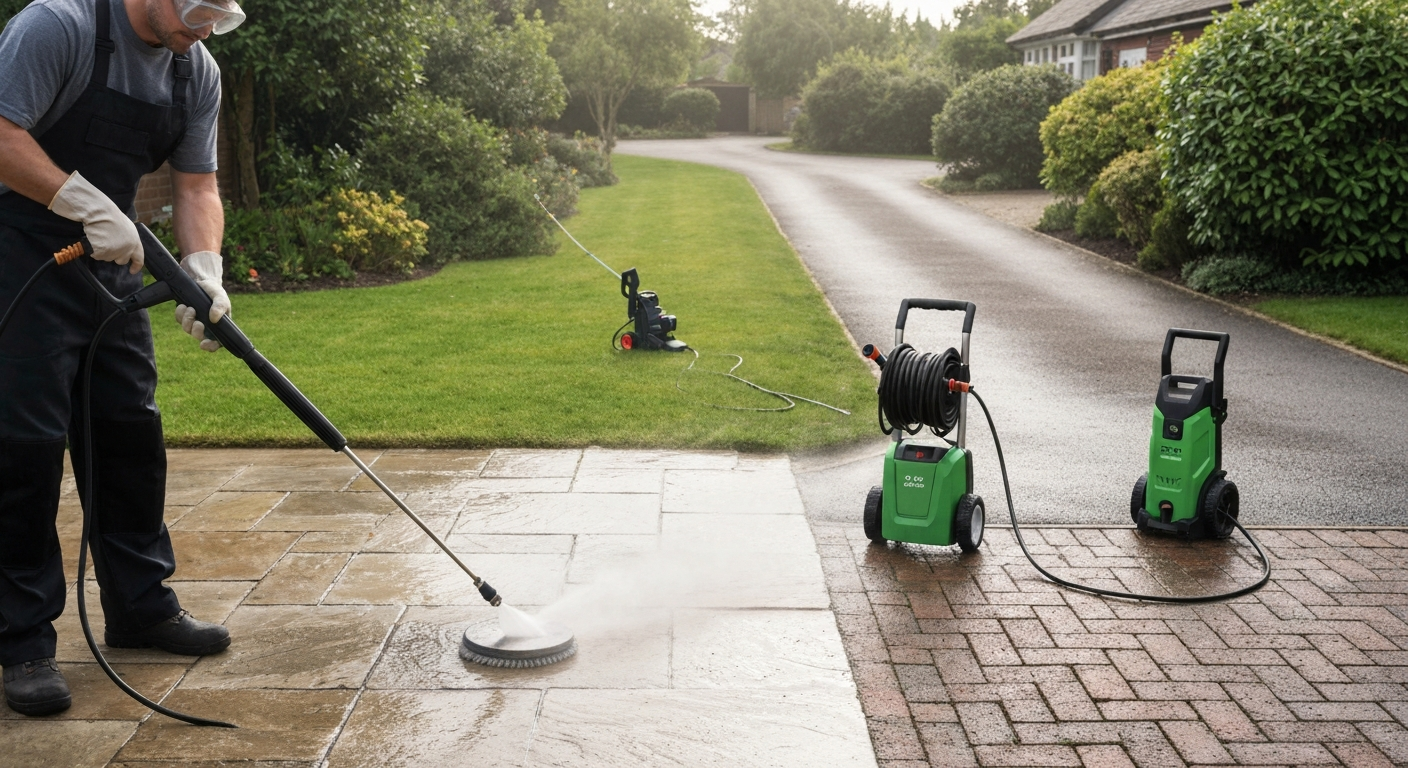
A rotating surface cleaner is the single best accessory you can buy for a patio or driveway. It mounts onto the lance, houses two rotating nozzles under a circular skirt, and cleans in overlapping circles rather than hand-held sweeping lines. The result is consistent pressure across the whole width, no streaking, significantly faster coverage and far less operator fatigue. The Kärcher T-Racer T5 fits the K series and costs around £40–£60. Check that the maximum PSI rating of the surface cleaner matches or exceeds your machine's output before buying. Most domestic surface cleaners handle up to 180–200 bar. Spec-check maximum PSI, maximum flow (l/min) and the inlet connection type before purchasing.
Rotary nozzles (turbo nozzles)
A turbo nozzle spins a zero-degree jet in a cone pattern, concentrating more cleaning energy than a standard flat fan nozzle while covering slightly more area than a plain 0-degree tip. They are excellent on hard concrete and tarmac but should not be used on brick, sandstone, slate, porcelain or anywhere that jet concentration would damage the surface or blow out jointing sand.
Extension wands and lances
A 1-metre extension wand is useful for cleaning along fence lines, under steps and around garden furniture without contorting your back. Most Kärcher and Nilfisk accessories use compatible quick-connect fittings, but check compatibility before buying third-party lances. Variable-pressure or adjustable lances let you dial back pressure for sensitive surfaces without swapping nozzles.
Detergent systems
Most domestic machines have an onboard detergent tank or a siphon tube for drawing detergent from a bottle. Detergent should always be applied through a low-pressure (black) soap nozzle or the machine's dedicated low-pressure mode, allowed to dwell for 5–10 minutes, and then rinsed off on a higher-pressure setting. Using a regular pressure nozzle to apply detergent wastes chemical and reduces dwell time. Always check the manufacturer's manual for compatible detergent types since some machines specify formulations to protect pump seals.
Brushes and soft-wash attachments
Rotating brushes that connect to the lance are useful for patios with heavily ingrained lichen or for surfaces where you want agitation without high pressure. They are particularly handy for cleaning around furniture legs, steps and narrow planters where a surface cleaner will not fit.
Recommended models by budget and use case
Best budget pick: Nilfisk Core 140
At around £130–£150 from Toolstation or Amazon UK, the Core 140 is a genuine workhorse for its price. Its 140 bar and 7.5 l/min output give it enough cleaning units to handle a small driveway and average-sized patio without fuss. The build quality is better than similarly priced competitors, and Nilfisk's hose connectors are secure and durable. The axial pump has a shorter service life than an induction motor unit but at this price that is expected. The main limitation is the shorter hose (6 metres) and the absence of an induction motor, so it is not designed for all-day heavy use.
- Pros: low price, solid build, good nozzle kit, widely available in the UK
- Cons: shorter hose, axial pump not designed for daily heavy use, no onboard storage
- Best for: occasional driveway cleaning, patios under 40 sq m, budget-conscious buyers
Best all-rounder: Kärcher K5 Premium
The K5 Premium is the machine I recommend most often. At 145 bar and 9.5 l/min it delivers one of the higher cleaning unit scores in its domestic class, and the induction motor is significantly quieter and longer-lived than a universal-motor machine. The 7.5-metre hose gives decent reach and it accepts the full range of Kärcher K series accessories including the T-Racer surface cleaner. Available at Screwfix, Toolstation and directly from Kärcher UK. Kärcher publishes full user manuals online including UK mains voltage (230V, 13-amp BS 1363 plug) and compatible detergent types.
- Pros: induction motor, strong flow rate, excellent accessory ecosystem, good warranty (2 years domestic UK), widely available
- Cons: mid-range price may feel high versus budget options, heavier than cheaper machines
- Best for: regular patio and driveway cleaning, block paving, concrete, most domestic surfaces
Best cordless: Ryobi RY120BWV 40V
The Ryobi 40V cordless is a legitimately useful machine where cable management is a real problem: a large garden where the patio is well away from the house, or cleaning paths between raised beds where a cord is a hazard. Its 69 bar (1,000 PSI) and 5.3 l/min output place it at the lower end of cleaning power but it is more than enough for a maintained patio with normal moss and algae buildup. Ryobi sells it both as a kit with battery and charger (around £260) and as a bare unit if you already own Ryobi ONE+ 40V batteries. Ryobi UK publishes the full manual on their website confirming 40V battery compatibility and pump maintenance schedule.
- Pros: completely cable-free, quiet, light, part of a broader battery ecosystem
- Cons: lower pressure and flow than corded equivalents, runtime limited on one battery
- Best for: patios, decking, garden furniture, fence cleaning, areas without easy socket access
Best petrol pick for DIY: Hyundai HYW3000P
If you have a long driveway, a rural property or need to clean large surfaces regularly without a convenient power supply, the Hyundai HYW3000P (207 bar, 12 l/min, Honda or Hyundai engine depending on variant) delivers genuinely professional-grade cleaning power at a realistic domestic price of around £380–£450. The pump on most consumer petrol units is still axial rather than triplex, so it is not rated for all-day continuous commercial use, but for monthly or seasonal domestic cleaning it will outlast most homeowners' patience. Note: petrol machines are loud (above 85 dB) so hearing protection is necessary per HSE guidance.
- Pros: very high cleaning output, no mains needed, good for large areas
- Cons: heavy, noisy, fumes, requires petrol and oil maintenance, not suitable for semi-enclosed spaces
- Best for: large driveways, farm properties, heavy commercial-grade domestic use
Step-by-step cleaning workflow for patios and driveways
Before you start: preparation
- Clear the area: remove furniture, planters, bins and vehicles. Move anything that could be damaged by overspray or that would block your path.
- Sweep off loose debris: a stiff brush or leaf blower first removes loose leaves, grit and dry moss, which reduces the load on the machine and prevents clogging drains.
- Check your drainage: where does the wash water go? Under UK regulations (referenced in NetRegs GPP13) wash water containing detergent or oily residue must not enter surface-water drains that lead directly to a watercourse. If your drain outlets to a road gulley or ditch, lay down a drain cover and mop up or let wash water soak away into the ground instead. Check with your local authority if in doubt.
- Protect adjacent surfaces: mask off or wet down nearby render, painted walls and wooden fences before you start. High-pressure overspray carries further than most people expect.
- Put on your PPE: safety glasses or goggles, waterproof gloves, steel-toecap or waterproof boots and, if using a petrol machine, hearing protection. The HSE's COSHH guidance specifies eye and face protection and chemical-resistant gloves when handling cleaning chemicals.
Machine setup
- Connect the water supply: attach the garden hose to the machine inlet. Run the supply first and check for leaks before switching on. Minimum supply pressure is usually 0.3 bar — a domestic tap is typically 1–3 bar.
- Connect the high-pressure hose and lance firmly before switching on.
- For electric machines, use a 13-amp socket with a functioning RCD. If using an extension lead, ensure it is an outdoor-rated, fully unwound drum.
- Select your nozzle: start with a wide-angle tip (25° or 40°) or fit the surface cleaner. You can always move to a narrower nozzle if needed.
- Switch on and squeeze the trigger to purge air from the system before starting work.
Cleaning sequence
- Apply detergent first (if using): attach the soap nozzle or switch to low-pressure mode, apply patio cleaner or algae treatment evenly across the surface and allow to dwell for 5–10 minutes. Do not let it dry on the surface.
- Switch to your cleaning nozzle or surface cleaner and start at the highest point, working downhill so dirty water flows away from cleaned areas.
- Keep the nozzle or surface cleaner moving steadily. For hand-held lances, use overlapping passes at a consistent distance (see surface guides below). Pausing in one spot concentrates pressure and can etch surfaces.
- Work in manageable sections of around 2–3 sq m at a time so you can see your progress and maintain a consistent technique.
- Rinse thoroughly: once the main clean is done, switch to the 40° nozzle or a lower pressure setting and rinse off all detergent residue. Detergent left on the surface can leave marks or damage sealants.
- Final inspection: walk the surface once the water has partially drained and check for areas you have missed, persistent stains that need a second pass, or any sand joints that have been displaced.
Surface-specific guidance: concrete and tarmac
Concrete is the most forgiving surface for pressure washing. Standard concrete driveways handle 2,000–3,000 PSI (140–200 bar) without damage, and higher-flow machines paired with a surface cleaner will move through a large area quickly. Use a 25° nozzle or turbo nozzle on standard concrete, or fit a surface cleaner for larger flat areas. On tarmac (asphalt), stay below 150 bar and avoid turbo nozzles: tarmac is softer and older surfaces can develop surface fretting if you concentrate too much energy on one spot. Keep the surface cleaner or lance moving and maintain a distance of at least 20–25 cm from the surface on tarmac.
For heavy oil or grease staining on concrete, apply a degreaser and let it dwell before pressure washing. A hot-water machine (hired for the day) will make a dramatic difference on engine oil and hydraulic fluid stains that cold water and degreaser alone struggle with. After washing, sealing the concrete with a penetrating sealant is worth considering to make future cleaning easier.
Surface-specific guidance: paving slabs and block paving
Paving slabs and block paving are where most homeowners get into trouble with pressure washers. The surface itself is usually hard enough to handle moderate pressure, but the real risk is blasting out the jointing material between blocks or slabs. Kiln-dried sand joints, mortar joints and polymeric sand are all vulnerable to direct high-pressure water. Use a surface cleaner wherever possible: it distributes pressure evenly and is far less likely to erode joints than a hand-held lance swept at an angle. If you must use a lance, use a 25° nozzle, hold it perpendicular to the surface (not at an angle) and keep it at least 20–25 cm from the surface.
After cleaning block paving, inspect the joints and top up with kiln-dried sand or polymeric sand if any has been displaced. Apply a block paving sealant (penetrating or film-forming depending on your preference) once the surface is fully dry, usually 24–48 hours after cleaning in UK conditions. This step is consistently the one homeowners skip and then regret the following spring when the moss returns twice as fast.
Surface-specific guidance: brick and sandstone
Brick and sandstone require a genuinely low-impact approach. Industry consensus puts safe pressure for brick and masonry at 500–1,500 PSI (35–100 bar), with older, softer or reclaimed brick at the lower end of that range. Sandstone is particularly vulnerable to surface pitting, edge erosion and loss of the sawn finish if over-pressurised. I learned this the hard way on a riven sandstone patio that looked fine until it dried and showed pitting across the entire surface from a 130-bar machine at too close a distance.
For sandstone and soft brick, use the 40° white nozzle, stand further back than you think necessary (30–40 cm), and let a purpose-formulated stone cleaner or patio cleaner do most of the chemical work. Rinse gently. For persistent moss or lichen on sandstone, a biocidal treatment applied and left to work over a few days is far safer and more effective than mechanical force. If your stone is historic, Listed Building or Conservation Area material, Historic England's guidance is clear: pressure washing is a major intervention and should at minimum be preceded by trial areas in an inconspicuous spot, with conservator advice for anything of heritage significance.
Surface-specific guidance: slate and porcelain
Porcelain paving has become popular precisely because it is non-porous and easy to clean, but that does not mean it is indestructible. High pressure can chip edges, damage the surface finish on textured porcelain and blast out grout or sand joints. Keep pressure at 100 bar or below, use a 40° nozzle, and maintain a working distance of at least 25–30 cm. A surface cleaner is ideal for large porcelain-paved areas. Avoid turbo nozzles entirely on porcelain.
Slate is relatively durable but the natural cleavage planes in riven slate can be vulnerable to high-pressure water forcing its way between layers. Use no more than 80–100 bar, a 40° nozzle, and keep the spray angle perpendicular to the surface rather than at a raking angle that could lever along the grain. After cleaning slate, a slate-specific sealant helps prevent future ingress of algae and simplifies maintenance. Do not use acidic cleaners on slate, which can affect the surface finish.
Tackling specific problems: moss, algae, mould, rust, grease and pet stains
Moss and algae
Moss and algae are the most common issues on UK patios and driveways, particularly on north-facing or shaded surfaces. Pressure washing alone will remove the visible growth but it does not kill the root structure (rhizoids) in moss or the spores of algae. The most effective approach is to apply a biocidal patio treatment (look for products containing benzalkonium chloride or quaternary ammonium compounds) a few days before pressure washing. This kills the growth at the source, making it easier to remove and delaying regrowth. After washing, a second application of a preventative algae treatment will extend the clean period significantly. On concrete and hard paving, expect to repeat the full treatment annually in shaded or damp spots.
Mould and mildew
Black or grey mould patches on patio surfaces respond well to a sodium hypochlorite-based cleaner (diluted bleach) or a proprietary mould remover, followed by pressure washing. Always pre-wet surrounding soil and plants before applying bleach-based products and rinse the area thoroughly afterwards. Do not use bleach on coloured concrete, slate or porous stone where it can cause fading or discolouration.
Rust stains
Rust stains from metal furniture or tools need a dedicated rust remover based on oxalic acid or phosphoric acid. Apply to the stain, allow to dwell (follow the product instructions) and then rinse thoroughly. Pressure washing alone will not remove rust staining. After treatment, identify the metal source causing the staining and either seal it or remove it to prevent recurrence.
Grease and oil
As discussed in the hot-water section, grease and oil are best tackled with a combination of a dedicated alkaline degreaser, a dwell time of at least 10–15 minutes and either hot-water washing or several passes of a cold machine. Work the degreaser in with a stiff brush if the staining is deep. Cat litter or absorbent granules applied to fresh oil spills before cleaning will absorb the bulk of the contamination and make the subsequent wash far more effective.
Pet stains and odours
For pet urine odour on patios, an enzyme-based cleaner is far more effective than bleach or general patio cleaner because it breaks down the odour-causing compounds rather than masking them. Apply the enzyme cleaner, allow the recommended dwell time, and then rinse with the pressure washer on a low-pressure setting (you do not need high pressure for this). Note that neat bleach-based cleaners are toxic to cats and some dogs, so read the product label carefully and keep animals off the treated area until the surface is fully rinsed and dry.
When not to use a pressure washer: non-pressure alternatives
There are situations where pressure washing is the wrong tool entirely. Old, crumbling or repointed brick, decaying sandstone, historic stone flagging, timber decking with exposed grain, painted surfaces with loose paint, and surfaces where water ingress could cause damp issues inside a building all call for a gentler approach. The range of alternatives is wider than most people realise.
- Chemical cleaners and stiff brush: a good patio cleaner applied with a stiff deck brush and rinsed with a hose is often enough for lightly soiled or delicate surfaces. It is also the right approach when you cannot run a machine (noise restrictions, shared access areas, water supply limitations).
- Patio cleaning machines (oscillating or spinning brush units): battery or mains electric units with rotating brushes clean patios by agitation rather than pressure, making them safe for sandstone, old brick and more delicate surfaces. They are slower than a pressure washer but far less risky on sensitive materials.
- Steam cleaners: a domestic steam cleaner (not a steam pressure washer) uses very high-temperature steam at low pressure to kill moss, algae and mould on contact. They are excellent for grout lines, paving joints and areas where you want a chemical-free clean. Water volumes are low, which helps with drainage concerns.
- DOFF and TORC systems (professional hire or contractor use): for heritage stonework, specialist low-pressure steam (DOFF) or abrasive systems (TORC) are the industry-preferred alternatives to pressure washing. These require a trained operator but are often available through stone restoration contractors.
If you are considering alternatives to pressure washing for a chemical-only approach, there is a detailed breakdown of those options on this site covering the best patio cleaner without pressure washer, including which chemical types work on which surfaces.
Safety essentials
Pressure washers cause real injuries every year. The jet from a 130-bar machine can penetrate skin at close range and cause serious deep tissue damage that looks deceptively minor at first. Treat the lance like a tool with serious injury potential, not a garden hose. The HSE is clear on the requirements: eye and face protection whenever operating a pressure washer, chemical-resistant gloves when handling cleaning products, waterproof non-slip footwear, and hearing protection when using a machine producing more than 85 dB (most petrol units, some high-powered electric machines). The Water Jetting Association (WJA) publishes UK codes of practice, City & Guilds‑accredited training and safety guidance for pressure‑washing operatives.
- Always wear safety glasses or a face shield, not just sunglasses
- Use chemical-resistant gloves when mixing or applying patio cleaners and detergents (HSE COSHH SR1 guidance)
- Keep bystanders, children and pets out of the work area
- Never point the lance at people, animals or windows
- Use an RCD for all corded electric equipment used outdoors
- Never operate a petrol pressure washer in an enclosed or semi-enclosed space
- Check drainage routes before you start: detergent-laden wash water must not enter surface-water drains that discharge to a watercourse. NetRegs GPP13 sets out the UK guidance on wash water containment. If in doubt, contact your local environment agency office.
- Do not use ladders while operating a pressure washer: the recoil force can cause loss of balance
Maintenance, storage and winterising your pressure washer
Most domestic pressure washer failures I have seen come down to one thing: the machine was stored with water left in the pump over winter and it froze. Pump freeze damage is not covered by most warranties. Take ten minutes at the end of the season to flush the pump properly and your machine will last years longer.
- After the last use of the season, disconnect the water supply and run the machine for 20–30 seconds to purge as much water from the pump as possible.
- Flush with pump protector fluid (available from Kärcher, Nilfisk and generic brands) if you are storing in an unheated space.
- Coil the high-pressure hose loosely without kinking. Tight coils crack the inner lining over time.
- Remove any detergent from the tank or siphon tube and rinse with clean water to prevent nozzle clogging.
- Wipe down the exterior, check the inlet filter for debris and clean if necessary.
- Store in a frost-free location or use pump antifreeze solution if unavoidable.
- For petrol machines: drain or stabilise the fuel before long-term storage, change the oil per the manufacturer schedule, and run the carburettor dry to prevent varnish buildup.
- Before spring start-up: check hose connections and O-rings for cracks, inspect the trigger gun for any play in the safety catch, and test run briefly before starting work.
Troubleshooting common problems and mistakes to avoid
| Problem | Likely cause | Fix |
|---|---|---|
| Striping or uneven lines on the surface | Moving the lance too slowly or too quickly, or using a narrow nozzle angle | Use a 25° nozzle or surface cleaner, maintain consistent speed and overlap passes by 20% |
| Surface etching or pitting | Pressure too high or nozzle too close for the surface material | Reduce pressure, increase working distance, switch to a wider nozzle angle |
| Nozzle clogging | Grit or debris in the water supply or detergent tank | Remove nozzle and clear with a fine needle or nozzle cleaning tool. Check inlet filter. |
| Pulsating pressure | Air in the pump or insufficient water supply pressure | Check hose kinks, run the inlet water to prime fully, let air purge through the trigger |
| Machine trips RCD or blows fuse | Motor drawing too much current — possible winding fault or seized pump | Check for pump freeze damage. Have the motor tested. Do not reset and run repeatedly. |
| Loss of pressure during use | Inlet filter blocked, kinked hose, or worn nozzle | Check and clean the inlet filter first. Replace worn nozzles — they erode over time and lose effective pressure. |
| Jointing sand blown out | Lance held at angle to joints, pressure too high or nozzle too narrow | Use surface cleaner, hold lance perpendicular to surface, reduce pressure, re-sand after cleaning |
| Motor runs but no pressure | Water supply insufficient, nozzle loose or pump damage | Confirm supply pressure, check nozzle seat, check for pump fault |
Buying checklist and decision flow
Before you buy, work through these questions in order. They will save you from the most common buying mistakes I see: buying too cheap for the job size, buying too powerful for sensitive surfaces, or ignoring the accessories that make the real difference.
- What size area am I cleaning? Under 50 sq m (small patio): 100–130 bar, 7–8 l/min is sufficient. 50–150 sq m (medium driveway/patio): 130–150 bar, 8–10 l/min with a surface cleaner. Over 150 sq m or frequent use: 150 bar+, 10+ l/min, consider induction motor or petrol.
- What surface materials am I cleaning? Delicate stone (sandstone, slate, old brick): keep pressure low (under 80–100 bar) and invest in chemical cleaners. Concrete, tarmac, modern block paving: full domestic range is fine.
- How often will I use it? Occasional (1–3 times per year): budget axial-pump machine is fine. Regular (weekly or monthly): induction motor or professional pump to protect longevity.
- Do I have a mains socket within easy reach? Yes: corded electric is the right choice. No: battery-powered or petrol depending on budget and area size.
- Do I have oil/grease staining? Yes: budget for either a hot-water machine hire day or a good alkaline degreaser with the cold machine.
- What accessories should I budget for? At minimum: a surface cleaner (£40–£60) and a soap nozzle if not included. Consider: extension wand, rotating brush, patio cleaner detergent.
- UK-specific buying notes: all domestic UK electric pressure washers should run on 230V, 13-amp BS 1363 plug (standard UK plug). Verify this in the manual before buying — some grey-import models are wired for 110V or non-UK plugs. Check warranty terms: Kärcher UK and Nilfisk UK both offer 2-year domestic warranties through UK channels, which may differ from grey imports. Screwfix and Toolstation hold good stock of Kärcher K4/K5 and Nilfisk Core ranges with next-day store collection. For petrol models, confirm UK parts availability from the UK distributor before buying online.
- Check the Water Jetting Association (WJA) if hiring a contractor: the WJA publishes codes of practice and a list of accredited operators in the UK, which is useful if you are outsourcing driveway or heritage stonework cleaning.
Further reading on Patio Cleaner Reviews
This guide covers the broad landscape, but many of the topics here have their own in-depth pages on this site. If you are narrowing down to a single machine for patio use specifically, the dedicated best pressure washer for patio guide digs deeper into patio-specific considerations including surface-cleaner compatibility and lower-pressure settings for delicate stone. If you want a head-to-head of the top machines in a tested format, the patio pressure washer reviews section covers individual model testing in more detail, with notes on real-world cleaning speed and noise levels. For UK buyers looking specifically at machines sold and supported here, the best power washer for patios UK page covers British retail availability, current pricing and UK-specific warranty details in more depth.
If you are on the fence about whether you need a pressure washer at all, or your surfaces are too delicate for one, the best patio cleaner without pressure washer guide walks through chemical-only approaches that work surprisingly well on many surfaces. And for a broader comparison of cleaning machines in a review format with test scores, the best patio cleaning pressure washer page pulls together cross-brand comparisons in a single ranked list.
FAQ
What product-specification questions must I answer to recommend top pressure-washer models (including UK options)?
Collect PSI, GPM (or l/min), calculated cleaning units (PSI×GPM), pump type (axial vs triplex), electric vs petrol vs battery, hot‑water vs cold‑water capability, maximum recommended duty cycle, inlet connection, nozzle kit included, surface‑cleaner/attachment compatibility, machine weight/portability, noise level (dB), recommended detergents, warranty length, and official UK mains/plug/voltage details from manufacturer spec sheets and manuals.
Which performance metrics and formulas should I explain and verify?
Explain PSI, GPM and Cleaning Units (CU = PSI×GPM) and why CU better predicts cleaning speed; confirm runtime and duty cycles; convert units for UK readers (PSI↔bar, GPM↔l/min); verify noise (dB) and electrical requirements (voltage, plug type, RCD guidance) from manuals and test reports.
What safety, PPE and legal/environmental topics require authoritative sourcing?
Research UK HSE guidance for PPE, COSHH controls for chemicals, and RCD/electrical safety; NetRegs (GPP13) and local water‑company rules for contaminated wash-water and drainage controls; Water Jetting Association codes for operator safety and technique; include legal risks of discharging detergent/oily water and recommended containment/collection measures.
What conservation or heritage cautions must I check and cite?
Consult Historic England and EN 17138 (and local conservation officers) for guidance on cleaning historic/porous stone; verify recommended pressures, nozzle types, trial‑patch protocols, and when to use specialist low‑impact methods (DOFF/steam/soft wash) or seek a conservator.
Which nozzle, spray-angle and technique details need precise references?
Document standard nozzle angles (0°,15°,25°,40°), low‑pressure soap tips and turbo/rotary tips; cite sources for recommended working distances, overlap techniques, and which angles are safe for which substrates; cross‑check with manufacturer manuals and WJA/industry guides.
How should I research surface‑specific protocols for patios/driveways?
For each material (concrete, paving slabs, brick, sandstone, slate, porcelain): gather recommended starting PSI/GPM ranges, nozzle angle, safe working distance, cleaning sequence, compatible detergents, pre‑treatment and post‑treatment steps, and conservation caveats; verify with manufacturers, conservation bodies, and product test/review sites; include small patch‑test procedures.
Next Article
Best Power Washer for Patios UK: Choose the Right One
Pick the best power washer for UK patios: pressure, nozzles, chemicals and surface tips for concrete, stone, slate, porc