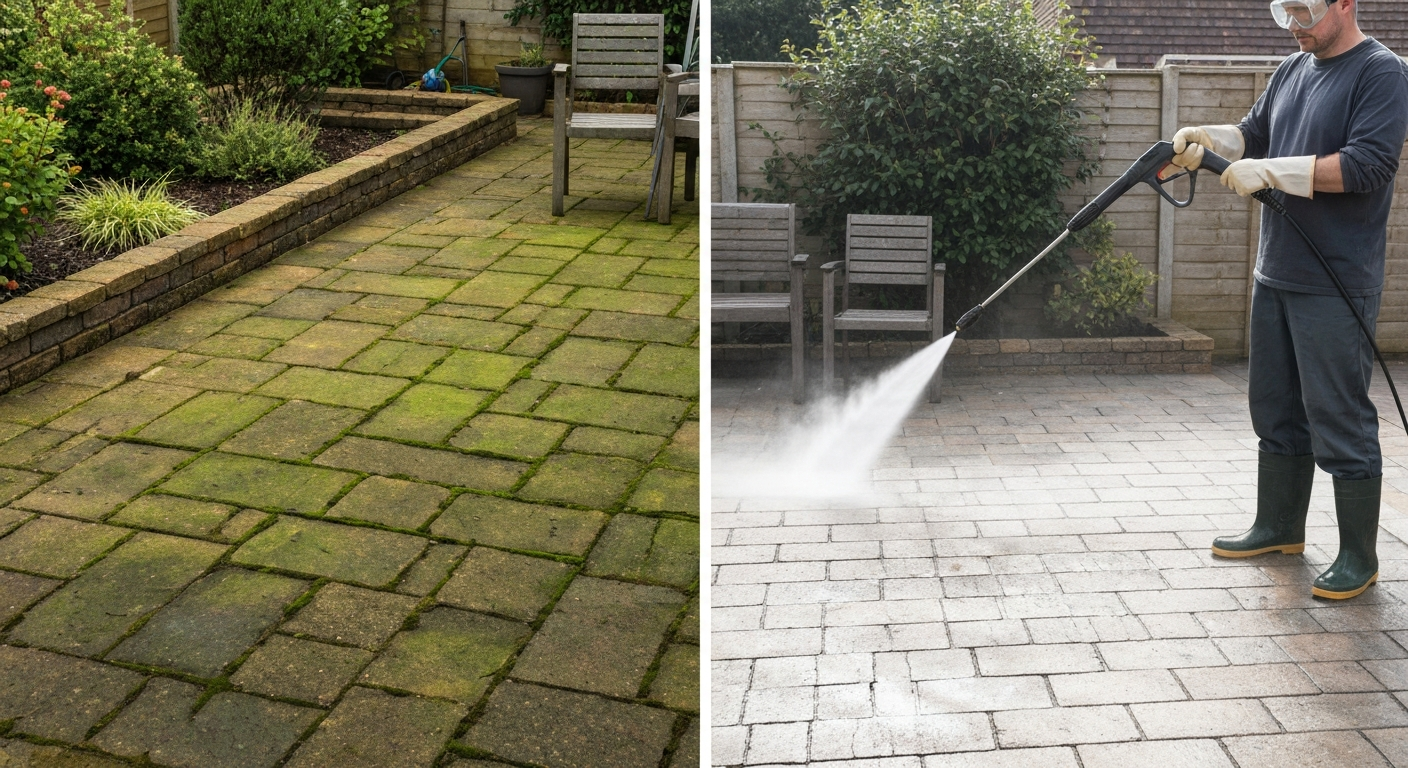
Yes, you can pressure wash patio cushions, but only if you use the right settings and the fabric can handle it. Keep your pressure washer at 500 PSI or below, use a wide 40-degree nozzle, stay at least 12 to 18 inches back from the fabric, and only attempt it on cushions made from solution-dyed acrylic (like Sunbrella), olefin, or water-repellent polyester. Anything older, cheaper, or stuffed with standard foam is a risk you probably do not want to take.
How to Clean Patio Cushions with a Pressure Washer Safely
Rhea Lang
11 Aug 2026
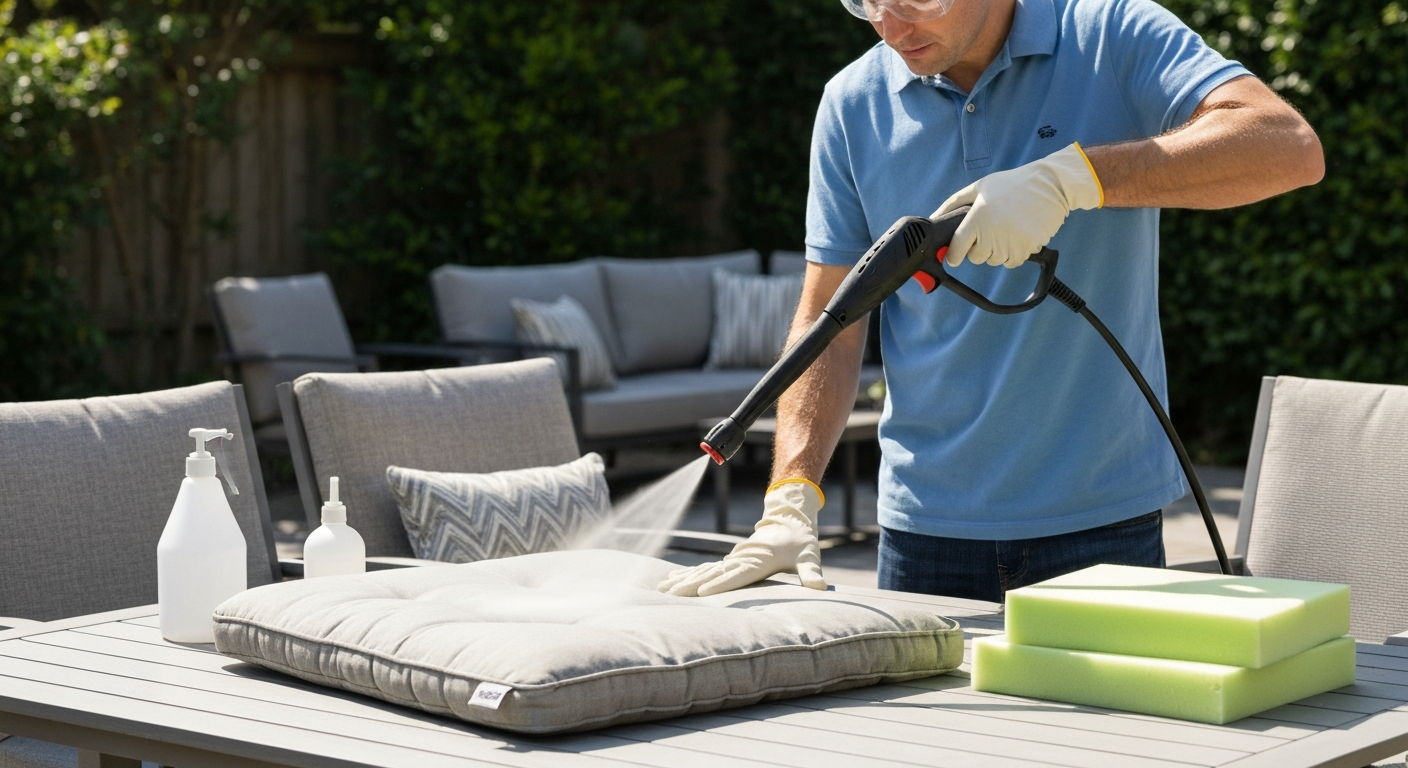
Is it OK to pressure wash patio cushions? The quick answer
The honest answer is: it depends on what your cushions are made of, how old they are, and what pressure washer settings you use. A powerful direct jet will shred stitching, force water deep into foam, and strip protective finishes off fabric in seconds. But a low-pressure rinse using a wide nozzle from a sensible distance? That is genuinely useful for shifting built-up grime, mold, and pollen on tough outdoor fabrics.
Use this quick decision flow before you even connect the hose. If you answer no to any of these questions, skip the pressure washer and go straight to the hand-wash or soft-wash alternatives covered later in this article.
- Is the fabric a performance outdoor textile (Sunbrella, olefin, solution-dyed polyester)? If yes, continue. If no, stop.
- Is the care label free of symbols indicating hand-wash only or dry-clean only? If yes, continue. If no, stop.
- Are the seams and any zippers in sound condition with no fraying or splitting? If yes, continue. If no, stop.
- Does your pressure washer go below 1,000 PSI or have a low-pressure mode / soap injector setting? If yes, continue. If no, stop.
- Do you have a 40-degree (white) nozzle available? If yes, you are good to proceed with caution and a test patch first.
Which cushions are safe to pressure wash: fabric and construction checks
Not all outdoor cushions are created equal. Before you drag anything onto the patio and point a wand at it, you need to know what you are dealing with. The fabric type, the cover construction, and especially what is inside the cushion all affect whether pressure washing is a reasonable option.
Fabrics that handle pressure washing well
Solution-dyed acrylic like Sunbrella is the gold standard for outdoor cushions. The colour is baked into the fibre during manufacture, not applied as a surface dye, which is why Sunbrella's own cleaning guide permits diluted bleach without colour bleed. Glen Raven (Sunbrella's maker) publishes specific cleaning recipes for routine stains and mildew: one teaspoon of dishwashing liquid per cup of water for general dirt, and a bleach-based solution for mildew. These fabrics tolerate a careful low-pressure rinse well. Olefin (polypropylene) is another solid performer. It is inherently water-resistant and in most cases handles gentle pressure washing at low settings provided you avoid hot water and test first. Olefin Fabric, Cleaning & Maintenance (Westminster Outdoor Living) notes many vendors advise cleaning olefin with mild soap and water and, in some cases, carefully with a low‑pressure washer, testing first and avoiding hot water or machine drying is recommended Olefin Fabric — Cleaning & Maintenance (Westminster Outdoor Living). Solution-dyed polyester sits in third place: more affordable than Sunbrella but still reasonably tough when it has a good weave and a water-repellent finish applied.
Removable covers versus fixed covers
Removable zippered covers are much safer to deal with because you can clean the fabric separately from the foam. Sunbrella actually recommends handwashing fitted (non-removable) covers rather than machine washing them because machine washing makes re-covering the foam difficult and can stress zippers and seams. If your covers zip off, remove them and pressure wash the fabric alone. Leave the foam core out of the direct spray path entirely if you can help it.
What is inside matters just as much as what is outside
This is where most people go wrong. Open-cell reticulated foam, often sold as Dry-Fast or Quick-Dry foam, is the correct fill for outdoor cushions. It drains and dries quickly, which is exactly what you want after any wet cleaning. Standard open-cell polyurethane or polyester batting, the kind found in cheaper indoor-outdoor crossover cushions, soaks up water like a sponge and holds it for days. That is the perfect environment for mildew to take hold inside the cushion. If you do not know what foam type your cushions have, press the cushion firmly after getting it wet: if it holds water like a damp sponge for hours, you have slow-drain foam and need to be far more careful about how much water you introduce.
Care label codes
The care label is your first stop and it is worth actually reading rather than just peeling off. Look for the IICRC cleaning codes: W means water-based cleaners are safe, S means solvent-based only, WS means both are options, and X means vacuum or dry-brush only. A code X cushion should never see water, let alone a pressure washer. A code S cushion is in the same boat. Only W or WS fabrics should be considered candidates for any wet cleaning approach.
When pressure washing will damage cushions, and what to do instead
I learned this the hard way with a set of discount cushions I bought a few years back. They had a woven polyester top but foam-batting fill and non-removable covers with visible lock-stitching. One pass at what I thought was a sensible distance and I watched the stitching on one seam start to loosen. The foam took four days to dry and came out smelling musty despite sitting in full sun. Some cushions are just not worth pressure washing.
Avoid pressure washing entirely if any of the following apply to your cushions:
- The fabric is velvet, chenille, canvas (untreated), or any natural fibre like cotton or linen
- The cover has visible fraying, weak seams, or split stitching anywhere
- The care label shows an S or X cleaning code
- The cushions are vintage, antique, or have decorative elements like tassels, embroidery, or piping that could be damaged
- The fill is standard polyurethane or polyfill batting (not quick-drain reticulated foam)
- The cushions are thin (under about 2 inches) with no zipper access to the foam
Better alternatives when pressure washing is off the table
Hand washing with a soft-bristle brush, warm water (not exceeding 100°F / 38°C as Outdura recommends), and a mild detergent is the safest universal option. You control the pressure completely and can feel when seams are under stress. For mildew, Outdura's care instructions call for soaking in a gallon of cold water with half a cup of bleach and half a cup of mild soap for an hour before scrubbing, then rinsing thoroughly. This recipe works well on Outdura and similar fabrics. An upholstery cleaner or fabric spray cleaner is the right tool for code-S fabrics or anything with decorative finishing you want to preserve. Soft washing, where you apply a low-pressure chemical solution (often sodium hypochlorite plus a surfactant) and let the chemistry do the work at under 100 PSI, is a good middle-ground for heavily soiled cushions that are borderline candidates. Steam cleaning at low settings is an option for stubborn stains on delicate fabrics, though it risks over-wetting thin covers. If the cushions are heavily mildewed, structurally compromised, or valuable, calling a professional upholstery cleaning service is genuinely the right call.
Prep and safety checklist before you pressure wash
Taking ten minutes to prepare properly will save you from ruining a cushion and protect your patio surface, your plants, and yourself. Run through this checklist before you start.
- Read the care label and confirm the fabric code is W or WS
- Close all zippers fully to protect the zipper pull and teeth from the jet
- Inspect every seam, especially at corners and along the piping, for loose or fraying stitching — reinforce or skip problem areas
- Brush off loose debris (leaves, dirt, dried bird droppings) with a dry soft brush before any water touches the fabric
- Set the cushion on a clean hard surface like a garden table or clean concrete rather than directly on grass (to avoid grass staining)
- Test your chosen nozzle and pressure on a hidden section of the cushion for 10 to 15 seconds and inspect for fibre lifting, colour bleed, or seam stress before committing
- Put on safety glasses and waterproof gloves, especially if you are using any detergent or bleach solution
- Cover nearby plants and move any nearby furniture off the spray path — detergent runoff from outdoor fabric cleaners can harm plant roots
- Keep children and pets out of the working area, particularly if using any bleach-based solutions
Tools and products you will need
You do not need a heavy-duty machine for cushions. In fact, the stronger the pressure washer, the more disciplined you need to be. An electric pressure washer in the 1,200 to 1,800 PSI range is ideal because most of them have a low-pressure soap injection setting that brings working pressure right down, and the maximum output is far easier to manage on delicate textiles than a petrol machine cranking out 2,500 PSI or more.
Nozzle selection
Kärcher's own guidance is clear on this: never use a zero-degree (red) or 15-degree (yellow) nozzle on soft or delicate surfaces, and maintain a minimum standoff of around 30 cm (12 inches) for anything you want to treat gently. For cushions, the 40-degree (white) nozzle is the right starting point. It spreads the spray across the widest angle available in the standard quick-connect set, dramatically reducing the point force on any given patch of fabric. The 25-degree (green) nozzle is an option for rinsing firmer outdoor fabrics but I would start with the 40 every time and only step down if the rinsing is inadequate.
Detergents and cleaners
For routine cleaning, a small amount of mild pH-neutral dish soap mixed into warm water works reliably on most outdoor performance fabrics and exactly matches Sunbrella's own recommendation (one teaspoon per cup of water). Apply it with a soft brush or a pump sprayer rather than through the pressure washer's detergent injector if possible: this gives you more control over dwell time and avoids over-saturating the foam. For mildew, an oxygen bleach product formulated for outdoor fabrics is safer than chlorine bleach on most coloured fabrics, though Sunbrella and Outdura explicitly tolerate diluted chlorine bleach at their stated ratios. Always follow the manufacturer's bleach ratios. Enzyme-based outdoor fabric cleaners are a gentler option for breaking down organic stains without bleach.
Reproofing sprays
Any cleaning involving detergent or bleach will degrade the fabric's Durable Water Repellent (DWR) finish over time. Sunbrella recommends 303 Fabric Guard for restoring water and stain resistance after cleaning (Tex'Aktiv for international markets). Outdura similarly recommends a post-cure fluorocarbon treatment after cleaning. Have your chosen reproofing spray ready before you start so you can apply it as part of the aftercare step rather than forgetting and wondering why the cushions seem to soak up water the following summer.
Step-by-step low-pressure method for cleaning cushions
This method is built around keeping pressure low, spray angles wide, and standoff distances generous. The goal is to use the water flow to rinse and carry away loosened grime rather than blasting it off with raw force.
- Set your pressure washer to its lowest output or use the soap/detergent injection mode, which typically drops working pressure to under 500 PSI. Fit the 40-degree (white) nozzle.
- Pre-wet the entire cushion surface with plain water from a distance of at least 18 inches. This loosens surface grit and prepares the fabric fibres.
- Mix your cleaning solution separately (one teaspoon mild dish soap per cup of water for general cleaning) and apply it with a pump sprayer or soft brush, working it gently into any visibly dirty areas.
- Allow the detergent to dwell for 3 to 5 minutes. Do not let it dry on the fabric.
- Test your pressure washer jet on a hidden corner at 18 inches standoff. If the fabric surface looks undisturbed after 10 seconds, you are good to continue. If you see any fibre lifting or colour change, increase your standoff to 24 to 30 inches.
- Work methodically across the cushion surface in slow, overlapping passes, keeping the nozzle moving at all times. Holding the jet in one spot even for a few seconds at close range risks damage.
- Maintain your 18 to 24 inch standoff throughout and keep the spray angle at roughly 45 degrees to the fabric rather than directly perpendicular — this reduces the impact force and helps carry water and soap away from the surface rather than deeper into the foam.
- Flip the cushion and repeat on the other side.
- For the final rinse, switch to plain water and flush the fabric thoroughly. Sunbrella and Outdura both stress that thorough rinsing after any soap or bleach use is non-negotiable — residual detergent attracts re-soiling faster and can degrade thread over time.
- After rinsing, press the cushion gently to expel trapped water from the foam, then stand it on its edge to drain before moving to the drying stage.
Targeted stain removal and mold/mildew treatment
General rinsing will not shift everything. For targeted stains you need to pre-treat before the pressure wash step, not expect the water jet to do the chemical work for you.
Food, grease, and organic stains
Grease and food stains respond well to an enzyme-based outdoor fabric cleaner or a degreaser formulated for soft surfaces. Apply directly to the stain, work it in gently with a soft brush, and give it 5 to 10 minutes of dwell time before rinsing. Avoid petroleum-based degreasers or anything solvent-based on water-coded (W) fabrics. Wine and berry stains should be treated immediately when fresh: blot excess liquid, apply a small amount of mild dish soap solution, and rinse. Dried wine stains may require an oxygen bleach pre-soak of 20 to 30 minutes before washing.
Rust stains
Rust from metal furniture feet or frame screws is one of the trickier stains on outdoor fabric. Standard soap and water will not touch it. A purpose-made fabric rust remover containing oxalic acid works on most outdoor performance fabrics but always test on a hidden area first as it can affect some dyes. Apply, dwell for the time specified on the product label, then rinse thoroughly.
Mold and mildew
Mildew on Sunbrella is treated with one teaspoon of dish soap plus one teaspoon of household bleach per cup of water according to Glen Raven's published guide. For heavier mildew on awnings and similar Sunbrella applications, the stronger recipe is one cup of household bleach plus a quarter cup of mild soap per gallon of water, soaked for up to 15 minutes then rinsed thoroughly. For Outdura and similar fabrics, Sattler recommends soaking for up to an hour in a solution of one gallon cold water with half a cup bleach and half a cup mild soap. After any bleach treatment, rinse extremely thoroughly. Bleach degrades sewing thread and non-performance fabric components over time, so limit bleach treatments to when mildew is genuinely established rather than as routine cleaning. Sunbrella also explicitly warns to keep bleach runoff away from bodies of water and to protect surrounding plant life during cleaning. Always re-apply a fabric protector after bleach cleaning to restore repellency. Oxygen bleach (sodium percarbonate-based) is a gentler alternative for lighter mildew that does not carry the thread-degrading risk of chlorine bleach.
Drying and aftercare to prevent mildew and restore water repellency
Getting the drying step right is just as important as the wash itself. Most cushion mildew problems start not from rain exposure but from putting cushions away or stacking them while they are still damp after cleaning.
- Stand cushions on their edge after washing so gravity can pull water out through the fabric rather than pooling in the base
- Dry in a well-ventilated spot with air circulation on all sides — direct sun helps but is not essential if the airflow is good
- Separate removable foam cores from covers and dry them independently; even quick-drain reticulated foam needs several hours of good airflow to dry fully after a thorough soak
- Do not stack or compress cushions until they are completely dry all the way through — pressing the foam confirms this (it should spring back firmly without releasing water)
- Avoid using a tumble dryer on cushion covers unless the care label explicitly permits it; machine heat can distort foam inserts, shrink covers, and damage zipper hardware
- Once completely dry, apply a DWR reproofing spray like 303 Fabric Guard or a fluorocarbon fabric protector per the product instructions; this step is not optional after any bleach cleaning, and is a good idea after any deep clean that used detergent
- Check seams after drying; if any stitching has loosened during washing, address it before the cushions go back into service
Troubleshooting common problems
Even when you follow the process carefully, things sometimes go wrong. Here is what typically happens and how to deal with it.
| Problem | Likely cause | Fix |
|---|---|---|
| Fabric colour loss or bleaching | Too high a bleach concentration, incompatible dye type, or leaving bleach solution on too long | Rinse immediately and thoroughly with cold water; apply a colour-safe fabric restorer if available; switch to oxygen bleach or enzyme cleaner next time |
| Fabric shrinkage | Hot water used during washing or rinsing, or machine drying a non-dryer-safe cover | Gently stretch while still damp and allow to air dry flat; avoid hot water (stay under 38°C / 100°F) in future washes |
| Soggy foam that stays wet for days | Standard polyurethane or polyfill foam, not quick-drain reticulated foam; or foam soaked through without adequate drying time | Stand on edge in strong airflow; use a fan to assist; consider replacing foam with reticulated quick-dry foam if this recurs |
| Residue or soap rings on fabric | Detergent not fully rinsed out; hard water leaving mineral deposits | Rinse again thoroughly with clean water; a diluted white vinegar rinse (1 part vinegar to 3 parts water) can help with hard-water mineral marks |
| Stubborn stains that survived the wash | Insufficient pre-treatment dwell time or wrong cleaner type for the stain | Re-treat with a targeted product (enzyme cleaner for organic, oxalic acid for rust) and allow longer dwell time before rinsing |
| Persistent mildew odour after washing and drying | Mildew colonies inside foam core, not just on fabric surface | Consider a diluted fabric-safe antimicrobial spray applied to the foam core directly; dry very thoroughly; if odour persists after a second treatment, replace the foam insert |
Quick PSI and nozzle cheat sheet: cushions vs common patio surfaces
One of the most common mistakes homeowners make is using the same pressure washer settings for every task in the garden. The right settings for blasting algae off concrete are completely wrong for outdoor fabric. This table gives you a side-by-side starting point. For specific guidance on pressure levels, see how much PSI do I need to clean my patio.
| Surface / Material | Recommended PSI range | Nozzle type | Standoff distance | Key risk |
|---|---|---|---|---|
| Patio cushions (Sunbrella/olefin/polyester) | 300–500 PSI (use soap/low-pressure mode) | 40-degree (white) | 18–24 inches minimum | Seam damage, fibre lifting, foam saturation |
| Concrete or brick pavers | 1,500–2,500 PSI | 25-degree (green) or rotary | 6–12 inches | Joint sand erosion, surface pitting on soft brick |
| Porcelain patio tiles | 1,000–1,500 PSI | 25-degree (green) or 40-degree (white) | 12–18 inches | Grout damage, surface micro-cracking on cheaper porcelain |
| Slate patio | 800–1,200 PSI | 40-degree (white) | 12–18 inches | Surface delamination, flaking on weathered slate |
| Timber decking | 500–1,000 PSI | 40-degree (white) or dedicated deck wash nozzle | 12–18 inches | Grain lifting, splintering, wood fibre damage |
Note that these are starting-point ranges, not guaranteed safe settings for every product. Always test in a hidden area first. For porcelain and slate surfaces in particular, the material quality and age matter enormously: a high-quality porcelain tile that passes a scratch test will tolerate more than a softer, lower-fired version. The same logic applies to natural slate, which is not a uniform material.
How pressure-washing settings differ by patio material
If you have landed here partly because you are trying to figure out your whole-patio cleaning approach, it is worth understanding how the risks scale across surfaces. If you want to know whether pressure washing can damage different patio materials, see does pressure washing damage patio for a material-by-material guide. Cushions are at the most delicate end of the spectrum, but even hard patio materials need careful settings selection.
Porcelain
Porcelain is a dense, vitrified tile with low porosity, which makes it one of the more pressure-washer-friendly hard patio surfaces. The main risks are to the grout joints rather than the tile face itself, and to cheaper or thinner porcelain products that may not tolerate a concentrated nozzle. Keep to the 1,000 to 1,500 PSI range with a 25-degree nozzle at 12 inches standoff and you should be fine on most quality porcelain installations.
Slate
Slate is a layered sedimentary rock and its vulnerability to pressure washing depends almost entirely on how weathered and how delaminated the surface already is. Fresh, hard slate handles a controlled wash reasonably well. Old or heavily weathered slate can have surface layers that are already partially separated and a pressure jet can accelerate delamination rapidly. A 40-degree nozzle at the lower end of the PSI range (800 to 1,000 PSI) and a longer standoff (15 to 18 inches) is the conservative approach. For more detailed guidance, see can you pressure wash slate patio which explains the risks and recommended settings for cleaning different types of slate. If your slate patio already shows surface flaking, consider a lower-pressure chemical clean instead.
Pavers
Concrete and natural stone pavers are generally tolerant of higher pressures, but the biggest issue is joint sand. A concentrated jet directed at the gaps between pavers will erode polymeric jointing sand quickly. Use a surface cleaner attachment (Kärcher recommends these for flat surfaces specifically because the enclosed rotating jets divide the flow more evenly and maintain a constant standoff) rather than a wand for large paved areas, and re-sand joints after cleaning if needed. For detailed guidance on safe pressure levels, nozzle choices, and joint-protection techniques, see is it ok to power wash patio pavers.
Environmental and safety notes
Cleaning chemicals, including even mild detergents, can harm plants and contaminate garden water features if runoff is not managed. Sunbrella's manufacturer guide specifically warns against using bleach solutions when fabric is adjacent to bodies of water or where runoff could reach water. Before you start any chemical cleaning, move potted plants away from the work area, cover nearby borders with sheeting, and direct your runoff toward a hard surface drain rather than a lawn or planted bed.
Chlorine bleach should be handled carefully: wear waterproof gloves and eye protection, do not mix it with other cleaning products (particularly ammonia-based cleaners), and ensure good ventilation if working in an enclosed area like a covered patio. For pressure washing generally, safety glasses are non-negotiable as deflected water and debris can cause eye injuries at close range. Keep children and pets away from the cleaning area until the surface has been thoroughly rinsed and the area has dried.
Detergent and bleach solutions should not be allowed to enter storm drains, streams, or water features. Check whether your local authority has guidance on chemical disposal from domestic cleaning activities. In many areas, diluted household soap solutions that drain to a foul sewer are acceptable, but concentrated bleach or specialist chemical cleaners may have specific disposal requirements.
When to stop and call a professional
There is no shame in knowing when a job is beyond a DIY clean. If your cushions have any of the following issues, a professional upholstery cleaner or restoration service is a better investment than spending an afternoon making things worse.
- Mildew has penetrated the foam core and smell persists after two thorough cleans and complete drying
- Fabric has structural damage, large areas of thread deterioration, or holes that would be worsened by wetting
- Stains are from unknown chemicals, paint, or substances that require specialist identification before treatment
- The cushions are high-value or antique pieces where the risk of DIY damage outweighs the cost of professional service
- You have already attempted cleaning and the cushions have come out worse — discolouration, shrinkage, or loose seams — and you need professional restoration rather than further DIY attempts
Professional upholstery cleaning services use hot-water extraction tools that operate at 100 to 300 PSI at the tool head with controlled extraction cycles, far more precise than a consumer pressure washer spray. This approach is defined in the IICRC S300 upholstery cleaning standard and allows technicians to control moisture levels carefully to prevent over-wetting. For cushions with severe mildew, professional deep-sanitizing with antimicrobial treatment is the only reliable way to eliminate established colonies from foam cores.
If cushions are genuinely beyond saving, replacing the foam insert is often more cost-effective than replacing the whole cushion set. Sourcing a direct-cut piece of reticulated quick-dry foam to replace deteriorated standard foam can give a worn set of cushion covers a new lease of life and will dramatically improve their resistance to mildew in future seasons.
FAQ
Is pressure‑washing patio cushions safe and effective?
Sometimes — pressure washing can be safe and effective for many outdoor cushion fabrics (solution‑dyed acrylic like Sunbrella, olefin, and many polyester covers) when you use low pressure, the proper nozzle, correct detergents, and follow manufacturer care instructions. Do not pressure‑wash cushions with non‑removable covers, delicate trim/seams, or foam that soaks and won’t dry quickly. Always test an inconspicuous area first and follow the cushion/fabric care tag.
How do I check whether my cushions are suitable for pressure washing?
Checklist: 1) Removable cover? Preferable — unzip and remove covers if possible. 2) Fabric type: solution‑dyed acrylic (Sunbrella), olefin, or outdoor polyester generally tolerate careful low‑pressure cleaning; check manufacturer guidance. 3) Fill type: quick‑dry reticulated (dry‑fast) foam is OK; standard polyurethane that soaks up water is not. 4) Construction: avoid pressure washing cushions with glued seams, exposed piping, delicate zippers, or sewn‑in cushions where water can’t escape. 5) Care tag: follow the maker’s written instructions (Sunbrella, Outdura, etc.). If in doubt, choose a gentler method.
What safety and prep steps should I take before pressure washing cushions?
Prep & safety checklist: 1) Read fabric/cushion tags and manufacturer care guides. 2) Test a hidden area. 3) Remove covers and hardware where possible; close zippers and patch small holes. 4) Wear safety gear: eye protection, gloves, long sleeves. 5) Protect nearby surfaces and plants (cover with plastic if you’ll use bleach). 6) Choose a shaded, well‑ventilated area for drying. 7) Use a detergent recommended for outdoor fabric or mild dish soap; have fresh water and a soft brush on hand. 8) Keep pressure washer on a low setting and use wide‑angle nozzle; never use zero‑degree/rotary jets on fabric.
Exactly what pressure, nozzle, angle and distance should I use?
Recommended settings for cushions: - PSI: start low — 100–300 PSI (soft‑wash range). Don’t exceed ~400 PSI. - Nozzle: use a wide spray 25°–40° (green or white) or the soap/low‑pressure nozzle (black) for applying detergent. - Angle & distance: keep the spray at a roughly perpendicular but spread angle and maintain 12–30 inches (30–75 cm) from the fabric; start at the far end and move closer only if needed. - Technique: keep the wand moving; avoid holding the jet in one place; don’t use 0°/15° (red/yellow) nozzles on cushions. Test and adjust.
Step‑by‑step low‑pressure method for cleaning cushions with a pressure washer
Step‑by‑step: 1) Remove covers if possible; unzip and set aside foam. 2) Brush off loose dirt. 3) Pre‑test a hidden spot. 4) Apply detergent: use a mild soap solution or outdoor fabric cleaner through the low‑pressure/soap nozzle or hand‑apply with a soft brush. 5) Let detergent dwell per label (a few minutes; don’t let bleach sit on non‑bleach‑safe parts). 6) Rinse with 100–300 PSI, 25°–40° nozzle, 12–30 in distance, moving the wand continuously. 7) Inspect seams and repeats of cleaning if needed for spots. 8) Thoroughly squeeze/press out excess water from covers and foam (if allowed). 9) Air‑dry fully in sun/air, standing covers on edge to maximize airflow; allow 24–48+ hours until completely dry before reassembling.
What detergents and stain treatments are recommended?
Recommended cleaners and recipes: - Mild dish soap or dedicated outdoor fabric cleaner for routine cleaning. - Sunbrella routine: 1 teaspoon dishwashing liquid per 1 cup water. - Sunbrella mildew recipe: 1 teaspoon dishwashing liquid + 1 teaspoon household bleach per 1 cup water (test first). - Heavy/awning (Sunbrella): 1 cup bleach + 1/4 cup mild soap per gallon; soak up to 15 minutes, rinse thoroughly. - Outdura mildew: 1 gallon water + 1/2 cup bleach + 1/2 cup mild soap (soak 1 hour). - After any bleach use rinse thoroughly and consider re‑applying a fabric protector. Use a product intended for outdoor fabrics (303 Fabric Guard or Tex’Aktiv) to restore repellency. Always follow manufacturer dilution/contact‑time guidance and avoid bleach runoff to landscaping/water.
Next Article
Is it OK to Power Wash Patio Pavers? Safe Steps & PSI Guide
Learn when and how to safely power wash patio pavers: PSI/nozzle, prep, stains, material-specific steps, and pros vs DIY