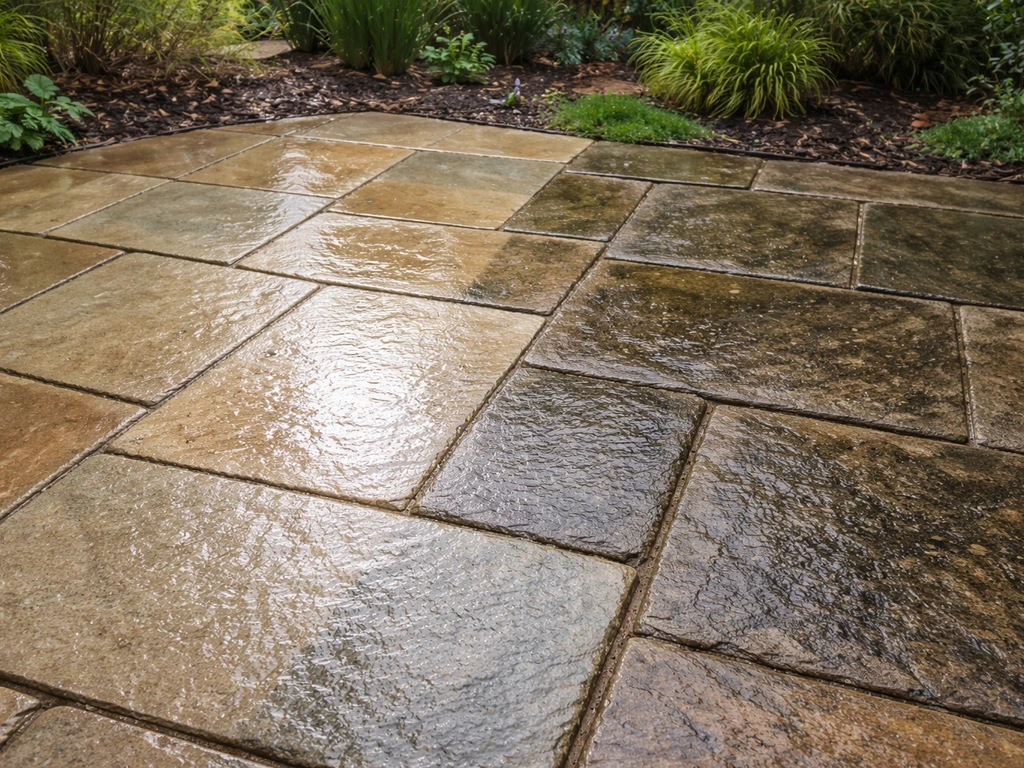
Apply Jeyes Fluid Patio Cleaner directly to a pre-wetted surface, leave it for 15 to 30 minutes, then scrub or jet wash and rinse thoroughly. That's the official process in a nutshell, and it really does work for algae, moss, green slime, and general outdoor grime. But getting consistently good results, without damaging your patio or killing the plants nearby, comes down to a few prep steps and surface-specific details that the label doesn't always spell out clearly. Here's everything you need to know. If you are comparing results across different products, you may also want to look up jennychem patio cleaner reviews to see how others rate performance in real-world use.
Jeyes Fluid Patio Cleaner Instructions: Step by Step Guide

Rhea Lang
26 Jun 2026
What Jeyes Fluid Patio Cleaner is actually for
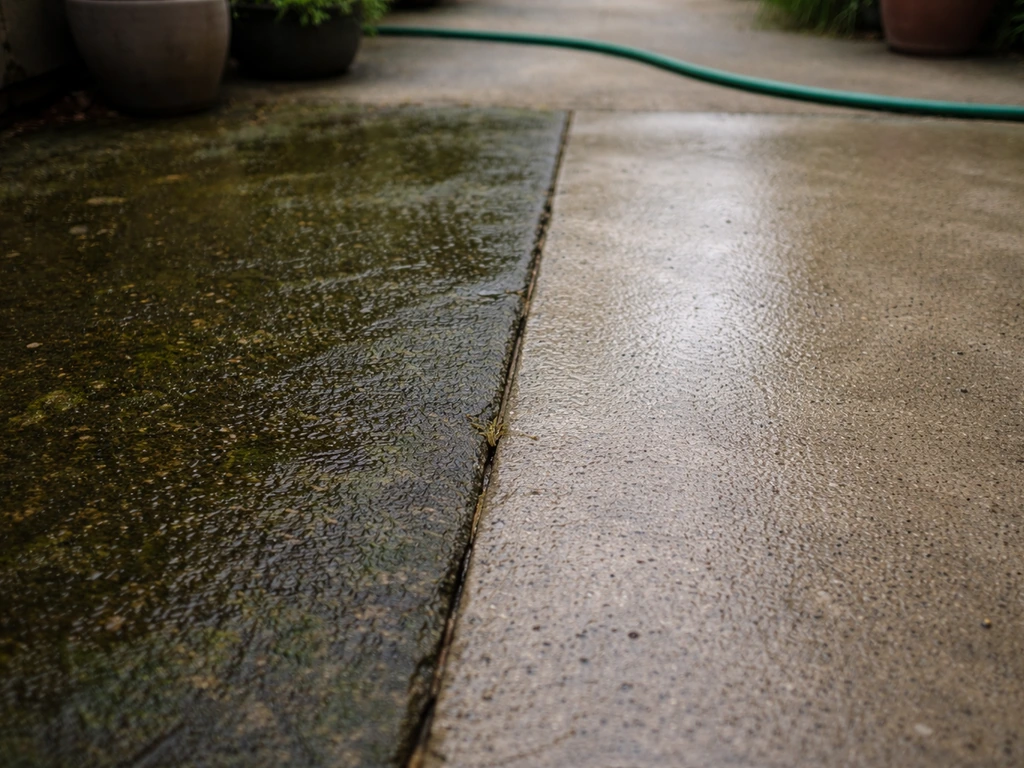
Jeyes Fluid Patio Cleaner (most commonly the 4-in-1 Patio and Decking Cleaner in the 4L bottle) is designed to tackle the bio-growth that makes outdoor surfaces slippery and unsightly: algae, moss, lichen, mildew, and general green grime. It also deals reasonably well with general outdoor dirt, leaf staining, and surface weathering. The 4L bottle is rated to cover up to 180 square metres, which makes it one of the more economical options for a large patio.
It's worth using Jeyes Fluid when you've got established green growth rather than just surface dust. If your patio is looking black-green and slippery after a wet winter, or you've got moss building up in the joints between flags, this is exactly the kind of job it's designed for. It's less suitable as a first-line solution for heavy rust staining, oil, or grease, where a specialist degreaser or acid-based cleaner tends to outperform it.
Safety first: plants, pets, and yourself
Jeyes Fluid is a disinfectant-based cleaner and it's not gentle. It contains sensitising substances that can cause skin irritation or allergic reactions in sensitive people, and mild eye irritation on contact. Wear chemical-resistant gloves, eye protection, and old clothes you don't mind splashing. If it gets on your skin, rinse well with water and remove any contaminated clothing. If it gets in your eyes, rinse immediately under running water for a full 10 minutes and seek medical advice. Don't ingest it, and keep it well out of reach of children.
For pets, Jeyes' official guidance is clear: keep animals away from the treated area while you're applying and until the surface is completely dry. That means not just waiting for the visible liquid to disappear, but actually letting the surface dry out fully before you let dogs or cats back onto it. On a warm day that might be a couple of hours; after a damp or overcast day, it could be longer. Don't rush this one.
Plants are a bigger risk than most people realise. Jeyes Fluid running off a patio into a border or lawn can damage or kill plants and soil organisms. Before you start, water your border plants well (this dilutes any splashback), and use plastic sheeting or old towels to cover any plants immediately adjacent to the patio edge. Protect the soil near the edges too. I learned this the hard way when a lavender plant next to a path I treated turned brown within a week.
One more thing on safety: always work in a ventilated space (outdoors is fine), and don't pour leftover solution or rinse water down drains, onto soil, or into surface water. Dispose of any remaining product according to the label instructions. This is both an environmental precaution and a legal one in the UK.
Prep steps before you apply anything
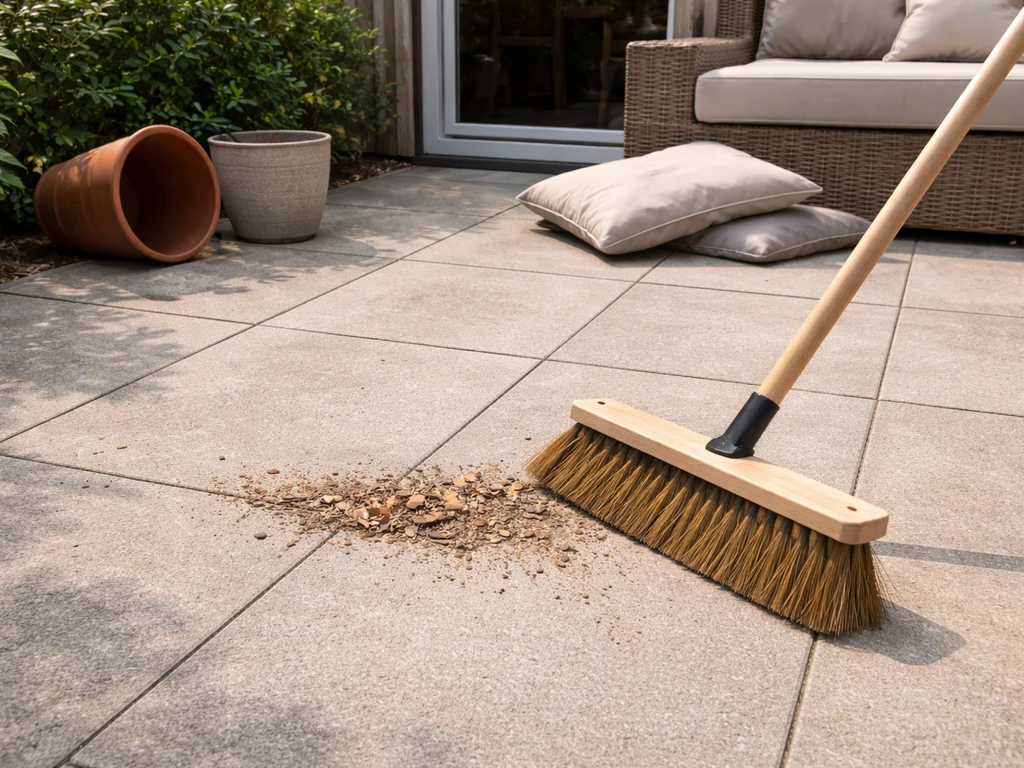
Taking five minutes to prep properly makes a real difference to how well the cleaner works. Here's what to do before the product even comes out:
- Clear the patio completely: move furniture, pots, and any loose items off the surface. You don't want to be working around obstacles, and you don't want the cleaner soaking into wood or getting onto painted or powder-coated furniture.
- Sweep off loose debris: leaves, twigs, and loose moss should be swept or blown off before you apply anything. The cleaner works on what's bonded to the surface, not what's sitting on top of it.
- Pre-wet the surface: this is the step most people skip, and it matters. Wet the patio with a hosepipe or watering can before applying. This stops the cleaner soaking in too fast, helps it spread more evenly, and reduces the risk of streaking on lighter-coloured surfaces.
- Cover or protect plants and borders: use plastic sheeting or old towels over any planting immediately bordering the patio. Water the plants first as an added buffer.
- Check the weather: don't apply before heavy rain is forecast (it'll wash the cleaner away before it has time to work) or in direct, blazing sunshine (it dries too quickly). An overcast, dry day is ideal.
Mixing and application: how much to use and how to apply it
The Jeyes Fluid 4-in-1 Patio Cleaner is a ready-to-use (RTU) formula, meaning you apply it directly without diluting it first. Don't water it down unless the label on your specific bottle explicitly says to do so. Different versions of Jeyes products can vary, so always read your bottle before you start. If your product has dilution instructions, follow those exactly.
For the standard RTU version: apply the cleaner directly and evenly across the pre-wetted surface. You can use a garden watering can for large areas (it gives good, even coverage), a pump sprayer for more controlled application, or simply pour it on and spread it with a stiff brush. Make sure you get good coverage without completely flooding the surface. Work in sections if your patio is large, so you can keep track of dwell times.
Once applied, leave it for 15 to 30 minutes. For light algae or general grime, 15 minutes is usually enough. For heavier moss or stubborn buildup, let it sit closer to the 30-minute mark. Don't leave it to dry out completely before you scrub and rinse. If it starts drying in hot weather, you can mist the surface lightly with water to keep it active.
Scrubbing and rinsing after the dwell time
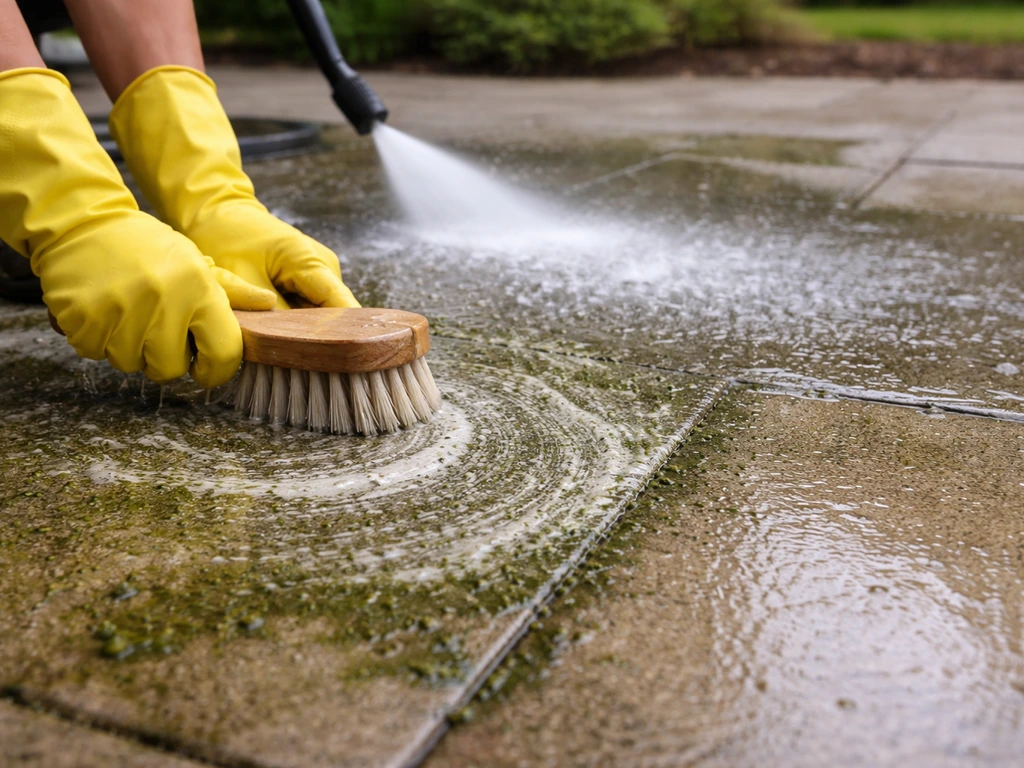
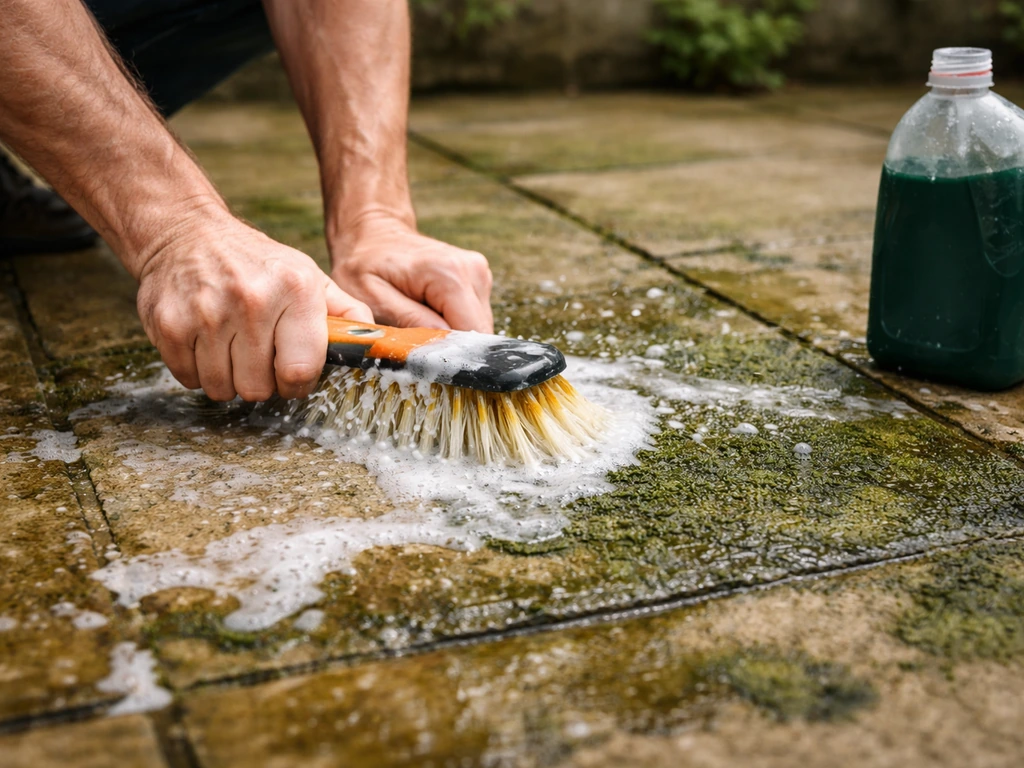
After the 15 to 30 minute contact time, you have two options: scrub by hand or jet wash. For lighter jobs, a stiff-bristled deck brush or yard broom works well. Scrub in circular or back-and-forth motions, paying extra attention to grout lines and any areas where moss or algae has built up. You'll often see the growth lifting and turning brown or orange as you work, which means it's working.
For larger patios or heavier contamination, a pressure washer is faster and more thorough. The Jeyes 4-in-1 is explicitly suitable for jet washing, so there's no issue using one after the dwell time. Use a fan nozzle rather than a pencil jet to avoid cutting into mortar joints, and keep the lance moving at a consistent distance (usually 20 to 30cm) to avoid surface damage.
After scrubbing or jet washing, rinse the entire surface thoroughly with clean water. This step is not optional. You need to flush the cleaner off completely, especially near any plant borders or drains. Rinse the borders too if any overspray or runoff got near them. A thorough rinse also removes any residue that could make the surface feel tacky or cause streaking once it dries.
For heavy contamination, you may need a second application. Let the surface dry after the first treatment, assess what's still there, and repeat the process. Two lighter treatments usually outperform one heavy application that's left too long.
Surface-specific tips: concrete, brick, stone, sandstone, slate, and porcelain
Jeyes Fluid Patio Cleaner is marketed as a general-purpose outdoor surface cleaner, but different patio materials respond differently and have different vulnerabilities. Here's what to watch for on each one. If you're comparing pro kleen patio cleaner reviews, look for results on your specific patio material and how well the cleaner lifts algae and grime without damaging joints outdoor surface cleaner.
| Surface | Works well for | Watch out for | Extra tip |
|---|---|---|---|
| Concrete | Algae, moss, green slime, general grime | Staining on light-coloured concrete if not rinsed quickly | Pre-wet well; rinse thoroughly to avoid residue marks |
| Brick | Green algae, surface mildew, general discolouration | Efflorescence (white salt deposits) can appear after treatment | Don't use on very old or crumbling mortar joints |
| Natural stone (e.g. sandstone) | Light algae and surface grime | Can darken or stain porous stone if left too long; may strip sealant | Test a small hidden area first; rinse faster (around 15 min max) |
| Slate | Green algae and moss | Very porous unsealed slate can absorb the product and mark | Seal after cleaning; keep dwell time short |
| Porcelain | Algae, moss, surface dirt | Porcelain is dense and non-porous, so it handles the cleaner well | Usually the easiest surface to treat; rinse well to avoid residue |
| Timber/decking | The 4-in-1 is formulated for decking too | Don't let it pool on decking or soak in too long; can grey the wood | Apply lightly and rinse promptly; avoid on painted or treated decks without checking first |
The surface I'd be most cautious with is unsealed sandstone. It's soft, porous, and can absorb cleaning products quickly, sometimes resulting in patchy discolouration. Always wet sandstone generously first, keep the dwell time to the shorter end, and rinse quickly. If you're at all unsure, test the cleaner on an inconspicuous corner before going all-in.
What to do if it's not shifting: troubleshooting and next steps
If the staining or growth is still clearly visible after a full treatment, start by repeating the process. A second application after the surface has dried will often shift what the first one loosened. Make sure you're giving it the full 30 minutes on a second pass and scrubbing properly before rinsing.
If biological growth (moss, algae, lichen) is genuinely thick, the Jeyes Fluid alone may not remove all of it physically. If you want to see how other homeowners rate similar patio cleaners, check out zep patio cleaner reviews before you decide what to buy. What the cleaner does is kill the growth; it doesn't always dissolve thick buildups entirely. In that situation, use a stiff scrubbing brush or a pressure washer to physically remove the dead material after the dwell time. The combination of chemical treatment followed by mechanical removal is much more effective than either alone.
For black spot specifically (a stubborn fungal staining common on limestone and some concrete), a standard patio cleaner may only lighten the marks rather than fully remove them. If you're trying to remove black spot, reading black spot patio cleaner reviews can help you choose the right dedicated product for stubborn fungal staining For black spot specifically. Dedicated black spot treatments tend to outperform general-purpose cleaners on that particular problem.
If you're dealing with rust, oil, grease, or paint staining, Jeyes Fluid Patio Cleaner isn't the right tool. Rust needs an oxalic acid-based product; oil and grease need a dedicated degreaser. Using the wrong product just wastes time and money.
Finally, if the growth keeps coming back quickly (within a few months), the underlying issue is usually shade and moisture. Jeyes Fluid doesn't leave a long-lasting preventative barrier. If you're trying to gauge whether the results are consistent, it helps to read Jeyes patio cleaner reviews from homeowners who have used it on similar patio materials. If regrowth is a recurring problem, consider applying a dedicated sealant after cleaning to slow the return of algae and moss, especially on porous surfaces like concrete or natural stone.
A quick note on Jeyes Fluid versions and label differences
Jeyes makes several products under the Jeyes Fluid name, and the instructions can vary between them. The concentrated original Jeyes Fluid (the brown disinfectant liquid in a smaller bottle) is a different product to the 4-in-1 Patio and Decking Cleaner covered here, and it's used at a dilution rather than neat. The guidance in this article is focused on the RTU patio cleaner version, but always check your specific label before you start. If your bottle has a manufacturing date or expiry window, check it: older product can lose effectiveness. The official Jeyes guidance blog was last updated in November 2025, so the core application steps are current, but the label on your bottle is always the authoritative source for your specific product.
FAQ
Can I use Jeyes Fluid patio cleaner without pre-wetting the surface, or will it still work?
Pre-wetting matters because it helps the product spread evenly and reduces the chance of uneven “hot spots” where staining can occur. If you missed pre-wetting, re-wet the area lightly, then re-apply so the full dwell time is spent on a damp surface rather than dry patches.
Is the 15 to 30 minute contact time flexible, or what happens if I leave it longer?
It is flexible, but leaving it too long increases the risk of patchy discolouration on porous surfaces and can make rinsing harder. If it dries fully, misting lightly to keep it active is usually better than extending well past the stated window.
What nozzle setting should I use if I jet wash, and how do I avoid damaging the patio joints?
Use a fan nozzle, keep the lance moving, and avoid holding one spot. If you can see grout lines or mortar edges, increase the distance slightly and reduce pressure if your machine allows, because concentrated jets can erode the joints.
How many times should I repeat the treatment for thick moss or heavy green slime?
For most patios, two lighter applications after assessing the result perform better than one very prolonged treatment. After the first pass, let it dry, then repeat, making sure you scrub or mechanically lift the dead growth before the second rinse.
Do I need to scrub every time, or can I rinse off after the dwell time?
You generally should scrub after the dwell time, because Jeyes Fluid kills growth, but it does not always remove the dead film cleanly on its own. Skipping scrubbing often leaves a slippery residue that looks like algae is still present.
Will Jeyes Fluid remove lichen completely, or just kill it?
It mainly works by killing the lichen or algae, then you remove what is left physically. If lichen colonies are thick and textured, expect to combine treatment with brushing or pressure washing to lift the dead material out of crevices.
Is it safe for use on decking, and should I change the method?
The RTU 4-in-1 is designed for patio and decking use, but softer wood and older finishes can mark more easily. Keep dwell time closer to 15 minutes on decking, apply evenly without pooling, and rinse thoroughly to avoid residue in the grain.
What should I do if the patio turns patchy brown or streaky after cleaning?
Streaking usually means either incomplete rinsing or uneven application, especially on porous stone. Re-rinse with clean water first, then if patches remain, lightly re-scrub and repeat a shorter dwell time rather than extending contact to the maximum.
Can I treat the same day after applying a sealant or after pressure washing?
Wait until the surface is fully clean and dry, and avoid applying right over fresh sealant. If the patio was recently sealed, the cleaner can react unpredictably with the coating, so test a small hidden area and follow the sealant manufacturer’s recoat or cleaning guidance.
How long should I keep pets off the area if the weather is warm but the patio feels slightly damp?
Do not base it on visible wetness only. The surface should be fully dry to the touch, and you should also watch for damp grout lines in edges and corners, because pets may return there even if the centre looks dry.
What about nearby plants, do I need to cover them every time?
If you have borders or plants close to the edge, covering or shielding is strongly recommended because runoff can reach roots. Water plants beforehand to reduce splash damage, then physically protect the immediate patio edge with plastic or old towels to catch any drips.
Can I pour leftover product or rinse water into a drain after finishing?
No, you should not dispose of rinse water or leftover solution into drains, onto soil, or into surface water. Collect and dispose according to the label, and consider using a controlled application approach (sections and careful runoff control) to reduce leftover liquid.
What should I do if I accidentally get Jeyes Fluid on skin or in my eyes?
For skin, rinse thoroughly with plenty of water and remove any contaminated clothing. For eyes, rinse immediately under running water for a full 10 minutes and seek medical advice, do not wait for symptoms to develop.
Does Jeyes Fluid prevent algae from coming back, and how can I slow regrowth?
It is not a long-term preventative barrier. If regrowth happens within a few months, address shade and moisture, then consider applying a compatible sealant after the patio is completely clean and dry, especially on porous surfaces like concrete or natural stone.
Is Jeyes Fluid effective on rust, oil, grease, or paint stains?
Typically no. Rust usually needs an oxalic acid-based product, while oil or grease requires a dedicated degreaser. For paint, use the appropriate paint remover method for the surface type, because using Jeyes Fluid there is likely to waste time without fixing the stain source.
How should I test Jeyes Fluid on sensitive surfaces like unsealed sandstone?
Wet the sandstone generously first, use a shorter contact time, then rinse quickly and observe for patchiness or dull spots. If you see uneven discolouration, stop and switch to a gentler or more suitable stone cleaner, and always test in a less visible corner before treating the whole area.
If regrowth comes back quickly, does it mean the product failed?
Not necessarily. Quick return usually points to ongoing moisture or lack of sunlight, plus dead material that was not fully removed. Re-clean with proper scrubbing after treatment, improve drainage and airflow where possible, and consider sealing for porous patios.
Next Article
Jeyes Patio Cleaner Reviews: Real Results, How to Use It
Jeyes Fluid patio cleaner reviews with real results on algae, moss and stains plus use, dwell time, safety and troublesh