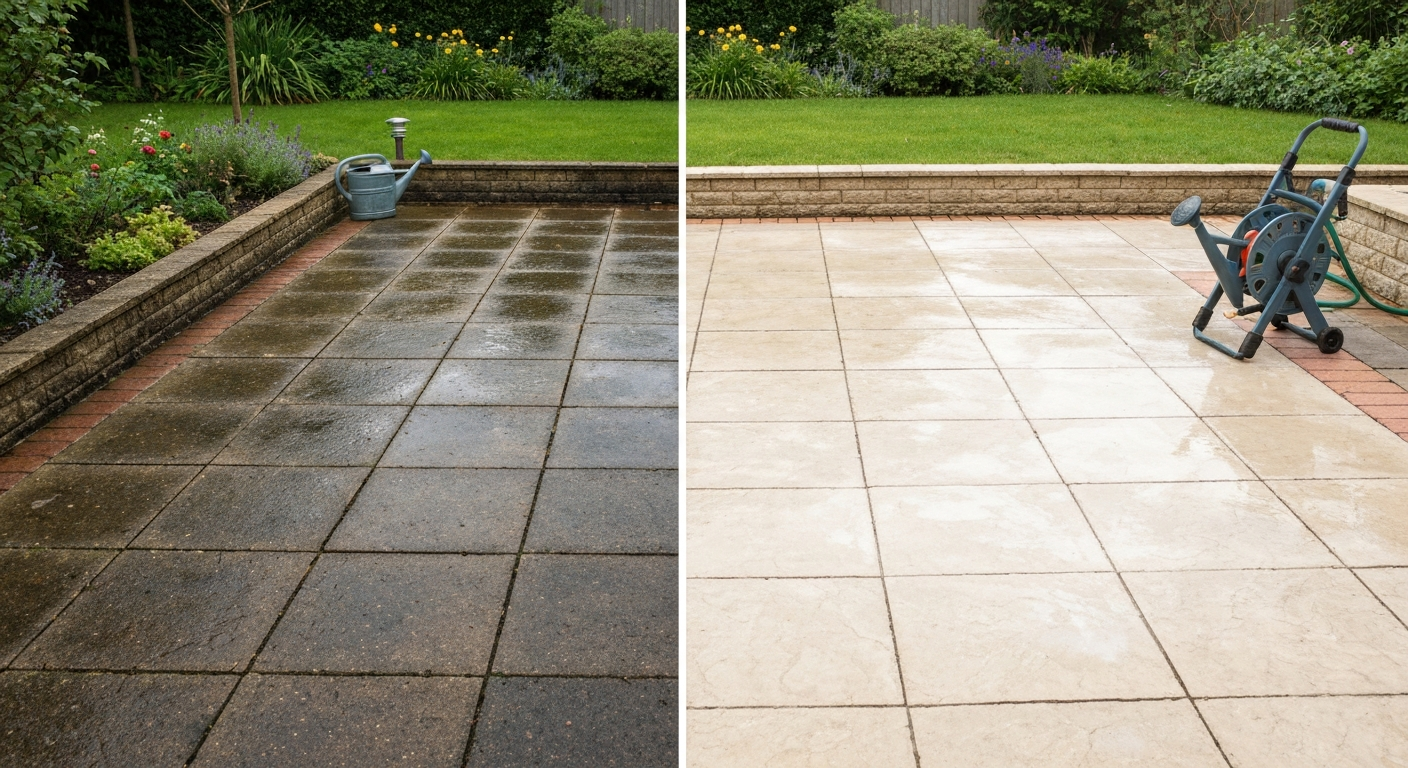
Pro Kleen Simply Spray & Walk Away patio cleaner works on a straightforward principle: dilute 1 part product to 4 parts water, apply with a garden sprayer or watering can, leave it alone for 2 to 3 days, then rinse or brush off the dead growth. That's the core of it. You don't need a pressure washer to apply it, and for most patios dealing with green algae, moss or general biological grime, that process genuinely works. Where it gets more nuanced is surface compatibility, safety handling (the SDS classifies it as a skin corrosive, which the cheerful marketing tends to understate), runoff precautions, and knowing when a different product would serve you better.
Pro Kleen Patio Cleaner Instructions: Step-by-Step Guide

Rhea Lang
6 Aug 2026
What Pro Kleen Patio Cleaner is and when to use it
Pro Kleen Simply Spray & Walk Away is a quaternary ammonium compound (QAC) biocide, not a bleach-based cleaner. Its active ingredients are Alkyl (C12-16) Dimethyl Benzyl Ammonium Chloride and Didecyl Dimethyl Ammonium Chloride, with water making up 80 to 90 percent of the formulation. The manufacturer markets it as biodegradable, bleach-free and pH neutral, and those claims are broadly accurate for the finished diluted solution. What you're getting is a biocide that kills the organisms causing green, black or orange biological growth rather than a heavy-duty chemical stripper.
It's the right tool when your main problems are algae, moss, lichen or general green or black biological growth on paving. A 5 L bottle makes 25 L of working solution at standard dilution and covers up to 200 m², which is genuinely good value for a large patio or driveway. The manufacturer also claims a residual protection barrier that resists re-growth for up to 6 months, and in my experience that broadly holds in sheltered or well-drained areas, though north-facing patios in damp climates will likely need retreating sooner. Where Pro Kleen is less suited is heavy oil or grease contamination and deeply embedded rust, where you'd want an alkaline degreaser or oxalic-acid treatment instead.
Preparing the area before you start
Clear the patio completely before you apply anything. Move furniture, planters, BBQs and children's toys off the surface. Sweep off loose debris, fallen leaves and surface dirt with a stiff brush. This isn't just tidiness: organic debris sitting on top of the chemical will waste your product and slow the kill-off of any growth underneath.
Always do a spot test first, especially on natural stone, sandstone or any surface you haven't treated before. Apply a small amount of the diluted solution to an inconspicuous corner, leave it for the full dwell time, then rinse and check for discolouration, etching or surface change. I learned to do this the hard way on a customer's Indian sandstone that turned slightly patchy after a competitor product was used without testing. Pro Kleen is pH neutral and generally gentle, but spot testing costs you nothing and saves potential regret.
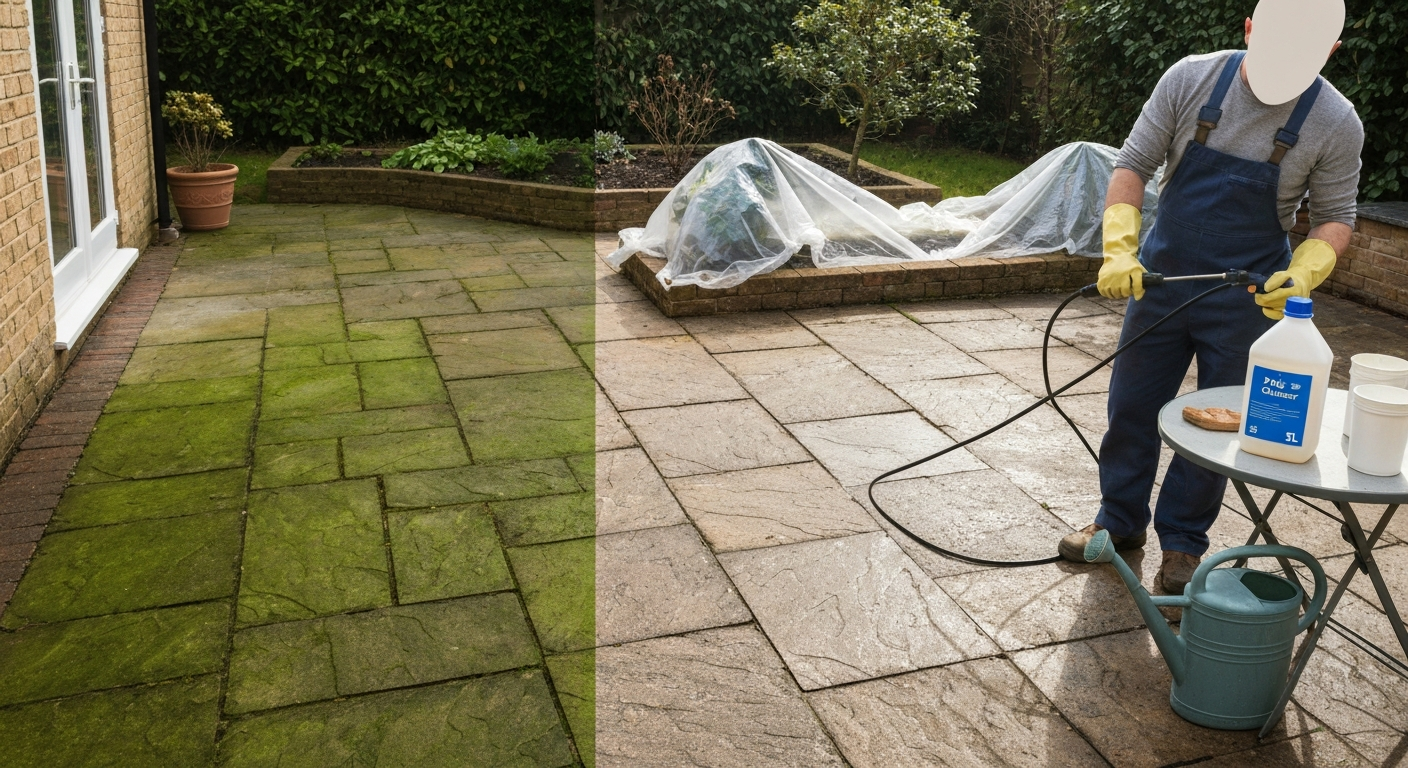
Protecting plants, lawns and garden beds is genuinely important here and not just box-ticking. The product's own Safety Data Sheet classifies it as Aquatic Chronic 2 (toxic to aquatic life with long-lasting effects), and the QAC chemistry is harmful to plants if concentrated runoff reaches root zones. Water down nearby plants and lawn edges thoroughly before you start. Cover beds adjacent to the patio with plastic sheeting if you're working close to them, and try to apply on a dry, low-wind day to minimise spray drift. If you have a garden pond within a few metres, take extra care or consider whether another product is a better fit for your setup.
Surface compatibility: what's safe and what needs a careful test
Pro Kleen is bleach-free and pH neutral, which makes it one of the safer options for a wide range of patio surfaces. That said, 'generally safe' and 'safe without testing' are two different things. Here's how it breaks down by surface type.
| Surface | Compatibility | Notes |
|---|---|---|
| Concrete | Good | Works well at standard 1:4 dilution. Use neat on stubborn black algae patches. |
| Clay or concrete block paving | Good | Safe at standard dilution. Re-sand joints after rinsing if required. |
| Natural stone (general) | Good with spot test | Spot test first. pH neutral formula suits most natural stone. |
| Indian sandstone | Good with spot test | Porous surface absorbs product well — spot test recommended. Rinse thoroughly. |
| Slate | Good with spot test | Generally compatible. Rinse promptly to avoid residue on dark surfaces. |
| Porcelain | Good | Non-porous surface; product sits on top. May need light brushing before rinse. |
| Limestone / calciferous stone | Caution | Avoid acids entirely (Pro Kleen is fine), but test for any surface sensitivity before full application. |
| Brick | Good | Standard dilution suitable. Avoid leaving neat product on mortar joints long-term. |
| Tarmac / asphalt | Caution — spot test | Not a primary use case. Spot test and check manufacturer compatibility guidance. |
| Metal fixtures / furniture | Avoid direct contact | QAC-based cleaners are less corrosive than bleach but rinse metal surfaces promptly if contacted. |
One practical note on porcelain: because it's non-porous, the product doesn't penetrate the surface the way it does with sandstone or concrete. Biological growth on porcelain is often sitting in the texture or grout lines. For porcelain, give the product its full 2 to 3 day dwell time and then use a stiff brush before rinsing rather than just washing off. You'll get a much better result.
Equipment, PPE and safe handling
This section matters more than the marketing copy suggests. The Pro Kleen SDS (Safety Data Sheet, 2018 revision) formally classifies the concentrate as Skin Corr. 1A under H314, meaning it causes severe skin burns and eye damage at full strength. At working dilution the risk is lower, but you should still treat it with proper respect.
PPE you actually need
- Chemical-resistant gloves: PVC or nitrile, not thin latex household gloves. The SDS specifies PVC.
- Eye protection: approved safety goggles or a face shield, not just glasses. Eye splash from a sprayer nozzle is a real risk.
- Protective clothing: a long-sleeved top and trousers as a minimum. An old set of clothes you don't mind getting product on.
- Footwear: closed shoes, ideally rubber-soled boots if you're covering a large area.
Respiratory protection is listed as 'not normally required' in the SDS for normal outdoor use, but I'd avoid spraying directly into a headwind and keep spray drift away from your face. QAC compounds produce fine mist particles that you'd rather not inhale in quantity. Spray downwind where the layout allows.
Mixing, storage and first aid
Mix the diluted solution in your garden sprayer or watering can immediately before use. Don't pre-mix large batches and store them. Store the concentrate in its original container, tightly sealed, out of direct sunlight, and out of reach of children and pets. If product contacts your eyes, rinse them continuously with water for at least 15 minutes and seek medical attention. For skin contact, rinse thoroughly with water. If swallowed, do not induce vomiting and contact a poison control centre or doctor immediately.
Pressure washer guidance
The manufacturer explicitly advises against using a pressure washer to apply the product. Use a garden sprayer or watering can for application. A pressure washer can be used for the final rinse stage after the dwell period if you prefer, but it isn't necessary. For an alternative product and its step-by-step application guidance, see Jeyes Fluid patio cleaner instructions. If you do use a pressure washer to rinse, follow surface-appropriate pressure limits: Indian sandstone and block paving at 1,200 to 2,000 PSI, concrete at 2,000 to 3,000 PSI. See Marshalls, Cleaning & maintenance guidelines for garden paving and driveways (manufacturer guidance PDF) for the manufacturer's recommended pressure ranges, nozzle choices and surface-specific advice blank" rel="noopener noreferrer">Marshalls — Cleaning & maintenance guidelines for garden paving and driveways (manufacturer guidance PDF). Always start at the lower end of the range and test an out-of-the-way section first. Use wide fan nozzles: a 40-degree white nozzle for sensitive or natural stone surfaces, a 25-degree green nozzle for general concrete or block paving. Kärcher product pages / accessories (pressure-washer nozzle guidance) note that consumer machines commonly include 25° (green) and 40° (white) nozzles, advise using wider fan/nozzles for delicate surfaces, recommend surface-cleaner attachments for even cleaning, and stress following PSI limits and maintaining a safe distance. Surface-cleaner attachments give a more even result and reduce the risk of streaking or surface damage.
Step-by-step application instructions
- Clear the area: remove furniture, sweep away loose debris, and water down adjacent plants and lawn edges thoroughly.
- Protect what needs protecting: cover nearby garden beds or ponds with sheeting if they're close to the patio edge.
- Mix your solution: for normal use, dilute 1 part Pro Kleen to 4 parts water in a garden sprayer or watering can. For stubborn or heavily affected areas, use the product neat (undiluted) directly to those spots.
- Put on PPE: PVC or nitrile gloves, safety goggles and protective clothing before you start spraying.
- Apply the solution: spray or pour evenly across the patio surface using your garden sprayer or watering can. Work methodically in sections to ensure even coverage. Do not over-saturate to the point of significant runoff pooling at the edges.
- Keep people and pets off: the treated surface must be avoided until fully dry. The manufacturer specifies this is when it's safe; wet product on paws or bare feet is the risk period.
- Wait 2 to 3 days: this is the dwell time that matters. Green or black biological growth will turn orange or brown as the biocide kills it. Do not rinse before this change has occurred or you'll reduce the effectiveness.
- Brush and rinse: once the growth has died off and changed colour, brush the surface with a stiff broom to loosen dead material, then rinse thoroughly with a hose or pressure washer. Direct rinse water away from garden beds, ponds and drains where possible.
- Check and reapply if needed: particularly stubborn patches (heavy lichen, thick moss, deeply embedded black spot) may benefit from a second application. Apply neat to those specific areas and repeat the dwell and rinse process.
Quick reference: dilution ratios and contact times
| Use case | Dilution ratio | Application method | Dwell time | Rinse required |
|---|---|---|---|---|
| Standard biological growth (algae, moss, green slime) | 1:4 (1 part product, 4 parts water) | Garden sprayer or watering can | 2–3 days | Yes — hose or pressure washer after dwell |
| Stubborn/heavy growth (thick moss, black algae) | Neat (undiluted) | Spot-apply with sprayer or watering can | 2–3 days minimum | Yes — brush then rinse |
| Preventive re-treatment / maintenance | 1:4 | Garden sprayer | 2–3 days | Yes — light rinse |
| Large area coverage (up to 200 m²) | 1:4 from 5 L bottle = 25 L working solution | Garden sprayer | 2–3 days | Yes |
Troubleshooting common patio problems
Moss and algae
These are Pro Kleen's strongest suit. Apply at 1:4, wait the full 2 to 3 days and you'll see the kill-off happen. If growth is very thick (raised, spongy moss layers), physically remove the bulk of the growth with a stiff brush before applying, so the product can actually reach the surface beneath. Leaving the dead layer on too long before rinsing can allow new spores to establish on the dead organic matter, so rinse promptly once the colour change is complete.
Black spot
Black spot on paving is typically a dark algae or lichen that embeds into the surface, particularly on natural stone. It's more persistent than surface algae. Apply Pro Kleen neat to black-spotted areas, give it a 3-day dwell, scrub with a stiff brush and rinse. You may need two rounds. For particularly stubborn black spot, a dedicated black spot cleaner designed for this specific problem may be worth considering alongside or instead of Pro Kleen. For particularly stubborn black spot, a dedicated black spot cleaner designed for this specific problem may be worth considering alongside or instead of Pro Kleen. See our black spot patio cleaner reviews for targeted product recommendations.
Rust stains
Pro Kleen won't shift rust staining. Rust needs an oxalic-acid or specialist rust-remover treatment. These are completely separate chemistry to a QAC biocide. Treat rust stains first with an appropriate rust remover, rinse thoroughly, and then use Pro Kleen for the biological growth on the rest of the surface.
Grease and oil
QAC-based cleaners are not the right tool for oil and grease. For those stains you need an alkaline degreaser, which is how products like Zep Driveway and Concrete Cleaner position themselves. For comparisons and user experiences with Zep products, see zep patio cleaner reviews. Apply your degreaser to oil spots first, then treat the patio biologically with Pro Kleen as a separate step.
Pet stains
The product is marketed as pet-friendly when dry, but 'pet-friendly when dry' and 'good at removing pet urine odour' are different things. Pro Kleen will kill the bacteria and organic material contributing to the smell, and for mild pet-staining on outdoor paving it's generally effective. Apply at 1:4, allow to dwell, then rinse. For persistent odour soaked into porous stone or concrete, you may need an enzymatic cleaner specifically designed for pet stain odour removal.
Recurring growth
If growth keeps coming back every few months, the likely causes are shade, poor drainage or both. The product claims 6 months of residual protection, and in sunny, draining conditions that's credible. In damp, shaded spots it may be closer to 3 to 4 months. Plan a retreatment schedule rather than waiting for visible growth to return, and consider whether trimming back overhanging trees or improving drainage would address the underlying conditions.
Stubborn marks that won't lift
If you've done two full applications and a section still won't come clean, step back and identify what the mark actually is. Biological growth responds to Pro Kleen. Mineral deposits, efflorescence, rust, oil staining and dye or paint marks each need different chemistry. Diagnosing the stain type before reaching for more biocide will save you time and money.
Environmental considerations, runoff and disposal
This is an area where the 'biodegradable and eco-friendly' marketing deserves some scrutiny. The active QAC ingredients in Pro Kleen are classified as Aquatic Chronic 2 under the SDS (H411: toxic to aquatic life with long-lasting effects). Lab testing on the components lists fish LC50 values that confirm genuine aquatic toxicity. This doesn't mean you can't use the product responsibly, but it does mean you need to manage where the rinse water goes.
- Do not let concentrated product or rinse water flow directly into drains, streams, ditches or garden ponds.
- Water down adjacent lawn and plant areas before application, and again after rinsing to dilute any product that reaches the soil boundary.
- Apply on a dry day when no rain is forecast for at least 24 hours, to reduce the chance of unintended runoff before the product has been absorbed by the biological growth.
- For disposal of unused concentrate or empty containers, follow your local authority's chemical waste disposal guidance. Do not pour down the drain or into garden waste bins.
- If you have a pond or water feature within the splash zone of your patio, cover it during application and the dwell period and rinse the area directed away from it.
- The product is not listed as a controlled substance, but QAC compounds have documented environmental persistence and aquatic toxicity, so treat them accordingly.
The 'biodegradable' claim refers to the broader formulation breaking down over time, not immediate environmental harmlessness. Responsible use is straightforward: dilute properly, don't over-apply, control where rinse water flows, and don't dispose of concentrate down household drains.
How Pro Kleen compares to other popular patio cleaners
Pro Kleen isn't the only patio cleaner worth considering, and knowing where it sits relative to the alternatives helps you decide whether it's the right one for your specific situation. For a direct comparison and performance notes on a different formulation, see our Spear and Jackson patio cleaner review for compatibility and results. For independent perspectives on performance, safety and value, see pro kleen patio cleaner reviews. Jeyes Fluid, Zep, Jennychem and Spear & Jackson all take different approaches and suit different problems.
| Product | Chemistry type | Best for | Key advantage | Key limitation | When to choose instead of Pro Kleen |
|---|---|---|---|---|---|
| Pro Kleen Simply Spray & Walk Away | QAC biocide, bleach-free, pH neutral | Algae, moss, general biological growth | No-scrub 'spray and walk away' application; large coverage area per litre | Not suited to oil/grease, rust, or non-biological stains | It's your default choice for biological growth on most patio types |
| Jeyes Fluid | Phenolic disinfectant concentrate | General outdoor disinfection, algae, mould | Long-established product; widely available; versatile outdoor disinfectant | Strong smell; requires more precise dilution (typically 1:19 to 1:20); 30-min contact/scrub approach differs to walk-away method | When you want a traditional outdoor disinfectant or already have it on hand |
| Zep Driveway & Concrete Cleaner | Alkaline concentrate (sodium hydroxide-type) | Oil, grease, tyre marks, heavy concrete staining | Superior on hydrocarbon/grease stains; designed for pressure-washer application | Highly alkaline — unsuitable for natural stone, sandstone or brick without careful dilution; harsher handling requirements | When oil, grease or tyre marks are the primary problem on concrete or tarmac |
| Jennychem Patio Cleaner | Surfactant-based biocide concentrate | General paving, algae, moss | Often sold in larger commercial quantities; competitive price per litre at volume | Less well-known consumer brand; fewer independent reviews than Pro Kleen | When buying in bulk for large areas or commercial use |
| Spear & Jackson Patio Cleaner | Typically surfactant/biocide blend | Light to moderate biological growth | Garden-centre availability; recognisable brand name | Generally positioned as a lighter-duty option than Pro Kleen concentrate | When you need a readily available option from a garden centre for a smaller patio |
The honest summary: Pro Kleen's walk-away format and strong coverage ratio make it one of the most practical choices for the typical UK homeowner dealing with green or black biological growth across a medium to large patio. For another walk-away option and comparative user feedback, see jeyes patio cleaner reviews. If Jeyes Fluid is what you're more familiar with, the instructions and approach differ enough that it's worth reading specific guidance for that product separately. For heavy oil or grease contamination, reach for Zep or a similar alkaline degreaser rather than persisting with a biocide.
Aftercare and keeping the patio clean longer
Once the patio is clean, sealing is the single most effective step for extending the time before growth returns. A penetrating sealer on natural stone or a surface sealer on concrete or block paving reduces the moisture and organic material that algae and moss need to establish. However, timing matters: stone suppliers commonly advise waiting 30 to 90 days after a deep clean before applying a penetrating sealer, allowing moisture and any residual salts to stabilise. Sealing too soon can trap moisture and cause surface issues. Check your specific sealer's product guidance and your stone or paving manufacturer's recommendations.
For maintenance without a full clean, a light top-up application of Pro Kleen at standard dilution every 4 to 6 months is a good preventive habit, particularly heading into autumn or early spring when biological growth conditions are most active. Keep joints brushed clear, don't let leaf litter accumulate on the surface for extended periods, and ensure drainage channels around the patio are clear. A little routine maintenance between full treatments is always easier than dealing with a heavily fouled surface.
FAQ
What is the correct dilution and contact time for Pro‑Kleen Simply Spray & Walk Away Patio Cleaner?
Manufacturer guidance: normal use — dilute 1 part product to 4 parts water (1:4). For stubborn, heavy growth or localized stains you may apply neat (undiluted) to the spot. After application, leave the solution to work: green growth normally discolours (turns brown/orange) over 48–72 hours; then rinse or brush to remove dead material. Keep people, pets and plants away until the surface is dry.
How should homeowners apply Pro‑Kleen (equipment and method)?
Recommended applicators: garden sprayer or watering can for even coverage. Do not use a pressure washer to spray the chemical (Pro‑Kleen explicitly advises against using a pressure washer to apply the product). If using a pressure washer, use it only for rinsing afterwards at low pressure or a soft‑wash setting and test an inconspicuous area first.
What personal protective equipment (PPE) and handling precautions are required?
Follow the Safety Data Sheet: wear chemical‑resistant gloves (e.g., PVC), approved safety goggles or face protection and suitable protective clothing. Avoid inhaling spray/mist — use in well‑ventilated outdoor conditions and avoid windy days. If product contacts eyes or skin, rinse promptly and seek medical attention for serious exposure. Keep children and pets away until the surface is dry.
What are the main hazards and environmental precautions?
Pro‑Kleen contains quaternary ammonium compounds (benzalkonium‑type ‘quats’) and is classified on the SDS as causing severe skin/eye damage and toxic to aquatic life with long‑lasting effects. Avoid release to drains, soil and waterways. Contain and collect any spillage and dispose of waste and containers according to local hazardous‑waste rules. Don’t apply where runoff can enter ponds or storm drains; if unavoidable, protect drains/collect runoff for disposal.
Which surfaces is Pro‑Kleen safe to use on (compatibility guidance)?
Generally compatible with hard garden surfaces including concrete, concrete block paving, brick, Indian sandstone, slate and porcelain when used per label instructions and rinsed as required. Always test a small, hidden area first because natural stone and some finishes (polished porcelain, soft sandstones) can react differently. Avoid use on delicate, polished or acid‑sensitive finishes without testing. Do not assume compatibility with metal fixtures or painted surfaces — protect them or rinse promptly.
How do you prepare a patio before applying Pro‑Kleen?
Clear the area of furniture and loose debris; sweep or blow away leaves, moss and dirt. Protect nearby plants, ponds and drains with polythene or covers to prevent runoff contact. Wet fragile plants with water before treatment to reduce uptake, or move potted plants away. Mark any sections that will be tested before large‑scale application.
Next Article
Black Spot Patio Cleaner Reviews: Top Picks & Buying Guide
Black spot patio cleaner reviews: tested picks, surface-specific tips, dilution rates, DIY fixes, safety & buying checks