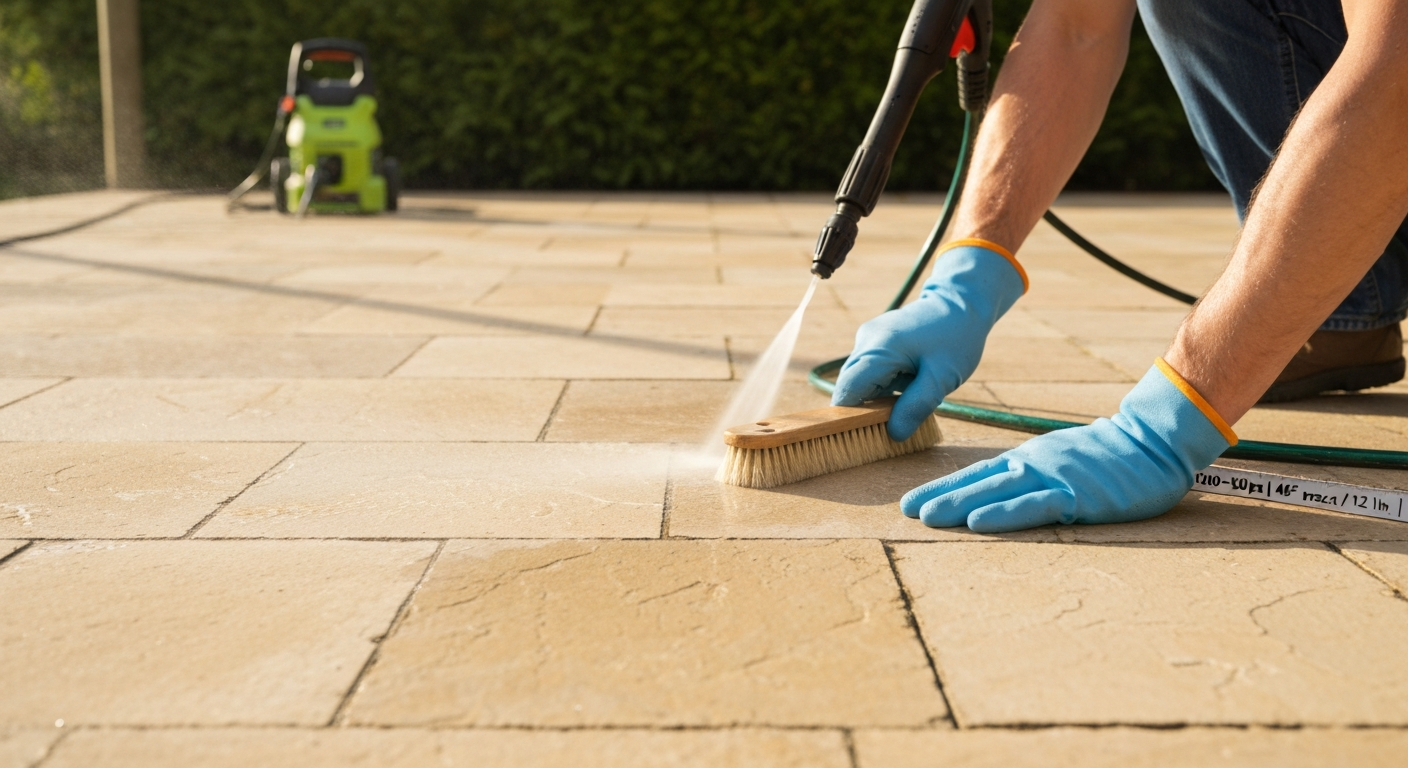
The best patio cleaner for Indian sandstone is a pH-neutral stone-specific cleaner, such as STONETECH Stone & Tile Cleaner, used alongside a soft nylon brush and a thorough rinse. For product comparisons and buying advice, see our guide to the best sandstone patio cleaner. For organic growth like moss, algae and mould, a sodium percarbonate (oxygen bleach) solution steps things up without the iron-staining risk that chlorine bleach carries on sandstone. Avoid anything with sodium hypochlorite, strong acids below pH 5.5, or high-alkaline caustics above pH 11, all of them can cause damage that is genuinely difficult or impossible to reverse on this stone.
Best Patio Cleaner for Indian Sandstone: Cleaning & Care Guide

Rhea Lang
20 Jul 2026
Why Indian Sandstone Needs Special Care
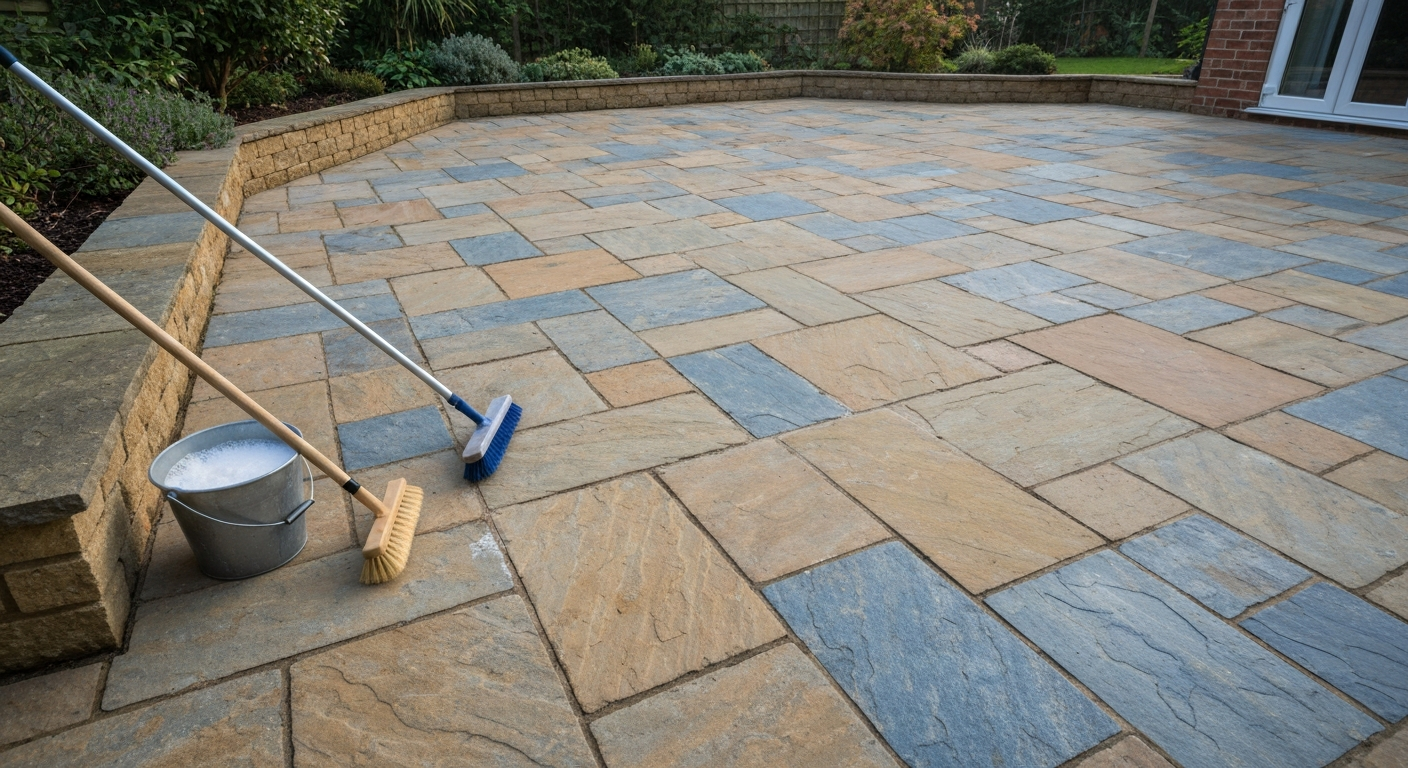
Indian sandstone is one of the most popular paving choices in UK gardens, and for good reason: it looks beautiful, it ages gracefully, and it comes in a wide range of colours from buff to riven blue-grey. But those same qualities that make it attractive also make it genuinely demanding to clean. Unlike porcelain or concrete, Indian sandstone is a natural sedimentary rock with real porosity, iron-bearing minerals in many colour variants, and a surface texture that traps organic debris. Pick the wrong cleaner and you can permanently stain it orange, etch the surface, or draw salts up from the bedding mortar. I have seen all three happen, and none of them are cheap to fix.
The other complication is that Indian sandstone sold in the UK comes from dozens of quarries across Rajasthan and other Indian states, meaning the mineralogy, porosity and iron content vary noticeably from slab to slab. A cleaner that works perfectly on your neighbour's buff sandstone might discolour your kandla grey. That variability is precisely why every credible authority on natural stone, from the Natural Stone Institute to the National Park Service conservation guides, emphasises testing a small hidden patch before committing to a full clean. It is advice worth taking seriously.
Indian Sandstone 101: Porosity, Sensitivity and Common Stain Types
Sandstone is a silica-rich sedimentary rock made up primarily of quartz grains bonded by a natural cement (usually silica, calcite, or iron oxide). Quartz itself sits at around 6–7 on the Mohs hardness scale, but the overall hardness of a slab depends heavily on how tightly the grains are cemented together, which varies by quarry and batch. Indian sandstones from some sources are softer and more friable than the numbers suggest, so mechanical abrasion and high-pressure washing can be more damaging than the hardness figure implies.
Porosity is the bigger practical concern. Indian sandstone typically shows significant capillary porosity, meaning water and cleaning solutions absorb readily into the stone. This is why cleaning agents can penetrate deep rather than sitting on the surface, which is both useful (it allows cleaners to reach embedded soils) and risky (aggressive chemicals travel deeper into the stone and are harder to neutralise or rinse out). The iron-oxide cements present in many colour variants, particularly the warm buff, Indian autumn, and raj green tones, are sensitive to oxidising chlorine compounds. Sodium hypochlorite reacts with those iron minerals and produces irreversible yellow-orange staining. UK paving suppliers have been warning about this for years, and it is one of the most common costly mistakes I see homeowners make.
Common stains you will encounter on an Indian sandstone patio fall into a few broad categories:
- Organic growth: moss, algae (green or black), lichen and mould. These are the most frequent problem in UK gardens, accelerated by shaded areas and damp climates.
- Grease and oil: from barbecues, garden furniture, or cooking. These penetrate quickly into porous sandstone and require either a mild alkaline cleaner or a poultice for deep extraction.
- Rust: iron-rich staining from metal furniture legs, water run-off from steel fixings, or from the stone's own iron minerals mobilised by moisture.
- Efflorescence: white salt deposits drawn to the surface through the stone from bedding mortar or the stone itself, particularly on newer patios.
- Organic tannins and leaf stains: especially under trees in autumn, these can produce brown-black tannin marks.
- Pet stains and general soiling from tracked-in mud and organic matter.
What to Look for in a Patio Cleaner for Indian Sandstone
pH is the single most important variable. For routine cleaning and maintenance, stick to pH-neutral cleaners in the 5.5–8.5 range. Mild alkaline cleaners in the 8.5–11 range are more effective on oils and greases but need to be tested before widespread use on your particular stone. Strong acids below pH 5.5 can dissolve the calcite cement found in some Indian sandstones and will attack jointing mortar; strong caustics above pH 11 risk etching and salt mobilisation. The STONETECH Stone & Tile Cleaner sits squarely in the neutral zone and uses non-ionic surfactants with a small amount of EDTA chelating agent, that combination shifts soils off the surface without attacking the stone chemistry. For product comparisons and buying options, see the best patio slab cleaner.
Beyond pH, check the active ingredients. Non-ionic surfactants are your friends for routine cleaning. Sodium percarbonate (oxygen bleach) is effective for organic growth and breaks down to water, oxygen and a small amount of soda ash, far less risky on iron-bearing stone than sodium hypochlorite. For product comparisons and hands-on tests, see our patio stone cleaner review for recommended brands and application tips. Enzyme-based cleaners work well for pet stains and organic matter over time but are slow-acting. What you absolutely want to avoid is sodium hypochlorite listed as an active ingredient in any cleaner you plan to use on Indian sandstone.
Biodegradability matters more on a patio than on an indoor floor because whatever you apply will eventually run into your garden soil, drains, or nearby planting. Look for products with biodegradable surfactants and check the SDS (Safety Data Sheet) for environmental hazard classifications. Manufacturer guidance is worth reading carefully: a product labelled 'suitable for natural stone' is not automatically safe for Indian sandstone specifically. Check whether the manufacturer explicitly lists sandstone or siliceous stone as a tested surface, and look for any warnings about iron-bearing stone.
Cleaner Types Explained: Which Chemistry Does What
Stone-Specific Neutral Cleaners
These are formulated specifically for natural stone and sit in the pH 5.5–8.5 range. Products like STONETECH Stone & Tile Cleaner use surfactant blends to lift surface soils without attacking stone chemistry. They are the right starting point for routine maintenance cleaning, sweeping off loose debris, then mopping or scrubbing with a diluted stone cleaner. STONETECH recommends 2 oz per gallon for light maintenance and up to 4 oz per gallon for heavier soiling. They will not shift established moss or deep grease unaided, but they are the safest choice for a first clean on a new patio.
Alkaline Cleaners
Mild alkaline cleaners (pH 8.5–11) are effective on oil, grease, and general grime because alkalinity saponifies fats and shifts protein-based soils. Many patio-specific degreasers fall into this category. They are suitable for use on Indian sandstone if you test first, keep dwell times short (5–10 minutes maximum), and rinse thoroughly. I always neutralise with a clean water rinse twice after using any alkaline product on sandstone. Avoid anything at the extreme end of this range, above pH 11 and you are getting into caustic territory that I would not put on natural stone.
Acid Cleaners
Mild acid cleaners are sometimes marketed for efflorescence and hard water deposits on paving. On Indian sandstone, even mild acids need careful patch testing because some Indian sandstone has calcite cement that will dissolve under acid attack. Muriatic (hydrochloric) acid and strong phosphoric acid formulations should not be used on Indian sandstone as a rule. If you need to address efflorescence, a professional stone conservator or a targeted weak-acid efflorescence treatment at the lower end of the mild range (pH 3–5) can be used after a successful patch test, but it is a specialist operation rather than a standard DIY task.
Oxygen Bleach (Sodium Percarbonate)
This is my go-to for moss, algae, mould and general organic blackening on Indian sandstone. Sodium percarbonate dissolves in water to release hydrogen peroxide and oxygen, which oxidise and break down organic matter without generating chlorine compounds. Products like OxiClean are based on this chemistry (sodium percarbonate plus sodium carbonate). Mix to a solution, apply to damp stone, allow 15–30 minutes dwell time, then scrub and rinse. It is effective, the breakdown products are relatively benign, and it does not carry the iron-staining risk of chlorine bleach. Still patch test, the peroxide action can lighten some iron-oxide pigments in sensitive stone if left too long.
Enzyme-Based Cleaners
Enzyme cleaners use biological catalysts to break down organic material, proteins, fats, urea (useful for pet urine). They are genuinely excellent for pet stains on porous stone because the enzymes get into the pores and digest the odour source rather than just masking it. The trade-off is time: enzymes work slowly and may need multiple applications or an overnight dwell period. They are gentle on stone chemistry and are a sensible choice where chemical aggression is a concern and you can afford a slower result.
Natural and DIY Options
White vinegar is often suggested as a natural patio cleaner. On Indian sandstone, I advise against it: vinegar is dilute acetic acid (typically pH 2–3) and will attack calcite-cemented sandstone and any mortar joints. Bicarbonate of soda (baking soda) mixed with water is mild enough for surface cleaning but lacks the active power to shift established growth or grease. Hot water and a stiff nylon brush is a genuinely underrated option for light soiling and regular maintenance, simple, zero chemical risk, and quite effective on fresh organic matter before it embeds. For deeper organic staining, a dilute oxygen bleach solution is a more effective natural-leaning choice than vinegar.
Chemical Cleaners vs. Pressure Washing vs. Natural Methods: When to Use Each
The guiding principle from every credible conservation authority is to start with the gentlest method and escalate only when it proves insufficient. I follow the same logic on domestic patios. Work through this checklist to decide your approach:
- Is the patio newly laid (less than 12 months old)? Start with pH-neutral stone cleaner and hand brushing only. New mortar joints are still curing and vulnerable to chemical or pressure attack.
- Is the soiling light surface dirt and grime with no visible growth? pH-neutral cleaner, warm water and a nylon brush will usually be sufficient.
- Is there significant moss, algae or mould? Move to an oxygen bleach (sodium percarbonate) solution, dwell time, and scrubbing before considering a pressure washer.
- Is there embedded grease or oil from a BBQ? Apply a mild alkaline degreaser or a poultice (cellulose or fuller's earth) to draw out the oil before rinsing.
- Is there rust staining? This needs a targeted oxalic acid-based treatment or a reductive poultice (sodium dithionite gel). This is specialist work — patch test rigorously or consult a stone conservator.
- Has chemical cleaning failed to shift the growth or staining after two applications? Pressure washing with a wide fan nozzle at conservative settings (see section below) is the appropriate next step.
- Is the patio a listed building or part of historic fabric? Use only heritage-approved methods (DOFF low-pressure steam or equivalent) and consult English Heritage guidance.
One situation where I reach for chemical cleaners before a pressure washer is black spot algae and lichen. Physical pressure alone tends to dislodge the visible growth but leaves the root-like holdfast embedded in the stone, where it regrows faster than before. Treating with oxygen bleach first, letting it penetrate the organism, then rinsing (with a pressure washer or a hose) gives a more durable result.
Pressure Washing Indian Sandstone: PSI, Nozzles, Distance and Technique
Pressure washing is effective on Indian sandstone, but the margins for error are narrower than on concrete or porcelain. The stone surface can be eroded by excessive pressure, and the force can dislodge jointing material if it is already soft or degraded. Used correctly, a pressure washer removes organic growth, general soiling and residual cleaner far more effectively than a hose alone. For very sensitive or historic stone where low‑pressure thermal cleaning is preferred, See Brilliance / DOFF system information (industry vendor) describes the DOFF steam/low‑pressure hot‑water method used in conservation, delivering high temperature with low surface pressure and cited by heritage bodies as lower‑risk than conventional high‑pressure jetting.
For most Indian sandstone patios in good condition, a machine delivering 1,000–1,500 psi at the nozzle is the practical working range. For particularly soft or friable stone, or for any stone you are unsure about, start at the lower end around 800–1,000 psi. GSA historic-preservation guidance recommends no more than 100 psi for sensitive interior stone; for exterior residential paving, a more conservative exterior threshold is around 1,200–1,500 psi using a wide fan, but always test a hidden corner first. Avoid turbo or rotary nozzles entirely on Indian sandstone, they concentrate the jet and will erode the surface.
| Setting | Recommendation for Indian Sandstone | Notes |
|---|---|---|
| PSI (working range) | 800–1,500 psi | Start at 800–1,000 for soft/uncertain stone; max 1,500 for robust slabs after test patch |
| Nozzle type | 25-degree (white) or 40-degree (black) fan tip | Never use 0-degree (red) or turbo/rotary nozzles |
| Stand-off distance | 30–45 cm (12–18 in) | Increase distance if surface shows any marring; never closer than 20 cm |
| Nozzle angle | Approx. 45 degrees to the surface | Reduces direct impact force; helps lift debris rather than driving it in |
| Sweep speed | Steady, consistent passes at walking pace | Avoid dwelling in one spot; keep passes overlapping by 50% |
| Water temperature | Cold or warm (not steam) | Steam/DOFF systems are specialist; standard consumer machines use cold water |
| Jointing mortar | Keep nozzle away from grout lines | Pressure can dislodge brush-in grout if undercured or degraded |
The technique that protects the stone most is consistent overlapping passes at a steady walking pace, holding the lance at roughly 45 degrees to the surface rather than perpendicular. Perpendicular direct-impact washing concentrates force on individual grains and can erode surface texture over time. Angled passes lift rather than hammer. After pressure washing, always do a final rinse with clean water to ensure no chemical residue is left on the surface.
One more thing worth mentioning here: if your jointing material is a brush-in patio grout rather than traditional mortar, check the manufacturer's pressure limits before you start. Some polymeric jointing compounds are more sensitive to pressure washing than conventional mortar.
Tools and Equipment: Brushes, Scrapers, Grout Tools and PPE
The right brush makes a significant difference on Indian sandstone. Conservation guidelines and the GSA both specify non-metallic bristles for chemical cleaning of natural stone, soft or medium nylon, or natural fibre bristles. Wire brushes are off the list entirely: they scratch and gouge the surface, leave metal deposits that can rust, and create micro-damage that accelerates future biological growth by giving organisms more surface area to colonise. I learned this the hard way on a client's riven sandstone patio years ago. Even a few passes with a wire brush left visible scratching in the softer parts of the stone.
For most scrubbing tasks on Indian sandstone, a long-handled deck brush or patio brush with medium nylon bristles (bristle diameter around 0.3–0.5 mm, set in a stiff block) gives good mechanical action without surface damage. For tight grout lines and detailed areas, a hand-held tile grout brush or a stiff nylon grout brush works well. Plastic or wood-handled scrapers are useful for lifting thick moss mats before chemical treatment, avoid metal-bladed scrapers on the stone face, though a plastic scraper or a wooden spatula works fine.
| Tool | Recommended Spec | Use on Indian Sandstone |
|---|---|---|
| Long-handled patio brush | Medium nylon bristles, 0.3–0.5 mm diameter, 30–40 cm wide head | General scrubbing after chemical application; pre-rinse agitation |
| Grout / jointing brush | Stiff nylon, narrow profile, angled head | Cleaning grout lines; applying and working in brush-in grout products |
| Hand scrubbing brush | Natural or synthetic bristle, palm-grip block | Detail areas, edges, steps; working in poultice materials |
| Plastic scraper | Rigid HDPE or polypropylene blade, wide format | Lifting thick moss and lichen mats before cleaning |
| Pressure washer lance | Trigger gun with fan tip attachment (25 or 40 degree) | Final rinse and light-to-moderate surface cleaning |
| PPE: gloves | Chemical-resistant nitrile or neoprene, at least 0.2 mm thick | Required for all alkaline, acid, and oxidising cleaner applications |
| PPE: eye protection | ANSI Z87.1 or EN166 splash goggles | Required when mixing concentrates or pressure washing |
| PPE: footwear | Rubber-soled non-slip boots or overshoes | Wet stone surfaces; chemical splash protection |
On PPE: chemical-resistant gloves and eye protection are non-negotiable when you are working with concentrated cleaners. Sodium percarbonate, alkaline degreasers and even pH-neutral stone cleaners at concentrate strength can irritate skin and eyes. Read the SDS for every product before use, it will tell you specific PPE requirements, first-aid procedures, and what you cannot mix with other chemicals. Never mix chlorine-based products with acids (toxic chlorine gas) or with ammonia, and keep all cleaners away from drains where possible or dilute heavily before disposal.
Best Brushes and Brush-in Patio Grout Tools for Indian Sandstone
For sandstone specifically, the brush you use for cleaning is as important as the cleaner itself. Below are the categories and types I recommend after working with various options across different sandstone installations. For guidance on selecting the best brush in patio grout applications, see our guide to the best brush in patio grout.
Long-Handled Deck Brushes for Scrubbing
A wide-format, long-handled brush with a medium-stiffness nylon fill is the workhorse tool for Indian sandstone. You want a head width of at least 30 cm to cover ground efficiently, bristles that are stiff enough to agitate the cleaner into the surface but not so coarse that they scratch. Brushes in the 280–400 gsm bristle weight range with a nylon or polyester fill work well. Look for a handle with a comfortable grip angle, you will be applying reasonable downward pressure on a wet, slippery surface, and a poorly angled handle makes that harder. Brushes from professional janitorial or floor-care ranges (rather than cheap garden centre alternatives) tend to hold their bristle set better through multiple uses.
Grout Brushes and Jointing Line Tools
Cleaning grout lines and jointing on Indian sandstone requires a narrower, stiffer brush. A standard tile grout brush with an angled nylon head, or a hand-held scrub brush with a narrow profile, gets into the joint without dragging cleaner across the stone face unnecessarily. For applying and working in brush-in patio grout products (kiln-dried sand, resin-bound jointing compounds), a purpose-made brush-in grout brush with a flexible but firm nylon fill helps work the material into joints evenly. These tools come with either push-broom style heads or hand-grip blocks; for larger areas the push-broom format is far less tiring.
If you are re-jointing your sandstone patio after cleaning, which is genuinely worth doing if the original jointing has degraded, a brush-in jointing compound applied with the right tool will stabilise the joints and reduce future weed growth and organic ingress. For product comparisons and tool recommendations, see brush in patio grout reviews for impartial guidance on the best brush-in jointing compounds and application brushes. Applying it correctly matters: the stone and joints need to be dry, the compound needs to be worked in firmly with the brush, and surplus must be swept clear before any moisture hits it. Getting this process right will also affect how the surface weathers and cleans going forward.
Hand Brushes for Detail Work and Poultice Application
For poultice application (oil extraction, rust treatment), a natural bristle hand brush or a medium nylon block brush is ideal. You need enough bristle density to work the poultice paste evenly into the stone surface, but not so aggressive that you are abrading the stone while you apply it. A standard scrubbing brush with a wooden or plastic grip block in the 15–20 cm range does this job well and costs very little.
Step-by-Step Cleaning for Common Problems
Moss, Algae and Mould
- Sweep or blow off loose debris. Use a plastic scraper to lift any thick moss mats gently.
- Wet the stone surface with clean water to prevent the cleaner from being immediately absorbed in a dry stone.
- Mix sodium percarbonate solution at roughly 100–150 g per 5 litres of warm water (follow product instructions — concentrations vary). Apply evenly over the affected area.
- Allow 20–30 minutes dwell time. Keep the surface wet; reapply solution if it dries in warm weather.
- Scrub with a medium nylon deck brush, working in circular motions and paying extra attention to grout lines.
- Rinse thoroughly with a pressure washer at 1,000–1,200 psi using a 25 or 40-degree fan tip, or with a strong hose flow.
- Allow to dry and inspect. Stubborn black spot algae may need a second treatment 48 hours later.
Grease and Oil Stains
- For fresh spills, absorb excess oil immediately with cat litter, fuller's earth or dry sand. Do not rub — blot and lift.
- Apply a mild alkaline degreaser at diluted concentration (test pH — aim for below 11) to the stained area. Allow 10 minutes dwell time.
- Scrub with a stiff nylon brush and rinse thoroughly.
- For deep or set oil stains, make a poultice: mix fuller's earth or diatomaceous earth with a small amount of diluted alkaline degreaser or acetone to form a thick paste. Spread 6–10 mm thick over the stain, cover with plastic film, tape edges, and leave for 24–48 hours.
- Remove the dried poultice, dispose of it as contaminated waste, and rinse the area thoroughly.
- Repeat if staining persists. Deep penetration may require two or three poultice applications.
Rust Stains
Rust removal on Indian sandstone is one of the trickier jobs because the wrong chemistry makes things worse. An oxalic acid-based rust remover, applied as a gel or paste poultice, is the standard approach for siliceous stone. Mix the product to a poultice consistency, apply over the rust stain, cover and leave for the manufacturer's recommended time (typically 2–6 hours), then remove and rinse. Do not leave oxalic acid products on the stone longer than directed, the acid can begin to attack calcite-bearing areas of the stone or nearby mortar joints. Test an inconspicuous area first, and if you are dealing with extensive rust staining from a structural source (corroding fixings, iron pipes), address the rust source first or the staining will return regardless of how well you clean it.
Pet Stains and Urine
- Rinse the area immediately with cold water if the stain is fresh.
- Apply an enzyme-based cleaner directly to the stained area. Allow at least 30–60 minutes dwell time; for set stains, leave overnight if possible and keep the area damp.
- Scrub with a soft nylon brush and rinse thoroughly.
- Repeat as needed — enzyme cleaners often require multiple applications for deep organic penetration.
- If odour persists after cleaning, a light oxygen bleach treatment can oxidise residual organic compounds.
Efflorescence (White Salt Deposits)
On new patios (less than 18 months old), some efflorescence is almost inevitable and will diminish over time as the bedding mortar cures. Dry-brush the deposits off with a stiff nylon brush when they are dry, they often shift mechanically before you need any chemistry. For persistent efflorescence, a dilute mild acid efflorescence remover (specifically formulated for siliceous stone, not a generic acid cleaner) can be used after patch testing, with thorough rinsing afterwards. Do not seal a patio while it is still efforescing, you will trap the salts under the sealer and create ongoing problems.
Cleaner Type Comparison at a Glance
| Cleaner Type | pH Range | Best For | Safe on Indian Sandstone? | Key Risk |
|---|---|---|---|---|
| pH-neutral stone cleaner | 5.5–8.5 | Routine maintenance, general soiling | Yes — first choice | Ineffective on heavy growth alone |
| Mild alkaline degreaser | 8.5–11 | Oil, grease, general grime | Yes, with patch test and short dwell | Can mobilise salts; rinse thoroughly |
| Sodium percarbonate (oxygen bleach) | Approx. 10–11 in solution | Moss, algae, mould, organic stains | Yes — preferred over chlorine bleach | Over-dwell can lighten iron-tinted stone |
| Enzyme cleaner | Typically 6–8 | Pet stains, organic odours | Yes — very gentle | Slow-acting; needs multiple applications |
| Mild acid (targeted use only) | 3–5 | Efflorescence, hard water deposits | Patch test essential; risk to calcite cement | Can dissolve calcite cement and mortar |
| Sodium hypochlorite (chlorine bleach) | Highly alkaline (pH 11–13) | Not recommended for sandstone | No — high risk of iron discolouration | Irreversible orange/yellow iron staining |
| Strong caustic (>pH 11) | >11 | Not recommended for natural stone | No | Etching, salt mobilisation, mortar attack |
Sealing and Maintenance After Cleaning
Cleaning is only half the job. A properly sealed Indian sandstone patio is significantly easier to keep clean, resists organic growth better, and is less vulnerable to staining from oil and organic matter. The right sealer for sandstone is a penetrating (impregnating) sealer, not a surface film-forming sealer. See STONETECH Stone & Tile Cleaner, product/data guidance (test first; breathability noted for some sealers) for manufacturer advice to test products and to prefer penetrating (breathable) sealers on siliceous stones blank" rel="noopener noreferrer">STONETECH Stone & Tile Cleaner — product/data guidance (test first; breathability noted for some sealers). Indian sandstone is a breathable material, it needs to release moisture vapour from the substrate. A film-forming sealer traps moisture and will eventually flake, cloud, or delaminate. Look for a silane or siloxane-based penetrating sealer specified for siliceous stone; some are available in a natural finish and others offer a slightly enhanced colour (often labelled 'colour enhancing' or 'wet look' for stone, though the latter is more controversial on riven Indian sandstone).
Apply sealer only when the stone is fully dry, ideally after 48–72 hours of dry weather following cleaning. Apply in thin, even coats following the manufacturer's instructions, working the sealer in with a brush or roller and wiping off any surplus before it cures on the surface. Most penetrating sealers on Indian sandstone need reapplication every 2–5 years depending on traffic, climate and product specification.
For ongoing maintenance, an annual light clean with a pH-neutral stone cleaner and a nylon brush, followed by a hose rinse, is usually sufficient to keep moss and algae from re-establishing on a sealed patio. In wetter or shadier UK gardens, you may need a light oxygen bleach treatment once a year in early spring before the growing season starts. Keeping the patio clear of leaf litter in autumn significantly reduces organic staining and reduces the food source for moss and algae growth.
Safety, Environmental and Legal Precautions
A few practical points that are worth stating clearly before you start any cleaning project. Always read the SDS for every product you use, it is not optional documentation, it tells you what PPE you need, what you cannot mix the product with, and how to dispose of it safely. Mixing chlorine-based products with acids generates chlorine gas. Mixing bleach with ammonia generates chloramine vapours. Both situations happen more often than you might think when people combine multiple patio cleaning products without checking first.
In the UK, allowing cleaning chemicals to run into surface water drains or watercourses without dilution can breach environmental regulations (Water Resources Act 1991 and the Environmental Permitting Regulations). If you are using a pressure washer with cleaning chemicals, try to contain the run-off where possible, use biodegradable products, and dilute any chemical run-off before it reaches drains. For larger cleaning projects, damming around drain covers temporarily with sandbags or foam plugs while you work is a practical approach.
Protect nearby plants, lawns and borders before applying any cleaning chemicals. Even oxygen bleach at working concentrations can damage plant foliage. Wet down surrounding planting before you start, keep overspray away from beds, and rinse off any drift onto grass or borders after you finish. Indian sandstone often sits adjacent to planting borders, so this is a practical concern rather than a theoretical one.
How This Compares to Cleaning Brick, Slabs and Other Stone
If you are working across a mixed patio with Indian sandstone combined with other materials, it is worth knowing where the protocols differ. Brick is more robust to acid-based cleaning than Indian sandstone, and mild acid cleaners are often used routinely on brick to shift efflorescence. For brick-specific products and recommendations, see our guide to the best patio brick cleaner. However, the same iron-discolouration risk from chlorine bleach applies to many iron-rich brick types, so the caution about sodium hypochlorite carries across. Concrete and porcelain slabs are generally more forgiving of both acid and alkaline chemistry than natural stone, and porcelain can handle higher pressure-washing settings without surface damage. The pH-neutral and oxygen bleach approach recommended for Indian sandstone is a conservative protocol that will work on most other patio surfaces too, making it a practical choice if you have a mixed-material outdoor space.
FAQ
Why does Indian sandstone need special care compared with other patio materials?
Indian sandstone is a silica‑rich, porous natural sandstone with variable porosity and cementation. Its capillary porosity lets water and cleaners penetrate, which helps cleaning but raises risk of deep stains and chemical reactions (iron minerals can discolor when exposed to chlorine). Because properties vary by quarry/batch, start with the mildest method, test a small inconspicuous patch and escalate only if safe and effective.
What pH and active ingredients should I look for in a patio cleaner for Indian sandstone?
For routine cleaning choose pH‑neutral stone cleaners (approx. pH 5.5–8.5). For organic growth (moss, algae) oxygen‑based oxidizers (sodium percarbonate) are effective and lower‑risk than chlorine. For grease a mild alkaline cleaner (≈8.5–11) may be needed but must be tested. Avoid strong acids or strong caustics and avoid sodium hypochlorite (household bleach) because it can react with iron‑bearing minerals and cause permanent discoloration.
Which commercial cleaners are commonly recommended for Indian sandstone (short reviews)?
- STONETECH Stone & Tile Cleaner: pH‑neutral, surfactant‑based maintenance cleaner; gentle, good for routine soiling; dilute per label for patios. - Oxygen‑based powder cleaners (e.g., sodium percarbonate products like OxiClean): good for moss/algae and organic staining; follow SDS for PPE and dilution. - Stone‑specific biocide formulations: effective on persistent algae/moss; use per label and test. Avoid generic chlorine bleach on sandstone. Always test and follow manufacturer instructions.
Do these cleaners also work on brick and concrete slabs?
Yes, pH‑neutral cleaners and oxygen‑based oxidizers broadly work on brick and concrete slabs. Brick/concrete are often less sensitive to pH extremes than some natural stones but can retain efflorescence or dyes differently. Strong alkaline degreasers are effective on concrete/brick grease but test first. Avoid bleach on iron‑rich masonry where rust discoloration risk exists.
What brushes and grout tools should I use for Indian sandstone?
Use non‑metallic brushes: soft to medium nylon patio brushes for general scrubbing; natural‑fiber brushes if very soft surface finish. Avoid wire brushes (they can gouge sandstone). For grout joints use a stiff nylon grout brush or a ‘brush‑in’ grout tool set (nylon bristle tapered brushes). For heavy stuck‑in dirt, a long‑handled deck/patio brush with 2–4 in bristle height works best. For delicate surfaces use hand brushes and low‑force agitation.
How should I choose between pressure washing, steam/DOFF, or chemical cleaning?
Follow the gentlest‑first rule: (1) Water + pH‑neutral cleaner + soft/nylon brushing, (2) oxygen bleach or targeted stone cleaner with test patches, (3) mechanical or pressure methods. For sensitive stone/heritage work use steam/DOFF low‑pressure hot‑water cleaning. Pressure washing can be used on robust exterior sandstones after testing; keep nozzle wide‑fan, maintain distance, and use conservative PSI settings to avoid surface damage.
Next Article
Best Sandstone Patio Cleaner: Top Picks, Tools & How‑To
Best sandstone patio cleaner: expert picks, step-by-step cleaning, safety tips, and maintenance schedules.