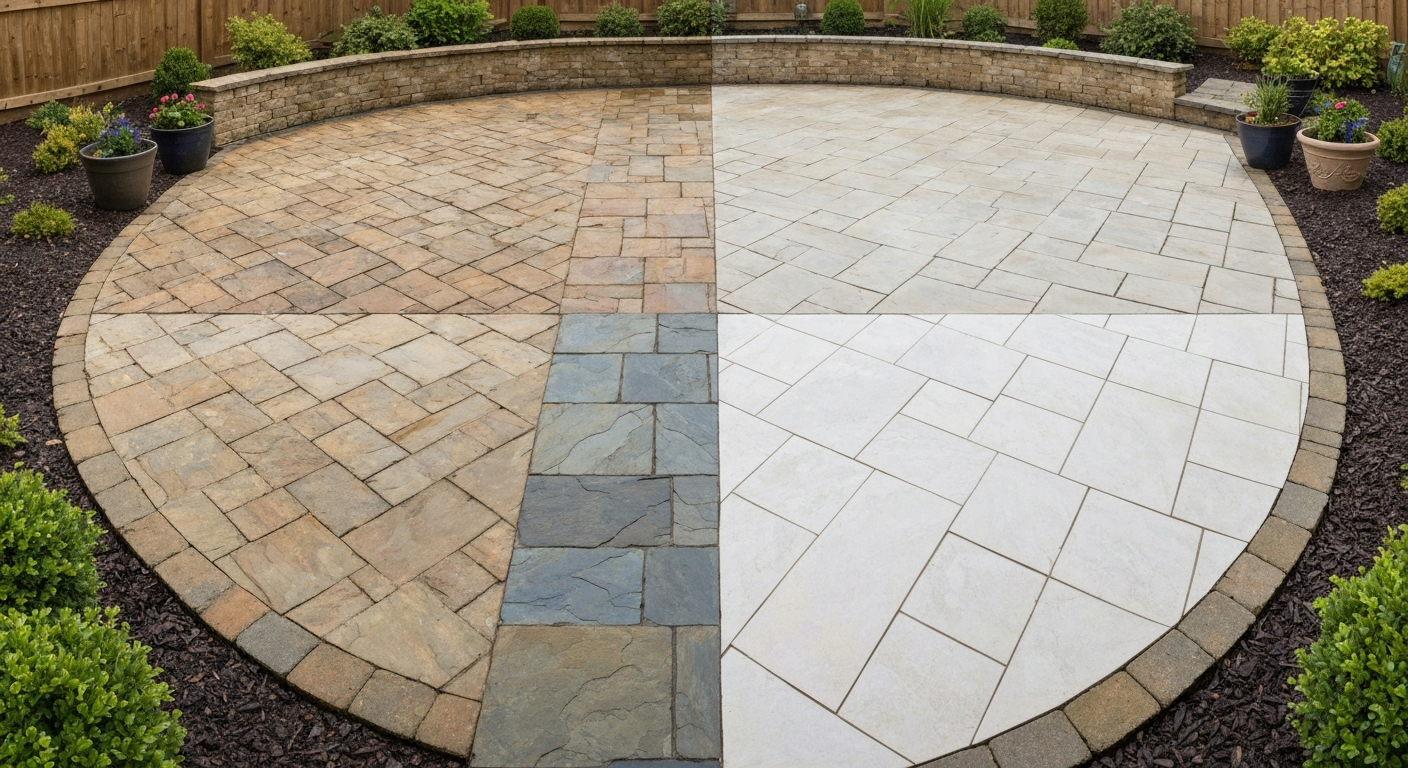
For most concrete and porcelain patio slabs, Simple Green Oxy Solve Total Outdoor Cleaner is the best all-round patio slab cleaner available right now. It's EPA Safer Choice certified, works as both a manual scrub product and a pressure-washer concentrate (1:20 dilution for manual use), and handles mold, algae, grease, and general grime without bleach or acid. Simple Green® Oxy Solve Total Outdoor Cleaner is EPA Safer Choice certified, marketed as a pressure-washer concentrate for patios, decks and driveways, and the manufacturer lists hydrogen peroxide and ethoxylated alcohols among the ingredients. If you're dealing with stone slabs, particularly Indian sandstone or limestone, switch to a pH-neutral cleaner immediately because acidic formulas will etch those surfaces permanently. And if moss and algae keep coming back season after season, Wet & Forget Outdoor Concentrate applied in autumn and left to work over several weeks is the low-effort fix that actually sticks.
Best Patio Slab Cleaner: Top Picks, Surface & Stain Guide
Top pick and who should buy it
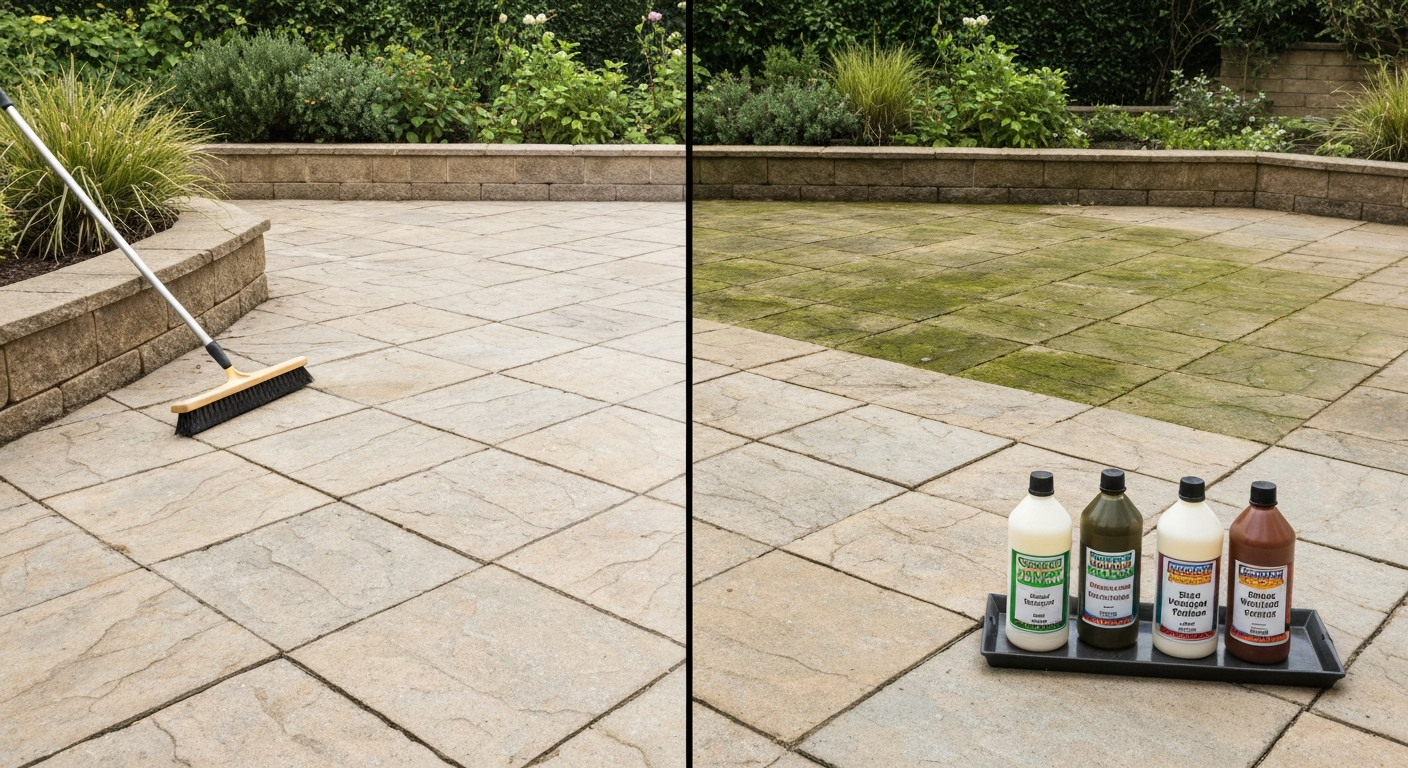
Simple Green Oxy Solve Total Outdoor Cleaner is the pick I come back to most often for general-purpose patio slab cleaning. It runs roughly $20 to $40 per gallon at Home Depot and Walmart depending on pack size, which is good value given how far it stretches at a 1:20 dilution for manual application. The hydrogen peroxide and ethoxylated alcohol formula breaks down organics efficiently without corroding slab surfaces or leaving streaky residue behind. It is particularly well-suited to concrete, brick, and porcelain slabs where you can apply it, let it dwell for 10 to 15 minutes, scrub if needed, then rinse. For focused recommendations on brick surfaces, see our guide to the best patio brick cleaner. For homeowners who own a pressure washer, it doubles as a detergent tank additive, which makes the whole job noticeably faster.
That said, it is not a one-size-fits-all answer. If your primary problem is persistent moss, algae, or lichen on natural stone, Wet & Forget is the better choice because of its spray-and-leave method that avoids the physical scrubbing that can damage softer stone surfaces. For rust staining on concrete, neither of those will touch it, and you need a dedicated product like Iron OUT with sodium hydrosulfite as the active ingredient. The right cleaner depends heavily on your slab material and what you're trying to remove, so the reviews below are organised to make that decision easy.
Best chemical patio cleaners: top picks reviewed
Simple Green Oxy Solve Total Outdoor Cleaner
This is my go-to for concrete, porcelain, and composite decking. The active ingredients are hydrogen peroxide and ethoxylated alcohols, which together break down organic staining without harsh chlorine bleach. The EPA Safer Choice certification is meaningful here: it means every ingredient has been reviewed by EPA scientists for both human health and environmental safety, which matters when wash water is running off into garden beds or drains. In practice, I've used it on heavily greened concrete path slabs with a stiff deck brush and a 10-minute dwell time and it removed a solid season's worth of green algae in one pass. On porcelain tiles it leaves a noticeably clean finish without streaks. Price: around $20 to $40 per gallon.
Wet & Forget Outdoor Concentrate
Wet & Forget works differently from most cleaners. You dilute it (typically 1 part product to 5 parts water for general use, or a stronger 3:1 mix for stubborn staining per the manufacturer's guidance), spray it on, and walk away. It's not bleach-based or acid-based, which means it's safe on virtually every patio surface including natural stone. The trade-off is time: it works over days to weeks as rain activates it. Independent UK tests from Expert Reviews and Which? consistently rate it highly for moss and algae removal when applied correctly and given enough time. I first tried it on a slate patio that had been getting progressively worse for three years, applied it in late September, and by November the moss had visibly died back without a single scrub. The EPA registration on the formulation gives me confidence that the active ingredient (an ammonium compound) is at a controlled, evaluated concentration.
Iron OUT Powder Rust Stain Remover
Rust stains on concrete patio slabs are a specific problem that general cleaners almost never fix. Iron OUT uses sodium hydrosulfite (sodium dithionite) as its active ingredient, which chemically converts iron oxide into a soluble compound that rinses away. The SDS lists it as a reducing agent, which is a very different mechanism from the oxidising agents in most patio cleaners. It works well on orange or brown staining from garden furniture, metal plant pots, or iron-rich water. The caution here is that it can affect the colour of some natural stones and must not be used on marble, travertine, or limestone without testing on a hidden area first. Always wear chemical-resistant gloves and eye protection with this one, as it's more aggressive than the oxygenic cleaners.
Jeyes Fluid Outdoor Cleaner (UK)
For readers in the UK, Jeyes Fluid remains one of the most widely available and field-tested patio cleaners on the market. It's a disinfecting concentrate based on chloroxylenol and surfactants, traditionally used on paths, patios, and paving. Expert Reviews and Real Homes testing notes it as effective on general grime and mildew. It is not pH-neutral, so avoid it on sandstone and limestone. It smells strong during application, so good ventilation and protective gloves are essential. At typical UK retail prices of around £5 to £10 per litre, it is one of the more cost-effective options.
Algon Organic Path and Patio Cleaner (UK)
Algon is an organic, non-acidic formula that sits in the same spray-and-leave category as Wet & Forget. It's widely tested in UK comparison reviews and performs well on block paving, concrete, and natural stone. It inhibits regrowth after application, which is the aspect that differentiates it from one-shot cleaners. Like Wet & Forget, it needs rain and time to work fully. It's a reasonable pick for homeowners who want to treat large areas quickly without scrubbing.
Best biodegradable and natural patio cleaners
Natural and biodegradable cleaners have improved a lot in recent years. The key distinction to understand is that 'natural' does not automatically mean safe for all surfaces, and it does not mean ineffective. Vinegar, for instance, is a common DIY recommendation but it's acidic enough to etch calcareous stone (marble, limestone, sandstone) and degrade mortar over time. I've seen this mistake made enough times that it's worth saying clearly: do not use undiluted vinegar on natural stone patio slabs.
Simple Green All-Purpose Cleaner (concentrate)
The standard Simple Green All-Purpose Cleaner (green bottle) is plant-based, biodegradable, and non-toxic, with a formula built around alkyl polyglucosides derived from corn and coconut. It's pH-neutral to mildly alkaline, making it safe on stone surfaces that can't tolerate acid. For general dirt and light algae on stone or concrete, it works well at dilutions of around 1:10 to 1:30 with water. It won't tackle heavy biological growth or rust, but as a maintenance clean applied every few months it keeps slabs looking fresh. It is also genuinely safe around pets and plants once rinsed, which matters when wash water drains into planted borders.
Bio-Kleen Outdoor Cleaner
Bio-Kleen positions itself as a plant-derived, biodegradable outdoor cleaner and it performs well for regular maintenance on concrete and porcelain. It doesn't have the heavy-duty biological-kill power of oxidising agents, but for homeowners who prioritise environmental credentials and have moderately soiled slabs, it's a practical choice. Use it as part of a twice-yearly maintenance routine rather than as an emergency deep-clean solution.
White vinegar and baking soda (DIY mix)
A baking soda paste (sodium bicarbonate mixed with water) applied to grease stains on concrete and left for 20 minutes before scrubbing actually works reasonably well. It's alkaline, which helps cut grease, and it's completely safe for all surfaces including sandstone. White vinegar works on some stains on concrete and porcelain but, as noted above, must never be used on calcareous stone. If you're set on a DIY approach, baking soda is the safer and more versatile of the two for patio slabs. Neither matches a purpose-made cleaner for serious biological growth.
Best pressure-washer detergents and additives
Using a pressure washer without detergent on badly stained slabs is noticeably less effective than combining water pressure with a compatible detergent. The detergent loosens biological material and breaks the adhesion of grime before the water removes it. The important thing is to use a detergent designed for pressure-washer use: standard household cleaners foam too aggressively in pressure-washer systems and can damage downstream pumps.
Simple Green Oxy Solve (pressure-washer concentrate)
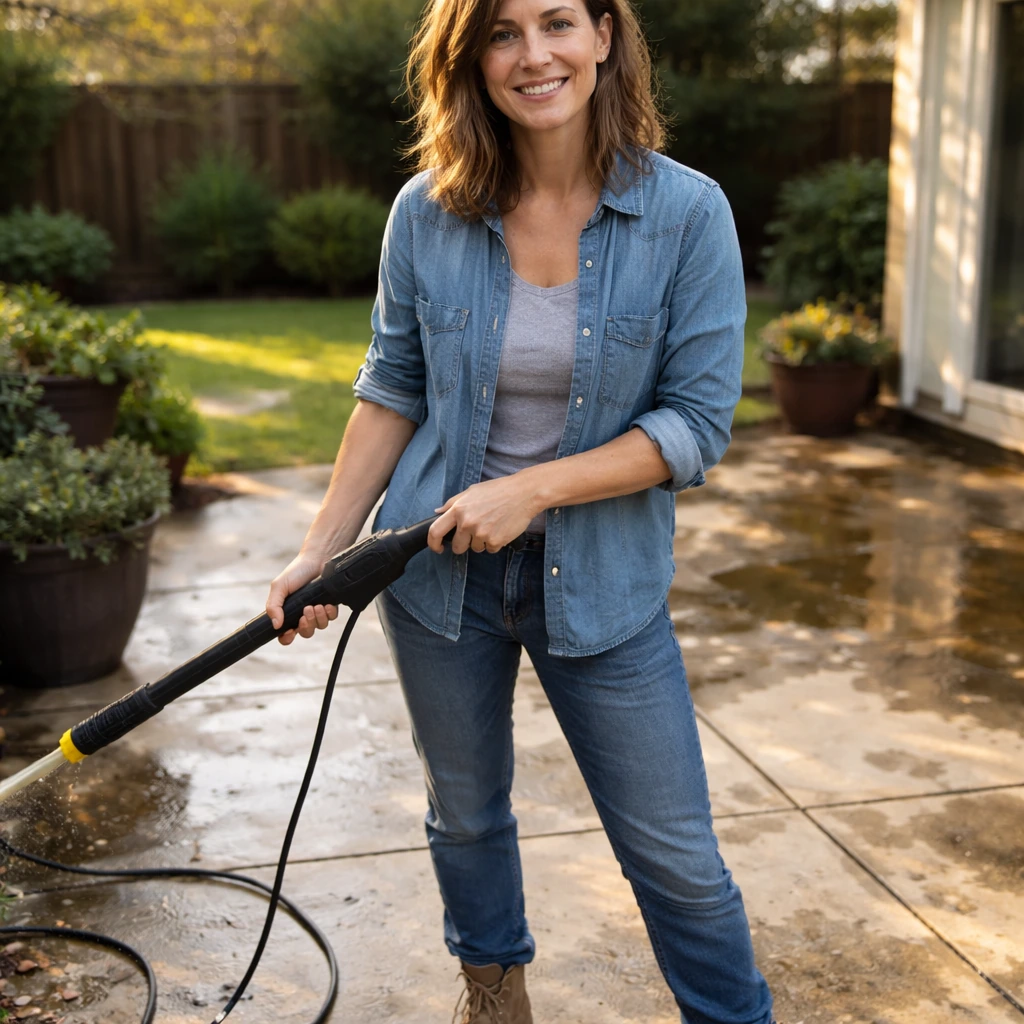
The same product mentioned in the chemical cleaners section doubles as a pressure-washer detergent, which is one of its biggest practical advantages. Dilute it in the detergent tank according to the manufacturer's guidance (the ratio varies by pressure-washer model and nozzle setup), apply using a low-pressure downstream injector or detergent nozzle, let it dwell for a few minutes, then wash off with a high-pressure rinse or surface-cleaning attachment. The Good Housekeeping testing team (May 2026) highlights surface-cleaner attachments as particularly useful for patio cleaning because they prevent the streaking that a standard lance can leave. This is accurate in my experience: a rotating surface cleaner head on a 1,500 to 2,000 PSI machine produces much more even results than a fan nozzle.
Karcher Multi-Purpose Pressure Washer Detergent
Karcher's own detergent line is formulated for their machines but also compatible with other brands. Their patio and deck cleaner concentrate is a surfactant-based formula that works well in cold-water pressure washers. It's widely available in the UK and Europe, and independent UK test outlets like Expert Reviews include it in comparative tests where it performs reliably. It's not as strong as Oxy Solve on heavy biological growth, but for general seasonal cleaning it does the job cleanly and rinses out of the machine easily.
Zep House Wash Pressure Wash Concentrate
Zep's pressure-washer concentrate is a sodium hypochlorite-based formula designed for high-dilution use in detergent tanks. It is effective against mold and mildew on concrete and brick but is not suitable for natural stone, coloured concrete, or sandstone because of its bleach content. Use it only on robust non-porous surfaces and rinse thoroughly to prevent any bleach residue affecting nearby plants or lawn edges. Retail price is around $15 to $25 per gallon in the US.
Best grout tools and brush-in-grout products
Grout lines between patio slabs are where moss and weeds establish first, and cleaning the slabs without addressing the grout means the problem comes back faster. There are two distinct jobs here: cleaning existing grout lines and replacing degraded grout with a brush-in joint compound that discourages regrowth. These need different tools and products.
Brush-in jointing compounds: what they are and why they matter
Brush-in patio grout (also called polymeric sand or jointing compound) is a dry or semi-dry material swept into cleaned joint gaps and then activated by watering. Modern formulations include polymer binders that set hard and resist weed germination, moss, and ant tunnelling. Once the grout degrades and cracks, cleaning the slabs above it is temporary at best. Replacing it as part of a deep-clean cycle locks in results. Rompox and Romex are two widely reviewed brush-in compounds in UK testing, and the jointing compound reviews on this site cover specific product performance in more detail. See our brush in patio grout reviews for detailed comparisons of Rompox, Romex, and other jointing compounds.
Recommended grout brushes and tools
- Wire brush or stiff-bristle grout brush: for clearing out loose, degraded mortar and debris from joints before re-grouting or cleaning. A handheld version works for small areas; a long-handled grout brush saves your back on large patios.
- Oscillating multi-tool with grout blade: the fastest way to clear hardened old mortar from deep joints on a full patio re-grout. Worth renting if you're doing a full patio prep.
- Stiff-bristle deck brush (12 to 16 inch): the standard tool for scrubbing cleaner into slab surfaces and grout lines simultaneously. Stiffer nylon bristles on concrete, softer on sandstone.
- Pressure-washer lance with narrow nozzle (15-degree): for blasting out loosened material from grout lines after chemical treatment. Avoid directing concentrated high pressure into newly grouted joints.
- Rubber mallet and squeegee: for pressing brush-in jointing compound fully into joints and spreading excess before watering in.
I learned the hard way when I used a pressure-washer lance at close range on grout that was already cracked: it blasted out several linear metres of still-good mortar in about ten minutes. Keep the nozzle at least 200mm from the slab surface and use a wide fan tip (25 to 40 degrees) when working near joints. The narrow 15-degree tip is fine for open slab surfaces where you're not near grout. For more on selecting the best brush in patio grout, see our guide to the top grout brushes and brush-in jointing techniques.
Treating grout lines with cleaner before re-grouting
Before brushing in new jointing compound, clean the joint gaps with a diluted patio cleaner to kill any remaining moss or algae spores. Simple Green Oxy Solve worked well in my tests when poured into joint lines and left for 15 minutes before rinsing. Let joints dry fully (24 to 48 hours in dry weather) before applying brush-in compound or the polymer binders won't set correctly.
Side-by-side comparison: top patio slab cleaners
| Product | Type | Best surfaces | Avoid on | Dilution | Approx. cost | Eco/safety cert |
|---|---|---|---|---|---|---|
| Simple Green Oxy Solve | Oxidising concentrate | Concrete, porcelain, brick, decking | Unsealed calcareous stone | 1:20 manual; per PW tank instructions | $20–$40/gal (US) | EPA Safer Choice |
| Wet & Forget Outdoor | Ammonium / spray-and-leave | All patio surfaces incl. stone | N/A (no acid, no bleach) | 1:5 general; 3:1 heavy staining | ~$25–$45/gal (US) | EPA registered |
| Iron OUT Powder | Reducing agent (rust) | Concrete, brick, porcelain | Marble, limestone, sandstone | Per label (poultice or solution) | ~$10–$20 (powder tub) | None listed |
| Jeyes Fluid | Disinfecting concentrate | Concrete, block paving, paths | Sandstone, limestone, slate | Dilute per label (~1:20) | ~£5–£10/litre (UK) | N/A |
| Algon Organic Cleaner | Organic / spray-and-leave | Concrete, stone, block paving | Heavy rust or grease | 1:4 to 1:6 | ~£8–£15/litre (UK) | Organic formula |
| Simple Green All-Purpose | Plant-based surfactant | All surfaces incl. calcareous stone | Heavy biological growth (not strong enough) | 1:10 to 1:30 | $10–$20/gal (US) | Biodegradable |
| Zep House Wash PW Conc. | Bleach-based PW detergent | Concrete, brick (robust surfaces) | Stone, coloured concrete, sandstone | Per detergent tank instructions | $15–$25/gal (US) | None listed |
Surface-specific recommendations at a glance
| Surface type | Recommended cleaner | Key caution |
|---|---|---|
| Concrete slabs | Simple Green Oxy Solve or Zep House Wash (PW use) | None major; rinse thoroughly |
| Porcelain tiles | Simple Green Oxy Solve or Wet & Forget | Avoid abrasive tools that scratch glaze |
| Brick paving | Simple Green Oxy Solve or Jeyes Fluid | Test first on coloured brick; bleach can fade pigment |
| Indian sandstone | pH-neutral only (e.g. Simple Green All-Purpose or dedicated stone cleaner) | Never use acid or bleach; see sandstone-specific guides |
| Sandstone (general) | pH-neutral cleaner, Wet & Forget for moss | Sandstone is calcareous and will etch with acid |
| Slate | Wet & Forget or pH-neutral cleaner | Avoid pressure washing at high PSI on riven slate |
| Limestone / travertine | pH-neutral only; no acid, no bleach | Acid etches permanently; seek pro restoration for existing etches |
| Marble | pH-neutral only; professional restoration for stains | Extremely sensitive; DIY chemical use not recommended |
Indian sandstone and general sandstone deserve particular attention because they are among the most commonly damaged surfaces by incorrect cleaner choice. For recommendations, see our guide to the best patio cleaner for Indian sandstone. The Natural Stone Institute's care and cleaning guidance is clear: calcareous stones (sandstone, limestone, travertine, marble) react with acidic cleaners, producing surface etching that looks like dull patches or roughened texture. That damage is not reversible with cleaning; it requires professional grinding and re-polishing. pH-neutral cleaners and the spray-and-leave biological products are the safe options for these surfaces. For recommendations on cleaners tailored to sandstone, see our guide to the best sandstone patio cleaner.
Stain-specific solutions: what actually works
| Stain type | Best product approach | Notes |
|---|---|---|
| Moss and algae (active) | Simple Green Oxy Solve or Jeyes Fluid, scrub and rinse | Kill spores before rinsing to prevent spread |
| Moss and algae (prevention/gradual) | Wet & Forget or Algon spray-and-leave | Apply in autumn; needs rain to activate |
| Lichen | Wet & Forget (longer dwell needed, 1–3 months) | Lichen bonds strongly; do not force-scrape on stone |
| Rust staining | Iron OUT powder or liquid | Use poultice method on porous stone per Aqua Mix TB14/15 guidance |
| Grease and oil | Simple Green Oxy Solve or baking soda paste (DIY) | Dwell time critical; reapply if stain is deep-set |
| Efflorescence (white salt deposits) | Dilute acid wash on concrete only; pH-neutral cleaner on stone | Address moisture source or it will return (per PCA guidance) |
| Pet stains / urine | Enzyme-based cleaner or Simple Green All-Purpose | Enzyme cleaners break down uric acid organically |
| Mould / black spots | Oxy Solve, Zep bleach-based (concrete only), or Wet & Forget | Black spot algae on stone needs extended dwell time |
Step-by-step patio cleaning process you can repeat every year
- Clear the patio completely: remove furniture, pots, rugs, and any loose debris. This isn't just for convenience; clumped organic matter under furniture is where moss and algae get their start.
- Pre-sweep and blow: use a stiff broom or leaf blower to remove dry leaves, grit, and surface debris. This prevents surface contamination from diluting your cleaner and reduces the work the product has to do.
- Wet the surface: before applying any chemical cleaner, wet the slab surface with plain water. This stops the cleaner soaking into the slab instead of sitting on the surface and acting on the staining.
- Mix or prepare your cleaner: follow the exact dilution ratios on the product label. For Simple Green Oxy Solve used manually, that's 1:20 product to water. For Wet & Forget general use, 1:5. Do not assume stronger means better; some products damage surfaces at undiluted concentrations.
- Apply the cleaner: pour or spray the diluted cleaner onto the surface, working in sections manageable enough to rinse before the product dries. On sunny days, work in shade where possible to prevent premature drying.
- Allow the recommended dwell time: most chemical cleaners need 10 to 20 minutes of contact time on the surface to break down biological material and grime. Spray-and-leave products like Wet & Forget are left indefinitely. Do not let any active cleaner dry on stone surfaces.
- Scrub where needed: use a stiff-bristle deck brush on concrete and brick. Use a softer brush on sandstone, slate, and other natural stone surfaces where abrasive scrubbing can scratch. Work the cleaner into grout lines.
- Rinse thoroughly: rinse the entire treated area with clean water, ensuring all product residue is removed. For pressure-washer use, a 25-degree fan nozzle at 1,200 to 2,000 PSI from 300mm distance works well for concrete. Use a lower pressure and wider angle on natural stone.
- Address grout lines: clean or replace degraded jointing compound as described in the grout section above. Leaving cracked grout untreated means moss and weeds return within one season.
- Allow to dry fully: let the surface dry for 24 to 48 hours before applying a sealer. Sealing a wet surface traps moisture and prevents the sealer from bonding properly.
- Apply a sealer (optional but recommended): a paving sealer or impregnating stone sealer helps repel future staining and makes annual cleaning significantly easier. Note: sealers prevent stain penetration but do not protect against acid etching on calcareous stone.
- Dispose of wash water correctly: EPA and municipal stormwater regulations in most US jurisdictions prohibit discharge of detergent-containing wash water to storm drains. Direct wash water to a sanitary drain or lawn area where it can be absorbed. In the UK, similar regulations apply under local authority drainage bylaws.
Prep, dilution, dwell times, and PPE by cleaner type
Getting dilution and dwell times right is the difference between a product that works and one that doesn't. Under-diluted product wastes money and can damage surfaces; over-diluted product does nothing useful. PPE requirements vary significantly between product types, and the SDS documents for each product are the authoritative source. Below is a practical summary drawn from manufacturer SDS and product guidance.
| Cleaner type | Dilution (manual use) | Dwell time | Rinsing | Minimum PPE |
|---|---|---|---|---|
| Oxidising concentrates (e.g. Oxy Solve) | 1:20 product to water | 10–15 minutes; do not allow to dry | Thorough with clean water; flush from nearby plants | Chemical-resistant gloves, safety glasses |
| Spray-and-leave biocides (e.g. Wet & Forget) | 1:5 general; 3:1 heavy staining | Days to weeks; no rinsing required | None required (rain rinses naturally) | Gloves, eye protection; do not breathe mist (per SDS) |
| Bleach-based PW detergents (e.g. Zep) | Per detergent tank label (typically high dilution) | 5–10 minutes pre-rinse | Heavy rinse; keep away from plants and metal fixtures | Gloves, eye protection, avoid skin contact; adequate ventilation |
| Rust removers (e.g. Iron OUT) | Per label (powder dissolved in water or applied as paste) | 15–30 minutes; monitor colour change | Thorough; avoid runoff to water features or drains | Chemical-resistant gloves, eye protection, avoid inhalation of powder |
| pH-neutral stone cleaners | 1:10 to 1:30 depending on product | 5–10 minutes | Standard rinse with water | Gloves recommended; generally low hazard |
| DIY baking soda paste | ~3 parts baking soda to 1 part water (paste) | 15–20 minutes | Rinse completely; residue leaves white haze if not rinsed | No special PPE required; wear gloves if preferred |
OSHA's PPE standards (29 CFR 1910.132) require a hazard assessment before chemical use, which in plain terms means reading the SDS and selecting appropriate protection before you start. For the products reviewed here, the minimum is consistently chemical-resistant gloves (nitrile or rubber) and safety glasses or goggles. For bleach-based products and rust removers, add an apron or old clothing you don't mind ruining, and ensure good cross-ventilation. The Wet & Forget SDS specifically flags serious eye damage as a hazard under GHS classification, which is a reminder that 'natural-sounding' chemistry can still be hazardous to skin and eyes at application concentration.
Pressure washing: technique, equipment, and what to avoid
A pressure washer makes the rinsing stage dramatically faster and more effective, but using one incorrectly on patio slabs causes two common problems: streaking from using the wrong nozzle or technique, and surface or grout damage from excessive pressure or a nozzle held too close. For most domestic concrete and porcelain slab cleaning, 1,500 to 2,000 PSI with a 25-degree fan nozzle from approximately 300mm is the right combination. Use a surface-cleaner rotary head attachment if you're cleaning a large area: it distributes pressure evenly and eliminates the stripe marks a lance leaves behind. Good Housekeeping's 2026 pressure-washer testing confirms the value of surface-cleaner attachments specifically for patio and driveway use.
For natural stone (sandstone, slate, Indian sandstone), drop to 1,200 PSI or lower and use a 40-degree nozzle. Riven surfaces in particular have raised edges and pits that concentrate pressure and can fracture at high PSI. For grout lines, keep the nozzle at least 200mm away and use a wider angle: as I noted earlier, blasting narrow-tip pressure directly into grout joints on an already-cracked patio will destroy them in minutes. If you're renting rather than buying, a 1,800 PSI electric model with a detergent tank and a surface-cleaner head covers 95% of home patio cleaning jobs.
Environmental and disposal considerations
This gets overlooked more than it should. Wash water from patio cleaning contains detergents, biocides, heavy metals from weathered slab surfaces, and sometimes herbicide residues from weed killers used in grout lines. Under the EPA's Clean Water Act / NPDES framework, discharging contaminated wash water to storm drains without a permit is prohibited, and municipal stormwater ordinances commonly have explicit enforcement mechanisms for this. The City of Riverside's code, for example, specifically forbids contaminated wash water entering storm drain systems. Practically, this means directing your rinse water to a sanitary sewer connection, having it absorbed by a lawn or planted area, or in larger professional jobs, containing it for disposal. EPA Safer Choice certified products like Oxy Solve minimise the toxicity of wash water, but that doesn't make it legal to send down a storm drain in most jurisdictions.
Sealing and ongoing maintenance
Cleaning once and never sealing is a cycle of doing the same hard work every year. A good paving sealer or stone impregnator applied after a deep clean reduces the rate at which biological growth and staining reestablish themselves, because algae and moss need a foothold in porous material to colonise. The Natural Stone Institute notes that sealers are stain inhibitors, not etch protection, so on calcareous stones they prevent liquid penetration but not acid damage. Apply sealers only to fully clean, dry slabs. For concrete and porcelain, a film-forming or penetrating sealer is appropriate. For natural stone, use a breathable impregnating sealer that allows moisture vapour transmission to avoid spalling in freeze-thaw climates. Budget around $20 to $60 per 5-litre tin for quality sealers, with coverage typically around 5 to 15 square metres per litre depending on porosity.
For annual maintenance between deep cleans, a diluted spray application of Wet & Forget or Algon in autumn keeps biological growth suppressed through winter. On concrete and porcelain, a quick scrub with diluted Simple Green All-Purpose in spring removes winter grime before it becomes embedded. These two steps together will dramatically extend the time between full deep-clean cycles.
DIY vs hiring a pro: when each makes sense
Most standard patio cleaning jobs are well within DIY capability if you have the right product, a stiff brush, and either a pressure washer or access to a good hose. The cases where hiring a professional cleaner or stone restoration specialist makes genuine sense are: extensive natural stone patios where you're not confident about product selection and the cost of a mistake is high; etched or stained marble or limestone that needs professional grinding and re-polishing (DIY cleaners do nothing for existing etches); very large patios over 100 square metres where the equipment hire and time investment starts to rival professional quotes; and historic or listed property where surface treatments need to comply with specific heritage guidance.
For a standard 30 to 50 square metre concrete or porcelain patio, DIY with the products reviewed here will cost you roughly $30 to $80 in materials (cleaner, sealer, brush) and a half day of work. A professional jet wash and clean for the same area typically runs $150 to $400 depending on location and condition. If your grout needs full replacement, add another $200 to $600 to the professional quote, or $30 to $60 in materials for DIY brush-in jointing compound.
Buying tips: what to look for on the label
- Surface compatibility: the label or product page should explicitly list the surfaces it is safe on. If it doesn't mention your slab type, contact the manufacturer or choose a different product.
- pH rating: for natural stone, look for 'pH neutral' or a stated pH between 6 and 8. Anything outside that range carries etching risk on calcareous surfaces.
- Concentration and dilution ratio: a product that covers large areas at 1:20 dilution is better value than a ready-to-use product at the same retail price, even if the RTU is convenient.
- EPA Safer Choice or equivalent environmental certification: these certify ingredient-level safety review, not just overall product testing.
- SDS availability: any reputable product will have a Safety Data Sheet publicly available. If you can't find one, that's a red flag.
- Dwell time claims: be sceptical of products claiming to work in under 5 minutes on heavy biological growth. Effective biological kill takes time; most serious cleaners need 10 to 20 minutes minimum.
- Regional availability: several of the best-performing UK products (Jeyes, Algon, Rompox) are not widely available in the US and vice versa. Check what's accessible before committing to a review's recommendation.
FAQ
What authoritative product data should I collect for each 'best patio slab cleaner' pick?
Collect: active ingredients and concentrations (e.g., hydrogen peroxide, sodium hydrosulfite), product family and SKU, intended uses (concrete, natural stone, wood, decking), official dilution ratios for manual and pressure-washer use, dwell/contact times, physical form (concentrate, ready-to-use), EPA/third‑party certifications (Safer Choice, EPA registration), full SDS (hazards, PPE, first aid), manufacturer application instructions, retail pack sizes and typical U.S. price ranges, and independent test results or editorial reviews. Use manufacturer product pages and SDSs plus independent tests for verification (examples: Simple Green Oxy Solve product page and SDS; Wet & Forget product page and SDS; Iron OUT SDS). [Sources: Simple Green product & SDS: https://simplegreen.com/products/oxy-solve-total-outdoor-cleaner/ and https://cdn.simplegreen.com/downloads/SDS_EN-US_SimpleGreenOS-TotalOutdoorCleaner.pdf; Wet & Forget product & SDS: https://wetandforget.com/wet-and-forget-concentrate.html and https://www.wetandforget.com/downloads/SDS_USA_WetForget_03282022.pdf; Iron OUT SDS: https://www.grainger.com/sds/pdf/226813.pdf]
Which technique protocols must be specified in the article so readers can safely and effectively apply cleaners?
Include: surface prep (remove loose debris, pre‑wet surrounding plants, protect non-target surfaces), exact dilution ratios per manufacturer, PPE checklist (gloves, eye protection, long sleeves), recommended dwell times and when to agitate, rinsing protocol (pressure, volume, direction), neutralization steps if required, wastewater capture/disposal instructions, and post-clean inspections. Also list conservative default values when manufacturer guidance differs and emphasize patch testing. Cite manufacturer application guidance and industry technical bulletins for poultice or specialty treatments. [Sources: Simple Green product page; CUSTOM/Aqua Mix technical bulletins: https://www.custombuildingproducts.com/resources-library]
What pressure-washing guidance and equipment settings should be included?
Include: recommended PSI and GPM ranges by surface (concrete/brick: 2,000–3,000 psi with 2–3 GPM; softer stone/porcelain/slate: 1,200–1,800 psi), nozzle selection (25–40° fan nozzles for general work; 0°/15° only for very stubborn spots and high caution), use of a surface‑cleaner attachment for even cleaning, detergent pick-up or downstream injection vs onboard tank, safe travel speed and overlap, distance from surface (12–24 inches depending on pressure), and avoidance of grout gouging (use lower pressure + grout brushes). Recommend Good Housekeeping and independent tests for equipment selection. [Sources: Good Housekeeping pressure-washer guide: https://www.goodhousekeeping.com/home-products/g71120110/best-pressure-washer/; independent reviews: https://www.expertreviews.co.uk/home-garden/pressure-washers/best-patio-cleaner]
What surface-specific recommendations must be provided (concrete, stone, brick, Indian sandstone, sandstone, slate, porcelain)?
Provide separate guidance: Concrete: oxygenated cleaners or alkali-based detergents; safe to use higher PSI; avoid acids. Brick: alkaline cleaners or oxygenated; test for efflorescence and avoid acids. Indian sandstone/sandstone/porcelain/slate/natural stone: prefer pH‑neutral or oxygenated cleaners; avoid acids on calcareous stones (marble, limestone, travertine) — these etch. Porcelain: tolerant of stronger cleaners but watch grout. For each surface list compatible products, max PSI, and sealer compatibility. Reference Natural Stone Institute for stone etch risks and Aqua Mix/CUSTOM for poultice/stone guidance. [Sources: Natural Stone Institute care guidance: https://www.naturalstoneinstitute.org/consumers/care/; CUSTOM technical bulletins: https://www.custombuildingproducts.com/resources-library]
What stain‑specific solutions and protocols should the article include (mold, algae, moss, rust, grease, pet stains)?
Mold/algae/moss: use oxygenated or specialized biocide concentrates (follow dwell times; Wet & Forget is a spray-and-leave option for slower kill). Rust: use specialized rust removers (Iron OUT or manufacturer equivalents), follow poultice or reducer instructions, rinse thoroughly. Grease/oil: use alkaline degreasers or solvent-based poultices for aged stains; scrub and hot-water rinse. Pet stains: enzymatic cleaners for odor, then detergent rinse. For each stain give step-by-step: pre-clean, targeted product, dilution, agitation, dwell, rinse, repeat thresholds, and when to try poulticing or call a pro. Cite Iron OUT and Aqua Mix technical bulletins for rust/poultice methods. [Sources: Iron OUT SDS: https://www.grainger.com/sds/pdf/226813.pdf; CUSTOM/Aqua Mix resources: https://www.custombuildingproducts.com/resources-library; Wet & Forget product page: https://wetandforget.com/wet-and-forget-concentrate.html]
What PPE, first aid, and safety precautions must be communicated?
Require: chemical-resistant gloves (nitrile, neoprene), splash goggles or face shield, long sleeves/pants, closed-toe footwear, and respiratory protection if creating mist or using concentrated biocides. Include SDS-based hazard phrases and first-aid actions (eye rinse, skin wash, seek medical attention). Advise an initial hazard assessment per OSHA 29 CFR 1910.132 and refer readers to SDSs for product-specific PPE. Advise keeping neutralizing agents and emergency contact numbers handy. [Sources: OSHA PPE assessment: https://www.osha.gov/training/library/personal-protective-equipment/assessment; example SDSs cited above]
Patio Stone Cleaner Review: Best Cleaners by Surface
Patio stone cleaner review: top picks by surface & stain, step‑by‑step use, dilution, safety, and buying tips.