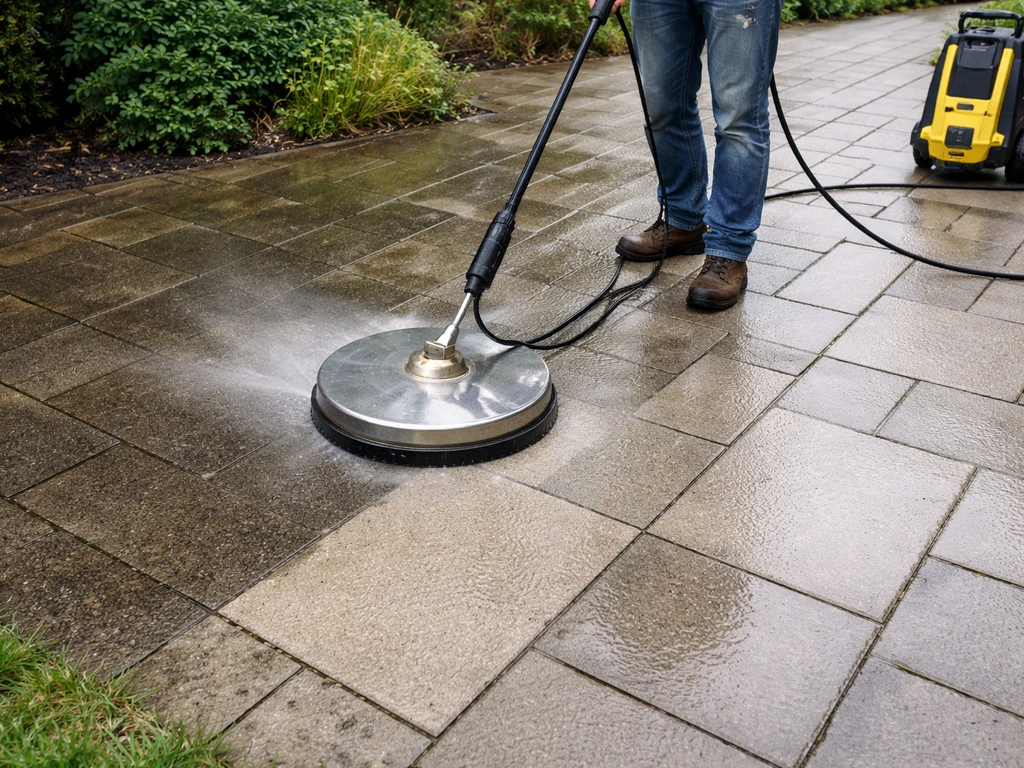
The best patio cleaning machines for most homeowners are electric pressure washers in the 1,600 to 2,200 PSI range paired with a surface cleaner attachment. That combination cleans concrete, brick, and stone faster than a standard lance, leaves fewer streaks, and is far less likely to etch softer surfaces than a raw turbo nozzle. If your patio is large, dirty, or made from a tougher material like dense concrete or block paving, a mid-range gas machine around 2,400 to 2,800 PSI gives you the extra grunt. For delicate surfaces like sandstone, slate, or porcelain, drop back to 1,200 to 1,400 PSI with a 40-degree nozzle and let a pH-neutral detergent do the heavy lifting. The sections below walk you through every category, what the specs actually mean in practice, and exactly which machine to match to your surface and your budget.
Best Patio Cleaning Machines: Top Picks & Buyer's Guide 2026
Who this guide is for and what it covers
If you are a homeowner or confident DIYer trying to figure out which patio cleaning machine is worth your money, this is the guide for you. It does not matter whether you have a small urban patio slabbed in porcelain or a sprawling concrete and brick garden that has not been properly cleaned in three years. This guide covers top picks by category and price, explains the meaningful differences between machine types, gives you a surface-by-surface and problem-by-problem breakdown, and includes safe working pressures, step-by-step workflows, accessory recommendations, detergent and runoff guidance, maintenance tips, and a realistic look at price ranges from budget to premium. It also tells you honestly when a particular job is better handed over to a professional.
Top picks: best patio cleaning machines by category and price
Rather than a single ranked list, I find it more useful to split recommendations by use case. The machine that is genuinely best for a compact sandstone patio would be a disaster on a large commercial-grade concrete forecourt, and vice versa. Below are the categories that matter most for patio cleaning, with specific model examples drawn from hands-on testing and lab data.
Best overall electric: Kärcher K7 Premium (with surface cleaner)
The K7 Premium delivers up to 2,600 PSI and 1.7 GPM, with a water-cooled induction motor that handles long cleaning sessions without overheating. Paired with the Kärcher T7 or T9 surface cleaner attachment, it is the closest thing to a set-and-forget patio cleaning machine you will find in the consumer electric segment. For model-by-model comparisons and buying tips, see our roundup of the best electric patio cleaner. Independent testers consistently rate Kärcher's higher-end K-series models at or near the top for cleaning speed and build quality. The machine runs quieter than most gas options (roughly 79 dB), and the integrated detergent tank means you can switch to soap mode without reaching for a separate container. It is heavy for an electric unit at around 13 kg, so portability is a mild trade-off.
Best for large concrete and block paving: Simpson PowerShot PS60843
Simpson's PowerShot series uses a Honda GX200 engine rated at 3,200 PSI and 2.5 GPM, which puts its Cleaning Units (PSI x GPM) well above anything in the consumer electric category. For large driveways and patios made from dense concrete or clay brick, that extra volume makes a real difference in rinse time. The triplex ceramic plunger pump is more durable than the axial-cam pumps found in cheaper gas machines and is designed for 500+ hours of use. Simpson publishes full spec sheets, and the pump is user-serviceable. The obvious downside is weight (around 75 lbs/34 kg) and the need for a safe ventilated outdoor space because of carbon monoxide from the engine.
Best budget electric: Greenworks 1900-PSI / 1.2 GPM
For a smaller patio or a light annual clean, the Greenworks 1900 PSI model is available from major retailers for under $150 / around £120. At 1.2 GPM it is not fast, but it has enough pressure to shift algae and general grime from concrete and brick. Lowe's and Home Depot reviews consistently note good reliability for occasional use. I would not recommend it with a surface cleaner (the low GPM starves the rotating heads) but with a 25-degree nozzle and a pre-treatment of diluted patio cleaner, it does a perfectly acceptable job on small areas. Keep expectations realistic: it will take two to three times longer than a mid-range machine.
Best battery/cordless: Greenworks 60V Cordless or EGO PWX3001
Battery machines have closed the gap considerably over the last two years. The EGO PWX3001 delivers 3,000 PSI (burst) and operates at a practical 1.0 to 1.2 GPM on a single 56V battery, which is enough for patios up to around 30 square metres on one charge. They are ideal for areas without a convenient power outlet, and there is no cord to manage. Runtime is the limiting factor: expect 20 to 30 minutes of continuous run on a standard 5.0 Ah battery. For a big clean, you will need a spare battery. They suit spot-cleaning and smaller jobs better than full-scale annual deep cleans.
Best specialist patio scrubber: Kärcher BR 30/4 or similar slow-rotating brush machines
For textured porcelain, brushed concrete, and any surface where raw pressure risks surface damage, a slow-rotating patio brush machine is a smarter choice than a pressure washer. These machines use rotating brush heads (typically 150 to 300 RPM) combined with water and detergent to agitate and lift dirt without the surface risk of high-pressure water. They are particularly good at getting into riven surfaces and textured tiles that a flat surface cleaner cannot reach. Heavier investment, but if you have a premium surface, it pays for itself in one avoided resurfacing bill.
Quick buying checklist before you spend a penny
Use this checklist before you buy. It takes about two minutes and will stop you from buying a machine that is wrong for your specific situation.
- PSI and GPM: target 1,600 to 2,200 PSI for general patio cleaning; prioritise GPM (flow rate) for large areas as it affects rinse speed; never buy solely on peak PSI claims which are often measured without load.
- Power type: electric for most homeowners (safe, quiet, lower maintenance); gas if you need more than 2,500 PSI or have no outdoor power outlet; battery/cordless if portability is your top priority.
- Surface cleaner vs turbo/rotary nozzle: a surface cleaner gives streak-free results on flat surfaces; a turbo/rotary nozzle is faster on tough staining but carries higher etch risk on softer materials.
- Detergent system: check whether the machine has an onboard detergent tank, a downstream injector, or a siphon hose; for biological growth (moss, algae), you need reliable chemical application.
- Portability and storage: check weight and wheel/handle setup; a 30+ kg machine is fine on a flat driveway but impractical on a raised patio accessed by steps.
- Safety features: look for GFCI protection on electric models, automatic shut-off when the trigger is released (Total Stop System/TSS), and clear operator manual guidance on PPE.
- Warranty and service: consumer-grade machines typically carry 1 to 2 year warranties; professional-grade gas machines with triplex pumps often offer 3 to 5 years on the pump; check what parts (seals, O-rings) are user-serviceable.
Machine types explained: electric, gas, battery, and hot-water vs cold-water
Electric pressure washers
Electric machines run off a standard 120V (US) or 230V (UK) supply. Consumer models range from around 1,300 to 2,000 PSI with flow rates of 1.2 to 1.8 GPM. The better models use induction motors (quieter, longer-lasting) rather than universal brush motors. Most include a Total Stop System that kills the motor when you release the trigger, which reduces pump wear significantly. Electric is the right choice for the vast majority of homeowners: it is quieter (typically 70 to 82 dB), requires almost no maintenance, and produces no exhaust emissions. The main limitation is the cord and the power ceiling.
Gas pressure washers
Gas machines start around 2,400 PSI and go well past 4,000 PSI in commercial configurations. For patio cleaning, the practical sweet spot is 2,400 to 3,000 PSI with a 2.0 to 2.5 GPM flow rate. They require regular maintenance (oil changes, fuel stabiliser, carburettor checks) and must never be used in enclosed spaces because of carbon monoxide risk. The CDC and NIOSH are explicit: gas pressure washers must be kept outdoors with adequate ventilation at all times. For large patios, driveways, and hardworking annual cleans, gas machines save significant time over electrics. For a standard domestic patio under 60 square metres, they are often overkill.
Battery/cordless machines
The cordless category has matured quickly. Current 60V and 80V platforms from brands like EGO, Greenworks, and Ryobi are genuinely capable for light-to-medium patio work. Runtime on one charge remains the honest limitation. They suit spot-cleaning, decking, garden furniture, and smaller patios where the convenience of no cord outweighs the reduced run time and slightly lower cleaning performance compared to corded electrics.
Hot-water vs cold-water washers
Nearly every consumer patio cleaning machine is a cold-water machine, and that is fine for biological growth, general grime, and most surface staining. Hot-water pressure washers (which heat water to 60 to 155 degrees C / 140 to 310 F) are dramatically more effective at cutting grease, oil, and certain resin-based stains because the heat chemically breaks down fats. They are also much more expensive (typically $1,500 to $5,000+) and are mainly found in professional or commercial settings. If grease is your primary problem (think outdoor kitchen or garage floor), renting a hot-water unit for a single annual deep clean makes more sense than buying one.
Specialized attachments and what they actually do
Surface cleaners
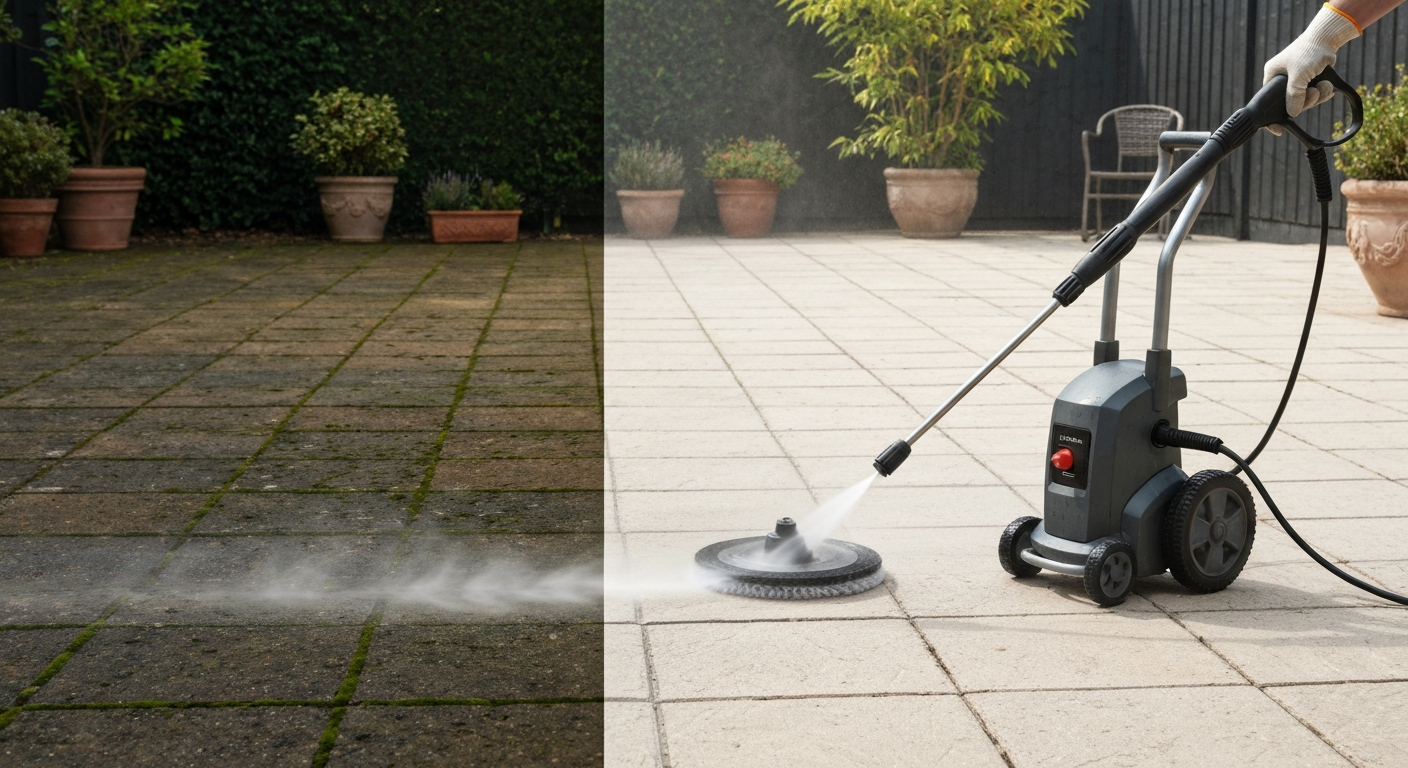
A surface cleaner is a disc-shaped housing (typically 11 to 20 inches / 28 to 50 cm diameter) that contains one or two rotating spray arms fed by the pressure washer. It cleans in a uniform, overlapping circular pattern, which eliminates the striping you get from a lance. On flat concrete and brick, a surface cleaner is genuinely transformative: it is faster than a lance, produces a consistent finish, and keeps spray contained (less splash-back on you and surrounding plants). The trade-off is that most require at least 1.5 GPM to operate properly, so they do not pair well with budget low-flow electrics. Match your surface cleaner diameter to your machine's GPM output.
Patio scrubbers and slow-rotating brush heads
These are separate, dedicated machines or attachments that spin bristle brush heads at low RPM (typically 150 to 300 RPM) while delivering water and detergent. They are gentler than a pressure washer on delicate surfaces and superior at working cleaner into textured, riven, or grouted surfaces that a flat surface cleaner skates over. The Kärcher BR range and similar machines are the benchmark here. They are also quieter and easier for less confident users. For sandstone, slate, textured porcelain, and any grouted surface you cannot afford to damage, a scrubber is frequently the better tool choice.
Turbo nozzles and rotary wands
A turbo (or rotary) nozzle spins a zero-degree water jet in a rapid cone, effectively combining the cutting power of a zero-degree tip with the coverage of a 25-degree tip. They are excellent for blasting stubborn staining off hard concrete and block paving, and they cut cleaning time significantly compared to a standard fan nozzle. However, they carry real surface risk. Used too close (under 6 to 8 inches / 15 to 20 cm), they will etch soft concrete, damage grout lines, and score limestone or sandstone. I would not use one on anything softer than a hard dense concrete or engineering brick. If in doubt, use a 25-degree nozzle and a longer dwell time with detergent instead.
How PSI, GPM, and cleaning action actually affect results
PSI (pounds per square inch) is the pressure measurement: how hard the water hits. GPM (gallons per minute) is the flow rate: how much water is being delivered. The combination is expressed as Cleaning Units (CU = PSI x GPM) and is a better single-number comparison than PSI alone. A machine rated 2,000 PSI at 1.2 GPM has 2,400 CU. A machine rated 1,800 PSI at 2.0 GPM has 3,600 CU and will clean a large surface faster, even though its PSI rating sounds lower. The PWMA PW101 standard sets the testing methodology for these ratings, so always look for machines from brands that publish tested (not peak) specs.
Surface risk from pressure comes primarily from PSI and nozzle angle, not flow rate. A high-PSI narrow nozzle concentrates force onto a small area, which can etch, score, or force water into the surface structure. This matters less on hard dense materials and enormously on porous soft stone. I learned this the hard way when I etched a light score pattern into a sandstone patio using a 15-degree nozzle at around 2,400 PSI. The marks were shallow but permanent. Always start wider and further away, then step in if you need more effect.
Matching machines to your patio surface
| Surface | Max recommended PSI | Best nozzle/attachment | Machine type | Notes |
|---|---|---|---|---|
| Dense concrete | 2,500–3,000 PSI | Surface cleaner or 25° nozzle | Electric or gas | Can tolerate higher pressure; still avoid zero-degree tips |
| Clay brick / block paving | 2,000–2,500 PSI | Surface cleaner or 25° nozzle | Electric or gas | Watch mortar joints; back off pressure if grout starts lifting |
| Natural stone (hard) | 1,500–2,000 PSI | 25°–40° nozzle or surface cleaner | Electric | Test in an inconspicuous spot first |
| Sandstone | 800–1,200 PSI | 40° nozzle, slow scrubber, or soft wash | Low-pressure electric or scrubber | Very soft; high pressure causes irreversible pitting |
| Slate | 1,000–1,400 PSI | 40° nozzle or slow scrubber | Low-pressure electric or scrubber | Risk of delamination with excess pressure |
| Porcelain tiles | 1,200–1,600 PSI | 25°–40° nozzle, avoid surface cleaner | Electric | Hard glaze is durable but grout is vulnerable; keep nozzle moving |
| Composite decking | 1,500 PSI max | 40° nozzle, with the grain | Electric | Go with the board direction; never blast across the grain |
These are working recommendations based on material hardness and practical testing, not manufacturer marketing. If you are unsure of your surface material or its condition, always start at the lower end of the pressure range and test on a hidden area. Worn, older, or previously damaged surfaces need even more caution.
Matching machines to common patio problems
Mold and algae
Mold and algae need chemical treatment, not just pressure. Sodium hypochlorite (bleach) at a dilution of around 1 to 3% is highly effective at killing biological growth before you wash. Apply it via the machine's detergent system, leave it to dwell for 10 to 15 minutes, then rinse with a surface cleaner or 25-degree nozzle. Without the pre-treatment, you risk just spreading spores around and the growth returns in weeks. Always check that your machine's seals and pump are bleach-compatible before using sodium hypochlorite through the system. Many manufacturers warn against running undiluted bleach through the high-pressure pump.
Moss
Dry moss is much easier to remove than wet moss. If possible, treat with a moss killer (potassium salts of fatty acids or a dilute hypochlorite solution) a few days before washing. By cleaning day, most of the moss will have died off and loosened. A surface cleaner at moderate pressure then removes it cleanly. Attempting to remove thick wet moss with pressure alone results in a mess: you spread it across adjacent areas and it re-establishes quickly because the root structure is not killed.
Rust stains
Rust stains on concrete or stone will not shift with pressure alone regardless of PSI. You need an acid-based chelating agent, typically oxalic acid or a proprietary rust remover containing phosphoric acid. Apply it directly to the stain, allow adequate dwell time per the product label (usually 5 to 15 minutes), and scrub before rinsing. A pressure washer is used for the final rinse, not the primary cleaning action. Always neutralize with a baking soda solution rinse after using acid treatments, and never let acidic runoff reach drains without checking local discharge regulations.
Grease and cooking oil
An alkaline degreaser (pH 10 to 12) is the right chemistry for oil and grease. Apply generously, allow 10 minutes dwell, agitate with a stiff brush on stubborn areas, then rinse at moderate pressure. If you have persistent grease near an outdoor kitchen, a hot-water rinse (even from a kettle poured before pressure rinsing) makes a significant difference in cutting the oil. For serious or repeated grease contamination, renting a hot-water machine for a day is genuinely more effective than any cold-water approach.
Pet stains and organic matter
Enzymatic cleaners are the most effective chemistry for pet urine, feces, and general organic contamination. They break down the organic molecules rather than just masking or bleaching them. This matters practically because bleach can remove the visual stain but leave the odor compounds intact. Apply the enzymatic cleaner, allow the full recommended contact time (often 10 to 20 minutes), then rinse. These cleaners are also among the most environmentally benign options for runoff management, which matters if you are cleaning near planted beds or storm drains.
Safe-use pressure guidelines and nozzle choices
Nozzle angles follow an industry-standard color code. This chart is consistent across the PWNA, major manufacturers, and trade publications. PWNA (Power Washers of North America) publishes technical training on PSI/GPM fundamentals, nozzle selection, and safe operation, making it an authoritative operational and safety reference for pressure-washing practices. The zero-degree red tip is worth highlighting separately: Consumer Reports and This Old House both explicitly advise against homeowners using zero-degree tips because the concentrated water jet can lacerate skin at close range and etches almost any surface instantly. I keep one in my kit for extreme cases (paint stripping on concrete) but would never recommend it as a starting point for patio work.
| Nozzle color | Angle | Typical use | Min. working distance | Surface risk |
|---|---|---|---|---|
| Red | 0° | Extreme stain removal, not recommended for most patio use | 12 in / 30 cm minimum | Very high: etches, cuts, lacerates |
| Yellow | 15° | Concrete stripping, paint removal | 6–8 in / 15–20 cm | High: not for soft stone or tile |
| Green | 25° | General patio washing, concrete, brick | 8–12 in / 20–30 cm | Medium: safe on hard surfaces |
| White | 40° | Delicate surfaces, sandstone, slate, porcelain | 8–12 in / 20–30 cm | Low: preferred for soft materials |
| Black | 65° | Detergent/soap application (low pressure) | Any | Very low: soap application only |
| Surface cleaner | N/A | Flat areas, concrete, brick, hard stone | Contact with surface | Low on hard surfaces when PSI matched |
The practical rule is: start wider than you think you need, hold the nozzle 12 inches / 30 cm from the surface, and step closer only if the result is inadequate. Most people get better and safer results by stepping closer than by swapping to a more aggressive nozzle. Keep the nozzle moving at a consistent pace: dwell time in one spot is where damage happens.
Step-by-step patio cleaning workflow
Step 1: Preparation
- Clear the patio of furniture, planters, rugs, and any loose items.
- Brush off loose debris with a stiff broom: dirt, leaf litter, loose moss.
- Cover any adjacent planted beds with a tarp or rinse them well before and after washing to dilute chemical runoff.
- Check your machine: oil level (gas), hose connections, nozzle condition, and GFCI outlet (electric).
- Put on PPE: safety glasses, waterproof gloves, closed-toe non-slip footwear, and long trousers. High-pressure water injection injuries are serious medical emergencies. The clinical literature documents cases where water at pressure penetrated skin without a visible entry wound, causing deep tissue damage that required surgical treatment. Never direct the lance at yourself or anyone nearby.
Step 2: Pre-treatment (chemical application)
- Apply detergent using the machine's detergent system, a garden sprayer, or a watering can.
- For biological growth (moss, algae, mold): use a dilute sodium hypochlorite solution (1–3%) or a dedicated patio biocide.
- For grease: apply an alkaline degreaser.
- For rust: apply an oxalic or phosphoric acid-based rust remover.
- Allow the recommended dwell time (typically 10–20 minutes). Do not let the chemical dry on the surface.
- Pre-wet surrounding soil and plants before applying any chemical to reduce uptake.
Step 3: Washing
- Attach the correct nozzle or surface cleaner for your surface type (see PSI/nozzle table above).
- Work in manageable sections of 1–2 square metres at a time.
- Use overlapping passes with a surface cleaner, or consistent sweeping strokes with a lance.
- Keep the nozzle at a consistent distance and angle.
- Work from the highest point of the patio toward the lowest to let dirty water drain away.
Step 4: Rinsing
- Rinse thoroughly with clean water to remove all detergent residue.
- Switch to a 40-degree nozzle or the lowest-pressure setting for the rinse pass.
- Rinse planted areas again after washing to further dilute any chemical that has reached the soil.
Step 5: Neutralizing (acid treatments only)
If you used an acid-based rust remover or any pH-reducing chemical, follow up with a neutralizing rinse using a dilute baking soda solution (one tablespoon per gallon of water). This brings the surface pH back toward neutral, which is important for protecting grouting and preventing ongoing surface reaction. Rinse again with clean water after neutralizing.
Step 6: Drying and sealing
Allow the surface to dry fully before applying any sealer. For most surfaces this means 24 to 48 hours in reasonable weather conditions (dry, above 10 degrees C / 50 F). Applying sealer to a damp surface traps moisture, which causes lifting, hazing, and in freeze-thaw conditions, spalling. If you are sealing after a moss or algae clean, allow even longer: residual biological material needs to be fully dry and dead. A good penetrating or surface sealer applied every 1 to 3 years (depending on surface type and local climate) dramatically reduces future cleaning effort by preventing biological growth and staining from penetrating the material.
Recommended accessories and when to use them
- Surface cleaner (11–20 inch disc): essential for any flat patio over 15 square metres; eliminates striping and speeds up the job significantly.
- Foam cannon: applies a thick layer of detergent across a large area quickly and efficiently; ideal for pre-treating large patios with biological growth; check that your machine has sufficient pressure (usually 1,000 PSI minimum) to operate one effectively.
- Turbo/rotary nozzle: use only on hard concrete or engineering brick with stubborn staining; treat it as a specialist tool, not a default.
- Extension wand: extends reach for washing walls, steps, and awkward areas without changing nozzle or machine position; keep working distance consistent.
- Patio scrubber brush head: for delicate or textured surfaces where a pressure washer carries too high a risk; slow-rotating bristles combined with detergent deliver a safer, thorough clean.
- Hose filter (inlet filter): prevents grit and debris from entering the pump; inexpensive insurance, particularly if your water supply is from a tank or has any sediment.
- Hose reel: reduces kinking and tripping hazard, extends hose life, and makes packing up much faster.
Detergent, biodegradability, and runoff guidance
Detergent choice matters as much as pressure for most patio problems, and it matters significantly for environmental impact. The University of Georgia Extension and similar resources break detergents into clear categories by chemistry: sodium hypochlorite (bleach) for biological growth; oxygen bleaches and peroxides as lower-impact oxidizers; oxalic and phosphoric acids for rust and mineral stains; alkaline degreasers for oils and fats; and enzymatic cleaners for organic and pet staining. Each has a different environmental profile. Bleach is effective but can harm aquatic life in concentrated doses. Enzymatic cleaners are among the most biodegradable options. Always read the MSDS (Material Safety Data Sheet) and product label for dilution rates and environmental warnings before use.
On the legal side, the EPA's NPDES (National Pollutant Discharge Elimination System) program and corresponding municipal stormwater regulations in many US cities explicitly prohibit discharging pressure-washing wastewater containing cleaners, biocides, or oils into storm drains. The EPA's stormwater BMP guidance for equipment washing is clear: wherever feasible, washwater containing chemicals should be contained, diverted to a pervious (grass) area away from waterways, or directed to a sanitary sewer with permission. In the UK, similar rules apply under the Environmental Protection Act and water company bylaws. The practical implication for you: be thoughtful about where wastewater flows when you are using chemical pre-treatments. Rinse generously with clean water to dilute runoff, direct flow away from drains and watercourses, and avoid applying concentrated chemicals near drainage channels. This is especially important in areas with combined storm/sewer systems.
Maintenance and care for your machine
After every use
- Flush the pump with clean water after using any detergent, especially bleach-based products.
- Release pressure from the system by squeezing the trigger after turning the machine off.
- Disconnect hoses and allow them to drain fully before coiling.
- Clean the inlet filter screen if present.
- Wipe down the machine and store it dry.
Seasonal maintenance (especially winterizing)
- Winterize before storage in freezing climates: residual water in pumps and hoses will freeze and crack seals and pump bodies.
- For electric machines: run pump protector/antifreeze solution through the inlet, trigger to discharge, then store.
- For gas machines: add fuel stabilizer to the tank, run the engine for a few minutes to distribute it, change the oil, and follow the manufacturer's seasonal storage checklist.
- Inspect O-rings and seals annually; they are the most common failure point and are inexpensive to replace proactively.
- Check nozzle tips for wear: worn nozzles deliver inconsistent pressure patterns and reduce cleaning efficiency.
Price ranges and what to expect at each tier
| Tier | Price range (USD) | Price range (GBP approx.) | What you get | Best for |
|---|---|---|---|---|
| Budget | $80–$150 | £60–£120 | Electric, 1,300–1,900 PSI, 1.0–1.4 GPM, plastic pump, basic accessories, 1-year warranty | Small patios, light annual cleaning, occasional use |
| Mid-range | $150–$400 | £120–£300 | Electric, 1,800–2,200 PSI, 1.4–1.8 GPM, induction motor, detergent system, surface cleaner often included, 2-year warranty | Most homeowners, medium patios, annual deep cleans |
| Premium electric | $400–$700 | £300–£550 | High-end electric (e.g., Kärcher K7), 2,300–2,600 PSI, 1.7+ GPM, induction motor, full accessory kit, 2–3 year warranty | Large patios, frequent use, quality-conscious buyers |
| Mid-range gas | $300–$600 | £250–£500 | Gas, 2,400–3,000 PSI, 2.0–2.5 GPM, axial-cam pump, serviceable | Large driveways, heavy-duty annual or commercial DIY use |
| Premium gas | $600–$1,500+ | £500–£1,200+ | Gas with Honda/Kohler engine, triplex pump, 2,800–4,000 PSI, 2.5–4.0 GPM, 3–5 year pump warranty | Professional-grade DIY, contractors, very large areas |
| Battery/cordless | $200–$600 | £150–£450 | 60V–80V platform, 1,500–3,000 PSI (burst), 1.0–1.5 GPM practical, limited runtime | Portable convenience, smaller patios, spot cleaning |
| Hot-water (rental) | $80–$200/day rental | £60–£150/day rental | Commercial hot-water unit, highly effective on grease/oil | Occasional heavy-duty grease jobs; not worth buying for domestic use |
The mid-range electric tier (around $150 to $400 / £120 to £300) is where the best value sits for the average homeowner. You get a machine with enough GPM to run a surface cleaner properly, a decent detergent system, and a long enough hose (typically 20 to 25 feet) to work a full patio without constantly moving the unit. Spending above $400 / £300 makes sense if you are cleaning frequently, have a large area, or want the build quality for a 10-year lifespan rather than 3 to 5 years.
Troubleshooting common problems and mistakes to avoid
Striping and uneven results
Striping is almost always caused by using a lance nozzle (rather than a surface cleaner) with inconsistent overlap, or by moving too fast on one pass and too slow on the next. The fix is either to switch to a surface cleaner or to slow down and use a consistent 50% overlap on every pass. Striping on a concrete patio is not permanent damage but it is extremely visible when the surface dries, and re-cleaning it evenly requires care.
Etching and surface damage
Etching (micro-scoring of the surface material) results from too-high a PSI for the surface, too-narrow a nozzle angle, or holding the nozzle too close for too long. Soft materials like sandstone and aged concrete are particularly vulnerable. On softer surfaces, there is a real temptation to increase pressure when cleaning is slow, which is exactly wrong: slow cleaning on soft stone is a sign to add more chemical dwell time, not more pressure. Etching is usually irreversible without professional resurfacing.
Grout and joint damage
Aiming the nozzle directly into grout joints or mortar at high pressure will erode them. This becomes a structural problem over time, allowing water ingress under slabs. Always direct the nozzle at an angle to the surface rather than perpendicular, keep it moving, and never hover over a joint. If existing joints are already loose or crumbling, reduce pressure significantly or use a brush scrubber instead.
Detergent dried on the surface
If detergent dries before rinsing, it leaves white residue that is stubborn to remove and can stain porous surfaces. On hot or sunny days, work in smaller sections and rinse promptly. Never apply detergent across the entire patio and then walk away to let it dwell for 30 minutes in direct summer sun.
When to hire a professional instead
There are jobs where DIY pressure washing is not the right call. Hire a professional if: you are dealing with a large area (over 150 square metres) and the time and equipment cost of DIY does not make sense; you have a structurally questionable patio with loose or cracked slabs where water ingress under pressure could accelerate damage; the staining is deep, historic, or of unknown origin and you risk worsening it; you are looking at a full restoration (re-sanding, regrouting, sealing after a deep clean) that requires professional-grade equipment and materials; or the biological growth is severe enough (deep-rooted moss in thick joints, heavy black algae in riven surfaces) that the cleaning will require multiple professional-grade chemical treatments. Professional contractors with soft-wash systems and commercial hot-water equipment can achieve results on some surfaces and problems that domestic equipment genuinely cannot match. Get at least two quotes and ask specifically whether they are set up for the surface type you have, not just general patio cleaning.
Where to go deeper on Patio Cleaner Reviews
This guide gives you the framework for choosing and using a patio cleaning machine, but the details matter enormously when you are making a real purchase decision. If you are focused specifically on pressure washers, the site has dedicated reviews covering the best jet washer for patio use, the best patio jet wash options by surface type, and the best electric patio cleaner picks tested for domestic use. For buyers considering higher-output machines, there are separate breakdowns of the best patio power washer and best patio washer options across all price bands. For direct comparisons of high‑pressure consumer models, see our best patio jet wash guide. If you are curious about specialist cleaning systems, the top tech patio cleaner review looks at oscillating and smart-sensor systems that are starting to appear in the market. Each of those pages goes into model-specific detail, real-world test results, and direct comparisons that go beyond what a single comprehensive guide can cover in depth. For another relevant comparison, see top tech patio cleaner. For another relevant comparison, see best patio washer. For another relevant comparison, see best patio power washer.
FAQ
What overarching research objectives should guide an evidence‑based buyer’s guide for “best patio cleaning machines”?
Collect authoritative performance metrics (PSI, GPM, cleaning time, flow stability), safety/injury data, regulatory/runoff guidance, real‑world test results, manufacturer specs/manual warnings, detergent chemistry and BMPs, price history, and user‑experience patterns to support clear top picks, matching machines to surfaces/problems, and practical workflows/safety rules.
Which machine performance questions must be answered and what source types provide reliable data?
Questions: What are rated and measured PSI and GPM under load? How does cleaning effectiveness vary by nozzle and surface? What are motor/engine power, pump type, duty cycle, noise, and hose/reel specs? Source types: independent lab/editorial tests (Consumer Reports, Reviewed, Popular Mechanics), PWMA/PW101 standard docs, and manufacturer spec sheets/manuals.
What safety and injury topics should be researched and where to find authoritative guidance?
Topics: high‑pressure injection injuries, electrical shock risks, carbon monoxide from gas units, PPE recommendations, first‑aid and emergency response, recommended safe operating distances and nozzle restrictions. Sources: CDC/NIOSH safety pages, clinical literature on injection injuries (PubMed/PMC), trade training (PWNA), and consumer‑safety editors (Consumer Reports, This Old House).
What regulatory and environmental/runoff questions must be answered and which documents to consult?
Questions: Is washwater with detergents/biocides regulated locally? What BMPs exist for capture/disposal to sanitary sewer vs storm drain? Are permits or NPDES requirements applicable to residential/commercial jobs? Sources: EPA BMP guides, NPDES permit language, state/municipal stormwater agencies, and local public works ordinances.
What detergent and chemistry research is required and which sources are authoritative?
Questions: Which chemistries (bleach/sodium hypochlorite, peroxide/oxygen bleaches, alkaline degreasers, acid chelators, enzymatic cleaners) are appropriate for mold/algae/rust/oil/pet stains? What are recommended dilutions, contact times, plant/pond safety, and pump compatibility? Sources: University extension publications, product MSDS/labels, manufacturer manuals (warnings about acids/bleach), and peer‑reviewed cleaning/biocide guidance.
Which nozzle, tip, and safe‑pressure guidance must be compiled for specific patio surfaces?
Questions: What PSI/GPM/nozzle angle is safe and effective for concrete, brick, natural stone (sandstone, slate), and porcelain? What minimum spray distance and step‑narrow technique should be used? Sources: PWNA/PWMA technical guides, manufacturer manuals, Good Housekeeping/This Old House nozzle guides, and independent test reports illustrating surface damage thresholds.
Best Patio Washer: How to Choose and Use the Right One
Pick the best patio washer by surface and grime, compare PSI/GPM, nozzles and detergents, then use safely and maintain i