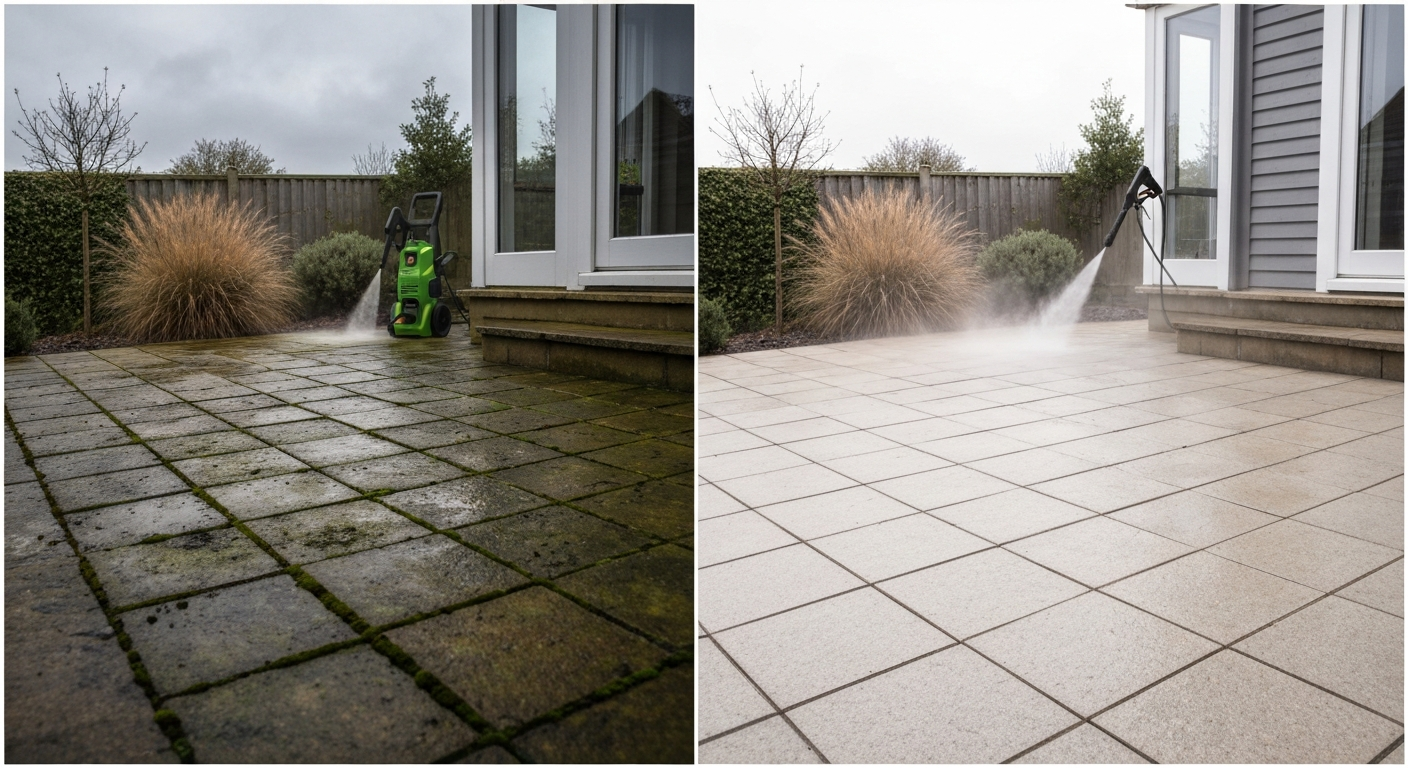
For a typical residential patio, you're looking at anywhere from 30 minutes to 3 hours of total work time. A small, clean 100 sq ft concrete slab takes about 30–45 minutes start to finish. A 400 sq ft patio in moderate condition runs 1 to 1.5 hours with the right equipment. A large, heavily soiled 800 sq ft patio with mold, grease, or moss can easily take 2.5 to 3 hours, especially if you need chemical pre-treatment and careful rinsing. Those ranges assume a single person working efficiently with a consumer-grade pressure washer. Add a surface cleaner attachment and a helper and you can shave 30–40% off most jobs.
How Long Does It Take to Pressure Wash a Patio: Time Guide
Rhea Lang
4 Aug 2026
At a glance: timed estimates by patio size and condition
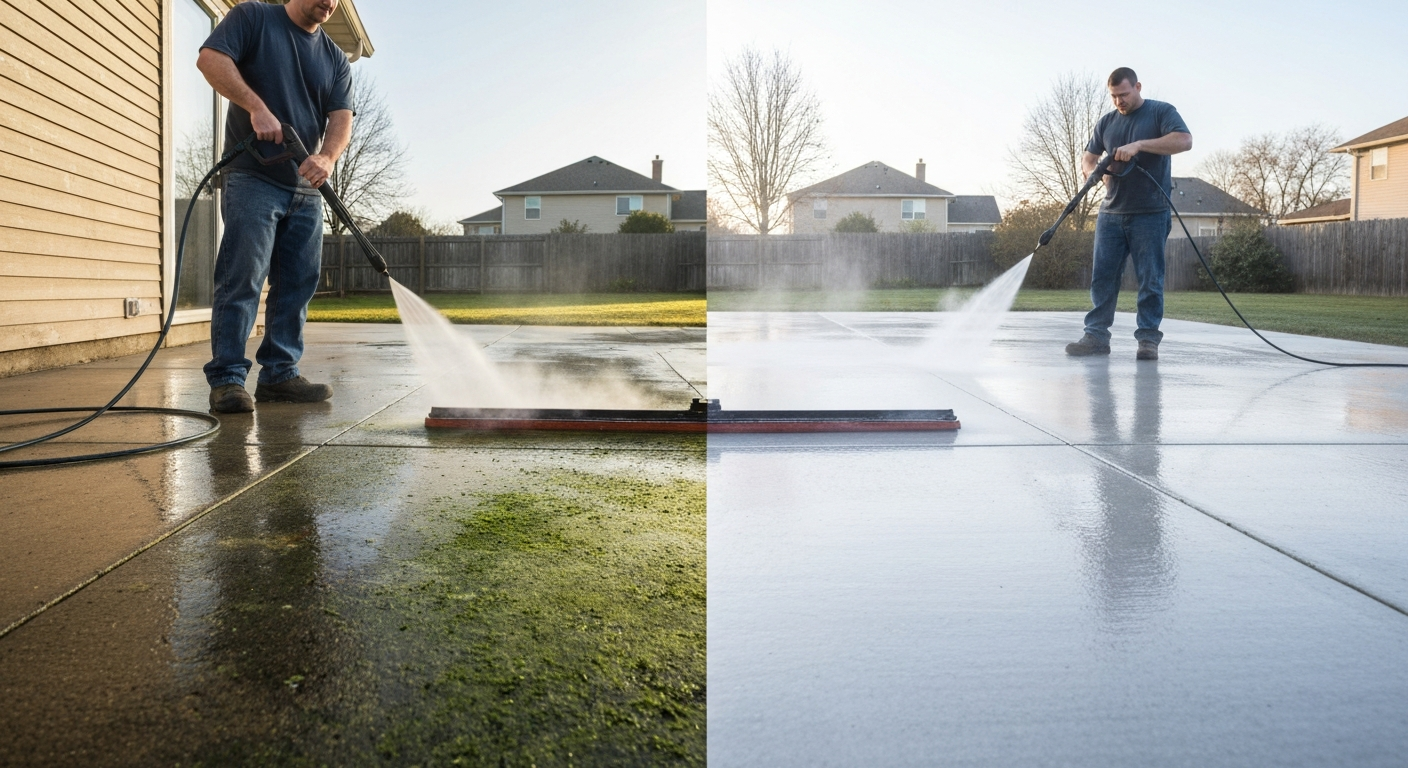
Before diving into the full breakdown, here are realistic time ranges for the most common scenarios. These include all time on-site: setup, washing, rinsing, and basic cleanup. They assume a single person with a consumer electric or light gas pressure washer.
| Patio Size | Clean / Lightly Soiled | Moderately Dirty | Heavily Soiled / Biological Growth |
|---|---|---|---|
| 100 sq ft | 30–40 min | 45–60 min | 60–90 min |
| 200 sq ft | 45–60 min | 60–90 min | 90–120 min |
| 400 sq ft | 60–80 min | 80–110 min | 120–150 min |
| 800 sq ft | 90–120 min | 120–160 min | 160–200 min |
| 1,000+ sq ft | 2–2.5 hrs | 2.5–3 hrs | 3–4 hrs |
These numbers are based on real-world contractor production rates and my own experience testing different setups. Heavily soiled means thick algae or moss, embedded grease, or rust staining that needs chemical pre-treatment and multiple passes. Lightly soiled means general dirt and dust that has built up over a season or two without significant biological growth.
Every minute accounted for: the full time breakdown
One thing I see homeowners consistently get wrong is planning only for the actual washing time and then being caught off guard by how long everything else takes. Prep, chemical dwell, rinsing, and cleanup together often add up to more time than the washing itself. Here is a realistic breakdown of each phase.
| Phase | Task | Time Estimate |
|---|---|---|
| Prep | Move furniture, clear debris, sweep surface | 5–15 min |
| Prep | Connect hose, fit nozzle/surface cleaner, test pressure | 5–10 min |
| Prep | Apply chemical pre-treatment (if needed) | 5–10 min |
| Chemical dwell | Wait for detergent or biocide to work | 5–20 min |
| Washing | First pass with pressure washer (per 100 sq ft) | 8–15 min |
| Washing | Spot-treat stubborn areas (per zone) | 5–10 min |
| Rinsing | Full rinse to remove detergent residue | 10–20 min |
| Cleanup | Coil hose, move equipment, wipe down machine | 5–10 min |
| Dry time | Surface dry before foot traffic (not your time, but plan for it) | 1–4 hrs |
The chemical dwell time is often where people lose the most unplanned time. Products like D/2 Biological Solution, which is commonly used for algae, moss, and lichen, require 10–15 minutes of contact time on the surface before you pressure wash. General-purpose degreasers like Krud Kutter typically need 5–15 minutes depending on the deposit. You cannot skip this and compensate with higher pressure without risking surface damage.
Step-by-step timed workflow you can actually follow
This is the workflow I use personally and recommend to anyone tackling a patio for the first time. I have used a 400 sq ft moderately dirty concrete patio as the worked example, but you can scale the times up or down using the table above.
- 0: 00 – Clear the patio: move chairs, pots, and furniture off the surface. Sweep or blow off loose leaves and debris. (10 min)
- 0: 10 – Set up the pressure washer: connect your garden hose, attach the correct nozzle or surface cleaner, run the machine briefly to purge air from the line. (5–8 min)
- 0: 18 – Apply pre-treatment: if you have moss, algae, mold, grease, or heavy staining, apply your chosen detergent or biocide now using a low-pressure soap nozzle or a garden sprayer. Work in sections so the product does not dry out. (8–10 min)
- 0: 28 – Dwell time: let the chemical sit and do its job. Do not rush this. Set a timer for the product's stated contact time (usually 10–15 min). (10–15 min)
- 0: 43 – Start washing: begin at the far end and work toward your drain or outlet. Overlap passes by about 20–30% to avoid tide marks. On a 400 sq ft patio with a surface cleaner, expect to cover it in 20–30 min. With a wand only, budget 35–45 min. (20–45 min)
- 1: 13 – Spot treatment: go back over any stubborn stains, joints, or edges that the first pass did not fully clean. Use a 25-degree nozzle for targeted work. (10–15 min)
- 1: 28 – Full rinse: switch to a wide-angle nozzle (40-degree) and rinse the whole surface thoroughly to push detergent residue toward the drain. (10–15 min)
- 1: 43 – Cleanup: coil hoses, flush the machine's detergent line with clean water, store equipment. (8–10 min)
- 1: 53 – Total active work time: approximately 85–110 min, with dry time of 1–4 hours before replacing furniture.
How surface type changes your total time
Surface material is probably the biggest variable in total job time after patio size. Some surfaces are forgiving and fast. Others demand caution, lower pressure settings, and multiple passes that add meaningful time. Here is what you should know about each.
Concrete
Poured concrete is the fastest surface to clean. It handles 1,500–3,000 PSI without damage, and a rotary surface cleaner covers it quickly and evenly. On clean concrete, production rates using a surface cleaner approach 1,500–2,000 sq ft per hour in practical residential use. How to Price Pressure Washing Jobs (CrewNest) reports contractor production ranges from about 500 sq ft/hour (manual wand) up to 1,500–3,000 sq ft/hour with a powered surface‑cleaner; crews price jobs accordingly. A wand alone drops that to roughly 500–800 sq ft per hour because you are manually tracking passes. The main time risk with concrete is etching (going too close or too high in PSI), which shows up as streaking and means you have to re-clean to blend the marks.
Brick and clay pavers
Brick and clay pavers need lower pressure than concrete, usually in the 1,200–1,500 PSI range, to avoid blasting out the jointing sand and eroding the face of softer bricks. The lower pressure means slower cleaning, and you almost always have to re-sand the joints afterwards, which is extra time not counted in the wash itself. Budget roughly 20–30% more time per square foot compared to concrete, plus 15–30 minutes for re-sanding a typical patio.
Natural stone (sandstone, limestone, slate)
Natural stone is where I have personally learned the most painful lessons. Sandstone and limestone are porous and soft enough that high pressure will pit or etch the surface permanently. Keep PSI below 1,200 on sandstone, ideally closer to 800–1,000 PSI with a wide-angle nozzle (40 degrees). This slow, careful approach can cut your area-per-hour rate roughly in half compared to concrete, meaning a 400 sq ft sandstone patio may take 90 minutes to wash rather than 45. Slate is denser and handles pressure better but has thin cleavage planes that can chip if you get the nozzle too close. Keep the wand at least 12 inches from the surface.
Porcelain and ceramic tiles
Porcelain tiles are actually quite forgiving for pressure washing because the surface is hard and non-porous. The issue is the grout lines. High pressure will erode grout quickly, so you need to work at a low angle, keep the pressure around 1,000–1,500 PSI, and avoid directing the jet straight into grout joints. Washing time is similar to concrete per square foot, but you have to be deliberate about your nozzle angle, which slows the pace a little.
A quick comparison
| Surface | Recommended PSI Range | Relative Speed | Key Caution |
|---|---|---|---|
| Concrete | 1,500–3,000 PSI | Fastest | Avoid etching from too-close nozzle |
| Brick / clay pavers | 1,000–1,500 PSI | Moderate (–20–30%) | Joint sand loss; may need re-sanding |
| Sandstone / limestone | 800–1,200 PSI | Slow (–40–50%) | Pitting and erosion at higher PSI |
| Slate | 1,000–1,500 PSI | Moderate–slow | Chipping along cleavage planes |
| Porcelain tiles | 1,000–1,500 PSI | Moderate | Grout erosion; mind nozzle angle |
How the type of dirt or stain changes the time
General grime and dust wash off fast. Biological growth and chemical stains are a different story. Each problem type either requires extra chemical pre-treatment, longer dwell time, or multiple passes, all of which add real minutes to the job.
Mold and algae
A light coating of green algae on concrete can be removed with a single pass at 2,000–2,500 PSI with no pre-treatment. Heavy algae or black mold needs a biocide applied and left to dwell for 10–15 minutes first, otherwise you just spread spores rather than killing them. Add 15–25 minutes to the total job time for pre-treatment and dwell on a standard patio.
Moss
Thick moss takes more passes than algae because it has root-like rhizoids that anchor into porous surfaces. You often need to pre-treat with a moss killer, allow 15–20 minutes of dwell, then wash, then inspect and re-wash any patches where moss came off in chunks. Total added time: 20–40 minutes on a heavily mossy patio. On natural stone, the lower PSI required slows this down further.
Rust stains
Pressure washing alone will not remove rust stains. You need an oxalic acid-based cleaner applied first, allowed to dwell for 5–15 minutes, scrubbed in for stubborn deposits, and then rinsed. Do not expect to blast rust off with high pressure. Budget an extra 20–30 minutes for a rust-stained area, including the scrubbing step.
Grease and oil
BBQ grease, cooking oil, or motor oil soaked into concrete is one of the slower problems to deal with. Apply a degreaser generously, work it in with a stiff brush on severe spots, allow 10–15 minutes of dwell, then wash. On deeply soaked stains you may need two applications, which doubles the dwell time. Add 25–45 minutes total for a grease problem depending on severity.
Pet stains and organic matter
Pet urine and organic debris (bird droppings, food residue) typically respond well to an enzymatic cleaner pre-treatment. Apply, dwell for 10–15 minutes, then pressure wash. The washing itself is not particularly slow, but the pre-treatment step adds 15–25 minutes. The upside is that enzyme cleaners neutralize odour where pressure washing alone just moves it around.
Equipment and settings that speed up (or slow down) the job
Electric vs gas pressure washers
A consumer electric model like the Karcher K5 runs at around 2,000 PSI and 1.4 GPM. A light gas unit like the Simpson MegaShot delivers around 3,000–3,200 PSI at 2.4–2.5 GPM. That difference in GPM is actually what matters most for speed. Cleaning units (PSI multiplied by GPM) give you a better predictor of area covered per minute than PSI alone. The Karcher K5 produces about 2,800 cleaning units; the Simpson produces roughly 7,500–8,000. In practice this means the gas unit will clean the same area 30–50% faster on a lightly soiled surface, with the gap widening on heavier soil where more water volume is needed to flush debris.
Surface cleaners
A rotary surface cleaner is the single biggest time-saver on a flat patio. Commercial surface cleaners on concrete achieve 2,000–3,000 sq ft per hour. Even a decent consumer surface cleaner attachment on an electric machine will clean 800–1,200 sq ft per hour and eliminates the stripe marks you get from a wand. If you are cleaning a patio larger than 200 sq ft regularly, a surface cleaner pays for itself in time alone. The trade-off is that you still need a wand for edges, corners, and steps.
Nozzle selection
The 25-degree (green) nozzle is the general-purpose workhorse for concrete and brick. The 40-degree (white) nozzle is better for rinsing and for soft stone. The 15-degree (yellow) nozzle covers area more slowly but hits stubborn spots harder. The 0-degree (red) nozzle has almost no practical use on a patio surface and risks etching concrete or stripping grout instantly. Switching nozzles mid-job adds 2–3 minutes each time, which is worth accounting for if you are doing multiple problem zones.
Detergents and chemical application
Using the onboard detergent tank (if your machine has one) is faster than a separate garden sprayer for pre-treatment. However, on-board systems deliver low-pressure chemical application and are less even on large surfaces. A separate 1–2 gallon pump sprayer gives better control and coverage on a big patio and is worth the minor setup time. Either way, factor in the product's dwell time as non-negotiable waiting time that you cannot compress.
Solo vs two-person teams: realistic time savings
Adding a second person to a patio pressure-washing job does not cut time in half, because most of the actual washing is one person operating the machine. But a helper makes a real difference in three specific areas: pre-treatment application (one person sprays while the other sets up the machine, saving 10–15 minutes), clearing and replacing furniture (saving 5–10 minutes), and managing hoses and power cables on larger patios (reducing the interruptions that slow down a single operator). On a 400–800 sq ft patio, a two-person team typically finishes 25–35% faster than a solo operator, primarily because pre-treatment and setup happen in parallel rather than sequentially.
| Patio Size | Solo Operator | Two-Person Team | Time Saved |
|---|---|---|---|
| 200 sq ft (moderate soil) | 75–90 min | 55–65 min | ~25% |
| 400 sq ft (moderate soil) | 100–120 min | 70–85 min | ~30% |
| 800 sq ft (moderate soil) | 130–160 min | 90–110 min | ~30–35% |
| 400 sq ft (heavy soil, chemical pre-treat) | 130–150 min | 95–110 min | ~25–30% |
Timed examples by patio size: the numbers side by side
To make planning straightforward, here are worked examples covering the four most common residential patio sizes under three soil conditions. All times assume a single operator with a gas or quality electric pressure washer, using a surface cleaner for the main area and a wand for edges.
100 sq ft patio
- Clean / lightly soiled: 5 min prep, 12–15 min washing, 8 min rinse, 5 min cleanup = 30–35 min total
- Moderately dirty (some algae, general grime): 10 min prep, 15–18 min washing, 10 min rinse, 5 min cleanup = 40–45 min total
- Heavily soiled (moss, grease, or mold): 10 min prep, 10 min pre-treatment application, 15 min dwell, 20–25 min washing, 10 min rinse, 5 min cleanup = 70–80 min total
200 sq ft patio
- Clean / lightly soiled: 8 min prep, 18–22 min washing, 10 min rinse, 5 min cleanup = 40–45 min total
- Moderately dirty: 10 min prep, 25–30 min washing, 12 min rinse, 5 min cleanup = 52–60 min total
- Heavily soiled: 12 min prep, 12 min pre-treatment, 15 min dwell, 35–45 min washing, 12 min rinse, 5 min cleanup = 90–100 min total
400 sq ft patio
- Clean / lightly soiled: 10 min prep, 30–35 min washing, 15 min rinse, 8 min cleanup = 63–68 min total
- Moderately dirty: 12 min prep, 40–50 min washing, 18 min rinse, 8 min cleanup = 78–88 min total
- Heavily soiled: 15 min prep, 15 min pre-treatment, 15 min dwell, 55–65 min washing, 18 min rinse, 8 min cleanup = 126–136 min total
800 sq ft patio
- Clean / lightly soiled: 15 min prep, 55–65 min washing, 20 min rinse, 10 min cleanup = 100–110 min total
- Moderately dirty: 15 min prep, 70–80 min washing, 25 min rinse, 10 min cleanup = 120–130 min total
- Heavily soiled: 20 min prep, 20 min pre-treatment, 15 min dwell, 90–110 min washing, 25 min rinse, 10 min cleanup = 180–200 min total
Safety and prep steps that add time (do not skip them)
I know it is tempting to skip straight to washing, but a few short safety steps protect both you and your patio surface. If you need guidance on seasonal timing and weather considerations, see our guide on when is the best time to pressure wash your patio. For guidance on seasonal timing, see our guide to the best time to clean patio in the UK. For guidance on seasonality, see our guide to the best time of year to power wash a patio. For guidance on seasonal timing and weather considerations, see the best time of year to clean patio. Pressure washers cause serious injuries including injection wounds and chemical burns. The setup time is genuinely worth it.
- Put on eye protection, water-resistant footwear, and work trousers before starting. This takes under 2 minutes and is non-negotiable.
- Cover any outdoor electrical sockets, light fixtures, or wall-mounted items with plastic sheeting or tape before washing near walls. Add 3–5 minutes.
- Check the hose and wand connections for leaks before applying full pressure. A blown O-ring mid-job costs more time than the check takes.
- Test pressure on an inconspicuous corner before committing to a PSI setting on any unfamiliar surface. Budget 2–3 minutes for this.
- Check your local drainage rules: pressure washing wastewater that contains detergents or contaminants should not go directly to storm drains. For most homeowners this means directing runoff to a lawn or garden bed rather than the street drain. Factor in 5 minutes to plan your runoff direction before starting.
Tips that genuinely speed the job up
After testing a lot of setups and cleaning a lot of patios, these are the things that actually save meaningful time, not marketing-claim shortcuts. For guidance on weather and seasonal timing, see our guide to the best time to jet wash patio for optimal results.
- Use a surface cleaner for any flat area over 100 sq ft. It is faster, removes stripe marks, and reduces operator fatigue on bigger jobs.
- Apply pre-treatment before setting up the machine rather than after. The dwell time overlaps with your setup time and costs you nothing.
- Work in sections of roughly 50–100 sq ft, completing each section before moving on. Random back-and-forth wastes steps and time.
- Keep your water supply pressure consistent. A long undersized garden hose chokes GPM and slows the machine's performance. Use at least a 3/4-inch diameter garden hose and keep runs under 100 feet where possible.
- For biological stains (algae, moss, mold), do not attempt to blast them off without pre-treatment. Two rounds of washing without chemistry takes longer than one round with a 15-minute dwell.
- Rinse in a single directional sweep toward a drain or lawn edge rather than back-and-forth. This moves detergent residue off the surface faster.
- If you clean your patio once a year in autumn or spring (both common schedules based on the seasonal timing guidance homeowners often look for), you will rarely face heavily soiled conditions and your total time will stay at the lower end of these estimates.
When to consider hiring a professional instead
For most homeowners with a standard concrete or paved patio under 600 sq ft, DIY pressure washing is completely manageable. For advice on timing and seasonal considerations, see when to power wash patio. For guidance on scheduling regular maintenance, see how often to pressure wash patio. But there are situations where the time and risk calculation tips toward hiring a pro. If your patio is made of historic or delicate natural stone, professional operators know to work at very low pressures (sometimes as low as 200–400 PSI on sensitive masonry) and have experience reading how a surface responds. If you have a very large area (1,000+ sq ft), a contractor with a commercial surface cleaner and a higher-GPM machine will finish the job in half the time a DIY operator with consumer equipment will. And if your patio has deep rust, oil, or mold penetration that needs multiple chemical treatments and re-washing cycles, the total time for a DIY job can stretch beyond 4–5 hours, at which point a professional's rate (charged per square foot or per hour) may represent better value for your time. For guidance on maintenance frequency, see our guide on how often to jet wash a patio.
FAQ
Quick answer: How long does it take to pressure wash a patio?
Most typical residential patios take between 30 minutes and 3 hours from start to finish for a single DIY operator. Small, lightly soiled patios (100–300 sq ft) with an electric washer and a surface cleaner: ~30–60 minutes. Medium patios (300–800 sq ft) with a gas unit or surface cleaner: ~1–2 hours. Large or heavily soiled patios (>800 sq ft), intricate surfaces, or jobs needing chemical pre‑treatment/wastewater control: 2–4+ hours.
What are the step‑by‑step timed components of a patio pressure‑wash job?
Typical timed workflow for a 400 sq ft patio (single person): - Setup & safety prep: 10–20 minutes (inspect surface, move furniture, lay out hoses, PPE). - Pre‑treatment (chemical degreaser/biocide) if needed: 5–20 minutes application + 5–20 minutes dwell time (overlaps with setup if staged). - Washing by zone (surface cleaner vs wand): 20–60 minutes. Surface cleaner: ~10–25 minutes for 400 sq ft; wand: ~30–60 minutes depending on detail work. - Rinsing & detail passes (joints, edges): 10–30 minutes. - Cleanup & wastewater containment/collection (silt socks, tarps): 10–30 minutes (longer if routing to sanitary sewer or using recovery equipment). - Dry time before replacing furniture: 1–24 hours (solar/wind speeds drying; immediate light foot traffic possible in 1–2 hours). Total elapsed time: typically 1–3 hours; active hands‑on time often 60–120 minutes.
How does patio size affect time? (typical examples)
Examples using realistic production rates: - 150 sq ft (small): 20–45 minutes total (setup + wash + rinse). - 300 sq ft (small/medium): 30–75 minutes. - 500 sq ft (medium): 45–90 minutes with surface cleaner; 60–120 minutes with wand. - 1,000 sq ft (large): 1.0–2.5 hours with commercial surface cleaner; 2–4 hours with wand/manual detail. Production numbers pros use: manual wand work ~400–800 sq ft/hour (detailed); surface cleaners ~1,500–3,000 sq ft/hour (flat, concrete) depending on GPM/PSI.
How do surface types change the time required?
Surface sensitivity and texture change speed because of required pressure, dwell times, and care: - Concrete (flat): fastest — can use surface cleaner; expect 1,500–3,000 sq ft/hr on concrete with the right equipment. - Brick/pavers: moderate — need joint care and avoid sand loss; surface cleaner helps but slower than plain concrete. Add 10–30% extra time. - Natural stone (sandstone, slate): slower — lower pressures, gentler nozzles, possible hand‑scrubbing; add 25–100% extra time. - Porcelain tiles: moderate — avoid extremely high PSI and aggressive nozzles; similar speed to pavers but more careful passes. - Highly textured or patterned surfaces: slower because of edges and grooves; plan for extra detail passes and chemical dwell. For historic or fragile masonry, run test patches and expect much slower, low‑pressure cleaning (sometimes using detergent or poultices) — add significant time.
How do different soil/problems (mold, algae, moss, rust, grease, pet stains) change time?
- Light dirt/grime: minimal or no chemical, quick rinse — baseline time. - Mold/algae/moss: usually need biocide/cleaner, 10–20 minute dwell, then wash; plan +15–40 minutes. Moss with roots may require scraping before washing: +10–30 minutes. - Rust stains: often need specialized rust removers and multiple treatments; add 20–60+ minutes and possibly repeat visits. - Grease/oil: degreaser + dwell (5–20 minutes) and agitation or hot‑water/high‑GPM cleaning; add 15–45 minutes. - Pet stains: spot treat with enzyme cleaners and rinse; add 5–20 minutes. Heavy or multiple contamination types compound time.
How do equipment and settings affect speed (electric vs gas, PSI, GPM, nozzles, surface cleaners)?
Key equipment factors that speed or slow work: - PSI vs GPM: Cleaning speed is best predicted by cleaning units (PSI × GPM). Higher GPM generally cleans more area per minute if pressure is adequate. - Electric (1,700–2,200 PSI, low GPM): slower on heavy stains; fine for light jobs and small patios. - Gas/contractor (2,500–3,500+ PSI, higher GPM): faster on concrete and heavy soils but risk of damage on soft stone. - Surface cleaners: dramatically faster on flat concrete/pavers (often 1,500–3,000 sq ft/hr) and reduce streaks — can cut wash time by 50–80% vs wand. - Nozzles: wider fan nozzles and lower pressure tips speed coverage; turbo/rotary nozzles increase cleaning power but risk surface damage and require cautious use. - Hot‑water units: much faster on grease/oil and industrial stains; adds equipment complexity/time to set up but reduces dwell/agitational needs. Choosing a surface cleaner and a higher‑GPM, appropriate PSI unit is the single biggest speed gain for typical patios.
Next Article
When Is the Best Time to Pressure Wash Your Patio: Timing Guide
Best time to pressure wash your patio: season, time of day, weather, surfaces, pressure settings, DIY vs pro.