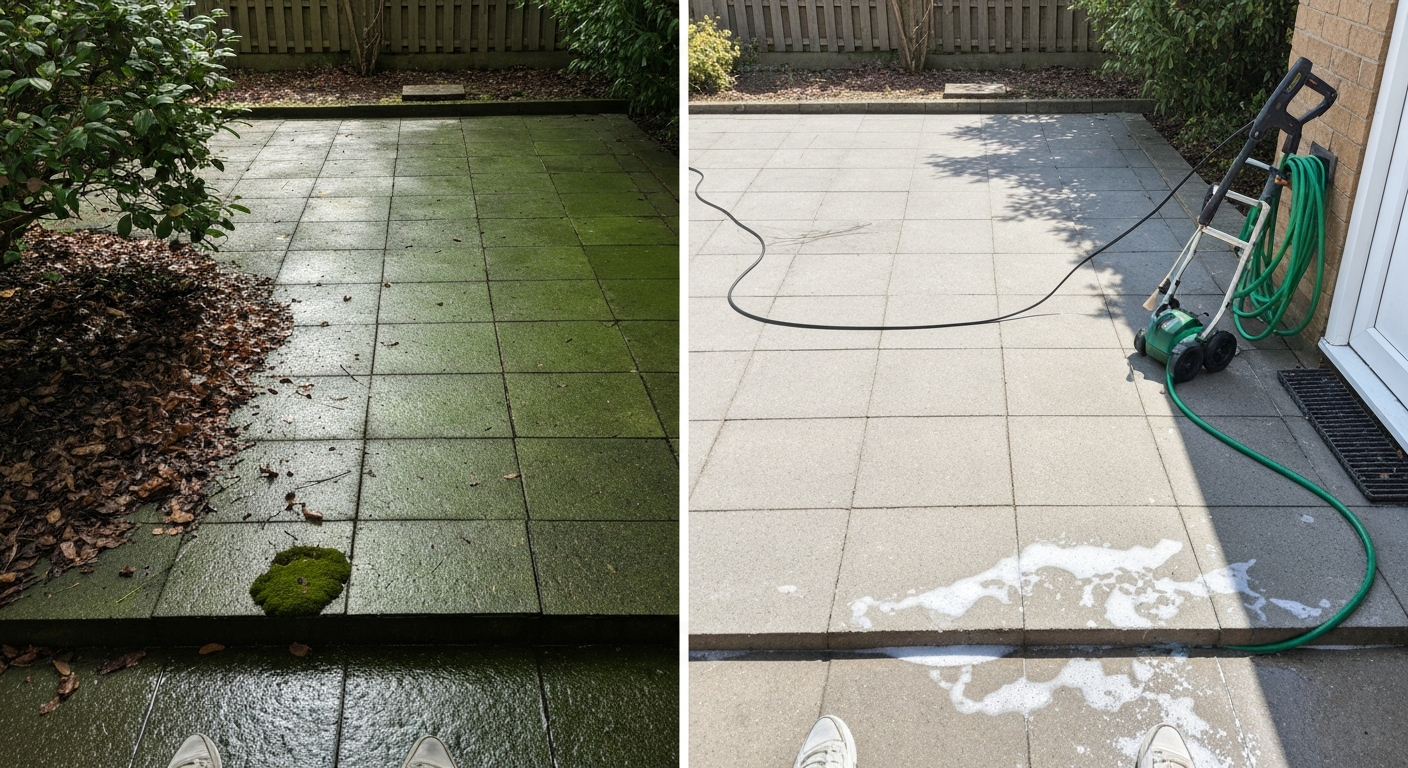
For most patios, once a year is the right rhythm. A thorough jet wash every spring keeps biological growth from taking hold and removes the grime that builds up over winter. If your patio is heavily shaded, under trees, or sees a lot of foot traffic, you'll want to clean it twice a year (spring and autumn). A sheltered, sunny patio with light use can get away with every 18 months to 2 years, provided you inspect it regularly and act the moment you see green film or feel it getting slippery underfoot.
How Often to Jet Wash a Patio: Frequency, Timing & Tips (UK)
Rhea Lang
26 Jul 2026
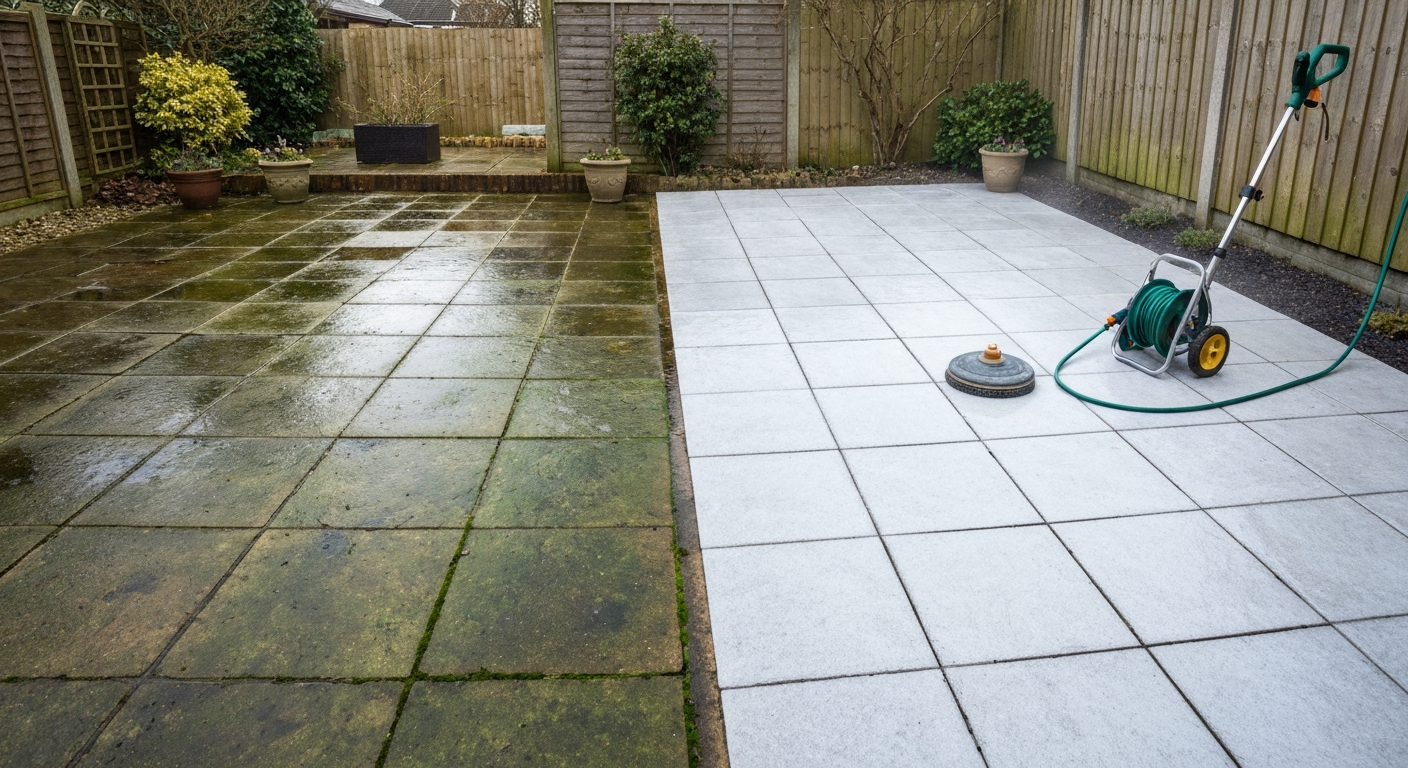
Factors that change how often your patio actually needs cleaning
There is no one-size-fits-all answer because two patios in the same street can have completely different cleaning needs. I've seen a north-facing slab covered in black algae by October, while a south-facing porcelain patio twenty metres away looked almost new after two years. Here's what actually moves the needle on cleaning frequency.
- Shade and sun exposure: patios in persistent shade stay damp and grow moss, algae, and lichen far faster than sunny spots. A north-facing or heavily shaded patio almost always needs cleaning twice a year.
- Climate and rainfall: high humidity, frequent rain, and mild winters in the UK create near-perfect conditions for biological growth year-round. Wetter regions (western Scotland, Wales, the northwest of England) typically see faster build-up.
- Tree and plant cover: overhanging trees deposit tannins, leaf debris, and organic matter that feed algae and stain paving. Heavy leaf fall in autumn is a strong signal to add a second clean.
- Foot traffic and use: a heavily used patio or one that doubles as a play area collects more dirt, grease, and organic debris. The ICPI recommends annual inspection and cleaning for high-traffic paved areas as a minimum.
- Drainage quality: poor drainage means water pools and sits, which accelerates algae and moss growth. If your patio drains slowly, expect to clean more often.
- Organic growth (moss, algae, lichen): visible green, black, or grey film is the most reliable signal to clean regardless of schedule. If a patio is slippery when wet, it needs treating now, not next spring.
- Staining from food, oil, or pets: frequent barbecues, cooking, or pet use introduces grease and organic stains that embed quickly and are harder to shift the longer they're left.
- Proximity to soil and lawn edges: patios next to planted borders or lawns get a constant supply of dirt migrating onto the surface, shortening the effective interval between cleans.
How often to clean each patio surface type
Surface material genuinely changes both how often you need to clean and how aggressively you can do it. Here's what I'd recommend for the most common types, based on manufacturer guidance and real-world use.
| Surface | Typical Interval | Max Safe PSI (approx.) | Notes |
|---|---|---|---|
| Concrete | Once a year (sooner if stained) | 2,500–3,500 PSI / 170–240 bar | Handles higher pressure well; use a rotary surface cleaner and keep standoff to avoid spalling or etching |
| Brick / concrete block paving | Once a year | 1,500–2,500 PSI / 103–172 bar | Use wide-fan nozzle or surface cleaner; re-sand joints after cleaning if sand is displaced |
| Natural stone (limestone, marble) | Annually or when biofilm/staining appears | Up to 1,200 PSI / 83 bar | Calcareous stones are chemically sensitive; always use a stone-safe cleaner and test patch first |
| Sandstone | Once a year, inspect after heavy rain seasons | Up to 1,200 PSI / 83 bar | Soft and absorbent; low pressure and pH-neutral cleaners only, avoid acidic products |
| Slate | Annually or as required | Up to 1,200 PSI / 83 bar | Soft-wash approach preferred; slate can delaminate under sustained high-pressure impact |
| Porcelain | Once a year or spot clean as needed | Moderate; wide-fan or surface cleaner | Low absorbency means less staining; follow manufacturer instructions, diagonal passes recommended by many UK suppliers |
A word on sandstone and slate specifically: I've seen both surfaces badly damaged by homeowners using the wrong nozzle or pressure setting. The surface looks fine, you finish the job, and then a few weeks later the stone starts to pit or flake. Always do a test patch in a hidden corner before you commit to cleaning the whole patio.
The best time of year to jet-wash your patio
Spring is the primary window for a deep clean, and for good reason. After winter, your patio will have accumulated months of frost-and-thaw cycles, trapped moisture, and organic debris. Cleaning in early to mid-spring (typically March to May in the UK) removes all of that, and more importantly, gives you the right conditions to apply a preventive biocide or sealer before the warmer, wetter months arrive. For a full guide on timing and seasonal considerations, see our best time of year to power wash patio. For more detail on timing and seasonal advice, see our guide on when to power wash patio (internal resource ID 2f5281e9-5fb0-46ee-99d6-189eddfb5d63). See best time of year to clean patio for detailed seasonal guidance. Apply a biocide after your spring clean and you can significantly slow biological regrowth for the rest of the year. For a focused guide on timing and seasonal tips, see our article on when is the best time to pressure wash your patio. For more detail on timing and conditions, see our guide to the best time to jet wash patio. For a detailed UK-focused guide on the best time to clean a patio, see our best time to clean a patio in the UK.
For patios under trees or in heavy-shade gardens, an autumn clean in September or October makes a real difference. Leaf tannins and organic matter left sitting over winter stain paving and feed moss aggressively. Getting the surface clean before the cold sets in means you're not dealing with months of embedded organic material come spring.
UK-specific note: avoid pressure washing or applying chemical treatments during frost, or when temperatures are forecast to drop below 0°C within a few hours. Many biocides and sealers have a working temperature window, often 10°C to 25°C, and some specify no rain for a set number of hours after application. Lithofin ALGEX, for example, has specific application conditions on its datasheet that are worth reading before you spray. If you're cleaning in October or November, check the overnight forecast, not just the current temperature.
Best weather and time of day to get the job done
The ideal conditions are a cool, overcast, calm day with no rain forecast for several hours. Direct hot sunshine is actually one of the worst conditions to apply detergent or biocide: it dries on the surface before it can work, streaks badly, and you end up using far more product than necessary. I learned this the hard way on a July afternoon when the detergent was drying faster than I could rinse it.
Morning or late afternoon are the best times of day. You avoid the heat of midday sun, the surface is unlikely to have dried out from direct sun, and if you're applying any treatment, it has time to dwell before conditions change. Wind is worth factoring in too: pressure washing in a stiff breeze means spray drift onto plants, furniture, and yourself. Windy days also increase the risk of biocide or detergent run-off hitting adjacent soil, which is worth avoiding both for the plants and because of environmental considerations. How To: Pressure Wash Your House, Lowe's (operator manual/guide) recommends avoiding pressure washing in windy conditions to minimise spray drift and reduce the risk of detergent or biocide runoff onto nearby soil and plants How To: Pressure Wash Your House — Lowe's (operator manual/guide).
Signs your patio needs cleaning now, not later
Don't wait for the calendar if you're seeing any of these. Slipperiness is the most urgent one: in the UK, the Pendulum Test Value (PTV) is the accepted safety measure for wet surfaces, and a wet PTV below 36 is the threshold at which a surface is considered a slip risk by HSE and UKSRG guidance. You don't need to conduct a formal test to know when a patio is dangerous. If you walk on it after rain and feel your boot heel lose grip, or if a family member or pet has slipped, that surface needs treating immediately.
- Visible green, black, or grey biological film (algae, moss, lichen)
- Slippery or reduced traction when wet
- Dark staining or discolouration across large areas
- Embedded food, grease, or oil stains from a barbecue or outdoor cooking
- Significant leaf or organic debris that has been sitting for more than a few weeks
- Joint moss that is lifting or displacing pointing or sand
- Pet stains that are starting to smell or discolour the surface
- Visible rust spots from metal furniture
How long does pressure washing a patio actually take?
Most homeowners underestimate the time. A standard consumer pressure washer moves more slowly than you'd think if you're doing the job properly, and setup, moving furniture, and any post-clean treatment all add time on top of the actual washing. For a detailed breakdown of typical timings and what adds to the job, see how long does it take to pressure wash a patio.
| Patio Size | Condition | Estimated Time (washing only) | With prep and treatment |
|---|---|---|---|
| Small (up to 20 m²) | Light dirt, no heavy biofilm | 20–40 minutes | 1–1.5 hours |
| Small (up to 20 m²) | Heavy moss, algae, or staining | 40–60 minutes | 1.5–2.5 hours |
| Medium (20–50 m²) | Light to moderate dirt | 45 minutes–1.5 hours | 2–3 hours |
| Medium (20–50 m²) | Heavy biological growth or staining | 1.5–2.5 hours | 3–4 hours |
| Large (50 m²+) | Light to moderate dirt | 1.5–2.5 hours | 3–5 hours |
| Large (50 m²+) | Heavy growth, deep staining | 2.5–4+ hours | Half to full day |
A rotary surface cleaner attachment significantly speeds up the washing phase on flat surfaces and gives a more even result than a lance alone. If you're cleaning a large concrete or block paving area regularly, it's worth the investment.
Prep checklist before you start jet washing
Skipping prep is how you end up with damaged plants, scratched furniture, and a soaking wet garden shed. Run through this before you turn the machine on.
- Clear the patio: remove all furniture, plant pots, ornaments, and anything else that could be hit by spray or needs protecting.
- Protect adjacent plants and borders: cover or move any plants close to the patio edge. Biocides and detergents can harm plants, and high-pressure spray can strip foliage.
- Check and protect any drains: if using chemical treatments, be aware of where run-off goes. Some products have environmental restrictions on draining to watercourses.
- Identify delicate surfaces: note any areas with cracked or loose pointing, fragile joint material, or repaired sections that need lower pressure or avoidance.
- Do a test patch: pick a hidden corner and test your pressure, nozzle, and any cleaner on a small area before committing to the whole patio.
- Put on PPE: waterproof boots with grip, waterproof trousers or leggings, eye protection (essential, not optional), and waterproof gloves, especially if using chemical cleaners.
- Check the hose and connections: inspect your pressure washer hose, lance, and connections for wear or damage before pressurising the system.
- Have your detergent or biocide ready: if you plan to apply a product after washing, have it mixed and ready so you can apply it while the surface is still open and slightly damp.
Equipment basics: what you actually need for a DIY patio clean
Types of pressure washer
For most domestic patios, an electric pressure washer in the 1,500–2,200 PSI (100–150 bar) range is sufficient and much easier to manage than a petrol unit. Petrol machines produce higher pressure and flow rates (useful for large driveways or commercial use) but are heavier, noisier, and require more maintenance. Cold-water electric machines cover the vast majority of home patio cleaning needs. Hot-water pressure washers are very effective at cutting through oil and grease but are expensive and largely a professional tool.
Key accessories
- Rotary surface cleaner: the most useful upgrade for flat patio surfaces. Cleans faster, more evenly, and reduces the risk of stripe marks from a lance. Most consumer units from Kärcher, Bosch, and Nilfisk have compatible surface cleaner attachments.
- Fan nozzles (25° and 40°): use these for patios rather than narrow tips. A 40° tip is good for a light rinse, 25° for general cleaning. Avoid 0° (pencil jet) tips on paving entirely.
- Foam cannon or detergent lance: useful for pre-applying cleaning solution to the surface before washing, particularly for biological growth or oil staining.
- Extension lance: helpful for getting into awkward corners and reducing the physical strain of bending or leaning.
PPE
- Safety glasses or goggles (mandatory: high-pressure spray can cause serious eye injury)
- Waterproof grip boots (non-negotiable on a wet, potentially slippery surface)
- Waterproof trousers or leggings
- Chemical-resistant gloves if using biocides, acid cleaners, or concentrated detergents
Pressure, nozzle, and technique: the numbers that matter
The most common mistake I see is people using either too much pressure or too narrow a nozzle angle, especially on natural stone and block paving. The second most common is holding the lance too close. These two errors cause more patio damage than any other factor.
Marshalls recommends holding the lance at an oblique angle (not straight down) and at least 200 mm (about 8 inches) from the surface. Kärcher's own operator guidance suggests around 150 mm (15 cm) as a working distance for consumer units on pavers. I'd suggest starting further away than you think you need to be, then gradually closing the distance until you're getting effective cleaning without surface disturbance or sand ejection from joints.
| Nozzle Tip | Spray Angle | Best Use on Patios | Avoid For |
|---|---|---|---|
| Red (0°) | Pencil jet | Do not use on paving | All patio surfaces |
| Yellow (15°) | Narrow fan | Stubborn stains on concrete only, with care | Natural stone, brick joints, sandstone, slate |
| Green (25°) | Medium fan | General cleaning on concrete and brick | Soft stone, sandstone, finished slate |
| White (40°) | Wide fan | Rinsing, light cleaning, all surfaces | Situations where more cleaning power is needed |
| Rotary surface cleaner | N/A | Best for flat areas: concrete, block paving, porcelain | Uneven or textured natural stone surfaces |
Keep passes overlapping and consistent. Uneven passes leave visible lines (tiger striping), especially on concrete. Work in sections, move with the grain of any surface texture, and rinse thoroughly after any detergent application.
Detergents, biocides, and sealers: when and what to use
Plain water pressure washing removes loose dirt and a good proportion of biological growth, but it doesn't kill algae or moss spores, so regrowth happens faster. Using a biocide after cleaning is the single most effective thing you can do to extend the time between cleans. Apply it after the surface has been washed and has started to dry. Most biocides need to be left to dwell for hours or even days, so don't schedule this on a day when rain is forecast.
For detergents, use a product matched to your surface. Acidic cleaners (including some commercial concrete and brick cleaners) can etch natural stone, especially calcareous stones like limestone, sandstone, and marble. Stick to pH-neutral or alkaline options for natural stone, and check the product label. If you're dealing with oil or grease stains, a specific degreaser applied before pressure washing will work significantly better than just high pressure alone.
Sealers are worth applying to absorbent natural stone (sandstone, limestone) and brick after cleaning. They won't stop biological growth completely, but they significantly slow it down by reducing the surface's ability to absorb water and organic matter. Most sealers on permeable stone need reapplying every 2 to 4 years depending on traffic and exposure. Porcelain generally doesn't need sealing due to its very low absorbency, but the joints may benefit.
When to call a professional instead of DIYing it
There are situations where hiring a professional patio cleaner is the right call, not just the lazy one. Deep-set lichen on natural stone is one of them: lichen actually bonds to and physically etches into the stone surface, and removing it without causing further damage is genuinely difficult without the right low-pressure soft-wash equipment and specialist chemical dwell treatments. Trying to blast it off with a high-pressure consumer machine usually makes things worse.
- Persistent lichen on natural stone that hasn't responded to biocide treatment
- Large patios (50 m² or more) where a DIY job would take a full day and good results aren't guaranteed
- Cracked, loose, or badly pointed paving that could be further damaged by high-pressure water
- Rust or iron staining that requires specialist acidic treatment not suitable for general DIY use
- Historic or premium natural stone (York stone, marble, travertine) where incorrect technique could cause permanent damage or invalidate a warranty
- Patios with significant structural issues or subsidence that need assessment alongside the clean
- If you're uncomfortable operating a high-pressure machine, particularly around children, pets, or glass
Aftercare and a simple year-round maintenance schedule
The easiest way to keep a patio looking good and reduce the intensity of each annual clean is to do a small amount of maintenance throughout the year. This doesn't take much time and it makes a genuine difference to how fast biological growth and staining establish themselves.
| Task | Frequency | Notes |
|---|---|---|
| Sweep to remove leaves and debris | Weekly or after leaf fall | Prevents organic matter feeding algae and staining the surface |
| Spot clean spills (oil, food, pet stains) | Immediately or within 24 hours | Much easier to shift before it's embedded; use a suitable spot cleaner for the surface type |
| Inspect joints for moss or weed growth | Monthly during growing season | Pull or treat weeds early before roots displace pointing or joint sand |
| Full jet wash | Once a year (spring) as standard | Twice a year for shaded, high-traffic, or tree-lined patios |
| Apply biocide | After each full jet wash | Extends time before regrowth; follow product temperature and rain timing requirements |
| Re-sand block paving joints | After each pressure wash if sand displaced | Use kiln-dried sand and compact it back into joints to prevent weed establishment |
| Re-seal natural stone or brick | Every 2–4 years | Check sealer effectiveness with a water droplet test: if water absorbs rather than beads, it's time to reseal |
| Check for cracked or loose slabs | Each spring | Address before a pressure wash to avoid worsening damage |
Choosing the right kit for your patio
Getting the cleaning frequency right is only half the job. Using the wrong pressure washer, nozzle, or cleaning product for your specific surface is what causes lasting damage or disappointing results. If you're not sure which pressure washer suits your patio size and surface, or which biocide or patio cleaner is worth buying, the reviews on this site break everything down by surface type and specific problem (moss versus algae, concrete versus natural stone, porcelain, and more). For a quick primer on timing and frequency, see our guide on how often to pressure wash patio. There are also detailed comparisons of patio cleaning chemicals, including biocides, degreasers, and sealers, covering both professional-grade options and budget-friendly alternatives that actually perform. Start with the surface type you have, and use that to filter down to the right equipment and cleaner combination rather than buying on brand name or price alone.
FAQ
Short answer: how often should I jet‑wash/pressure‑wash a patio?
For most homeowners: a thorough pressure wash about once a year. Shaded, damp, high‑traffic or tree‑lined patios often need cleaning 1–2× per year; sheltered, sunny, low‑use patios can be stretched to every 1–2 years. Inspect and clean sooner whenever you see slippery biofilm, staining or heavy dirt.
Checklist of factors that change how often you should clean
Clean more often if any apply: persistent shade, heavy tree cover/leaf fall, high humidity or frequent rain, heavy foot/vehicle traffic, adjacent soil/lawn (dirt migration), frequent oil/food spills, visible moss/algae/lichen, or safety/slip concerns. Clean less often if the patio is sunny, sheltered, low‑use and sealed.
Surface‑specific recommended intervals
Concrete: deep clean ~annually (sooner for stains). Concrete pavers/brick: annually or 1–2×/yr for high use; re‑sand joints if needed. Natural stone (sandstone, slate, limestone, marble): test first and clean as required—typically annually; use low‑pressure/soft‑wash for calcareous stone. Porcelain: low‑absorbency—annual wash or spot clean as needed.
Best time of year to pressure wash a patio (including UK notes)
Spring is the primary season—after frost/thaw—to remove winter grime and apply any biocide/sealer before wetter months. In shaded or leaf‑fall sites add an autumn clean. In the UK, treat biological growth after spring cleaning and avoid application during frost or immediate freeze/thaw; follow biocide product guidance on weather windows.
Best time of day and short‑term weather guidance
Work morning or late afternoon on a cool, calm day with low wind. Avoid direct hot sun (detergent may dry and streak), imminent rain (many treatments need several hours dry), strong wind (spray drift and run‑off risk) and frost/cold conditions outside product/machine limits.
How long does a typical patio jet‑wash job take and what prep is needed?
Typical times: small patios (10–20 m²) 30–90 minutes; medium (20–50 m²) 1–3 hours; large or heavily stained areas take longer. Prep checklist: remove furniture/planters, sweep loose debris, protect nearby plants/soil with sheeting, block drains if needed, close doors/windows, test an inconspicuous patch, and have jointing sand and re‑sanding tools ready if you clean pavers.
Next Article
How Often to Pressure Wash Patio: Schedules by Surface
How often to pressure wash patio: schedules by surface, climate & stains + PSI, detergents, costs & DIY timelines.